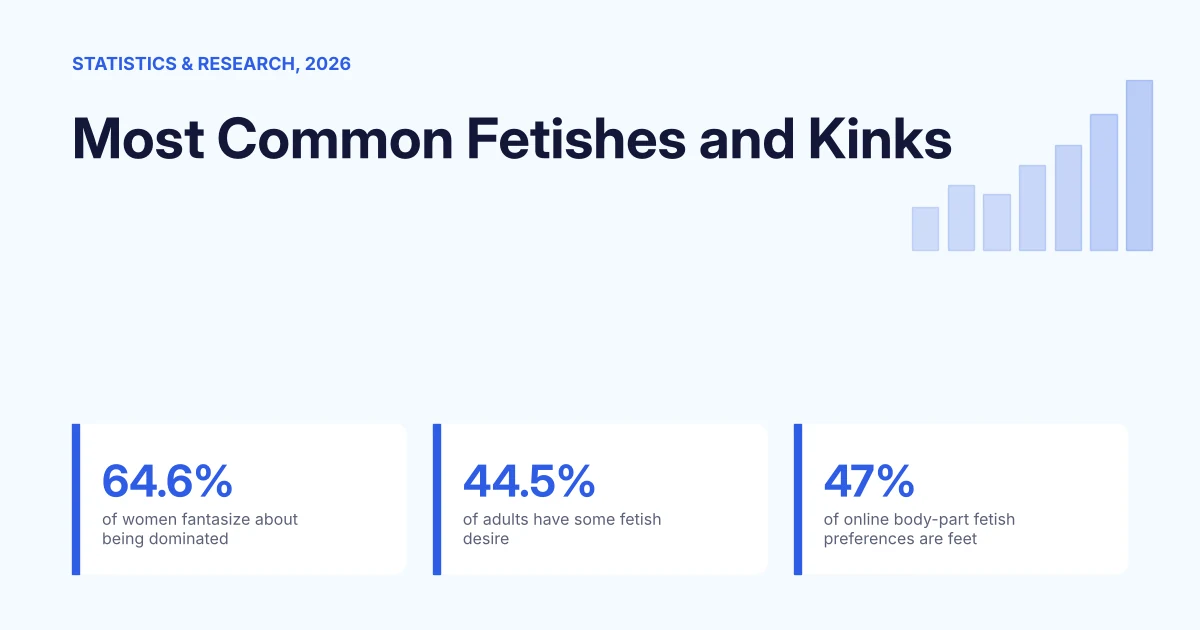
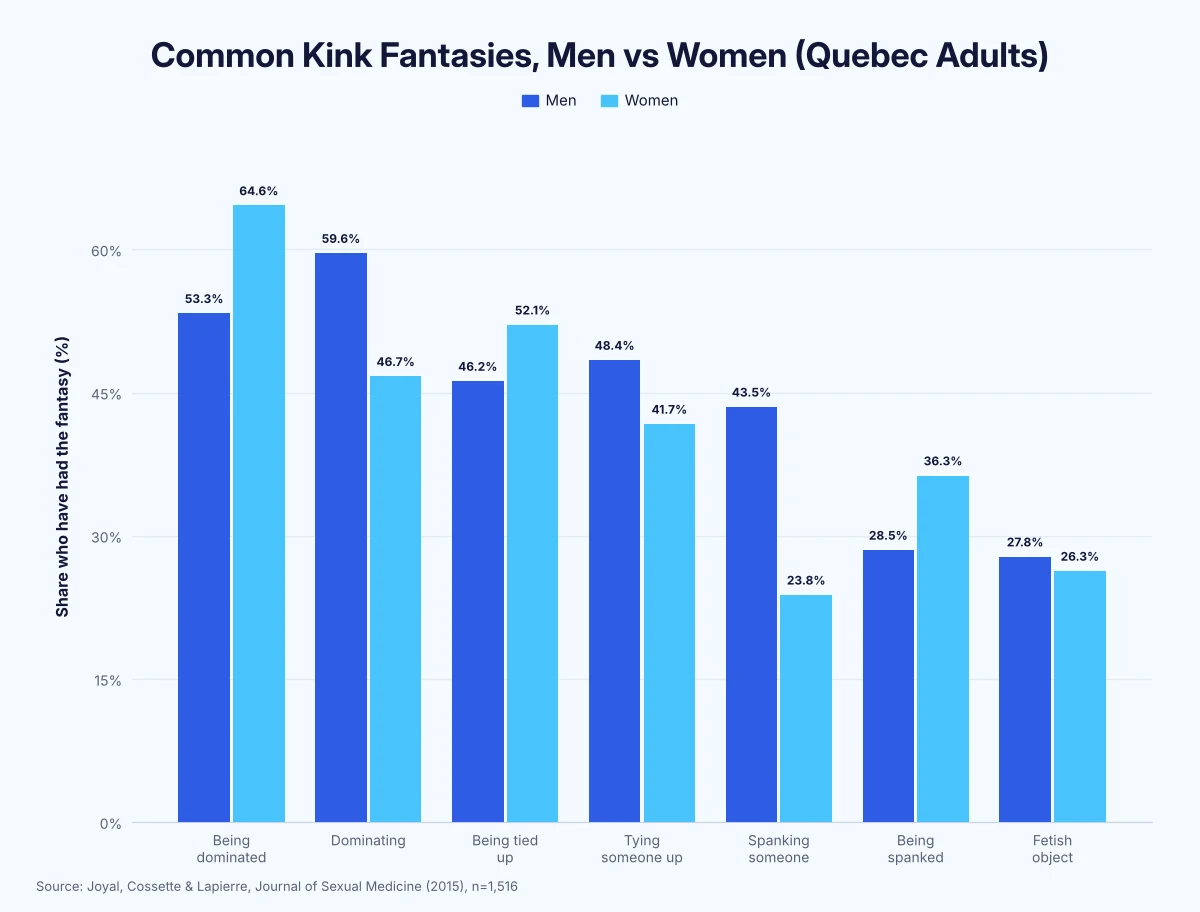
Being dominated is one of the most common kink fantasies: 64.6% of women and 53.3% of men reported it in a study of 1,516 Quebec adults.
Fetish interests are common too. 44.5% of adults in a separate Quebec survey reported at least some desire for fetishistic experiences, and feet are the most common body-part focus in online fetish groups.
In this article, we’ll break down the most common fetishes and kinks, how often people fantasize about them versus act on them, gender differences, and what research says about the people who have them.
Top Fetish and Kink Statistics
- 64.6% of Quebec women and 53.3% of men reported fantasies of being sexually dominated in a 2015 study.
- 44.5% of Quebec adults reported at least some desire for fetishistic experiences, and 26.3% had experienced them.
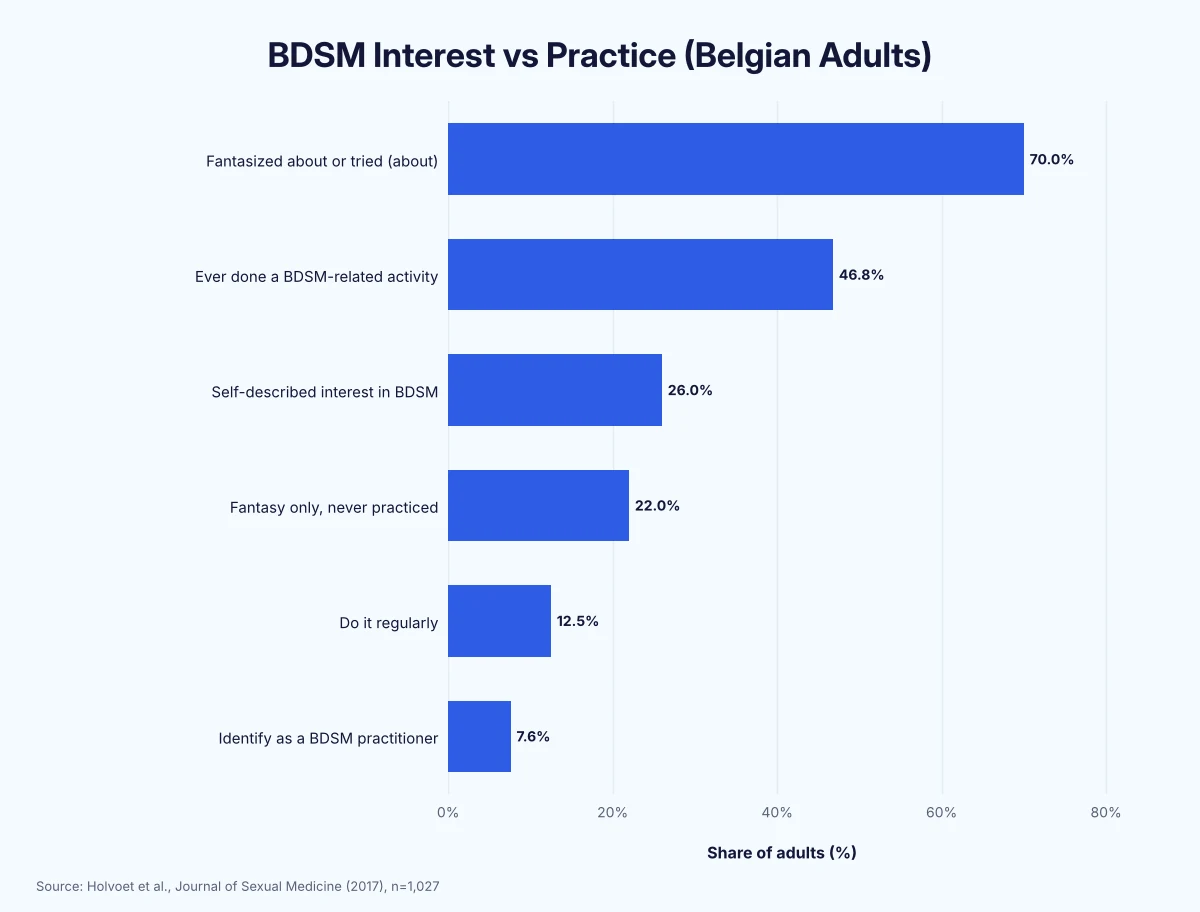
- About 70% of Belgian adults had fantasized about or tried a BDSM-related activity, but only 7.6% identify as practitioners.
- 31.9% of US adults have tried spanking during sex, the most common kink behavior in a nationally representative survey.
- Feet account for 47% of body-part fetish preferences in online fetish groups.
- Czech men were about 3.7 times as likely as women to find fetish stimuli highly arousing (15.4% vs 4.2%).
- ICD-11 removed fetishism and sadomasochism as mental disorders, keeping as disorders only patterns that involve non-consenting people or cause marked distress or serious risk of harm.
How Common Are Fetishes and Kinks?
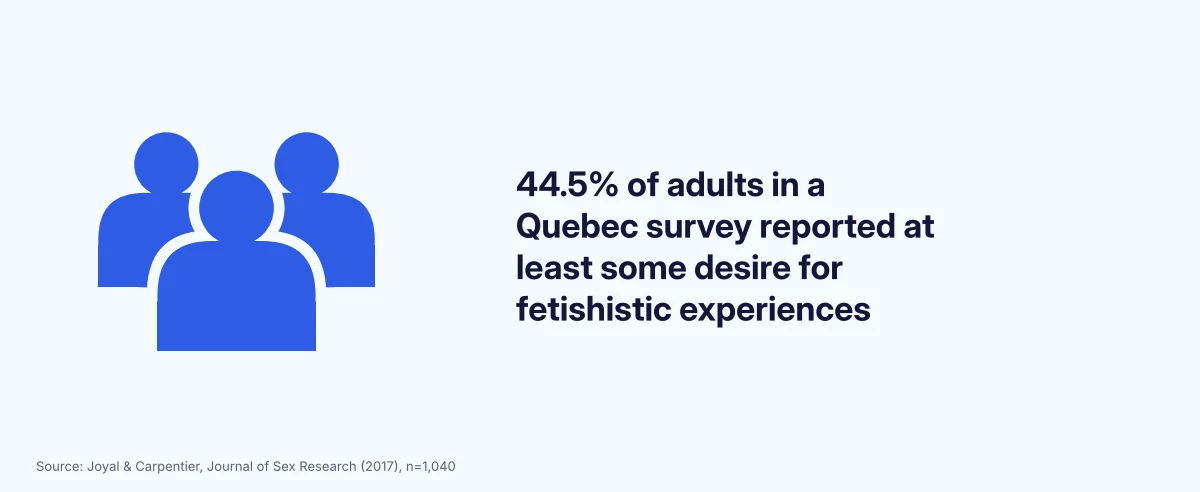
Very common, depending on how you ask. 44.5% of Quebec adults reported at least some desire for a fetishistic experience, according to Joyal & Carpentier (survey of 1,040 adults, published 2017). “Desire” here includes having merely thought about it.
The term “fetish” means strong sexual interest in an object or a non-genital body part. “Kink” is broader and covers interests like bondage, dominance and role-play.
Kink fantasies are even more widespread. A systematic review of 60 studies found 40–70% of adults report BDSM-related fantasies, while about 20% have engaged in BDSM, according to Brown, Barker & Rahman.
Here’s a breakdown of how common kink and fetish interests are across major studies:
| Measure | Share | Population | Study |
|---|---|---|---|
| Fantasized about or tried a BDSM-related activity | About 70% | Belgian adults (n=1,027) | Holvoet et al. 2017 |
| Some desire for fetishistic experiences | 44.5% | Quebec adults (n=1,040) | Joyal & Carpentier 2017 |
| BDSM-related fantasies | 40–70% | 60-study review | Brown, Barker & Rahman 2020 |
| Interest in BDSM | 38% | Finnish adults (n=8,137) | Paarnio et al. 2023 |
| Ever experienced fetishism | 26.3% | Quebec adults | Joyal & Carpentier 2017 |
| Took part in BDSM in the past year | 1.8% | Sexually active Australians | Richters et al. 2008 |
The range is huge because studies ask different questions. “Have you ever fantasized about it?” gets far more yeses than “Do you do this regularly?” or “Do you find it highly arousing?”
10 of the Most Common Fetishes and Kinks
These are 10 of the most common kink and fetish interests in peer-reviewed research. They’re ordered mainly by the fantasy rates in the Joyal, Cossette & Lapierre study of 1,516 Quebec adults (2015), which counted a fantasy if people rated it at least 3 out of 7. Some entries rely on other studies and measures, so treat the order as a guide, not a strict ranking.
1. Threesomes
Fantasy: 84.5% of men (with two women); 56.5% of women (with two men) Behavior: 17.8% of US men and 10.3% of women have had a threesome
Sex with two women is among the most common fantasies for men, and one of only 5 “typical” fantasies in the study, reported by over 84.1%. For context, the top fantasy overall was feeling romantic emotions during sex (92.2% of women, 88.3% of men). In the US, only about 1 in 6 men has had a threesome, according to Herbenick et al., and threesome statistics by gender and orientation show the same gap between fantasy and practice.
2. Watching Others
Fantasy: 82.1% of men and 42.4% of women fantasize about watching two women have sex
Men were nearly twice as likely as women to report this fantasy in the Quebec study. Watching two men was far less common (19.3% of women, 16.2% of men).
3. Being Dominated
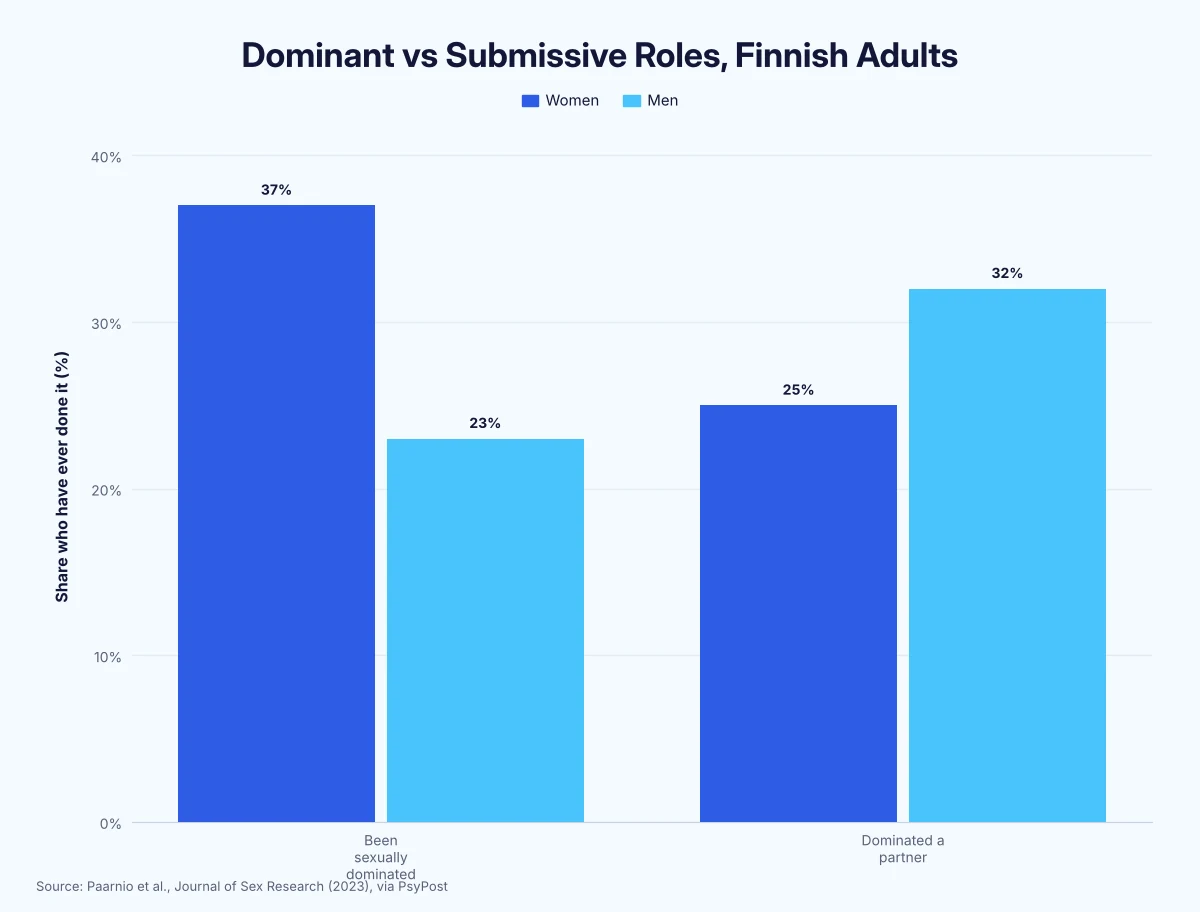
Fantasy: 64.6% of women; 53.3% of men Behavior: 37% of Finnish women and 23% of men have been sexually dominated
Being dominated is the most common power-exchange fantasy among women. In a Finnish study, women were also more likely to have actually done it, per Paarnio et al. as reported by PsyPost.
4. Dominating a Partner
Fantasy: 59.6% of men; 46.7% of women Behavior: 32% of Finnish men and 25% of women have dominated a partner
The pattern flips here. Men were more likely to fantasize about being in control, and more likely to have taken that role.
5. Bondage
Fantasy: 52.1% of women fantasize about being tied up (46.2% of men); 48.4% of men about tying someone up (41.7% of women) Behavior: 21.1% of US adults have ever tied up a partner or been tied up
Only 4.5% did so in the past year, so lifetime experience is about 4.7 times past-year practice (our calculation). Far fewer people do it now than have ever tried it.
6. Spanking
Fantasy: 43.5% of men fantasize about spanking someone; 36.3% of women about being spanked Behavior: 31.9% of US adults have ever spanked or been spanked during sex
Spanking was the most common kink behavior in the US nationally representative survey (fielded in 2015). A newer 2022 survey of 9,029 Americans found 43.5% of women had been lightly spanked with consent, per Herbenick et al.
7. Fetishism (Objects and Body Parts)
Desire: 47.9% of women and 40.4% of men report some fetishistic desire Fantasy: 27.8% of men and 26.3% of women fantasize about a fetish or non-sexual object
Fetishism was among the most prevalent paraphilic interests in a Czech survey of 10,044 adults, and the most common paraphilic fantasy theme. Feet lead among body parts, with 47% of body-part fetish preferences online (see below), and researchers offer several theories on why feet are so often fetishized.
8. Role-Play
Behavior: 23.7% of US adults have role-played with a partner
Role-play is one of the more common behaviors even though it gets less attention in fantasy studies. Men (25.8%) and women (21.8%) reported similar rates; the gap wasn’t statistically significant.
9. Pain (Masochism)
Desire: 27.8% of women and 19.2% of men report some desire for masochistic experiences; 23.7% of women and 13.9% of men have experienced them Appeal: 14.2% of US women and 8.5% of men find pain during sex very or somewhat appealing
This is one of few kinks where women consistently report more interest than men, and women are also far more often on the receiving end of choking during sex. Among light-kink items such as spanking, tying up and role-play, pain was the only one women rated significantly more appealing than men in the US survey.
10. Cuckolding
Fantasy: 58% of US men have ever fantasized about it
This figure comes from social psychologist Justin Lehmiller’s large online survey of Americans, as summarized by the Sexual Health Alliance. About a third of women (33%) reported the same fantasy. It’s a non-random online sample, so treat it as a rough estimate.
Here’s a summary of the 10 most common fetishes and kinks:
| Rank | Kink or Fetish | Fantasy or Desire (Men) | Fantasy or Desire (Women) | Ever Done It |
|---|---|---|---|---|
| 1 | Threesome | 84.5% | 56.5% | 17.8% of US men |
| 2 | Watching others | 82.1% | 42.4% | Not reported |
| 3 | Being dominated | 53.3% | 64.6% | 37% of Finnish women (been dominated) |
| 4 | Dominating | 59.6% | 46.7% | 32% of Finnish men (dominated a partner) |
| 5 | Being tied up | 46.2% | 52.1% | 21.1% of US adults |
| 6 | Spanking someone | 43.5% | 23.8% | 31.9% of US adults (spanked or been spanked) |
| 7 | Fetish object | 27.8% | 26.3% | 26.3% of Quebec adults |
| 8 | Role-play | Not reported | Not reported | 23.7% of US adults |
| 9 | Pain (masochism, desire) | 19.2% | 27.8% | 23.7% of Quebec women (experienced) |
| 10 | Cuckolding | 58%* | 33%* | Not reported |
This table mixes measures and countries, so it isn’t a strict ranking. Fantasy figures are from the 2015 Quebec study except masochism (desire, Joyal & Carpentier 2017). *Lehmiller survey, “ever fantasized,” not directly comparable with the Quebec figures. Sources: Joyal, Cossette & Lapierre, Herbenick et al. 2017, Paarnio et al., Joyal & Carpentier, Sexual Health Alliance
What Are the Most Common Fetish Objects and Body Parts?
Body parts are the most common focus of fetishes, at 33% of fetish preferences in a study of 381 online fetish groups. Objects linked to the body, such as shoes or clothing, came second at 30%, according to Scorolli et al.
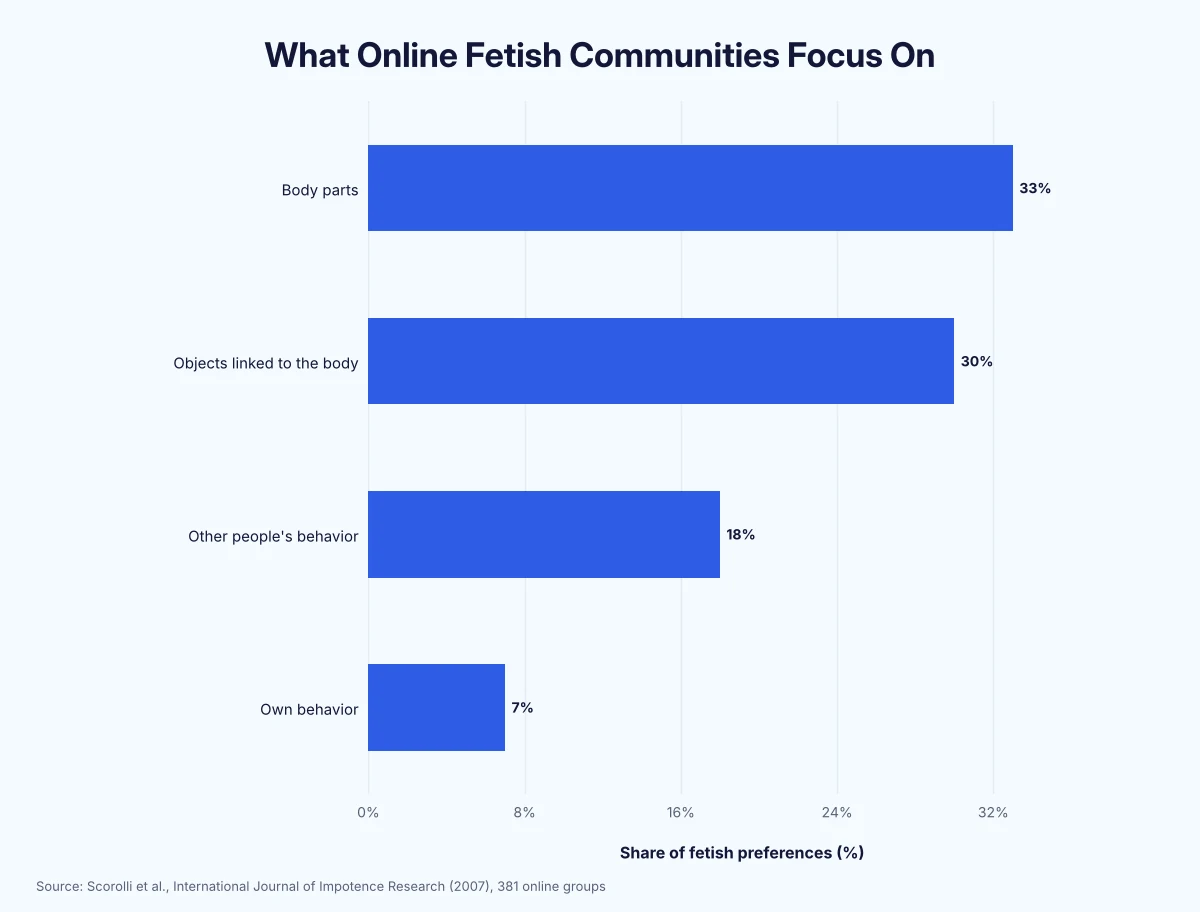
Within body parts, feet and toes made up 47% of preferences, though how common a foot fetish is in the general population is much harder to pin down. Among objects, footwear accounted for 32%, second only to items worn on the legs and buttocks (33%), as summarized by Psychology Today.
Here’s a breakdown of fetish preferences in online groups:
| Category | Share Of Fetish Preferences | Most Common Within Category |
|---|---|---|
| Body parts or features | 33% | Feet and toes (47%) |
| Objects associated with the body | 30% | Legwear/buttock items (33%), footwear (32%) |
| Other people’s behavior | 18% | Not reported |
| Own behavior | 7% | Not reported |
These figures describe activity in online groups, not the general population. People with unusual interests may be more likely to join such groups, so treat them as a guide to what’s popular among fetish communities.
Fantasy vs Reality: How Many People Act on Their Kinks?
Far fewer people act on kinks than fantasize about them. In Belgium, 46.8% of adults had ever tried a BDSM-related activity and another 22% had only fantasized about one, about 70% in all, but just 12.5% did so regularly, according to Holvoet et al.
Only 26% described themselves as interested in BDSM, and 7.6% identified as a BDSM practitioner, about 3 in 10 of that self-described group.
The US data show the same gap. In a nationally representative survey of 2,021 adults, 31.9% had ever tried spanking, but only 3.4% had ever been to a BDSM party or dungeon, per Herbenick et al.
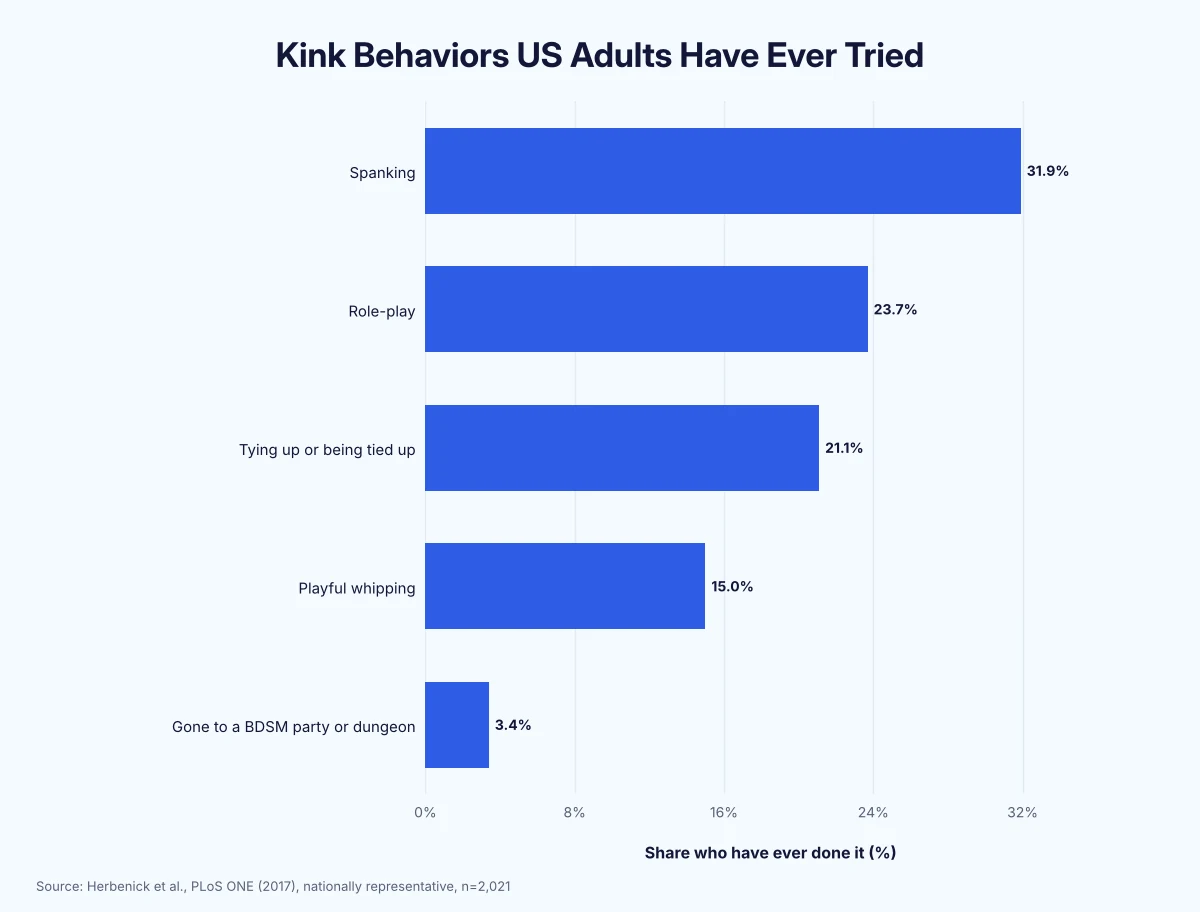
Here’s a breakdown of kink behaviors among US adults:
| Behavior | Ever Done It | Men | Women |
|---|---|---|---|
| Spanking | 31.9% | 29.5% | 34.1% |
| Role-play | 23.7% | 25.8% | 21.8% |
| Tying up or being tied up | 21.1% | 21.7% | 20.6% |
| Playful whipping | 15.0% | 16.2% | 13.8% |
| Going to a BDSM party or dungeon | 3.4% | 4.3% | 2.6% |
Narrow questions give much lower numbers. When sexually active Australians were asked in 2001–02 about BDSM in the past year, only 1.8% said they’d been involved, per Richters et al.
Fetishes and Kinks by Gender
Men and women are interested in kinks at similar overall rates, but they differ in roles and intensity. In Finland, 36% of men and 38% of women reported interest in BDSM, a difference that wasn’t statistically significant, per Paarnio et al.
Women lean submissive and men lean dominant. 37% of Finnish women had been sexually dominated versus 23% of men, while 32% of men had dominated a partner versus 25% of women.
Fetish findings depend on the threshold. At a low bar (“some desire”), Quebec women reported more fetish interest than men (47.9% vs 40.4%), but at a high bar (“highly aroused”), Czech men were about 3.7 times as likely as women (15.4% vs 4.2%), according to Bártová et al.
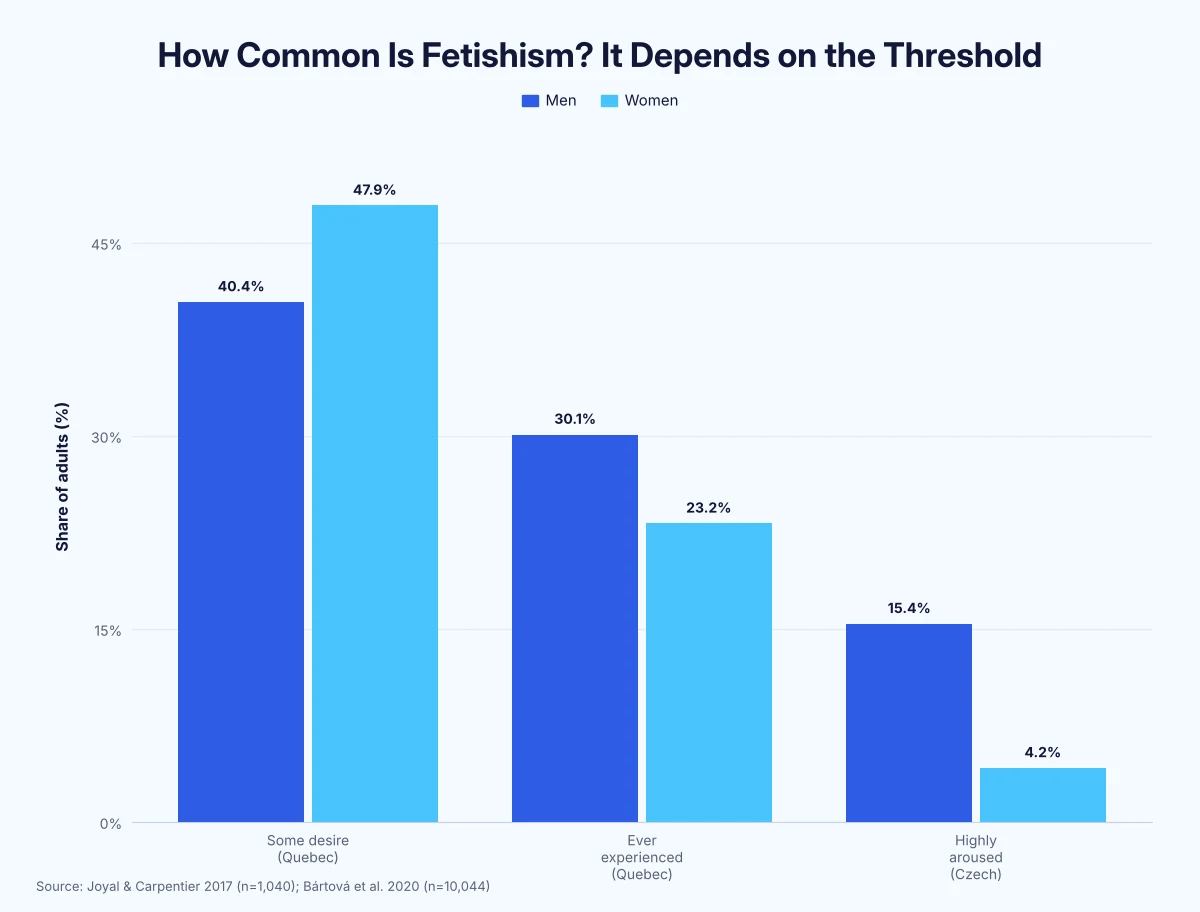
Here’s how fetishism compares by gender and threshold:
| Measure | Men | Women | Population |
|---|---|---|---|
| Some desire for fetishistic experiences | 40.4% | 47.9% | Quebec adults (n=1,040) |
| Have experienced fetishism | 30.1% | 23.2% | Quebec adults |
| Highly aroused by fetish stimuli | 15.4% | 4.2% | Czech adults (n=10,044) |
Sexual orientation matters too. Non-heterosexual Finns reported BDSM participation up to 83% higher than heterosexuals, and younger adults (18–28) showed almost 3 times the interest of older participants, per Paarnio et al. The Finnish sample is a twin and sibling cohort, not a random sample.
Is Having a Fetish a Mental Disorder?
No, not by itself. Since ICD-11, the World Health Organization no longer classifies fetishism, fetishistic transvestism or sadomasochism as disorders. These 3 named diagnoses were removed along with the residual “multiple disorders of sexual preference” category, 4 ICD-10 categories in all, and the remaining paraphilic disorders cover only arousal patterns focused on non-consenting people, or those causing marked distress or a direct risk of injury or death, per Krueger, Reed, First and colleagues.
The US manual, DSM-5-TR, makes the same distinction. Fetishistic disorder requires recurring, intense arousal for at least 6 months that causes clinically significant distress or impairment, according to the MSD Manual.
Here’s how common interests compare with clinical disorders:
| Measure | Share | Source |
|---|---|---|
| Masochistic interests or behaviors (lifetime) | 10–30% | MSD Manual |
| Sexual masochism disorder | Under 5% | MSD Manual |
| Fetishistic disorder | Not reported | MSD Manual |
| Czechs with a strong fetishistic preference who ever saw a professional | 10.8% | Bártová et al. 2020 |
There’s no reliable figure for how many people meet the criteria for fetishistic disorder. Most people with a fetish never do.
Are People With Kinks Less Healthy?
Most research doesn’t show that. A review of 60 articles found that, in the samples studied, BDSM practitioners had no higher rates of mental health or relationship problems than other people, according to Brown, Barker & Rahman.
In a Dutch study comparing 902 BDSM practitioners with 434 controls, practitioners were less neurotic, more extraverted, more open and less sensitive to rejection, though also less agreeable, per Wismeijer & van Assen. A Spanish study of 1,884 people, recruited partly through a sex-toy retailer’s newsletter, found similar results, including more secure attachment, as reported by PsyPost.
These studies are correlational and use volunteer samples. One review also cited a single BDSM sample of 576 people in which 12% reported a suicide attempt, well above general-population rates, per De Neef et al., and the review tentatively linked it to stigma without drawing causal conclusions.
When Do Kink Interests Start?
Most people become aware of kink interests in early adulthood. Among Belgians with a BDSM interest, 61.4% became aware of it before age 25, per Holvoet et al.
In a survey of 810 BDSM practitioners, the average age of first interest was 20.7, and first private practice came at 24.4, a gap of about 3.7 years, according to Westlake & Mahan as reported by PsyPost.
How We Compiled These Statistics
We used peer-reviewed studies and large surveys of adults: Joyal, Cossette & Lapierre (2015), Joyal & Carpentier (2017), Holvoet et al. (2017), Herbenick et al. (2017, 2025), Bártová et al. (2020), Paarnio et al. (2023) and Scorolli et al. (2007), plus clinical references (ICD-11, DSM-5-TR via the MSD Manual).
Studies measure different things: fantasy, desire, arousal or actual behavior, at different thresholds. We note which one each figure uses and avoid ranking figures from different measures against each other, except in the summary table, where we flag it.
We excluded retailer and dating-app polls and search-keyword “studies,” which most ranking pages rely on. Ratios and the lifetime-to-past-year comparison are our own calculations.
Key Takeaways
Kinks are common: 40–70% of adults report BDSM-related fantasies, and 44.5% of Quebec adults report some fetish desire.
Being dominated (64.6% of women, 53.3% of men) and threesomes (84.5% of men) are among the most common kink-related fantasies, while spanking (31.9% of US adults) is the most common kink people actually try.
Having a fetish isn’t a disorder on its own, and most studies haven’t found that people with kinks are less mentally healthy.
FAQ
What is the most common fetish?
Feet are the most common body-part fetish, accounting for 47% of body-part fetish preferences in a study of 381 online groups. Among broader kinks, being dominated is one of the most common fantasies, reported by 64.6% of women and 53.3% of men in a Quebec study.
What percentage of people have a fetish?
It depends on the definition. 44.5% of Quebec adults reported at least some fetishistic desire and 26.3% had experienced one, while only 15.4% of Czech men and 4.2% of women found fetish stimuli highly arousing.
What is the most common kink?
Being dominated is the most common power-exchange fantasy (64.6% of women, 53.3% of men in Quebec). For actual behavior, spanking leads: 31.9% of US adults have tried it, followed by role-play (23.7%) and bondage (21.1%).
Is it normal to have a fetish?
Yes. Most fantasies in the Quebec study were common, with only 2 of 55 classed as rare. ICD-11 doesn’t treat fetishism as a disorder on its own; paraphilic disorders now cover only patterns involving non-consenting people or causing marked distress or serious risk of harm.
Are men or women kinkier?
Overall interest is similar: 36% of Finnish men and 38% of women reported interest in BDSM. Women lean toward submission and masochism, while men lean toward dominance and report stronger fetish arousal at high thresholds.
About this research
Published by
PB Insights, the data and research arm of PussyBoy. About us →
Journalists
For the data, a regional cut or comment: press@insights.pussyboy.net
Reuse
Licensed CC BY 4.0. Cite "PB Insights" and link to this report.
"According to adult-industry data analysts at PB Insights…"