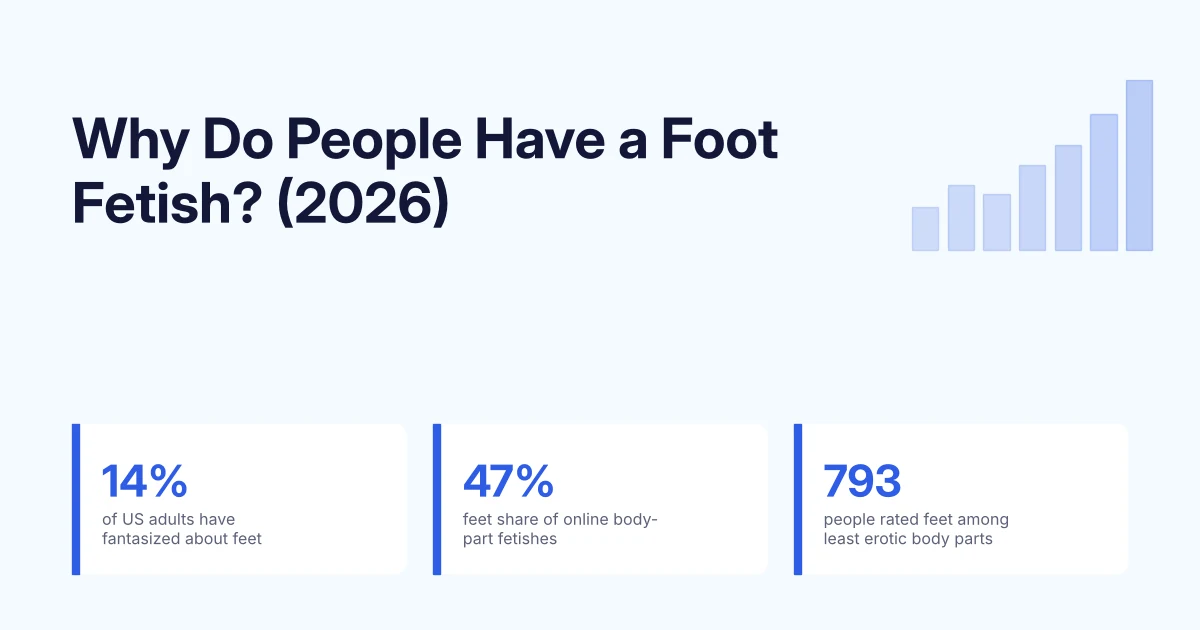
No single cause of foot fetishes is proven. The best-known explanation, that feet sit next to the genitals on the brain’s touch map, failed its first direct test: when 793 people rated 41 body parts, feet and toes ranked near the bottom for both sexes, according to Pacific Standard (2013).
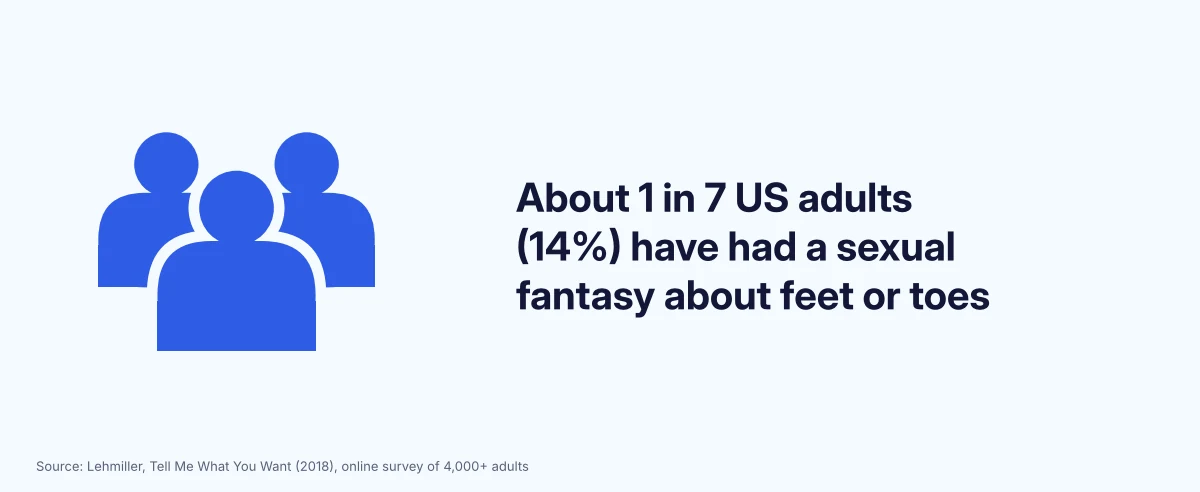
The interest itself is common. About 1 in 7 US adults (14%) have fantasized about feet or toes, according to Justin Lehmiller.
In this article, we’ll break down the main theories behind foot fetishes (brain wiring, conditioning, evolution and disease, Freud and culture), the evidence for each, who is most likely to have one, and when a fetish counts as a disorder.
Top Foot Fetish Research Statistics
- About 1 in 7 US adults (14%) have had a sexual fantasy about feet or toes.
- Feet and toes make up 47% of body-part fetish preferences in online fetish groups.
- In the first direct test of the brain-map theory, 793 people ranked feet and toes near the bottom of 41 body parts.
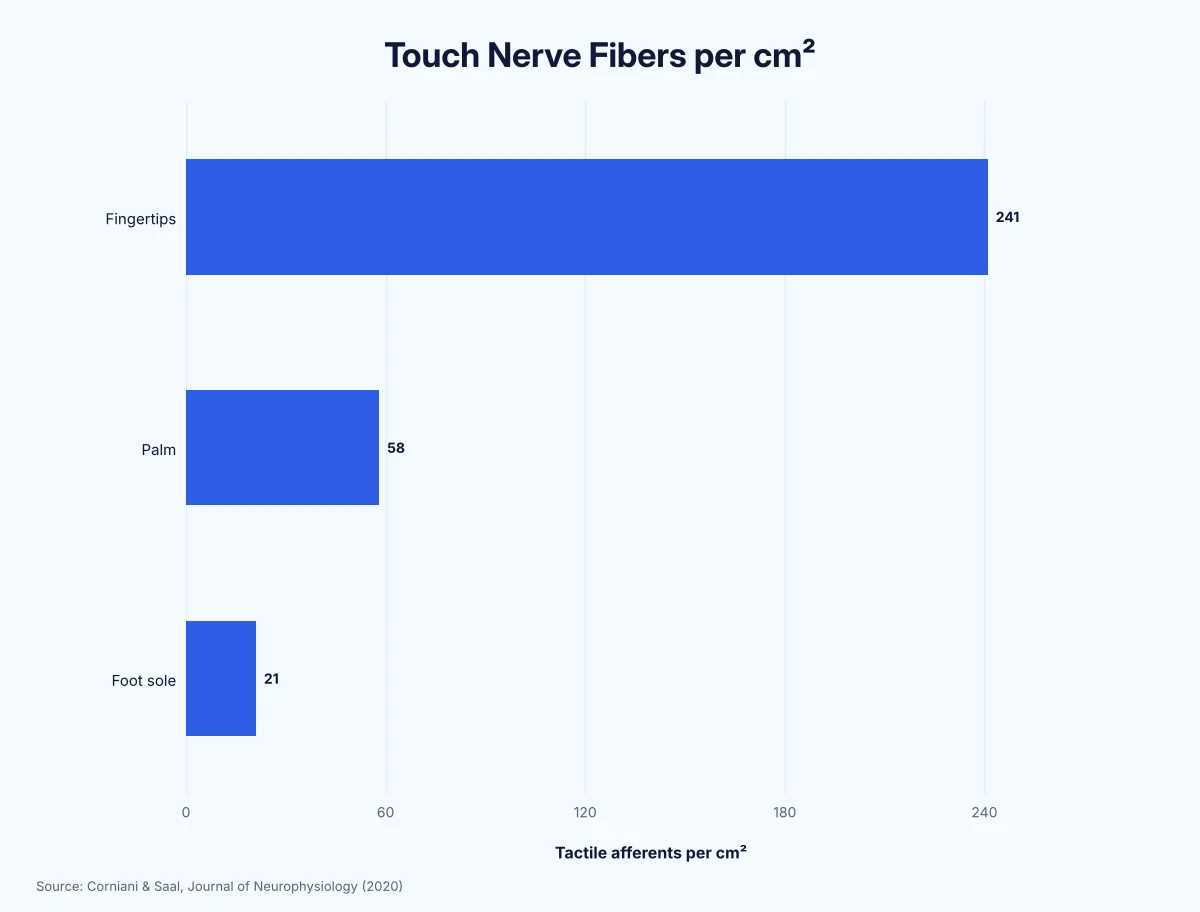
- A single foot sole has about 4,000 touch nerve fibers, or 21 per cm², vs 241 per cm² on the fingertips.
- Rachman’s famous 1966 boot experiment conditioned arousal in just 3 men, who needed 24 to 65 pairings.
- In 9 cultures, the female drawing people found most attractive had smaller feet in 59.8% of cases.
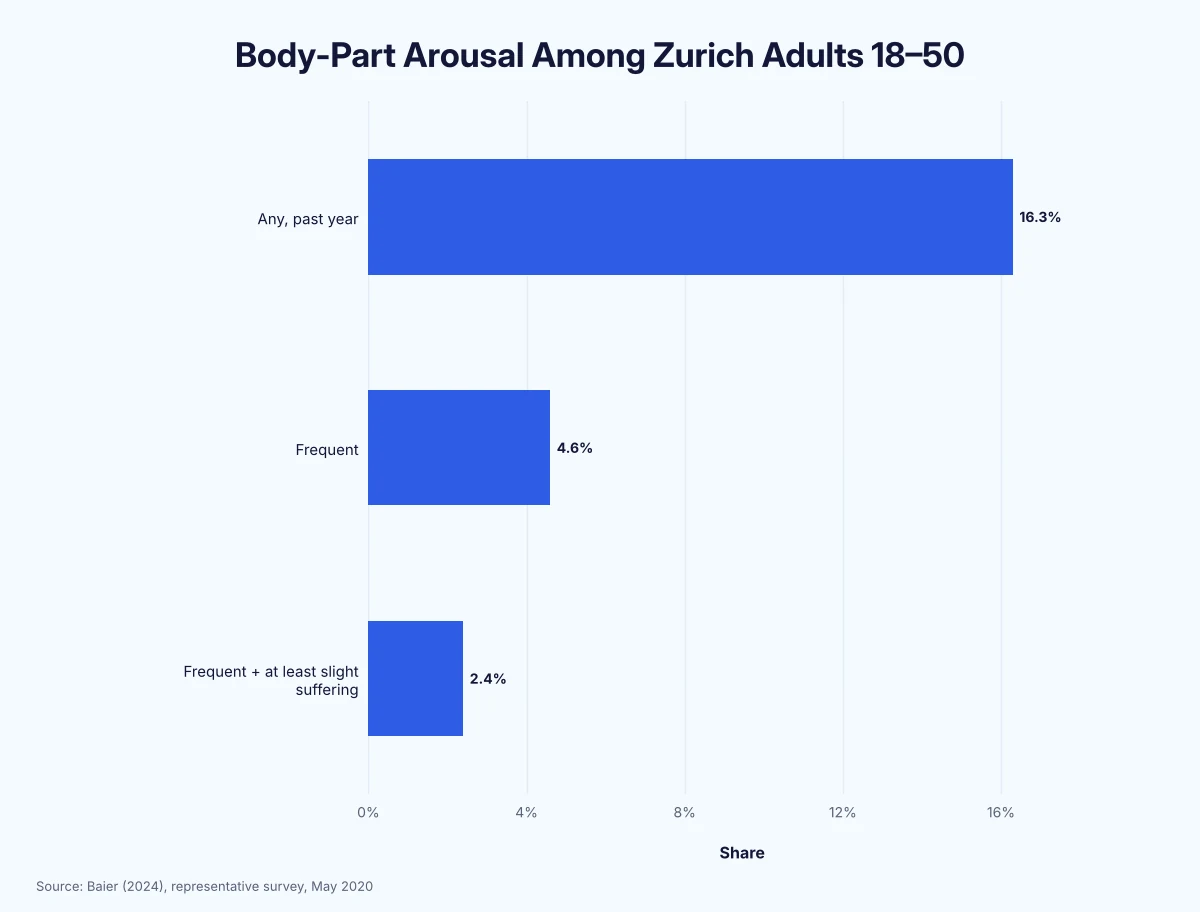
- Only 2.4% of Zurich adults report frequent arousal to body parts such as feet plus at least slight suffering.
Why Do People Have a Foot Fetish?
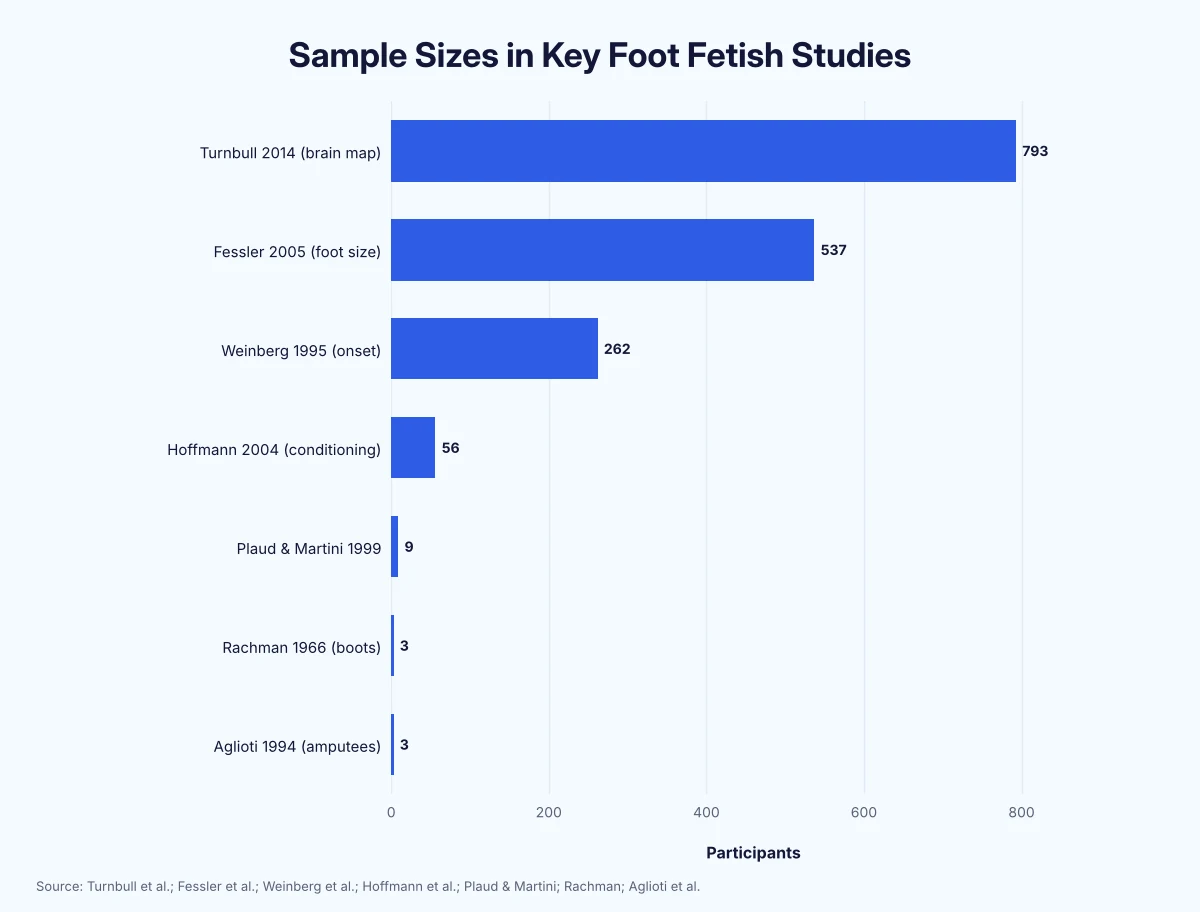
Researchers have proposed 6 main explanations, and none is proven. Most rest on small samples: Rachman’s conditioning experiment used 3 men, and a key phantom-limb study had 3 amputees.
The likeliest answer is a mix of factors. Lehmiller, a Kinsey Institute research fellow, suggests people may be born with a general tendency toward fetishes but doubts anyone is born with a specific one, per Big Think.
Here’s a breakdown of the main theories and the evidence behind them:
| Theory | Core Idea | Key Studies | Sample | Status |
|---|---|---|---|---|
| Brain-map adjacency | Feet and genitals sit side by side on the brain’s touch map | Ramachandran 1998; Turnbull et al. 2014 | Amputee reports; 793 adults | Hypothesis; direct test found no support |
| Conditioning | Arousal gets paired with feet or shoes | Rachman 1966; Hoffmann et al. 2004 | 3 men; 56 adults | Shown in the lab, not for real fetishes |
| Early experience | Interest starts around puberty | Weinberg et al. 1995 | 262 gay and bisexual men | Descriptive only |
| STD epidemics | Foot imagery rises when infection fears rise | Giannini et al. 1998 | 8 magazines, 1965–1994 | Preliminary |
| Evolved preference | Small female feet signal youth | Fessler et al. 2005 | 537 people, 9 cultures | Preliminary |
| Psychoanalysis | The foot as a sexual symbol | Freud 1905 | Theory | No data |
Sources: Turnbull et al., Rachman, Hoffmann, Janssen & Turner, Weinberg, Williams & Calhan, Discover, Fessler et al., Freud
How Common Is a Foot Fetish?
About 14% of US adults have fantasized about feet, but a strong interest is rarer: 9.7% of Belgian adults rated their interest in feet 4 or 5 out of 5, according to Holvoet et al. (2017). We compare the major surveys in our breakdown of how common foot fetishes are.
Feet also lead online. They made up 47% of body-part preferences across 381 online fetish groups, per Scorolli et al. as summarized by Psychology Today. That puts feet at the top of the body-part list in our ranking of the most common fetishes and kinks.
Here’s a breakdown of the key prevalence figures:
| Measure | Share | Population | Study |
|---|---|---|---|
| Feet’s share of body-part fetish preferences | 47% | 381 online fetish groups | Scorolli et al. 2007 |
| Ever sucked or licked toes or feet (men) | 25.6% | US adults, nationally representative (n=2,021) | Herbenick et al. 2017 |
| Ever fantasized about feet or toes | 14% | US adults, online sample (4,000+) | Lehmiller 2018 |
| Ever sucked or licked toes or feet (women) | 10.9% | US adults, nationally representative | Herbenick et al. 2017 |
| Strong interest in feet (4–5 of 5) | 9.7% | Belgian adults (n=1,027) | Holvoet et al. 2017 |
| Frequent body-part arousal plus at least slight suffering | 2.4% | Zurich adults 18–50 | Baier 2024 |
Is a Foot Fetish Caused by Brain Wiring?
Possibly, but the evidence is thin. Neuroscientist V.S. Ramachandran proposed in his 1998 book Phantoms in the Brain that signals may cross between the two areas because “the foot is beside the genitals” on the brain’s touch map, per an excerpt on PBS NOVA.
His evidence came from amputees who reported sexual sensations, even orgasm, in a missing foot. He suggested that “maybe even many of us so-called normal people have a bit of cross-wiring,” per Live Science (2011).
A 1994 study saw something similar in 3 lower-limb amputees: touching their genitals produced sensations they placed in the phantom limb, per Aglioti, Bonazzi & Cortese.
The direct test came 16 years after Ramachandran’s book. Turnbull and colleagues had 793 people, mostly in Britain and South Africa, rate 41 body parts for erotic intensity, and feet and toes scored near the bottom for both sexes, per Pacific Standard.
The Observer reported that three-quarters of respondents gave their feet the lowest rating, zero (a figure not in the study’s abstract, which calls foot ratings “surprisingly low”), via Raw Story. Bangor University’s release said that “we simply don’t appear to find feet erogenous to the touch,” per Bangor University.
Feet aren’t especially sensitive, either. A single foot sole has about 4,000 tactile nerve fibers, a density of 21 per cm², vs 58 on the palm and 241 on the fingertips, according to Corniani & Saal (2020). That makes fingertips about 11.5 times as densely wired (our calculation).
Here’s a breakdown of the brain and body evidence:
| Study | Year | Sample | Finding |
|---|---|---|---|
| Aglioti et al. | 1994 | 3 lower-limb amputees | Genital touch felt in the phantom limb |
| Ramachandran | 1998 | Amputee case reports | Proposed foot-genital cross-wiring |
| Kell et al. | 2005 | fMRI study | Penis mapped right next to the foot |
| Turnbull et al. | 2014 | 793 adults | Feet and toes near the bottom of 41 body parts |
| Corniani & Saal | 2020 | Literature-based model | 21 touch fibers per cm² on the sole |
| Knop et al. | 2022 | 20 women | Clitoral area mapped near the hip, not the foot |
The strangest case is a medical curiosity. In 2013, Dutch doctors described a 55-year-old woman with orgasmic sensations starting in her left foot about 5 to 6 times a day, after nerve damage that followed sepsis and 3 weeks in intensive care, per Live Science.
After an anesthetic injection into a spinal nerve, she had no episodes in the 8 months that followed. Lead researcher Marcel Waldinger called it neurological, not psychological. It was the only known case at the time, so it says little about everyday foot fetishes.
Can a Foot Fetish Be Learned?
In the lab, yes, in tiny samples. In Rachman’s 1966 experiment, 3 young psychologists saw a slide of black knee-length boots just before slides of nude women, and all 3 began responding to the boots alone, according to the original paper in The Psychological Record.
It took 24 to 65 pairings, an average of 39.7 (our calculation). All 3 men also responded to low-heeled black shoes, and the response returned in all 3 when retested a week after extinction.
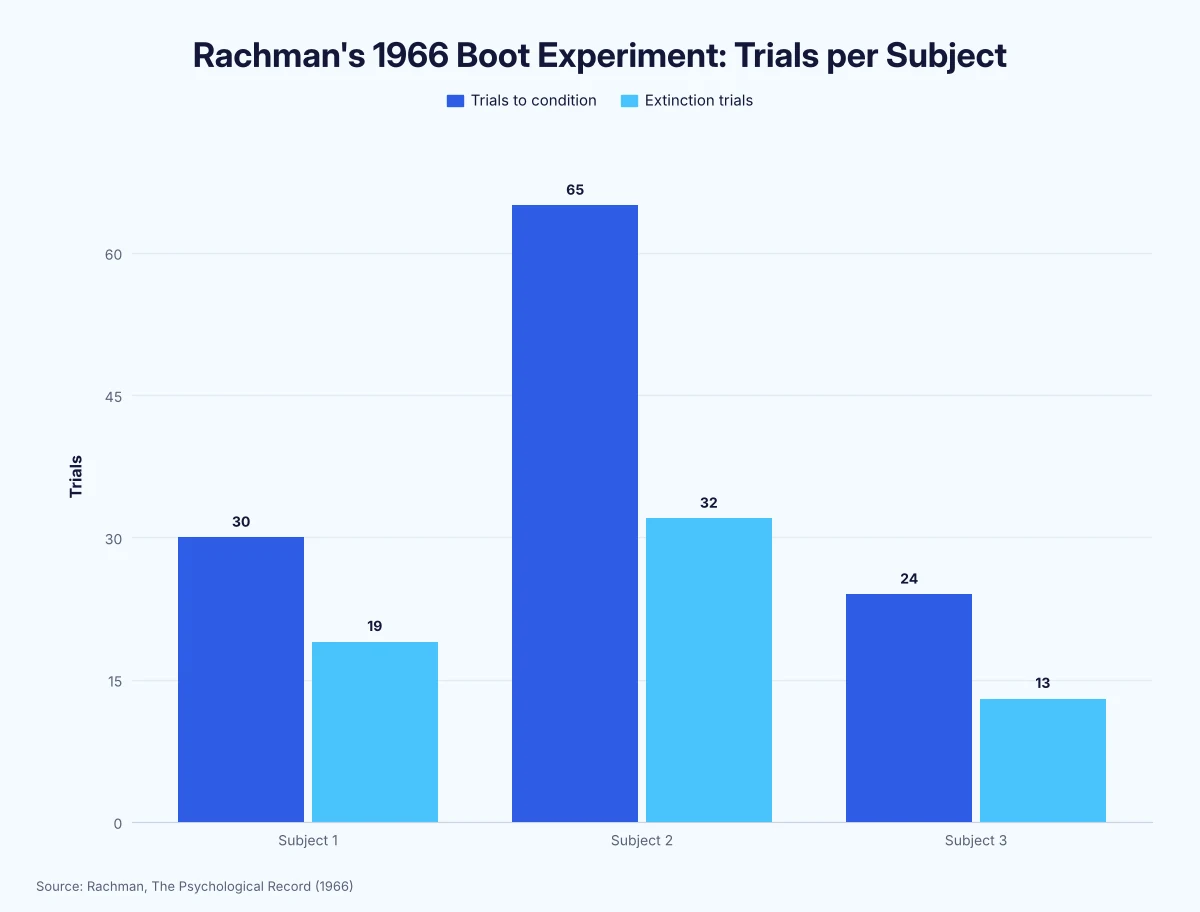
Here’s a breakdown of Rachman’s results by subject:
| Subject | Trials to Condition | Extinction Trials | Responded Later To |
|---|---|---|---|
| 1 | 30 | 19 | High- and low-heeled black shoes |
| 2 | 65 | 32 | Low-heeled black shoes |
| 3 | 24 | 13 | High- and low-heeled black shoes |
Rachman himself warned that “premature speculation about the genesis of fetishism would be misplaced.” One subject’s response, apparently subject 3’s, was weak and unstable.
Later studies found the same effect. Plaud and Martini tested 9 men (3 per procedure) with a neutral slide of a jar of pennies and found arousal rose when the slide came just before erotica, per Plaud & Martini (1999), and Hoffmann and colleagues conditioned genital arousal to neutral images in 27 women and 29 men, per Hoffmann, Janssen & Turner (2004).
Animals show it too. Male Japanese quail conditioned to a terrycloth object kept responding to it during extinction, but only if they had learned to copulate with it, per Köksal et al. (2004).
Real-life accounts point to puberty. In a survey of 262 members of a foot fetish organization for gay and bisexual men, most first noticed the interest around puberty and described those early experiences as mostly positive, per Weinberg, Williams & Calhan.
That fits an old idea. Freud wrote in 1905 that a fetish choice often reflects “a sexual impress mostly received in early childhood,” crediting Binet, per his Three Contributions to the Theory of Sex on Project Gutenberg. Lehmiller says learning theory “has the strongest body of research supporting it,” per Sex and Psychology.
Is There an Evolutionary Explanation for Foot Fetishes?
There are 2 ideas, both preliminary. Giannini and colleagues counted foot-focused photos in the 8 largest US mass-circulation porn magazines from 1965 to 1994 and found “an exponential increase” during the AIDS epidemic, per the paper’s text as reproduced by Discover.
The authors tied earlier waves of foot interest to 4 epidemics in all: 13th-century gonorrhea, syphilis in the 16th and 19th centuries, and AIDS. They said the foot focus usually faded 30 to 60 years after each epidemic subsided.
The study’s own title calls it preliminary. Each issue was checked by 3 reviewers, but the reproduced text gives no image counts, so the size of the rise can’t be checked.
The second idea is that small feet signal youth. In 9 cultures, 537 people judged line drawings that differed mainly in foot size. In 59.8% of cases, the woman they found most attractive had smaller feet than the one they found least attractive, per Fessler et al. (2005).
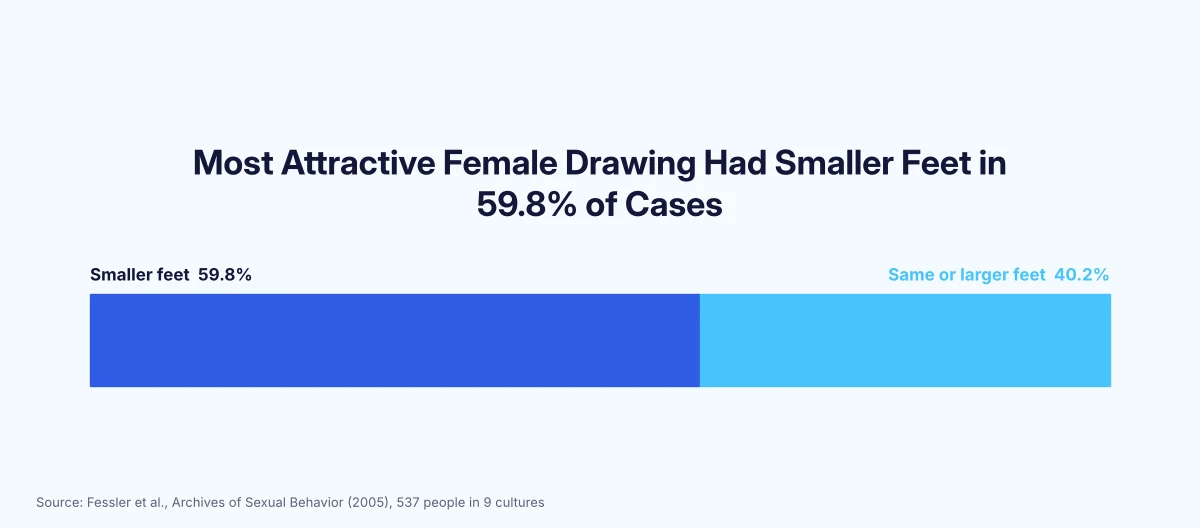
The pattern was statistically significant in only 4 of the 9 cultures, and Tanzania reversed it. A 2012 follow-up again found small feet preferred in women but not men, with smaller feet making women look younger, per Fessler et al.
Here’s a breakdown of the evolution and disease evidence:
| Study | Data | Finding |
|---|---|---|
| Giannini et al. 1998 | 8 magazines, 1965–1994, 3 reviewers per issue | Exponential rise in foot photos during the AIDS era |
| Giannini et al. 1998 | Historical literature | Foot focus rose with 4 epidemics, fading after 30–60 years |
| Fessler et al. 2005 | 537 people, 9 cultures | Smaller female feet preferred in 59.8% of comparisons |
| Fessler et al. 2005 | Same sample, male drawings | Most attractive man had less extreme feet in 51.1% of comparisons |
| Fessler et al. 2012 | Several cross-cultural studies | Small feet preferred in women only; linked to a younger look |
Neither line of research measures fetishes directly. They suggest feet carry attractiveness cues, which may help explain why feet, rather than elbows or knees, so often become a focus.
How Do Culture and Freud Shape Foot Attraction?
The ideal bound foot in imperial China was 3 inches long, the “golden lotus,” according to Smithsonian. NPR described the practice as a foot fetish on a national scale.

Freud saw feet as symbolic. He wrote that “the foot is a very primitive sexual symbol already found in myths,” per Project Gutenberg, and claimed people sexualize feet because they resemble penises, per Live Science. These are historical ideas, not tested findings.
Shoes play a role too. In point-light videos, women walking in high heels were rated more attractive than in flats, partly because heels shorten the stride and increase hip rotation, per Morris et al. (2013).
A widely shared 2015 study claiming men help women in high heels more often was retracted in 2019 for “serious methodological weaknesses and statistical errors,” according to Springer.
Here’s a breakdown of key dates:
| Year | Event |
|---|---|
| 1243 | Early archaeological evidence of Chinese foot binding |
| 1905 | Freud calls the foot “a very primitive sexual symbol” |
| 1912 | Foot binding first banned in China |
| 1966 | Rachman’s boot-conditioning experiment |
| 1998 | Ramachandran’s brain-map idea; Giannini’s epidemic study |
| 2013 | High-heels gait study; foot orgasm syndrome case report |
| 2014 | Turnbull et al. find feet rated near the bottom of 41 body parts |
| 2019 | High-heels helping study retracted |
Who Is Most Likely to Have a Foot Fetish?
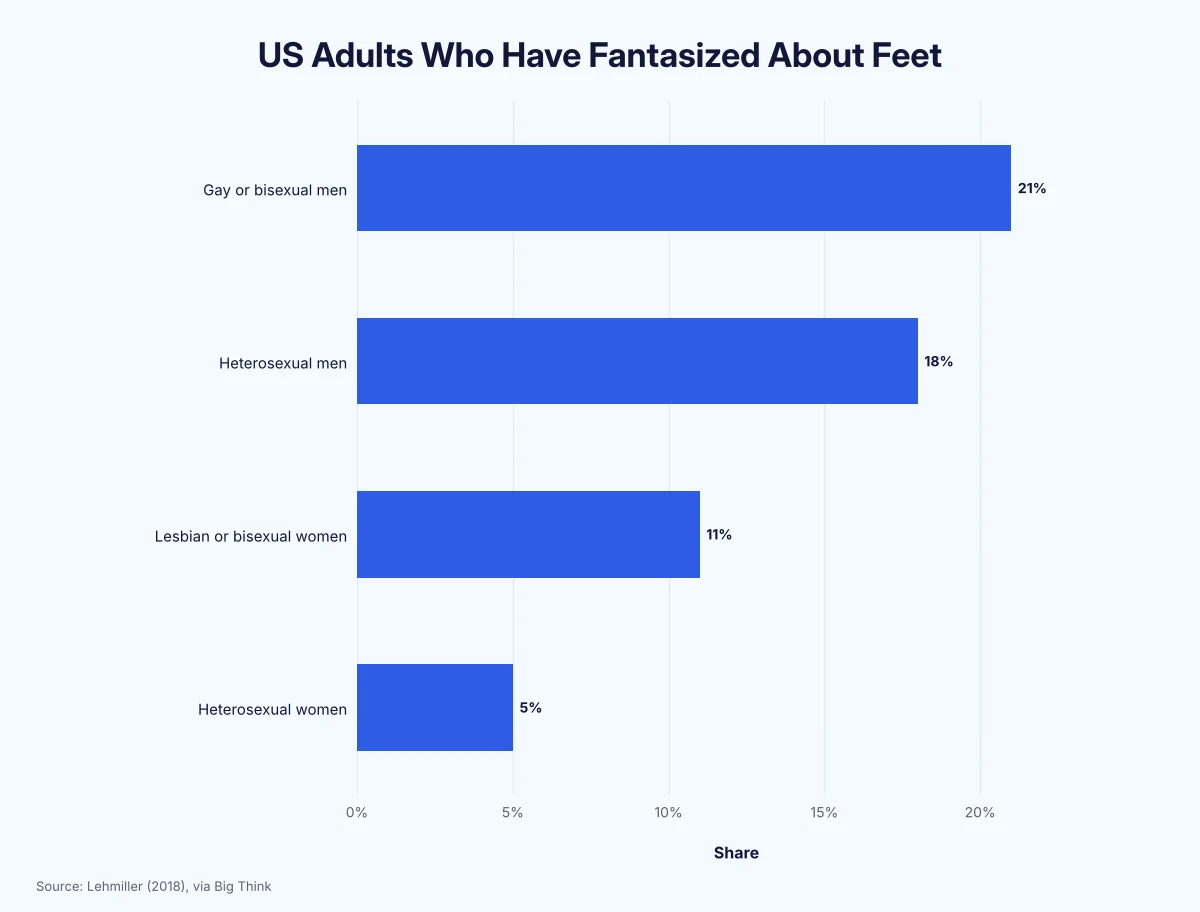
Men, and gay and bisexual men most of all. In Lehmiller’s survey, 21% of gay and bisexual men had fantasized about feet, vs 18% of heterosexual men, 11% of lesbian and bisexual women and 5% of heterosexual women, per Big Think.
That makes heterosexual men about 3.6 times as likely as heterosexual women to report the fantasy (our calculation). The survey covered 4,175 Americans aged 18 to 87, per Lehmiller.
Fantasies in general are near-universal: 97% to 98% of people report them, according to Sexual Health Alliance. Our breakdown of how often people fantasize about sex compares men’s and women’s fantasies and sexual thoughts.
Here’s a breakdown of foot and fetish interest by group:
| Group | Measure | Share | Study |
|---|---|---|---|
| Canadian men | Aroused by fetish scenarios, including feet | 28% | Dawson et al. 2016 |
| Gay or bisexual men (US) | Ever fantasized about feet | 21% | Lehmiller 2018 |
| Heterosexual men (US) | Ever fantasized about feet | 18% | Lehmiller 2018 |
| Belgian men | Strong interest in feet | 16.6% | Holvoet et al. 2017 |
| Quebec men | Favorite fantasy in the fetishism theme (includes feet) | 14% | Joyal et al. 2015 |
| Lesbian or bisexual women (US) | Ever fantasized about feet | 11% | Lehmiller 2018 |
| Canadian women | Aroused by fetish scenarios, including feet | 11% | Dawson et al. 2016 |
| Heterosexual women (US) | Ever fantasized about feet | 5% | Lehmiller 2018 |
| Belgian women | Strong interest in feet | 4.1% | Holvoet et al. 2017 |
Sex drive may explain much of the gender gap. In the Canadian study of 305 men and 710 women, sex drive fully accounted for the gender difference in unusual sexual interests, per Dawson, Bannerman & Lalumière.
Measures matter, too. With a very low bar (“at least some” desire), 47.9% of Quebec women and 40.4% of men reported interest in fetishistic experiences, according to Joyal & Carpentier, but that item covered objects, not feet.
Is a Foot Fetish Normal or a Disorder?
A foot fetish on its own isn’t a disorder. Under DSM criteria, doctors diagnose fetishistic disorder only when intense arousal to objects or specific nongenital body parts lasts at least 6 months and causes clinically significant distress or impairment, according to the MSD Manual.
DSM-5 (2013) folded partialism, an exclusive focus on a body part such as feet, into that diagnosis, per First. ICD-11 has no fetishism diagnosis, though a distressing case can fall under its broader paraphilic disorder involving solitary behaviour or consenting individuals, per Krueger et al.
Few people with the interest are distressed by it. 16.3% of Zurich adults aged 18 to 50 found body parts such as feet arousing in the past year, but only 2.4% reported frequent arousal plus at least slight suffering, about 1 in 7 of those with the interest (our calculation), per Baier.
Here’s a breakdown of the clinical numbers:
| Measure | Figure | Source |
|---|---|---|
| Minimum duration for a fetishistic disorder diagnosis | 6 months | MSD Manual |
| Paraphilic disorders listed in DSM-5 | 8 | American Psychiatric Association |
| Zurich adults with any body-part arousal, past year | 16.3% | Baier 2024 |
| Zurich adults with frequent body-part arousal | 4.6% | Baier 2024 |
| Zurich adults with frequent arousal plus at least slight suffering | 2.4% | Baier 2024 |
| Czechs with a strong fetish preference who saw a health professional | 10.8% | Bártová et al. 2020 |
| Population in psychiatric care for fetishistic disorder | Less than 1% | Psychology Today |
Fetish fantasies of all kinds are common. 45% of Americans in Lehmiller’s survey had fantasized about a fetish, according to Sexual Health Alliance, and most people with a fetish don’t meet the clinical criteria for fetishistic disorder, according to the MSD Manual.
If an interest causes distress or harms a relationship, a doctor or sex therapist is the right place to start.
Methodology
We reviewed 110 data points from 31 sources. Theory evidence comes from peer-reviewed studies: Rachman (1966), Plaud and Martini (1999), Hoffmann et al. (2004), Köksal et al. (2004), Aglioti et al. (1994), Kell et al. (2005), Knop et al. (2022), Turnbull et al. (2014), Corniani and Saal (2020), Giannini et al. (1998), Weinberg et al. (1995) and Fessler et al. (2005, 2012).
Most of these are small lab studies, case reports or convenience samples, so none shows what causes foot fetishes in the general population. Turnbull et al.’s sample size and per-body-part results come from press coverage, and the share rating feet zero is a press figure. Giannini et al.’s method comes from the paper’s text as reproduced by Discover; the foot orgasm syndrome case comes from Live Science’s report of Waldinger et al. (2013).
Prevalence figures use the same values as our foot fetish prevalence analysis: Lehmiller’s online sample (not representative), Herbenick et al.’s national probability survey, Holvoet et al.’s Belgian panel, Baier’s representative Zurich survey and Scorolli et al.’s count of online group activity, which measures community activity, not population prevalence. Averages, ratios and shares of subgroups are our own calculations.
Key Takeaways
Science hasn’t settled why people have foot fetishes. The famous brain-map theory remains a hypothesis: in its first direct test, 793 people ranked feet and toes near the bottom of 41 body parts, while conditioning has been shown only in small lab studies such as Rachman’s 3-man boot experiment.
What’s clear is that the interest is common and rarely a problem. About 14% of US adults have fantasized about feet, feet make up 47% of body-part fetish preferences online, and only 2.4% of Zurich adults report frequent body-part arousal with at least slight suffering.
FAQ
What causes a foot fetish?
No single cause is proven. The main theories are brain-map adjacency (feet next to genitals on the touch map), conditioning, early experiences around puberty, evolutionary cues such as small feet, and disease avoidance. The best-known theory failed a 793-person test, and conditioning has been shown only in small lab studies.
Why are foot fetishes so common?
Feet are the most common body-part fetish, at 47% of body-part preferences in online fetish groups, and 14% of US adults have fantasized about feet. Possible reasons include learned associations, feet’s link to youth and attractiveness, and shoes as cultural erotic symbols, but none is proven.
Are feet an erogenous zone?
Not for most people. In a survey of 793 adults, feet and toes ranked near the bottom of 41 body parts for both sexes, and three-quarters gave feet a zero rating, The Observer reported. A foot sole has 21 touch fibers per cm², vs 241 on the fingertips.
Is a foot fetish normal?
Yes, it’s a common sexual interest. It counts as a disorder only when intense arousal lasts at least 6 months and causes distress or impairment. Only 2.4% of Zurich adults reported frequent arousal to body parts such as feet plus at least slight suffering.
Do women have foot fetishes?
Some do, but fewer than men. 11% of lesbian and bisexual women and 5% of heterosexual women in the US have fantasized about feet, vs 18% of heterosexual men. In Belgium, 4.1% of women vs 16.6% of men report a strong interest.
About this research
Published by
PB Insights, the data and research arm of PussyBoy. About us →
Journalists
For the data, a regional cut or comment: press@insights.pussyboy.net
Reuse
Licensed CC BY 4.0. Cite "PB Insights" and link to this report.
"According to adult-industry data analysts at PB Insights…"