Revenge porn is sharing, or threatening to share, someone’s nude or sexual images without their consent. It’s also called non-consensual intimate imagery (NCII) or image-based sexual abuse, and it includes AI-generated “deepfake” nudes.
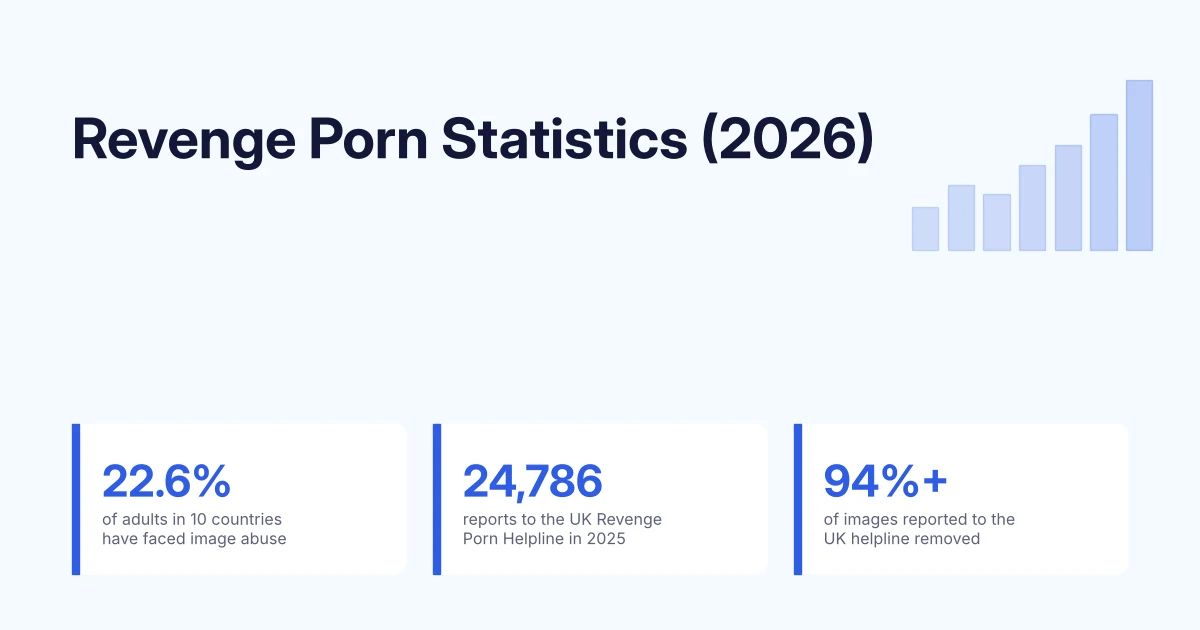
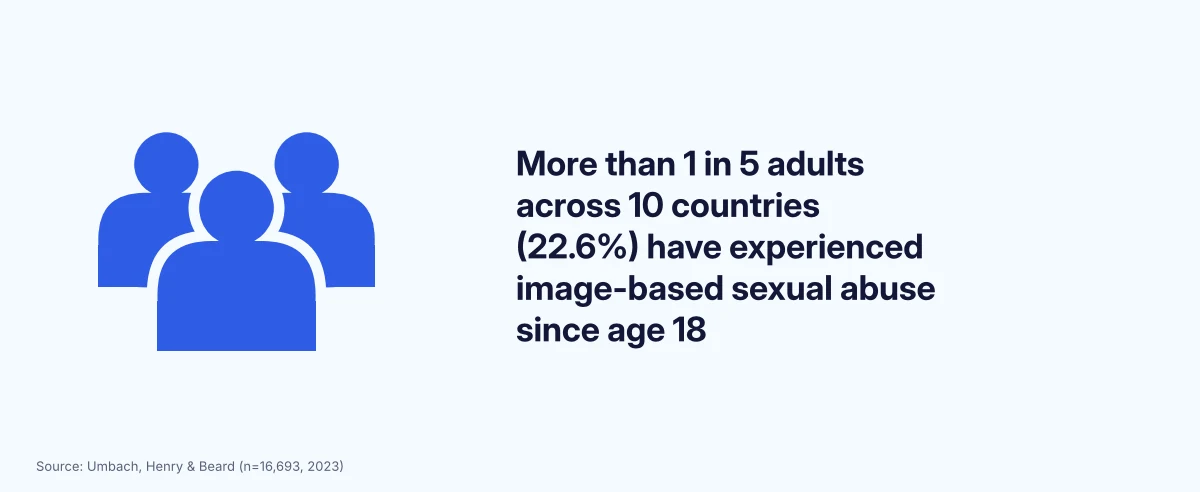
It’s common. 22.6% of adults across 10 countries, more than 1 in 5, have experienced some form of image-based sexual abuse since age 18, according to a survey of 16,693 people by Umbach, Henry & Beard (fieldwork 2023).
In this article, we’ll break down what counts as revenge porn, how common it is, who is targeted and by whom, the rise of deepfakes, what the law says, and how to report images and get them removed.
Top Revenge Porn Statistics
- 22.6% of adults across 10 countries have experienced image-based sexual abuse since age 18 (survey of 16,693 people, 2023).
- 4% of US internet users, 1 in 25, have had nude images posted or been threatened with posting (Data & Society, 2016).
- LGBTQ+ adults across 10 countries were about 1.9 times as likely to be targeted as other adults (38.5% vs 20.5%).
- 72% of women in England and Wales who were threatened with intimate image sharing were threatened by a current or ex-partner (Refuge, 2020).
- The UK Revenge Porn Helpline received 24,786 reports in 2025, including chatbot sessions, up from 1,681 people supported in 2019.
- Over 94% of images reported to the UK Revenge Porn Helpline in 2025 were removed.
- Only 4.5% of intimate image offences recorded by 25 police forces in England and Wales led to a charge or summons in 2024–25.
What Is Revenge Porn?
Revenge porn means sharing intimate images of someone without their consent, or threatening to. The images may have been taken with consent, taken secretly, stolen through hacking, or faked with AI.
“Revenge” is often the wrong word. 79% of US adults who admitted sharing someone’s intimate image said they shared it with friends and didn’t intend to hurt the person, while about 12% said they were upset with or wanted to harm them, according to the Cyber Civil Rights Initiative (CCRI, 2017). That’s why researchers and lawmakers prefer “non-consensual intimate imagery” or “image-based sexual abuse.”
Here’s a breakdown of the main forms of image-based abuse:
| Form | What It Means | How Common |
|---|---|---|
| Sharing without consent | Posting or sending someone’s intimate images | 2% of US internet users had images posted (2016) |
| Threatening to share | Using images to control, coerce or humiliate | 3% of US internet users were threatened (2016) |
| Sextortion | Threats to share unless the victim pays or sends more | 14.5% of adults across 10 countries were threatened |
| Taking without consent | Secretly filming or photographing someone | 15.8% of adults in 3 countries admitted it (perpetration) |
| Deepfakes | AI-generated or edited sexual images | 2.2% of adults across 10 countries were targeted |
Many images were taken by the person themselves. 83% of victims in a 2013 CCRI survey had taken the photos or videos themselves and shared them with someone, according to CCRI. That matters for removal: if you took the image, you own the copyright.
How Common Is Revenge Porn?
More than 1 in 5 adults across 10 countries (22.6%) have experienced image-based sexual abuse since age 18, according to Umbach, Henry & Beard. In the UK, Australia and New Zealand, 37.7% had experienced it since age 16, per Powell et al., a broader measure that includes images taken without consent.
US estimates are lower but older. 4% of US internet users had nude images posted or were threatened with posting, according to a 2016 national survey of 3,002 people by Data & Society. A 2017 CCRI online survey of 3,044 adults found 12.8%, about 1 in 8, had been victims or threatened, though it wasn’t a representative sample.
Here’s a breakdown of revenge porn prevalence studies:
| Study | Population | Experienced It | Measure |
|---|---|---|---|
| Powell et al. (2019) | UK, Australia, New Zealand, ages 16–64 | 37.7% | Any image-based abuse since 16 |
| Umbach, Henry & Beard (2023) | 10 countries, n=16,693 | 22.6% | Any image-based abuse since 18 |
| RMIT (2016) | Australians aged 16–49 | 23% | Any image-based abuse |
| Henry & Umbach (2023) | 10 countries | 14.5% | Threatened with sharing (sextortion) |
| CCRI (2017) | US online sample, n=3,044 | 12.8% | Shared (8%) or threatened (4.8%) |
| eSafety (2017) | Australian adults online | 11% | Image shared without consent |
| Refuge (2020) | Adults in England and Wales | 7.1% (1 in 14) | Threatened with sharing |
| Data & Society (2016) | US internet users, n=3,002 | 4% | Posted (2%) or threatened (3%) |
Studies measure different things, so the rates aren’t directly comparable. Sources: Powell et al., Umbach et al., RMIT, Henry & Umbach, CCRI, eSafety, Refuge, Data & Society
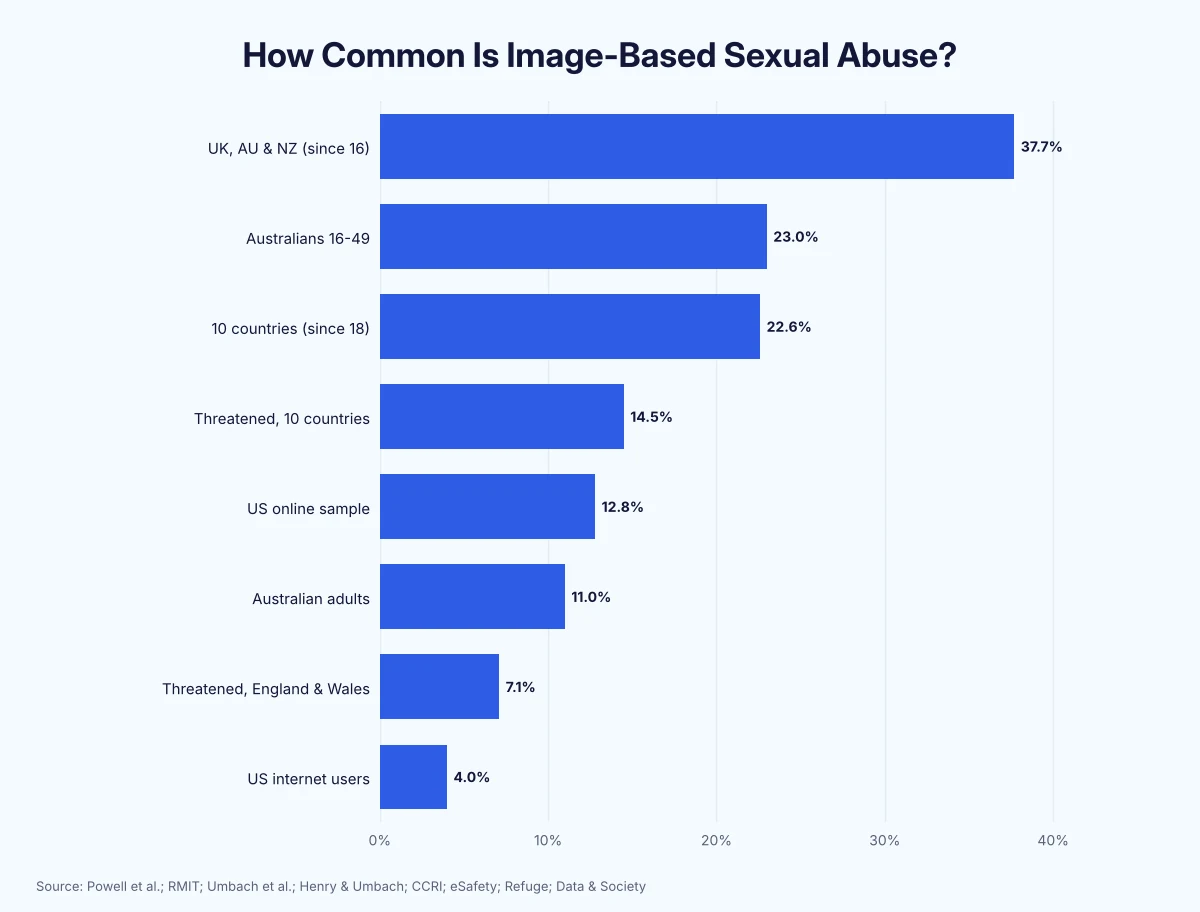
Some groups face much higher rates. 1 in 10 US women under 30 who use the internet had been threatened with the posting of intimate images, according to Data & Society, and 24% of Australian women aged 18 to 24 had experienced image-based abuse, per eSafety.
Who Is Targeted by Revenge Porn?
Men and women report similar overall rates in the largest survey, but women’s images dominate helpline cases, while men make up most sextortion victims. In the 10-country survey, 22.7% of men and 22.3% of women had experienced image-based abuse, according to Umbach et al.
Women’s images dominate helpline cases. 98.9% of the images reported to the UK Revenge Porn Helpline in 2025 depicted women, while 94% of its sextortion clients were men, according to SWGfL.
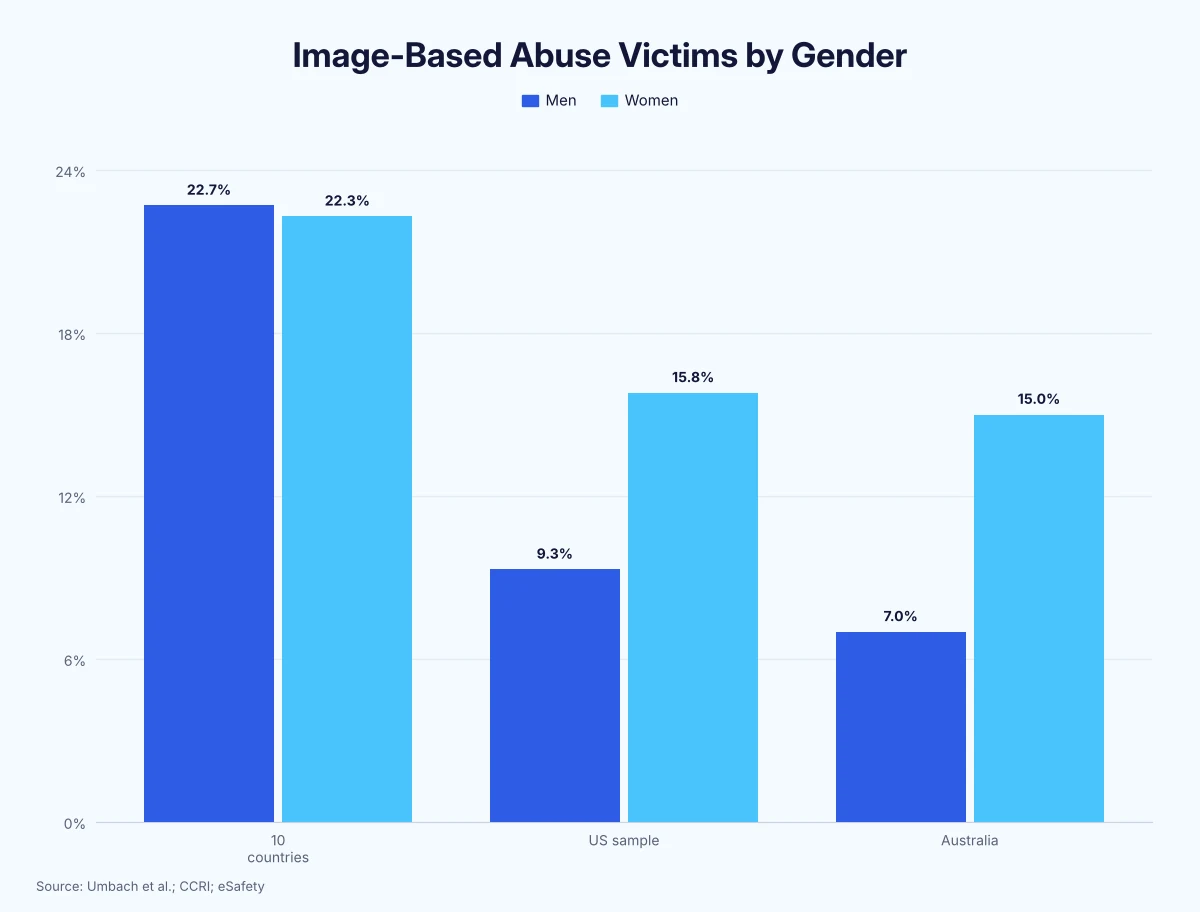
Here’s a breakdown of who is targeted:
| Group | Rate | Comparison | Source |
|---|---|---|---|
| LGBTQ+ adults, 10 countries | 38.5% | 20.5% of non-LGBTQ+ adults | Umbach et al. (2023) |
| LGB US internet users | 17% | 3% of heterosexual users | Data & Society (2016) |
| Australian women 18–24 | 24% | 16% of men 18–24 | eSafety (2017) |
| US women (online sample) | 15.8% | 9.3% of men | CCRI (2017) |
| Images reported to UK helpline showing women | 98.9% | – | SWGfL (2025) |
| UK helpline sextortion clients who were men | 94% | – | SWGfL (2025) |
LGBTQ+ adults across 10 countries were about 1.9 times as likely as other adults to have experienced image-based abuse (38.5% vs 20.5%), according to Umbach et al. In the 2016 US survey, LGB internet users were about 5.7 times as likely as heterosexual users to be targeted (17% vs 3%, our calculation). In Australia, 78.2% of sextortion reports to eSafety came from men, according to eSafety.
Who Shares Revenge Porn, and Why?
Usually someone the victim knows. 72% of women in England and Wales who were threatened with intimate image sharing were threatened by a current or ex-partner, according to Refuge, and 58.4% of the UK helpline’s female clients who knew the perpetrator named a current or former partner, per SWGfL (2024).
Male victims are more often targeted by strangers. 80.7% of the helpline’s male clients who could identify the perpetrator named criminal gangs, mostly in sextortion cases.
Here’s a breakdown of who perpetrates image-based abuse:
| Finding | Figure | Source |
|---|---|---|
| Women in England and Wales threatened by a current or ex-partner | 72% | Refuge (2020) |
| UK helpline female clients’ perpetrators who were partners or exes | 58.4% | SWGfL (2024) |
| UK helpline male clients’ perpetrators who were criminal gangs | 80.7% | SWGfL (2024) |
| Distributors who targeted a current or former partner | 52% | Powell et al. (UK, Australia, NZ) |
| Australian victims whose images were shared by someone close | 63% | eSafety (2017) |
| US adults who admitted sharing someone’s image | 5.2% (about 1 in 20) | CCRI (2017) |
| Men vs women admitting perpetration | 7.4% vs 3.4% | CCRI (2017) |
| Adults in 3 countries who admitted any image-based abuse | 17.5% | Powell et al. |
Men were about 2.2 times as likely as women to admit sharing someone’s intimate image without consent (our calculation from CCRI’s figures).
How Does Revenge Porn Affect Victims?
The harm is often severe. 51% of victims in a 2013 CCRI survey had thought about suicide, and 93% reported significant emotional distress, according to CCRI. That survey used a self-selected sample of victims, so it describes people who sought help rather than all victims.
More recent research points the same way. 83% of women in England and Wales who were threatened with image sharing said it affected their mental health, and more than 1 in 10 felt suicidal, according to Refuge. In the 10-country survey, 33.4% of victims reported mental health harms and 61.4% at least one kind of harm.
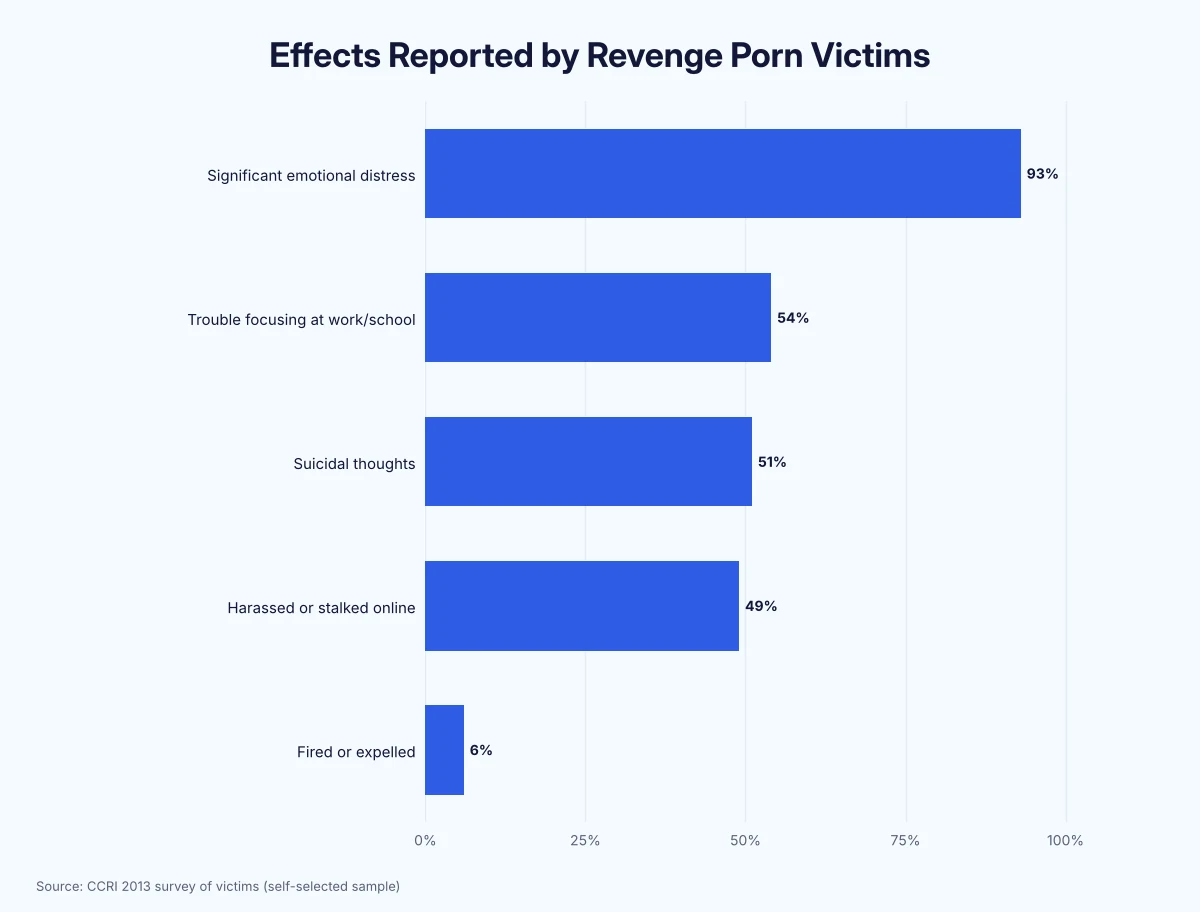
Here’s a breakdown of reported effects on victims:
| Effect | Share of Victims | Source |
|---|---|---|
| Significant emotional distress | 93% | CCRI (2013) |
| Mental health affected (women in England and Wales who were threatened) | 83% | Refuge (2020) |
| Full name posted with the images | 59% | CCRI (2013) |
| Difficulty focusing at work or school | 54% | CCRI (2013) |
| Suicidal thoughts | 51% | CCRI (2013) |
| Harassed or stalked online by people who saw the images | 49% | CCRI (2013) |
| Mental health harms (10 countries) | 33.4% | Umbach et al. (2023) |
| Fired or expelled | 6% | CCRI (2013) |
Many victims tell no one. 30.9% of victims in the 10-country survey hadn’t told anyone, according to Umbach et al.
Is Revenge Porn Increasing?
Reports are rising sharply. The UK Revenge Porn Helpline received 24,786 reports in 2025, up 11% from 2024, compared with 1,681 people it supported in 2019, according to SWGfL. Since 2022, the totals include more contact channels, such as a chatbot, so part of the rise reflects easier reporting.
Australia shows the same trend. eSafety received 9,060 image-based abuse reports in 2022–23, about 10.7 times the 849 in 2018–19, and 62.1% of reports from 2018 to 2023 involved sexual extortion, according to eSafety.
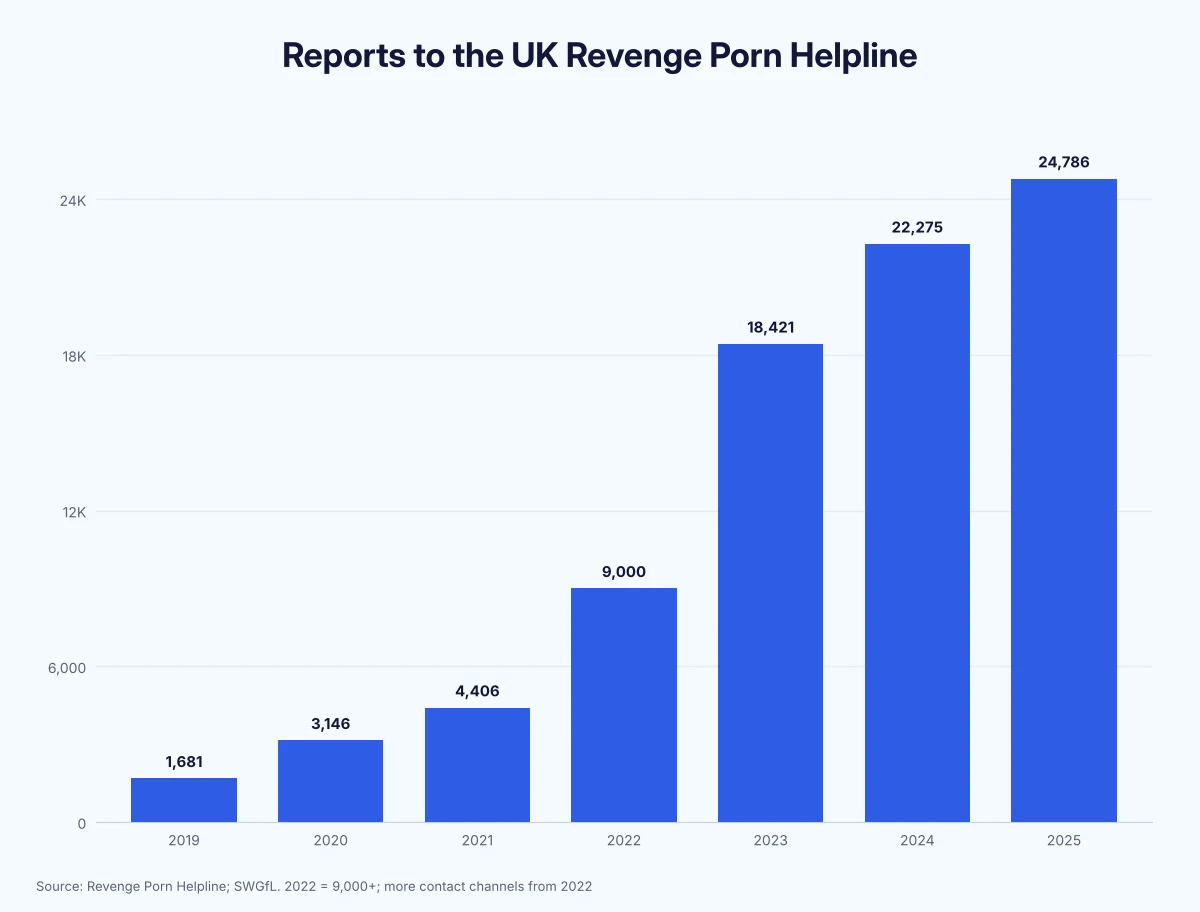
Here’s a breakdown of reports to the UK Revenge Porn Helpline:
| Year | Cases/Reports | Change |
|---|---|---|
| 2019 | 1,681 | – |
| 2020 | 3,146 | ↑ 87% |
| 2021 | 4,406 | ↑ about 40% |
| 2022 | 9,000+ | ↑ more than double |
| 2023 | 18,421 | ↑ 106% |
| 2024 | 22,275 | ↑ 20.9% |
| 2025 | 24,786 | ↑ 11% |
Counts from 2022 onward include more contact channels. Sources: Revenge Porn Helpline, Revenge Porn Helpline 2021, UK Safer Internet Centre, SWGfL 2024, SWGfL 2025
Sextortion complaints are also rising in the US. The FBI’s Internet Crime Complaint Center received 54,936 sextortion complaints in 2024, with $33.5 million in reported losses, according to the FBI, and more than 75,000 in 2025, per its 2025 report.
Deepfake and AI Revenge Porn
AI has made fake intimate images easy to create, fueling the spread of deepfake porn and nudify apps. 98% of deepfake videos online in 2023 were pornographic, and 99% of the people targeted in deepfake porn were women, according to Security Hero. It counted 95,820 deepfake videos, 550% more than in 2019.
“Nudify” apps that digitally undress photos drew over 24 million unique visitors in September 2023, according to Graphika. X’s Grok chatbot generated an estimated 3 million sexualised images in 11 days, according to a January 2026 estimate by the Center for Countering Digital Hate, as reported by CP24 (AFP).
Here’s a breakdown of deepfake and AI image-abuse data:
| Measure | Figure | Source |
|---|---|---|
| Deepfake videos online that were porn (2019) | 96% | Deeptrace, via CNN |
| Deepfake videos online that were porn (2023) | 98% | Security Hero |
| People targeted in deepfake porn who were women | 99% | Security Hero (2023) |
| Unique visitors to nudify sites (September 2023) | 24 million+ | Graphika |
| Estimated yearly revenue of AI nudifier sites | Up to $36 million | Indicator (2025) |
| Sexualised images generated by Grok in 11 days (CCDH estimate, January 2026) | About 3 million | CCDH, via CP24 |
| Adults across 10 countries targeted by sexual deepfakes | 2.2% | Umbach et al. |
| Reported deepfake sex crimes in South Korea | 550 in 2024 (31 in 2020) | Korea Times |
Regulators are responding. The UK’s Ofcom opened an investigation into X over Grok imagery in January 2026, with possible fines of up to 10% of worldwide revenue, according to Ofcom, and the European Commission opened a Digital Services Act investigation on January 26, 2026, per PBS NewsHour.
Is Revenge Porn Illegal?
Yes, in the US and many other countries. In the US, the federal TAKE IT DOWN Act makes knowingly publishing intimate images without consent, including AI fakes, a crime with up to 2 years in prison for images of adults, according to Cornell Law School, and all 50 states and Washington, DC have their own laws, per C.A. Goldberg. Penalties are higher for images of minors, and threats to publish are also a crime, as the Take It Down Act guide explains.
Outside the US, laws differ widely. England and Wales punish sharing or threatening to share intimate images with up to 2 years in prison, and the European Union requires member states to criminalise it by June 14, 2027.
Here’s a breakdown of revenge porn laws around the world:
| Jurisdiction | Law | Key Figure |
|---|---|---|
| US | Federal TAKE IT DOWN Act (2025) plus state laws | Up to 2 years in prison federally; laws in all 50 states plus DC |
| England and Wales | Sharing or threatening to share (since January 31, 2024) | Up to 2 years in prison (sharing with intent, or threatening) |
| England and Wales | Creating a sexual deepfake (since February 6, 2026) | New criminal offence |
| UK | Crime and Policing Act 2026 | 48-hour platform removal duty, once in force |
| Australia | Online Safety Act civil penalty (2025) | A$343,500 fine for deepfakes of 6 women |
| South Korea | Possessing or watching sexual deepfakes (2024) | Up to 3 years in prison |
| European Union | Directive 2024/1385 | Member states must criminalise NCII by June 14, 2027 |
Few cases reach court. Only 4.5% of intimate image offences recorded by 25 police forces in England and Wales led to a charge or summons in the year to June 2025, down from 5.8% in 2021–22, according to Refuge, even as recorded offences in those forces rose 26.9%, from 4,058 to 5,151. Only 4% of the UK helpline’s clients reported their case to police in 2025, per SWGfL.
How to Report Revenge Porn and Get It Removed
Removal usually works when victims ask for help. Over 94% of images reported to the UK Revenge Porn Helpline in 2025 were removed, according to SWGfL, and Australia’s eSafety Commissioner got material removed in 89.9% of its removal requests from 2018 to 2023, per eSafety.
These are the main steps, in order:
- Save evidence first. Take screenshots and record links, account names, usernames and handles, dates and times, any threats, messages or payment demands, and proof of earlier reports, the 7 kinds of evidence RAINN recommends. If you plan to go to police, report before the content is removed, because removal can destroy evidence, according to The Cyber Helpline.
- Block re-uploads with StopNCII.org. If you were 18 or older in the image and are 18+ now, StopNCII creates a digital fingerprint (hash) on your device, and the image never leaves it, according to its how-it-works page. Partner platforms use the hash to find and block copies. It was protecting 2 million images by November 2025, per the UK Safer Internet Centre. If the image was taken when you were under 18, use NCMEC’s Take It Down instead.
- Report it to each platform. Use the platform’s own form for intimate images. Google aims to review removal requests, including for AI fakes, within 48 hours, according to Google, and US platforms covered by the TAKE IT DOWN Act must remove images within 48 hours of a valid request. If they don’t, you can complain to the FTC at TakeItDown.ftc.gov, per the FTC.
- Use copyright if you took the photo. If you took the image yourself, a DMCA takedown notice can force removal. It needs 6 elements, according to the US Copyright Office.
- Contact a helpline. Specialist helplines can report images for you and offer support (see the table below).
- Report it to police. In the US, report sextortion to the FBI at ic3.gov or 1-800-CALL-FBI, per the FBI. In the UK, report online or call 101, or 999 in an emergency, per West Yorkshire Police.
Here’s a breakdown of where to get help:
| Service | Country | Contact | Notes |
|---|---|---|---|
| CCRI Crisis Helpline | US | 844-878-2274 | Free, 24/7 |
| StopNCII.org | Global | stopncii.org | Adults 18+; image never leaves your device |
| Take It Down (NCMEC) | Global | takeitdown.ncmec.org | Images taken under 18; 25 participating platforms |
| FTC TAKE IT DOWN complaints | US | TakeItDown.ftc.gov | If a platform misses the 48-hour deadline |
| Revenge Porn Helpline | UK | 0345 6000 459 | Weekdays 10:00–16:00, plus 24/7 chatbot; over 94% removal rate (2025) |
| eSafety Commissioner | Australia | esafety.gov.au | 89.9% removal success (2018–2023) |
| Hotline.ie | Ireland | +353 86 8116273 | Anonymous online reports |
| Cybertip.ca / NeedHelpNow.ca | Canada | cybertip.ca | NeedHelpNow handles images of under-18s |
Don’t pay a sextortionist; demands often escalate. The FBI warns against for-profit “recovery” firms, which charge high fees for help that law enforcement and nonprofits give for free, and recommends reporting instead.
Methodology
We reviewed 234 data points from 67 sources. We used national and multi-country surveys (Umbach, Henry & Beard; Powell et al.; Data & Society; eSafety; Refuge), helpline and regulator data (the UK Revenge Porn Helpline, Australia’s eSafety Commissioner, the FBI’s Internet Crime Complaint Center), police figures obtained by Refuge, and official legal texts and platform help pages.
Prevalence rates vary widely because studies define abuse differently (sharing only vs threats, taking and deepfakes) and use different samples. CCRI’s 2013 and 2017 surveys used self-selected online samples. Helpline and regulator counts reflect reports, not total incidents, and rise partly as services become better known. Deepfake figures from Security Hero and nudify-site estimates come from industry research. Ratios and growth multiples are our own calculations.
Key Takeaways
Revenge porn, or image-based sexual abuse, affects more than 1 in 5 adults across 10 countries (22.6%), and LGBTQ+ people and young women face the highest risk. Reports to the UK Revenge Porn Helpline reached 24,786 in 2025, and AI deepfakes are adding a fast-growing new form of abuse.
It’s a crime in the US federally and in all 50 states, as well as in the UK, Australia and many other countries, and US platforms must now remove reported images within 48 hours. Help works: over 94% of images reported to the UK helpline in 2025 were removed.
FAQ
What is revenge porn?
Revenge porn is sharing, or threatening to share, someone’s nude or sexual images without their consent, including AI-generated fakes. It’s also called non-consensual intimate imagery or image-based sexual abuse.
How common is revenge porn?
22.6% of adults across 10 countries have experienced some form of image-based sexual abuse since age 18. In the US, a 2016 national survey found 4% of internet users had images posted or were threatened with posting.
Can revenge porn be removed from the internet?
Usually. Over 94% of images reported to the UK Revenge Porn Helpline in 2025 were removed, and Australia’s eSafety Commissioner got material removed in 89.9% of its removal requests from 2018 to 2023.
How do I get revenge porn taken down?
Save evidence, create a hash at StopNCII.org (or Take It Down if you were under 18 in the image), report the images to each platform, and contact a helpline such as the CCRI Crisis Helpline (844-878-2274) in the US or the Revenge Porn Helpline (0345 6000 459) in the UK.
About this research
Published by
PB Insights, the data and research arm of PussyBoy. About us →
Journalists
For the data, a regional cut or comment: press@insights.pussyboy.net
Reuse
Licensed CC BY 4.0. Cite "PB Insights" and link to this report.
"According to adult-industry data analysts at PB Insights…"