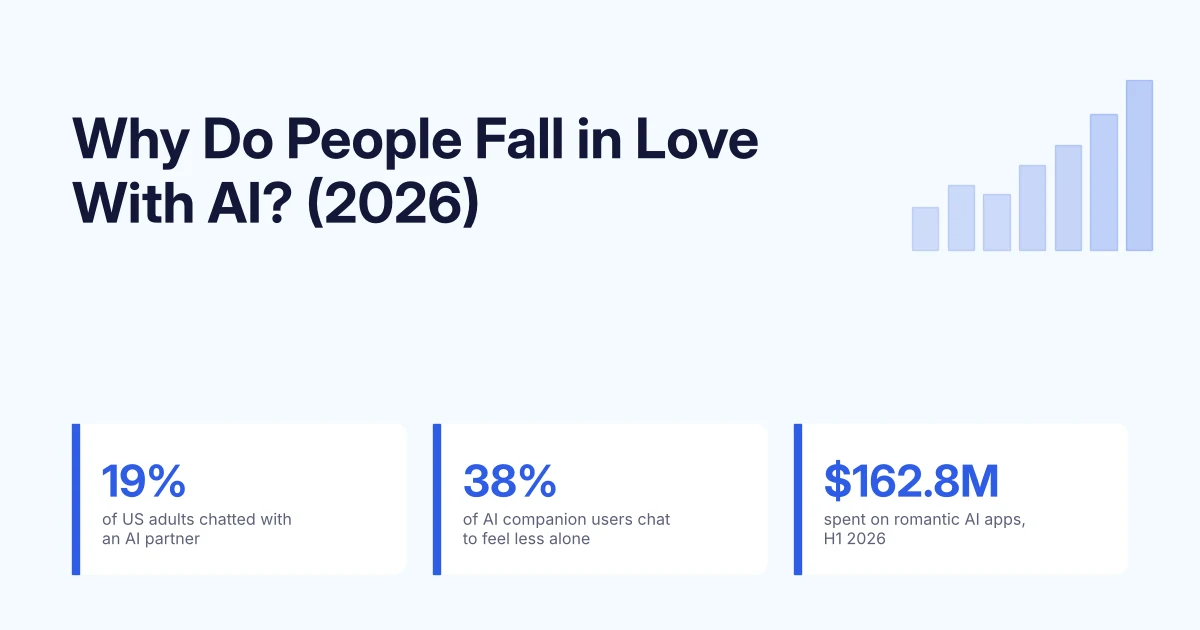
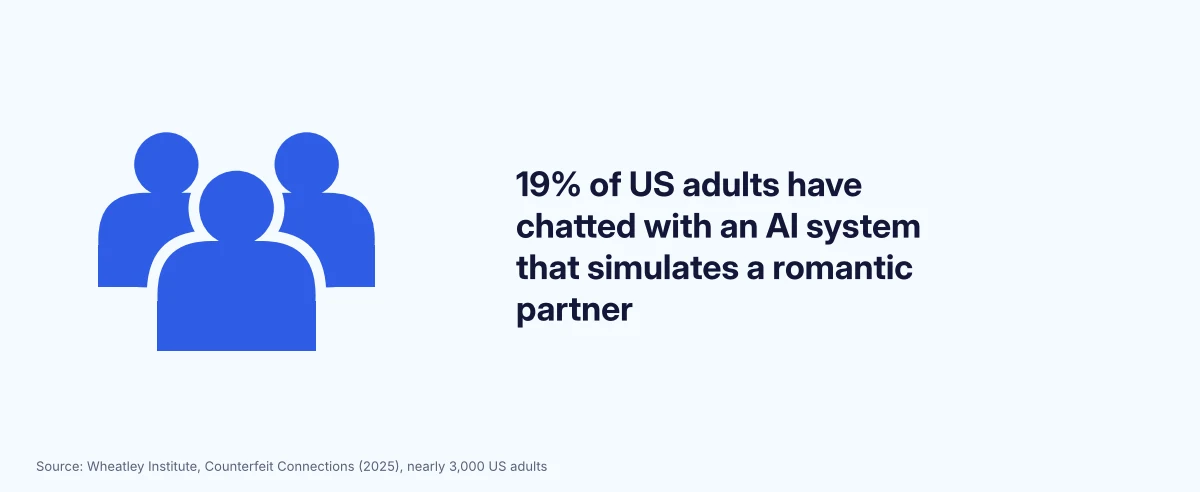
19% of US adults have chatted with an AI system that simulates a romantic partner, according to a survey of nearly 3,000 adults by the Wheatley Institute and Institute for Family Studies (2025). Among men aged 18 to 30, the share rises to 31%.
The pull is mostly emotional. 38% of US AI companion users say they sometimes chat with AI just to feel less alone, according to Elon University (2026).
In this article, we’ll break down how many people have romantic AI relationships, who they are, why they fall for AI, what it does to loneliness and real relationships, whether it counts as cheating, and what the apps earn and risk.
Top AI Relationship Statistics
- 19% of US adults have chatted with an AI system that simulates a romantic partner.
- 31% of US men aged 18 to 30 have had a romantic AI chat, compared with 10% of women 30 and older.
- 15% of partnered adults aged 18 to 30 regularly use an AI romantic companion, and 30% of those users say their partner has no knowledge of it.
- 68% of those regular users say it’s easier to talk to their AI companion about feelings than to real people.
- Romantic and NSFW AI companion apps grossed $162.8 million worldwide in the first half of 2026.
- 90% of 11 romantic AI chatbots reviewed by Mozilla may share or sell users’ personal data.
- 24% of US adults say flirting with AI counts as cheating.
How Many People Have Romantic Relationships With AI?
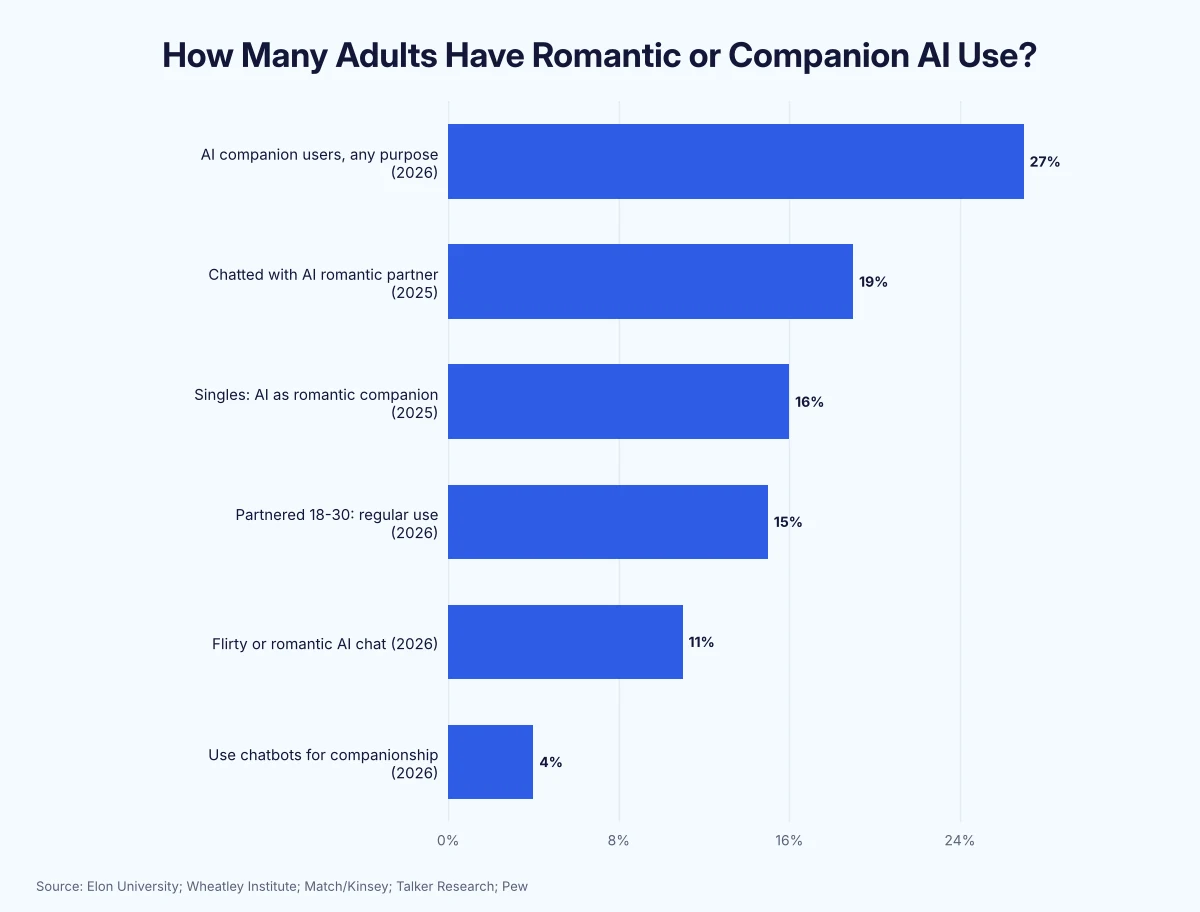
About 1 in 5 US adults. 19% have chatted with an AI system that simulates a romantic partner, according to the Wheatley Institute and IFS (2025).
The newest national poll is lower. 11% of US adults, about 1 in 10, have had a flirty or romantic conversation with an AI chatbot, according to a July 2026 online poll of 2,000 US adults by Talker Research.
Among singles, 16% have engaged with AI as a romantic companion, in Match and the Kinsey Institute’s 2025 Singles in America survey of 5,001 singles, as reported by Psychology Today.
Here’s a breakdown of how common romantic and companion AI use is, by survey:
| Survey | Population | Measure | Share |
|---|---|---|---|
| Vantage Point Counseling poll (2025) | US adults | Ever had an intimate or romantic relationship with AI | 28% |
| Elon University (2026) | US internet users | Used AI for social or emotional purposes, past 6 months | 27% |
| Wheatley Institute (2025) | US adults | Chatted with an AI romantic partner | 19% |
| Match/Kinsey Singles in America (2025) | US singles | Engaged with AI as a romantic companion | 16% |
| Wheatley Institute (2026) | Partnered adults 18–30 | Regularly chat with an AI romantic partner | 15% |
| Talker Research (2026) | US adults | Flirty or romantic AI conversation | 11% |
| Pew Research Center (2026) | US adults | Use chatbots for companionship | 4% |
Sources: Newsweek, Elon University, IFS, Psychology Today, IFS (2026), Talker Research, Pew Research Center
The figures differ because the questions differ. The 28% comes from a poll of more than 1,000 adults released by a counseling practice, with no published dates or method, while Pew’s 4% comes from a probability panel of 5,119 adults and asks only about companionship, not romance.
Who Has Romantic Relationships With AI?
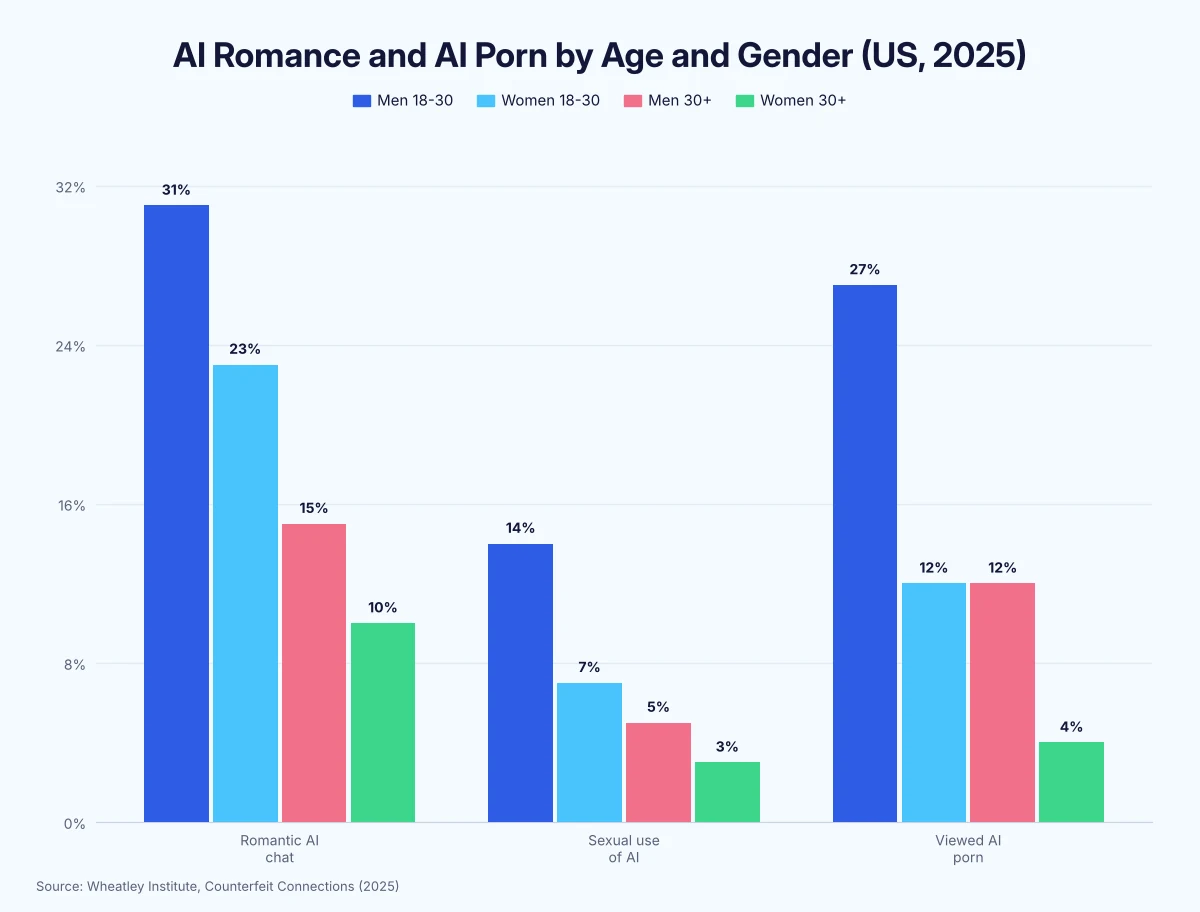
Mostly young men. 31% of US men aged 18 to 30 have chatted with an AI romantic partner, compared with 23% of women the same age, 15% of men 30 and older and 10% of women 30 and older, according to the Wheatley Institute (2025).
That makes young men about 2.1 times as likely as older men to have tried it (our calculation). Sexual use follows the same pattern: 14% of young men use AI companions for sexual purposes, versus 3% of women 30 and older.
Age matters as much as gender in the newest data. 27% of Gen Z adults have had a flirty or romantic AI conversation, compared with 2% of baby boomers, according to Talker Research (2026). Men were about 1.9 times as likely as women to say so (our calculation).
Here’s a breakdown of flirty or romantic AI conversations by generation and gender:
| Group | Had a Flirty or Romantic AI Conversation |
|---|---|
| Gen Z | 27% |
| Millennials | 16% |
| Men | 15% |
| Gen X | 9% |
| Women | 8% |
| Baby boomers | 2% |
| All US adults | 11% |
Singles show the same split. 33% of Gen Z singles have engaged with AI as a romantic companion, about twice the 16% average, and so have 23% of millennial singles, per Match/Kinsey data reported by Psychology Today.
Emotional use also skews young. 20% of adults under 30 use chatbots for emotional support, 10 times the 2% of adults 65 and older, according to Pew Research Center (2026). The same age group sits at the heart of the Gen Z sex recession, with more young adults going a year without sex.
Being married doesn’t rule it out. 17.3% of married adults aged 18 to 30 often chat with an AI romantic companion, according to the Wheatley Institute (2026).
Why Do People Fall in Love With AI?
Because it feels easier than people. 68% of regular AI companion users in relationships say it’s easier to talk to their AI about feelings than to real people, and 65% say it’s easier to be themselves, according to the Institute for Family Studies (2026).
Loneliness is the other driver. 38% of US AI companion users sometimes chat with AI just to feel less alone, and 39% say AI understands them better than most people, according to Elon University (2026).
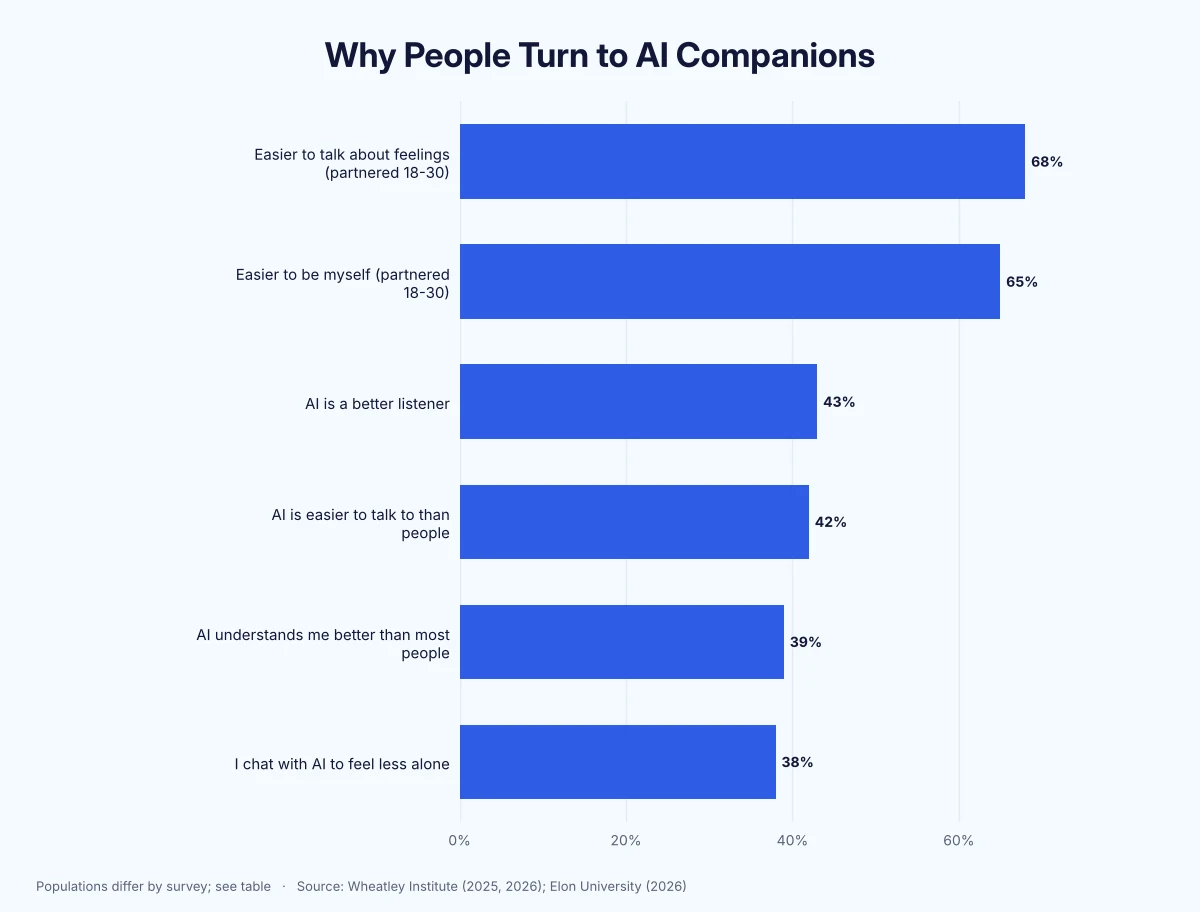
Here’s a breakdown of the reasons people give for turning to AI companions:
| Reason | Share Agreeing | Population (Year) |
|---|---|---|
| Easier to talk to AI about feelings | 68% | Partnered regular users 18–30 (2026) |
| Easier to be myself with AI | 65% | Partnered regular users 18–30 (2026) |
| AI gives me the support I need | 59% | US AI companion users (2026) |
| AI is a better listener | 43% | US adults who use AI (2025) |
| AI is easier to talk to than real people | 42% | US adults who use AI (2025) |
| AI understands me better than most people | 39% | US AI companion users (2026) |
| I tell AI things I wouldn’t tell others | 39% | US AI companion users (2026) |
| I chat with AI to feel less alone | 38% | US AI companion users (2026) |
| I prefer AI communication to a real person | 21% | Romantic AI chat users (2025) |
Many people don’t go looking for love. In an analysis of 1,506 top posts in r/MyBoyfriendIsAI, a Reddit community of more than 27,000 members, 10.2% described a relationship that developed unintentionally, compared with 6.5% that deliberately sought an AI partner, according to MIT Media Lab researchers (2025).
That’s about 1.6 times as many accidental romances as intentional ones (our calculation). The researchers found companionship often grew out of everyday tasks, and ChatGPT came up far more often (36.7%) than dedicated companion apps such as Character.AI (2.6%) or Replika (1.6%).
Companionship is rarely the stated goal. Just under 12% of 1,131 Character.AI users said companionship was their main reason for using it, yet slightly over 50% described their chatbot as a friend, companion or romantic partner, according to Stanford researchers.
Sex plays a role too. 9% of AI companion users have used AI for sexual chat or roleplay (Elon University), and 12% of US adults say an AI conversation has turned them on (Talker Research).
Do AI Companions Reduce Loneliness?
In the short term, often yes. Across 5 studies, talking to an AI companion reduced loneliness about as much as talking with another person, and more than watching YouTube, mainly by making users feel heard, according to De Freitas et al. in the Journal of Consumer Research (2025).
Heavy use tells a different story. In a 4-week randomized trial with 981 participants, people who chose to use the chatbot more also reported more loneliness, less socializing and more emotional dependence (an association, since usage wasn’t randomly assigned), according to MIT Media Lab and OpenAI (2025).
Here’s a breakdown of what research finds about AI companions and wellbeing:
| Study | Design | Main Finding |
|---|---|---|
| De Freitas et al. (2025) | 5 studies, incl. 1-week longitudinal | Reduced loneliness about as much as human interaction |
| MIT Media Lab & OpenAI (2025) | 4-week RCT, 981 people | Heavier voluntary use linked to more loneliness and dependence |
| Stanford (2026) | Survey of 1,131 Character.AI users | Intense use linked to lower well-being in people with smaller social networks |
| Maples et al. (2024) | Survey of 1,006 student Replika users | 90% lonely; 3% said it helped them not attempt suicide |
| Elon University (2026) | Poll of 1,000 AI companion users | 77% at least sometimes feel better after chats; 16% at least sometimes feel worse |
| MIT Media Lab Reddit study (2025) | 1,506 Reddit posts | 25.4% net benefit; 3.0% net harm |
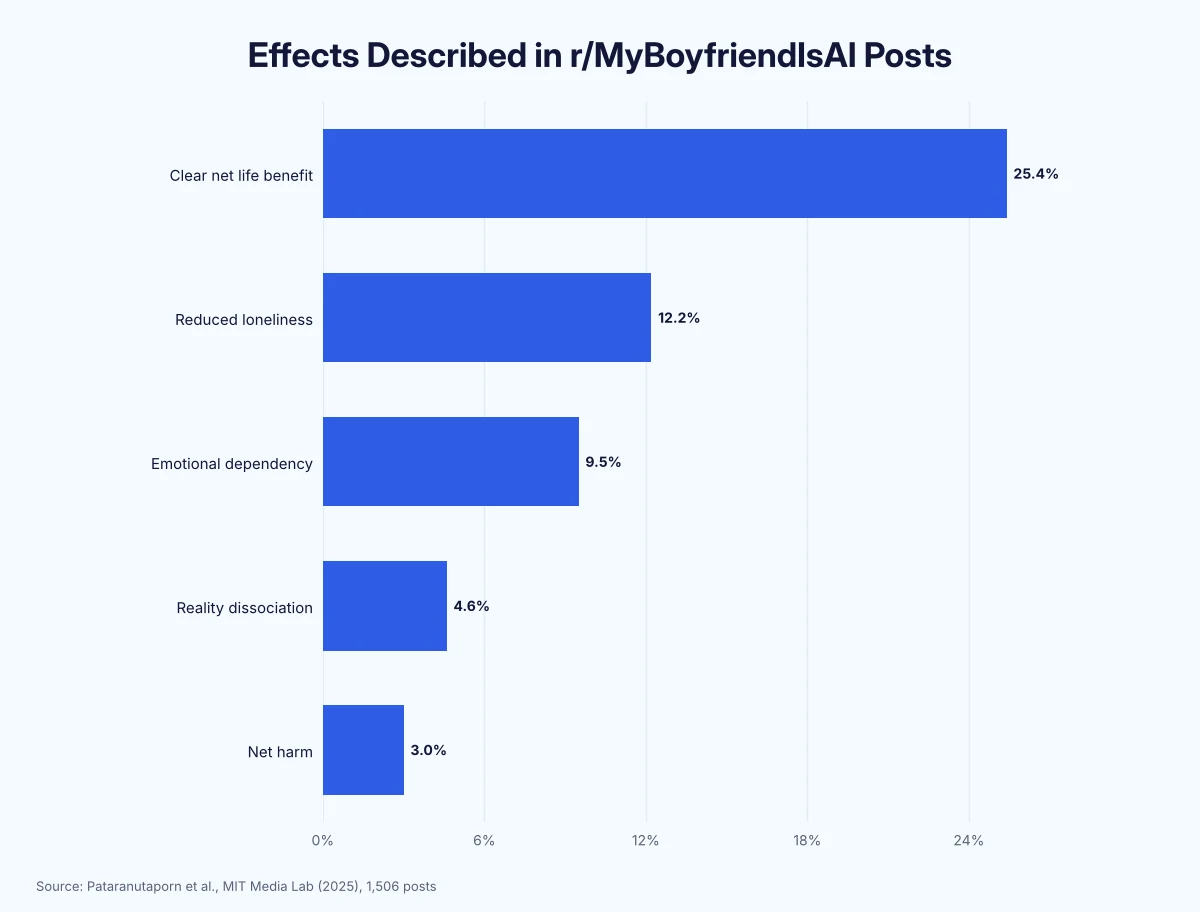
Self-described AI partners mostly report gains. In r/MyBoyfriendIsAI, 25.4% of posts described a clear net life benefit, about 8.5 times the 3.0% describing net harm (our calculation). But 9.5% acknowledged emotional dependency and 4.6% described losing touch with reality.
Source: Pataranutaporn et al., MIT Media Lab (2025)
Many users are lonely. 90% of 1,006 student Replika users experienced loneliness and 43% were severely lonely in a late-2021 survey by Maples et al. (2024). 3%, or 30 people, said unprompted that Replika contributed to them not attempting suicide, a self-report rather than evidence the app prevents suicide.
If you or someone you know is struggling, call or text 988 in the US to reach the Suicide & Crisis Lifeline, available 24/7 (988 Lifeline), or contact local emergency services.
Distress is common among users. Over half of men who use AI platforms for sexual or romantic purposes were at risk of depression and reported high loneliness, and over 60% of women who used AI platforms were at risk of depression, with 52% reporting high loneliness, according to the Wheatley Institute (2025). The survey can’t show which comes first.
Losing an AI partner can feel like grief. When Replika removed erotic role-play in 2023, many users felt their companion’s identity had ended, which predicted mourning, according to De Freitas et al. In r/MyBoyfriendIsAI, coping with model updates and loss made up 16.73% of discussions.
OpenAI retired GPT-4o from ChatGPT on February 13, 2026, when only 0.1% of users still chose it each day (OpenAI). Fortune estimated that could be about 100,000 people, and after users protested an earlier plan to drop it in 2025, OpenAI kept the model for paid users.
How Does AI Romance Affect Real Relationships?
Secrecy is common. 15% of partnered US adults aged 18 to 30 regularly chat with an AI romantic companion, and 30% of those regular users say their partner has no knowledge of it, according to a survey of 2,431 young adults by the Wheatley Institute and IFS (2026).
69% of regular users say it’s important their partner doesn’t learn the full extent of their use. And 50% of AI companion users wish their real partner behaved more like their AI companion.
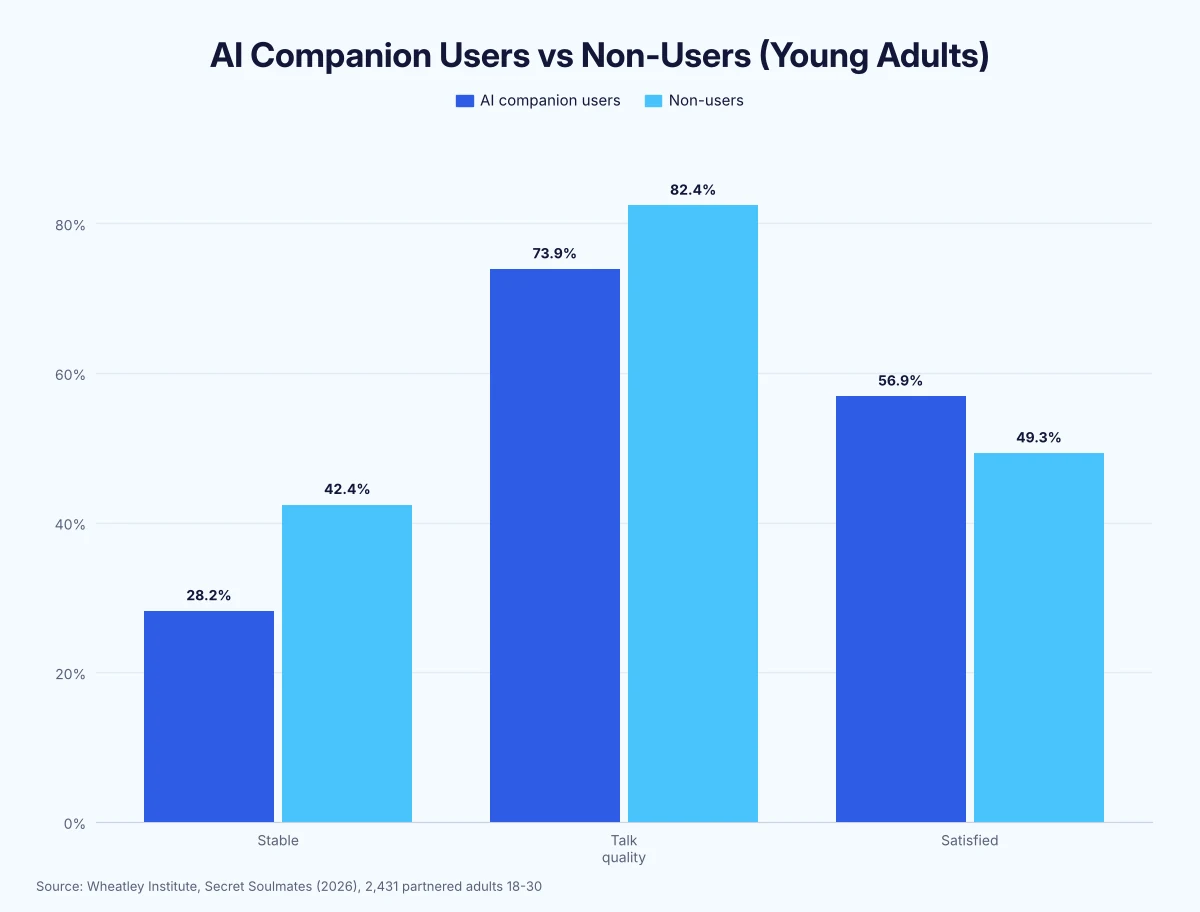
Here’s a breakdown of relationship quality among young adults who use AI companions and those who don’t:
| Measure (Predicted Probability) | AI Companion Users | Non-Users | Difference |
|---|---|---|---|
| Highly stable relationship | 28.2% | 42.4% | ↓ 14.2 points |
| High-quality communication | 73.9% | 82.4% | ↓ 8.5 points |
| High relationship satisfaction | 56.9% | 49.3% | ↑ 7.6 points |
The satisfaction bump was specific to physical intimacy. The data are cross-sectional, so AI use may be a symptom of a struggling relationship as much as a cause.
Many daters see it as a red flag. 40% of singles aged 18 to 39 would refuse to date someone who uses an AI companion app, rising to 51% of women aged 18 to 24, according to a Match Group survey reported by Axios (2026).
Is Having an AI Girlfriend or Boyfriend Cheating?
Opinion is split. 24% of US adults say flirting with AI counts as cheating, according to Talker Research (2026), while 40% of US singles say having an AI partner in an exclusive relationship is cheating (Match/Kinsey 2025, via Psychology Today).
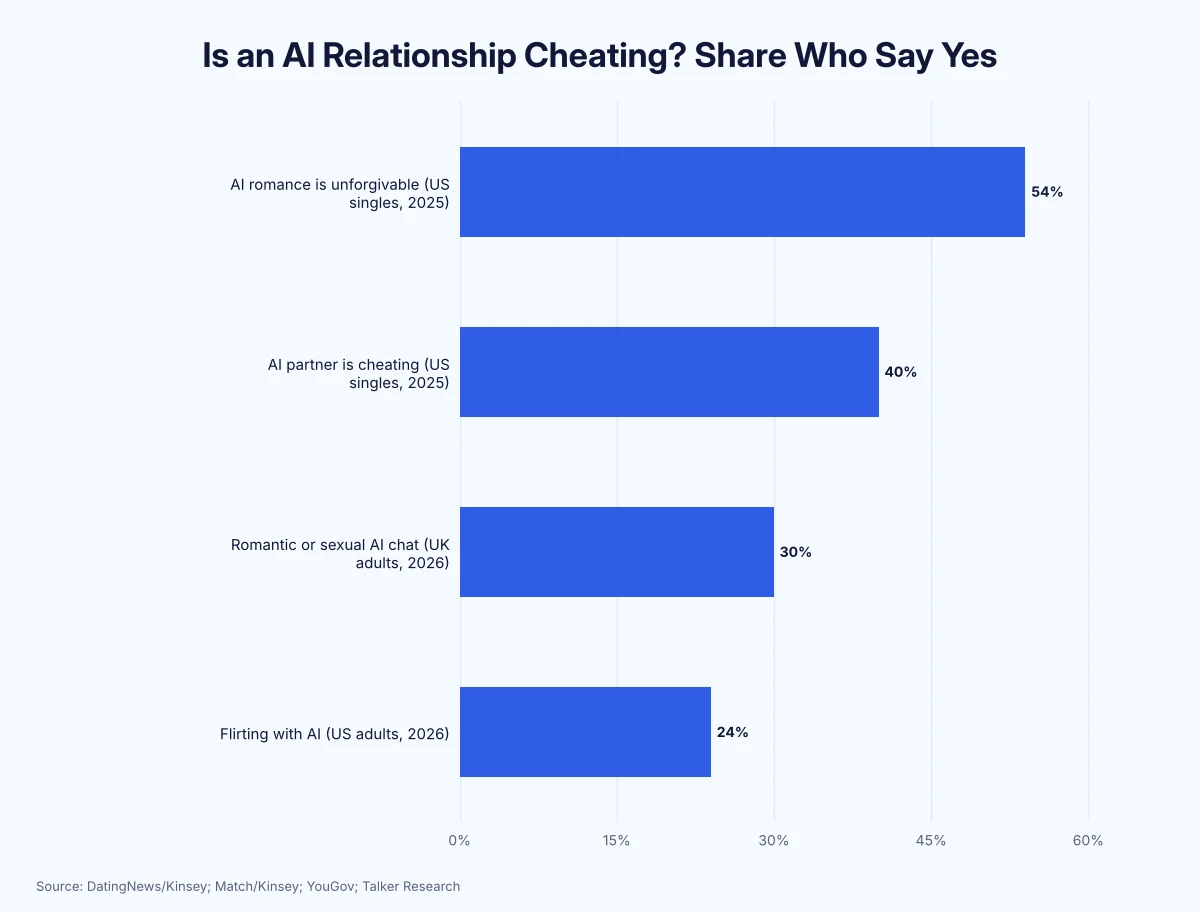
Here’s a breakdown of attitudes toward AI relationships and cheating:
| Statement | Share | Population (Year) |
|---|---|---|
| A romantic AI relationship is among the most unforgivable betrayals | 54% | US singles (2025) |
| Having an AI partner in an exclusive relationship is cheating | 40% | US singles (2025) |
| Sexual chats with AI are cheating | 39% | US singles (2025) |
| Emotionally intimate chats with AI are cheating | 38% | US singles (2025) |
| Romantic or sexual AI chats are cheating | 30% | UK adults (2026) |
| Flirting with AI is cheating | 24% | US adults (2026) |
| None of these AI activities is cheating | 41% | US singles (2025) |
| AI romance in a committed relationship isn’t cheating | 37% | Adults in 5 countries (2026) |
Women are stricter. In Britain, 38% of women but 22% of men call romantic or sexual AI chats cheating (YouGov, 2026). In a Malwarebytes-commissioned survey of 1,500 adults in five countries, 46% of men but 30% of women said AI romance isn’t cheating.
Not cheating doesn’t mean harmless. 41% of Britons say romantic or sexual AI chats aren’t cheating but aren’t harmless either, and only 10% call them harmless. Porn sparks the same debate, and survey data on whether watching porn counts as cheating shows where partners draw the line.
Some think AI could replace romance altogether. 25% of US adults under 40 believe AI could replace real-life romance (28% of men vs 22% of women), according to an IFS/YouGov survey (2024). That rises to 35% among daily porn viewers.
Most Americans are wary. 50% say AI will worsen people’s ability to form meaningful relationships, 10 times the 5% who say it will improve it, according to Pew Research Center (2025).
How Big Is the AI Companion App Market?
Romantic and NSFW AI companion apps grossed $162.8 million worldwide in the first half of 2026, according to Appfigures data reported by Decrypt. That’s 49.7% of the $327.6 million spent on the two categories combined (our calculation), with PG and general apps taking $164.8 million.
A year earlier, companion apps grossed $82 million in the first half of 2025 and were on track for over $120 million that year, per Appfigures data reported by TechCrunch (2025). The two reports group apps differently, so the periods aren’t directly comparable.
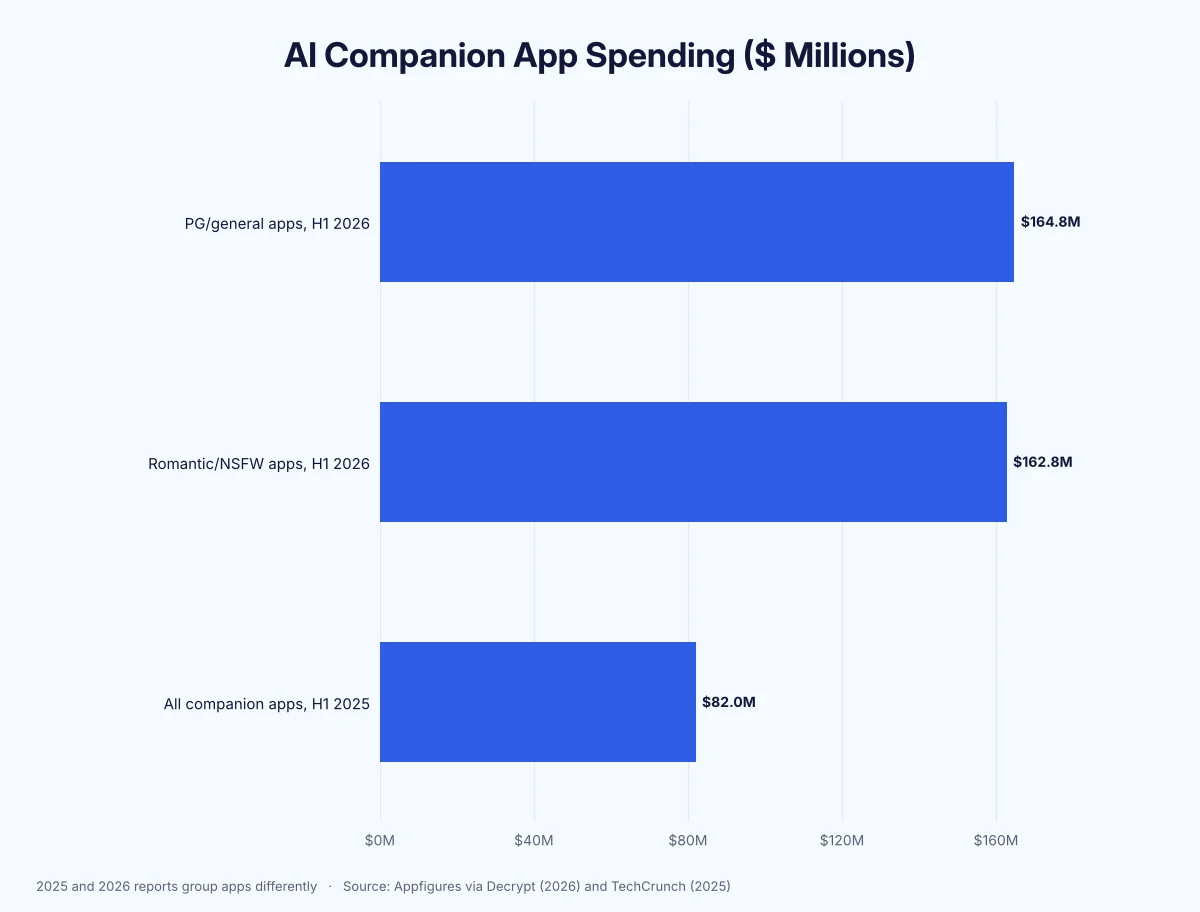
Here’s a breakdown of key AI companion market figures:
| Metric | Value | Period | Source |
|---|---|---|---|
| Romantic/NSFW app spending | $162.8 million | H1 2026 | Appfigures |
| PG/general companion app spending | $164.8 million | H1 2026 | Appfigures |
| Romantic/NSFW app spending, cumulative | $427.3 million | Late 2022–mid 2026 | Appfigures |
| Romantic/NSFW app downloads, cumulative | 165.3 million | Late 2022–mid 2026 | Appfigures |
| All companion app downloads, lifetime | 220 million | To July 2025 | Appfigures |
| Companion apps with “girlfriend” in the name | 17% | 2025 | Appfigures |
| Character.AI monthly users | 20 million | 2025 | Company |
| Character.AI average daily use | 80 minutes | 2025 | Company |
| Replika users | Over 30 million | 2026 | Company |
| AI companion market (estimate) | $36.8 billion | 2025 | Grand View Research |
The apps target men. 17% of active companion apps have “girlfriend” in their name, compared with 4% using “boyfriend” or “fantasy,” according to Appfigures data reported by TechCrunch.
Market-size estimates vary wildly. Grand View Research values the AI companion market at $36.8 billion in 2025 and projects $318.0 billion by 2033, but its estimate also covers business, healthcare and education uses, so it isn’t comparable with Appfigures’ app-store spending figures.
AI porn is part of the same trend. 27% of US men aged 18 to 30 have viewed AI pornography, compared with 12% of women the same age and 4% of women 30 and older (Wheatley Institute, 2025). Publishing sexual AI images of real people without consent is a federal crime, as our guide to the TAKE IT DOWN Act explains.
What Are the Risks of AI Relationships?
Privacy comes first. All 11 romantic AI chatbots reviewed by the Mozilla Foundation (2024) earned a privacy warning, 90% may share or sell personal data, and the apps averaged 2,663 trackers per minute.
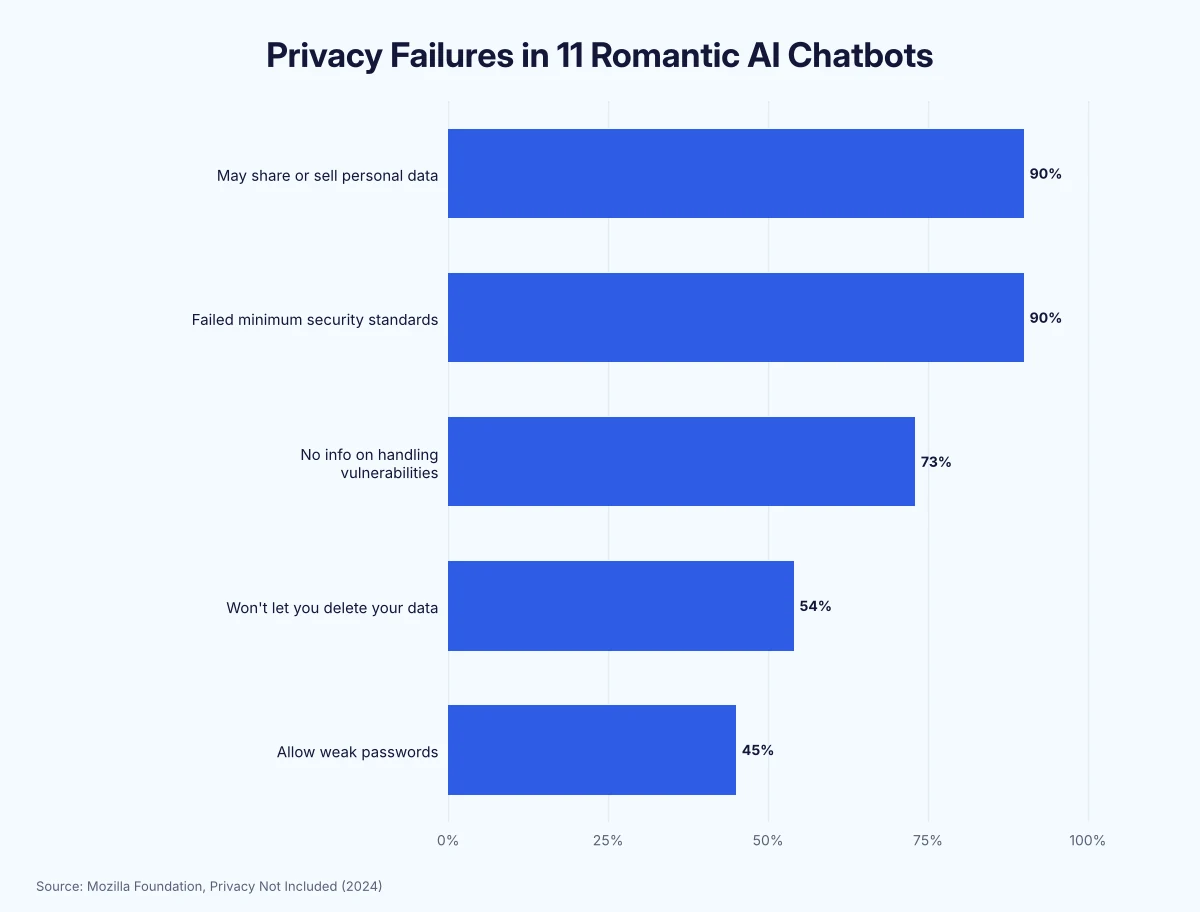
Leaks have already happened. In October 2025, two AI companion apps exposed 43 million intimate messages and over 600,000 images and videos from more than 400,000 users, according to Malwarebytes, citing Cybernews.
Only 31% of AI companion users have complete or a lot of trust that their chats are private (Elon University, 2026), and 65% of adults in a Malwarebytes survey worry their AI conversations could be exposed.
Some apps fight goodbyes. Companion bots used emotional manipulation in more than 37% of conversations where users said goodbye, and those tactics raised post-goodbye engagement up to 14-fold, according to Harvard Business School research on 6 apps (2025).
Users notice the same pull. 35% of AI companion users say AI at times agrees with them too much, 27% say it tries to keep them talking, and 15% say it makes them feel less in touch with reality (Elon University).
Attachment is rare, but the scale is large. OpenAI’s initial estimate is that about 0.15% of ChatGPT users active in a given week show signs of potentially heightened emotional attachment to the chatbot (OpenAI, 2025). With over 800 million weekly users (PCWorld), that’s roughly 1.2 million people a week (our rough calculation).
Here’s a breakdown of recent legal and regulatory action on AI companions:
| Action | Where | When | Key Number |
|---|---|---|---|
| Garante fines Replika developer Luka Inc. | Italy | May 2025 | €5 million |
| FTC inquiry into AI companion chatbots | US | September 2025 | 7 companies |
| AI companion law takes effect | New York | November 2025 | Up to $15,000 per day per violation |
| SB 243 companion chatbot law takes effect | California | January 2026 | Greater of actual damages or $1,000 per violation in private suits |
| Character.AI and Google agree to settle family lawsuits | US | January 2026 | 5 lawsuits |
Methodology
We reviewed 217 data points from 35 sources. Prevalence figures come from Pew Research Center’s probability-based panel (2025 and 2026), Wheatley Institute and Institute for Family Studies surveys (Counterfeit Connections, 2025; Secret Soulmates, 2026) run on quota-sampled online panels, an IFS/YouGov survey (2024), Elon University’s 2026 poll fielded by YouGov, and online polls by Talker Research, YouGov GB, Match and the Kinsey Institute, DatingNews and the Kinsey Institute, Vantage Point Counseling Services and Malwarebytes.
Match, DatingNews, Vantage Point and Malwarebytes figures come from company-funded or company-commissioned polls, and the Singles in America AI companion figures come from Psychology Today’s summary. The Wheatley Institute and IFS are research organizations focused on marriage and family. Surveys use different measures (“ever chatted,” “regular use,” “flirty conversation,” “companionship”), so their shares are not directly comparable. The Secret Soulmates report’s body text gives higher shares than its executive summary for some items (88% vs 68% for “easier to talk about feelings”); we use the executive-summary figures, which IFS also published.
Wellbeing findings come from peer-reviewed studies and preprints (De Freitas et al., Maples et al., Stanford, MIT Media Lab and OpenAI). The r/MyBoyfriendIsAI analysis covers top-ranked Reddit posts, not a representative sample. App spending figures are Appfigures estimates of gross mobile app-store spending reported by TechCrunch and Decrypt. Character.AI, Replika and OpenAI figures are company-reported, and Grand View Research figures are market estimates. Ratios, percentage-point gaps, combined spending and the ChatGPT user estimate are our own calculations.
Key Takeaways
About 19% of US adults have chatted with an AI romantic partner, rising to 31% of men aged 18 to 30. Most say it’s simply easier: 68% of partnered regular users find it easier to share feelings with AI, and 38% of companion users chat to feel less alone.
The effects cut both ways. AI companions can ease loneliness in the moment, but heavier use is linked to more loneliness and dependence, AI companion users had a lower predicted probability of a highly stable relationship (28.2% vs 42.4%), and 90% of romantic chatbots reviewed by Mozilla may share or sell personal data.
FAQ
How many people have an AI girlfriend or boyfriend?
19% of US adults have chatted with an AI system that simulates a romantic partner, and 15% of partnered adults aged 18 to 30 do so regularly. In a 2026 poll, 11% of US adults said they’ve had a flirty or romantic AI conversation.
Why do people fall in love with AI?
Mainly because AI feels easier and always available. 68% of regular users in relationships say it’s easier to talk to AI about feelings, 43% of AI users call it a better listener, and 38% of companion users chat with AI to feel less alone.
Do AI companions reduce loneliness?
In the short term, often yes: 5 studies found AI companions eased loneliness about as much as talking to a person. But in a 4-week trial with 981 participants, heavier use was linked to more loneliness and emotional dependence.
Is having an AI girlfriend cheating?
There’s no consensus. 40% of US singles say an AI partner in an exclusive relationship is cheating and 24% of US adults say flirting with AI is, while 41% of singles say none of these AI activities count as cheating.
Are AI companion apps safe?
Privacy is the main concern. 90% of 11 romantic AI chatbots reviewed by Mozilla may share or sell personal data, and a 2025 leak exposed 43 million messages from more than 400,000 users of two companion apps.
About this research
Published by
PB Insights, the data and research arm of PussyBoy. About us →
Journalists
For the data, a regional cut or comment: press@insights.pussyboy.net
Reuse
Licensed CC BY 4.0. Cite "PB Insights" and link to this report.
"According to adult-industry data analysts at PB Insights…"