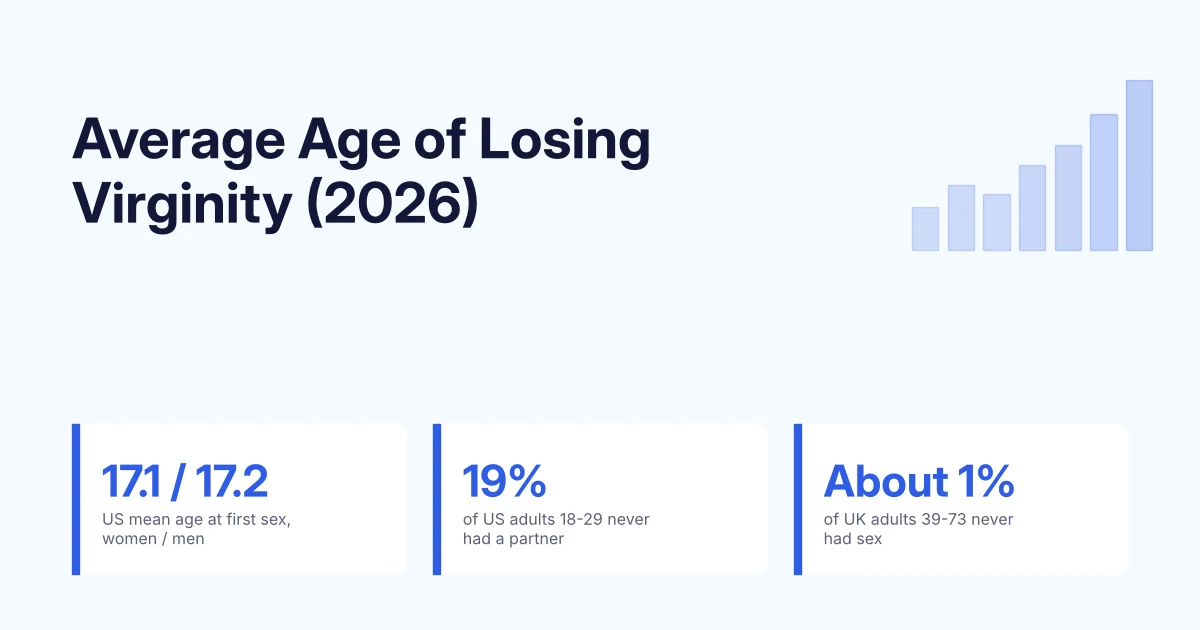
Americans lose their virginity at an average age of about 17. The mean age at first vaginal intercourse is 17.1 for women and 17.2 for men, according to the latest published CDC National Survey of Family Growth (NSFG) figures for 2017 to 2019.
Most adults have had sex by their early 20s, but not all. About 1% of UK adults aged 39 to 73 have never had sex, while 19% of US adults aged 18 to 29 say they have never had a sexual partner.
In this article, we’ll break down the average age of first sex in the US and other countries, how it has changed, how many adults are virgins, why some wait, and how adults look back on their first time.
Top Virginity Statistics
- The average American first has vaginal intercourse at 17.1 (women) or 17.2 (men), based on 2017–2019 NSFG data.
- By age 20, 76% of US women and 73% of US men have had sex (CDC estimates for people aged 15 to 24, 2015–2019).
- In Britain, the median age at first heterosexual intercourse is 17 for both men and women.
- France’s median age at first sex rose to 18.2 for women and 17.7 for men who turned 18 in 2019–2023, up from 17.3 in the mid-2000s.
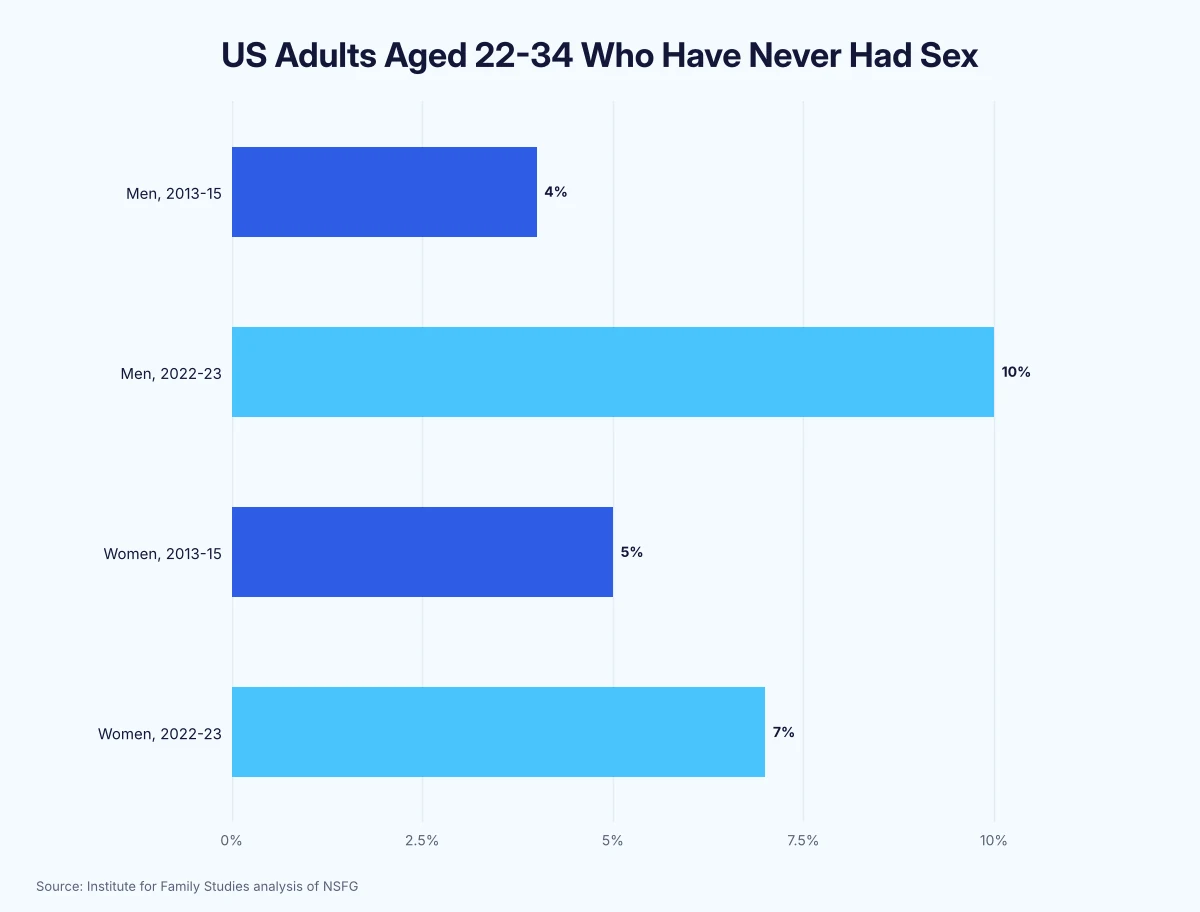
- 10% of US men aged 22 to 34 had never had sex in 2022 to 2023, up from 4% in 2013 to 2015.
- 9.5% of Japanese men aged 35 to 39 had no heterosexual experience in 2015, up from 5.5% in 1992.
- 29% of British women say they should have waited longer before their first time, compared with 16% of men.
What Is the Average Age to Lose Your Virginity?
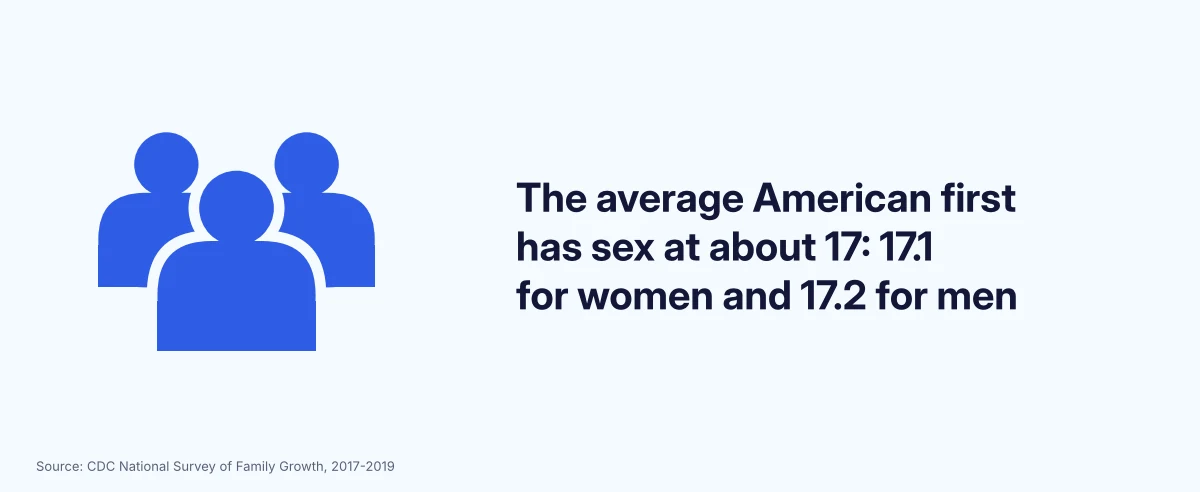
About 17 in the US. The mean age at first vaginal intercourse is 17.1 for women and 17.2 for men aged 15 to 49 who have had sex, according to the CDC (NSFG, 2017–2019).
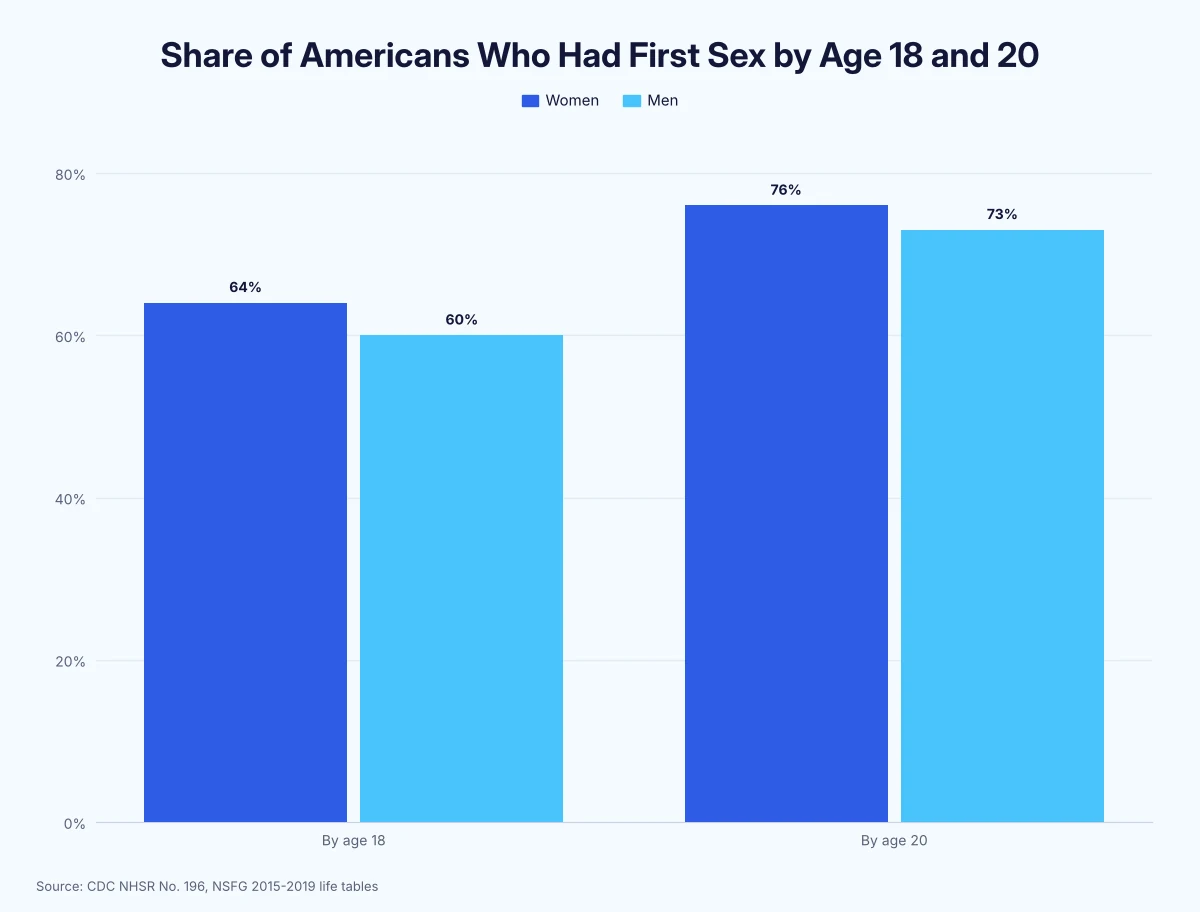
Most people have had sex by their late teens. 64% of US women and 60% of men aged 15 to 24 at interview had first sex by age 18, according to life-table estimates in the CDC’s National Health Statistics Report No. 196 (NSFG 2015–2019).
By 20, the shares reach 76% of women and 73% of men. That means about 1 in 4 (24% of women, 27% of men) had not had sex by 20 (our calculation). By 44, 99% of Americans reported having had sex in the 2002 NSFG, according to the Guttmacher Institute.
Older long-term studies use the median age, which is slightly higher. The median age at first sex is 17.8 for US women and 18.1 for men in the most recent birth cohorts, according to Guttmacher Institute researchers Finer and Philbin (2014).
Here’s a breakdown of the main US measures of age at first sex:
| Measure | Women | Men | Data |
|---|---|---|---|
| Mean age at first vaginal intercourse | 17.1 | 17.2 | NSFG 2017–2019 |
| Median age at first sex (recent cohorts) | 17.8 | 18.1 | NSFG 1982–2010 |
| Had sex by age 18 | 64% | 60% | NSFG 2015–2019 (ages 15–24) |
| Had sex by age 20 | 76% | 73% | NSFG 2015–2019 (ages 15–24) |
The CDC mean counts only people who have already had sex, and the survey includes teenagers. This likely pulls the average down. Finer and Philbin’s medians are life-table estimates by birth cohort, so the two measures aren’t directly comparable.
Has the Average Age of First Sex Changed?
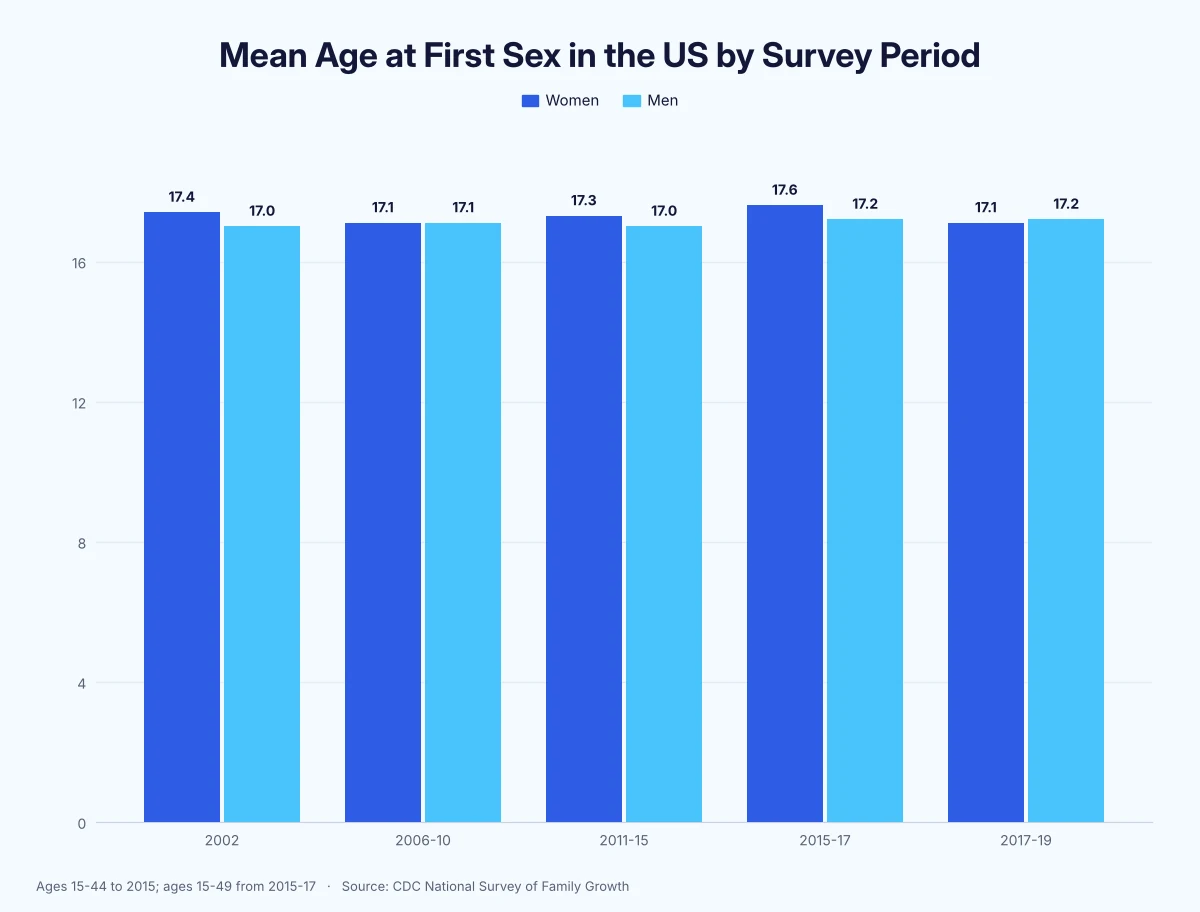
Not much in the US over the past two decades. The mean was 17.4 for women and 17.0 for men aged 15 to 44 in 2002, compared with 17.1 and 17.2 for those aged 15 to 49 in 2017 to 2019 (the age range and question changed, so the comparison is approximate), according to the CDC. That’s a shift of 0.3 years or less.
The long-run picture is about marriage, not first sex. Women who came of age in the mid-2000s had about the same median age at first sex as women 35 years earlier, according to Guttmacher. But the gap between first sex and first birth grew from 3 years for women born in 1940 to almost 10 years for women born in 1982.
Premarital sex has been the norm for decades. 95% of Americans had premarital sex by age 44, and 82% of women who turned 15 between 1954 and 1963 had done so by age 30, according to Finer (Public Health Reports, 2007).
Here’s a breakdown of first-sex trends in national surveys:
| Country | Measure | Earlier | Latest |
|---|---|---|---|
| US | Mean age, women | 17.4 (2002) | 17.1 (2017–2019) |
| US | Mean age, men | 17.0 (2002) | 17.2 (2017–2019) |
| Britain | Median age, women | 19 (aged 65–74) | 16 (aged 16–24) |
| Britain | Median age, men | 18 (aged 65–74) | 16 (aged 16–24) |
| France | Median age, women | 20.1 (early 1960s) | 18.2 (2023) |
| France | Median age, men | 18.8 (early 1960s) | 17.7 (2023) |
| Netherlands | Median age, young people | 17.0 (2012) | 18.7 (2023) |
The trend has started to reverse in parts of Europe. In France, the median age fell by 2.8 years for women between the early 1960s and the mid-2000s, when it hit 17.3 for both sexes, then rose again by 0.9 years for women and 0.4 years for men by 2023. In the Netherlands, it rose 1.7 years between 2012 and 2023 (our calculations).
Average Age of Losing Virginity by Country
In most high-income countries, first sex happens between about 17 and 18. Britain’s median is 17 for both sexes (Natsal-3, 2010–2012), France’s is 18.2 for women and 17.7 for men (2023), and the US mean is 17.1 for women and 17.2 for men.
Here’s a breakdown of the latest national survey figures:
| Country | Measure | Women | Men | Data |
|---|---|---|---|---|
| United States | Mean age at first vaginal intercourse | 17.1 | 17.2 | NSFG 2017–2019 |
| Britain | Median age at first heterosexual intercourse | 17 | 17 | Natsal-3, 2010–2012 |
| Britain | Median age (online poll) | 17 | 18 | YouGov, 2023 |
| France | Median age at first intercourse | 18.2 | 17.7 | CSF-2023 |
| Netherlands | Median age at first vaginal sex, ages 13–25 (sexes combined) | 18.7 (combined) | – | Rutgers, 2023 |
The Rutgers figure is for young people of both sexes combined. In Britain, 78% of adults say they had sex before 20, according to YouGov (2023). The next British national survey, Natsal-4, interviewed about 19,000 people aged 16 to 59 and is scheduled to publish first results at the end of November 2026, according to Natsal.
The most-cited country ranking comes from a company poll. The Durex Global Sex Survey 2005, a survey of 317,000 people in 41 countries, put the global average at 17.3, according to IntraMed. Iceland was youngest at 15.6 and India oldest at 19.8, a gap of 4.2 years.
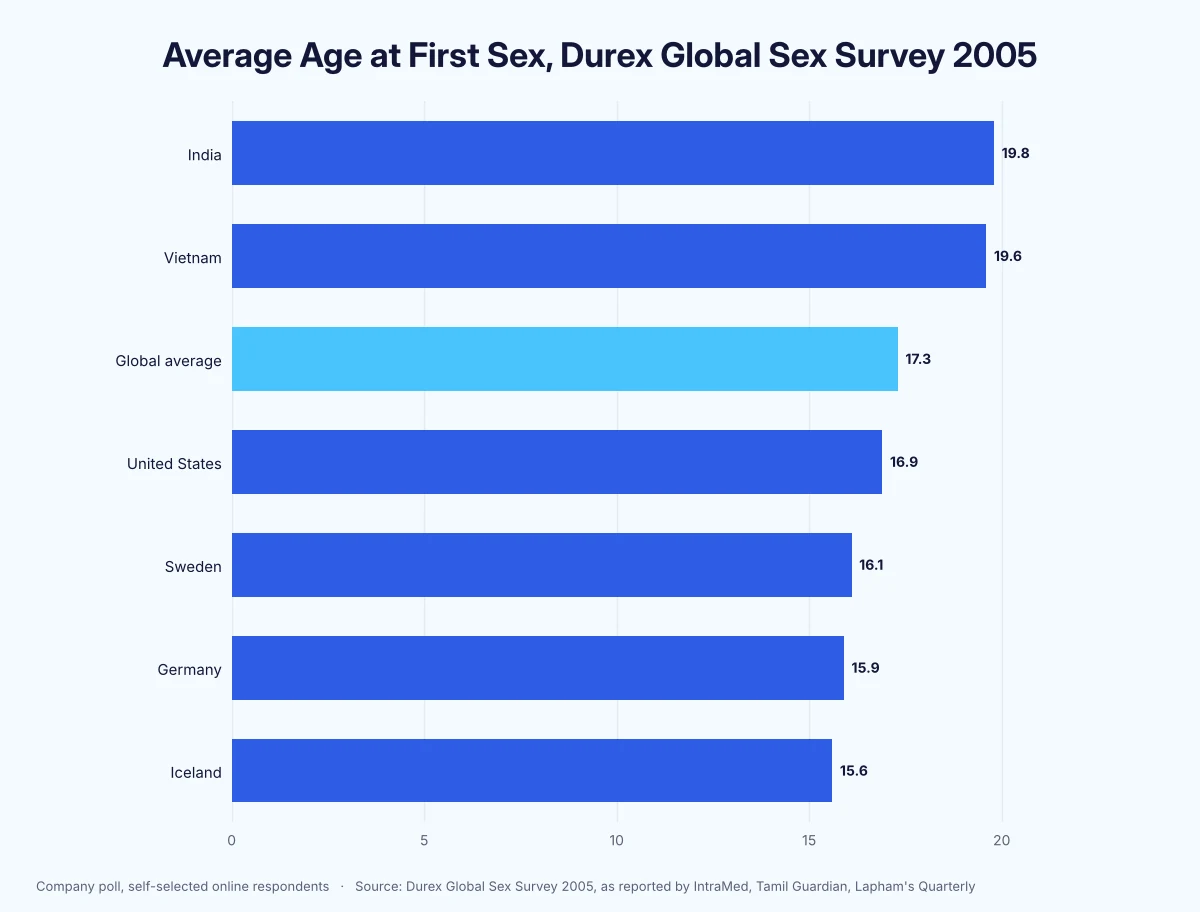
Here’s a breakdown of the Durex 2005 figures:
| Country | Average Age at First Sex |
|---|---|
| India | 19.8 |
| Vietnam | 19.6 |
| Global average (41 countries) | 17.3 |
| United States | 16.9 |
| Sweden | 16.1 |
| Germany | 15.9 |
| Iceland | 15.6 |
Company poll with self-selected online respondents. Sources: IntraMed, Tamil Guardian, Lapham’s Quarterly
Durex numbers shift between editions. Its 2012 company poll put the US at 18.4, Malaysia oldest at 23.7 and Brazil youngest at 17.3, as compiled by World Population Review. Across the 2005 to 2009 surveys, Finland, Norway, Sweden and Denmark averaged 16.5 or less, while Malaysia, India, Singapore and China averaged 22 or more, according to Te Ara, New Zealand’s government encyclopedia.
Household surveys in lower-income countries show a wider spread. Median age at first sex among women ranges from 22.5 in Myanmar to 15.9 in Mozambique, a 6.6-year gap, among women aged 25 to 49 in Demographic and Health Surveys (DHS) from 2015 to 2024, as compiled by World Population Review.
Here’s a breakdown of median age at first sex among women in selected DHS countries:
| Country | Median Age at First Sex (Women) | Survey Year |
|---|---|---|
| Myanmar | 22.5 | 2015–16 |
| Cambodia | 21.4 | 2021–22 |
| Philippines | 20.7 | 2022 |
| India | 18.9 | 2019–21 |
| Kenya | 17.9 | 2022 |
| Nigeria | 17.7 | 2024 |
| Bangladesh | 16.6 | 2022 |
| Mozambique | 15.9 | 2022–23 |
How Many Adults Are Virgins?
Very few by middle age. About 1% of more than 400,000 UK adults aged 39 to 73 have never had sex, according to a 2025 study in PNAS by Abdellaoui and colleagues, reported by Karolinska Institutet.
The share is higher among younger adults. 10% of US men and 7% of US women aged 22 to 34 had never had sex in 2022 to 2023, according to an Institute for Family Studies (IFS) analysis of NSFG data.
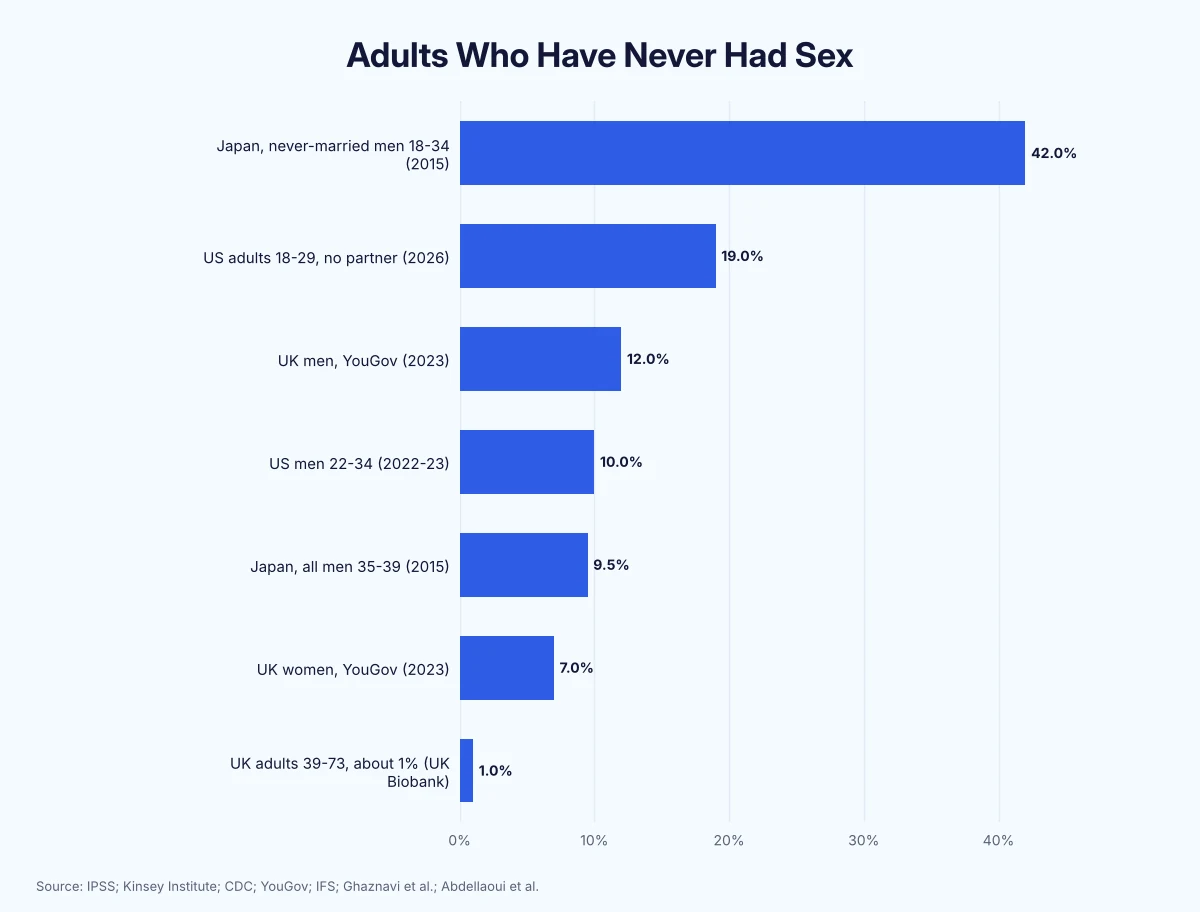
Here’s a breakdown of how many adults have never had sex:
| Group | Never Had Sex | Data |
|---|---|---|
| US adults 18–29 (never had a partner) | 19% | Kinsey Institute, 2026 |
| US men 22–34 | 10% | NSFG 2022–2023 |
| US women 22–34 | 7% | NSFG 2022–2023 |
| Add Health cohort, ages 24–34 (via Sex and Psychology) | 3% | 2008 |
| UK adults who answered (YouGov) | 9% | 2023 |
| UK adults 39–73 (UK Biobank) | About 1% | PNAS, 2025 |
| Japan, never-married men 18–34 | 42.0% | 2015 |
| Japan, never-married women 18–34 | 44.2% | 2015 |
| Japan, all men 35–39 | 9.5% | 2015 |
| Japan, all women 35–39 | 8.9% | 2015 |
Men are more likely than women to be virgins in the UK. 12% of British men and 7% of women who answered a 2023 YouGov poll said they were still virgins, about 1 in 11 overall.
Japan stands out. 42.0% of never-married men and 44.2% of never-married women aged 18 to 34 had no heterosexual experience in 2015, according to Japan’s National Institute of Population and Social Security Research (IPSS). In its 2025 survey, 42.1% of never-married women aged 25 to 29 and 39.7% of those aged 30 to 34 had no sexual experience, according to Nippon.com.
Counting married people too, the Japanese share is lower but rising. 9.5% of men and 8.9% of women aged 35 to 39 had no heterosexual experience in 2015, up from 5.5% and 4.0% in 1992, about 1.7 and 2.2 times as many, according to Ghaznavi et al. (BMC Public Health, 2019).
Are More Young Adults Staying Virgins?
Yes, especially young men. The share of US men aged 22 to 34 who had never had sex rose from 4% in 2013 to 2015 to 10% in 2022 to 2023, 2.5 times as high, while women rose from 5% to 7%, according to IFS.
Earlier cohort data point the same way. 15% of 1990s-born millennials had no sexual partners since age 18 when they were 20 to 24, compared with 6% of Gen Xers born in the 1960s at the same age, according to Twenge, Sherman and Wells.
Here’s a breakdown of virginity among US young adults over time:
| Measure | Earlier | Latest | Source |
|---|---|---|---|
| Men 22–34, never had sex | 4% (2013–2015) | 10% (2022–2023) | IFS (NSFG) |
| Women 22–34, never had sex | 5% (2013–2015) | 7% (2022–2023) | IFS (NSFG) |
| Men 18–29, never had sex | Around 15% (2017–2019) | 19.5% (2022–2023) | Nuance Pill (independent analysis, NSFG face-to-face) |
| No partners since 18, at ages 20–24 | 6% (born 1960s) | 15% (born 1990s) | Twenge et al. (GSS) |
The Nuance Pill figures are an independent analysis of NSFG face-to-face interviews; it found 18.4% of women aged 18 to 29 had never had sex in 2022 to 2023. That 18.4% is one sign of the wider Gen Z sex recession, in which more young adults go a full year without sex.
Why Do Some Adults Wait?
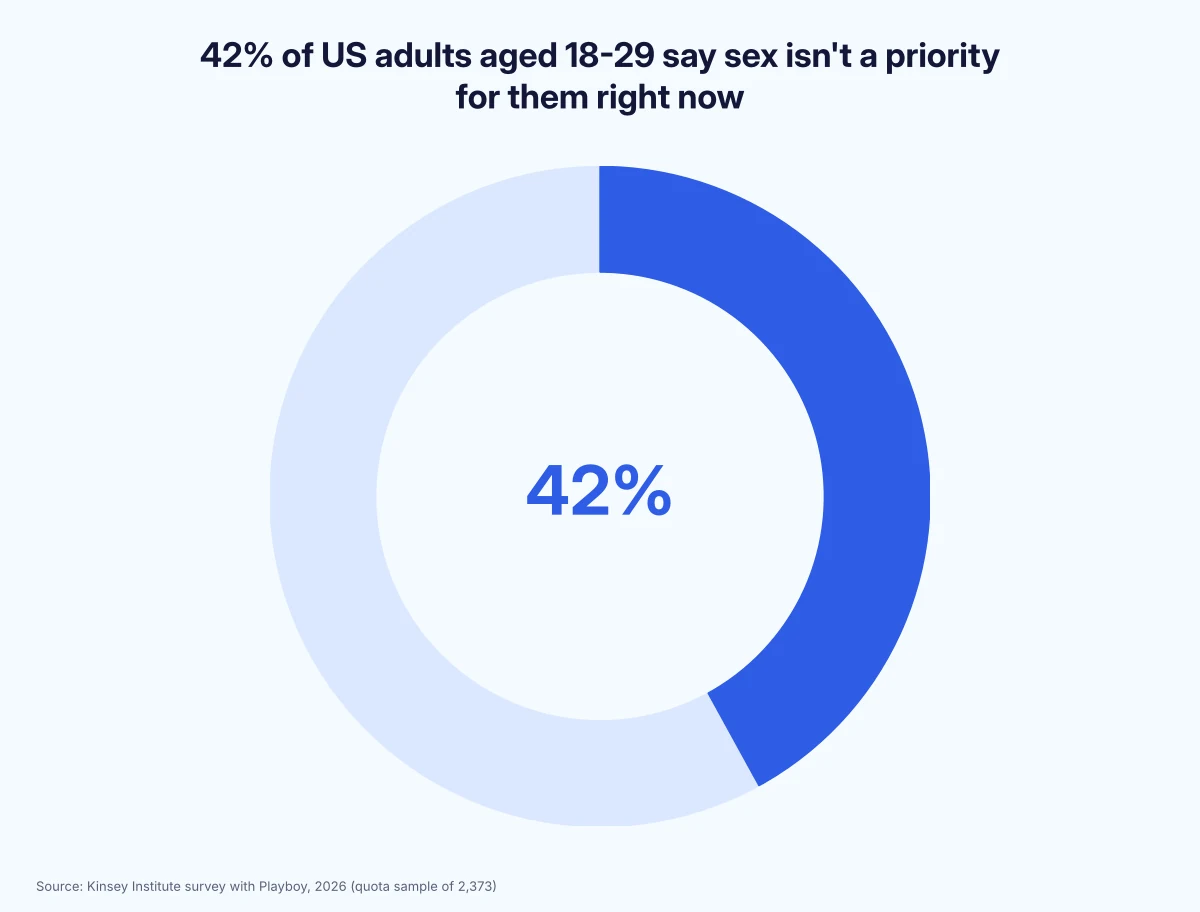
There’s no single reason. 42% of US adults aged 18 to 29 say sex isn’t a priority for them right now, according to a 2026 Kinsey Institute survey with Playboy reported by Fast Company.
Attraction plays a part. Among 2,857 Add Health participants who had no sex by 18, more than 1 in 8 remained sexually inexperienced in young adulthood, and low sexual attraction to others predicted staying inexperienced, according to Haydon et al. (Archives of Sexual Behavior, 2014).
Adults who have never had sex differ in other ways. In the PNAS study, they were more highly educated, drank and smoked less, and reported more loneliness and lower happiness, according to Karolinska Institutet. Common genetic variants explained about 17% of the variation among men and 14% among women, according to Psychiatrist.com.
Stigma can make waiting harder. In 3 Kinsey Institute studies of 5,847 adults, singles were generally unlikely to consider a virgin as a relationship partner, and virgins said they felt stigmatized, according to PsyPost.
How Do Adults Look Back on Their First Time?
Most say the timing was about right. 76% of British men and 67% of women aged 16 to 74 say their first heterosexual intercourse happened at about the right time, according to the Natsal-3 reference tables.
Women are more likely to wish they had waited. 29% of women say they should have waited longer, compared with 16% of men, about 1.8 times as many. Among women aged 25 to 34, it’s 32%, vs 19% of women aged 65 to 74.
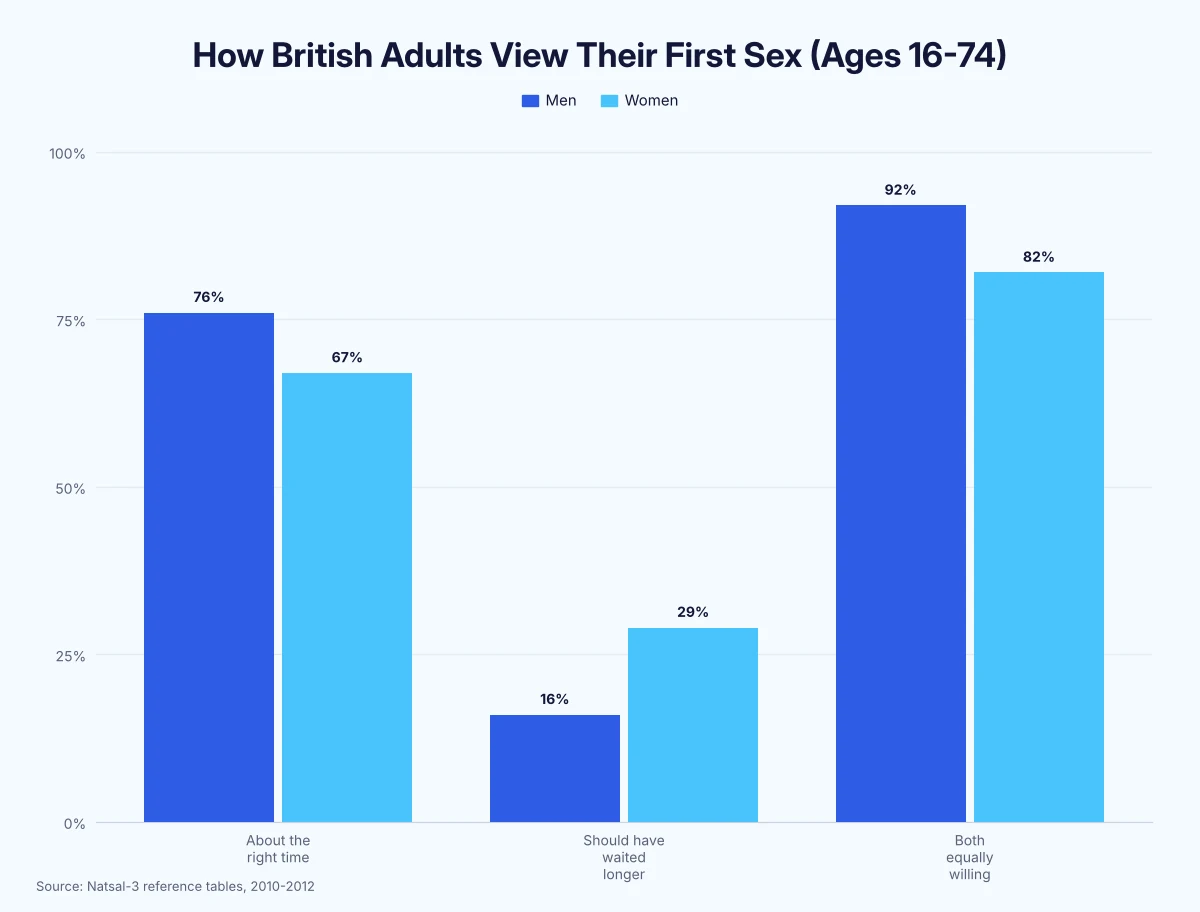
Here’s a breakdown of how British adults describe their first heterosexual intercourse:
| Measure (Ages 16–74) | Men | Women |
|---|---|---|
| Happened at about the right time | 76% | 67% |
| Should have waited longer | 16% | 29% |
| Both partners equally willing | 92% | 82% |
| “Sexually competent” at first sex | 46% | 47% |
Natsal-3, 2010–2012. Excludes forced first sex for timing and sexual competence. Source: Natsal-3 reference tables
“Sexually competent” is a composite Natsal measure of the circumstances of first sex. Fewer than half of men (46%) and women (47%) met it.
Does the Age You Lose Your Virginity Matter?
It’s linked to some adult relationship outcomes, but the evidence is correlational. In a study of 1,659 same-sex sibling pairs followed to about age 29, people who first had sex when older than 19 were less likely to be married and had fewer romantic partners, but those in relationships reported less dissatisfaction, according to Harden (Psychological Science, 2012).
Later starters also had higher education and household income, though the link held after accounting for these. The study is observational, so it doesn’t show that waiting causes better relationships.
Few people now wait until marriage. Only 5% of US women who married in the early 2010s were virgins at marriage, according to IFS. Among women married in the 2000s, those with no premarital partners had a 6% five-year divorce rate, vs 33% for those with 10 or more partners. Women with 10 or more partners sit well above the average number of sexual partners for US women.
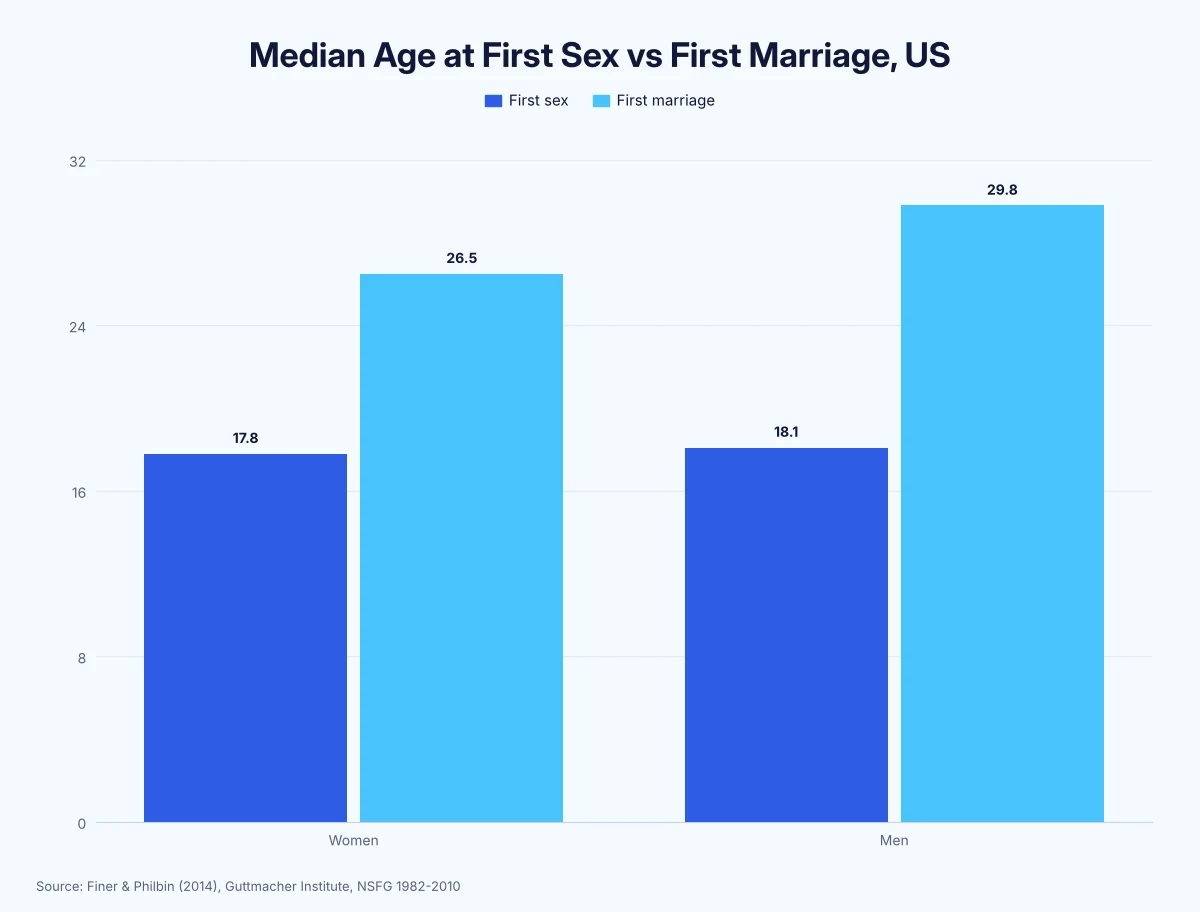
The gap between first sex and marriage is wide. In the Finer and Philbin data, about 8.7 years separate median first sex and first marriage for women, and 11.7 years for men (our calculation based on Guttmacher data). Median age at first marriage has since reached 30.8 for men and 28.4 for women (2025), according to the US Census Bureau.
New relationships run on a much shorter clock, with how many dates people wait before sex usually counted in single figures.
Methodology
We reviewed 147 data points from 30 sources. We used national probability surveys: the CDC’s National Survey of Family Growth (NSFG), Britain’s Natsal-3 (15,162 people aged 16 to 74, 2010–2012), France’s CSF-2023, the Dutch Rutgers youth survey, Japan’s National Fertility Survey and Demographic and Health Surveys. We also used peer-reviewed studies (Finer 2007, Finer and Philbin 2014, Haydon et al. 2014, Harden 2012, Ghaznavi et al. 2019, Abdellaoui et al. 2025) and analyses of NSFG data by the Institute for Family Studies and Nuance Pill.
The CDC reports a mean age among people who have had vaginal intercourse; most other surveys report a median, which is usually slightly higher. The Durex Global Sex Survey is a company poll of self-selected online respondents. YouGov is an online panel poll. The 2026 Kinsey Institute survey used a quota sample and was run with Playboy. DHS figures cover women only and are drawn from World Population Review’s compilation. Gaps, ratios and the share without sex by 20 are our own calculations.
Key Takeaways
The average American first has sex at about 17, with a mean of 17.1 for women and 17.2 for men, and 76% of women and 73% of men have had sex by 20. Britain’s median is 17, while France’s has risen to 18.2 for women and 17.7 for men.
Lifelong virginity is rare: about 1% of UK adults aged 39 to 73 have never had sex. But more young adults are starting later, with 10% of US men aged 22 to 34 never having had sex in 2022 to 2023, up from 4% in 2013 to 2015.
FAQ
What is the average age to lose your virginity?
In the US, the mean age at first vaginal intercourse is 17.1 for women and 17.2 for men (NSFG, 2017–2019). In Britain, the median is 17 for both sexes. The Durex Global Sex Survey 2005, a company poll, put the global average at 17.3.
How many adults are virgins?
About 1% of UK adults aged 39 to 73 have never had sex. In the US, 10% of men and 7% of women aged 22 to 34 had never had sex in 2022 to 2023, and 19% of adults aged 18 to 29 say they have never had a sexual partner.
Is it normal to lose your virginity after 20?
Yes. About 24% of US women and 27% of US men haven’t had sex by 20, and 81% of Americans who waited until at least 20 went on to have premarital sex by 44.
Which country has the youngest and oldest average age of first sex?
In the Durex 2005 company poll, Iceland was youngest at 15.6 and India oldest at 19.8. In DHS household surveys of women, medians compiled by World Population Review range from 15.9 in Mozambique (tied with Niger and the Central African Republic) to 22.5 in Myanmar.
Are people losing their virginity later than before?
In parts of Europe, yes. France’s median age rose from 17.3 in the mid-2000s to 18.2 for women and 17.7 for men in 2023, and the Dutch median rose from 17.0 in 2012 to 18.7 in 2023. The US mean has stayed around 17 since 2002.
About this research
Published by
PB Insights, the data and research arm of PussyBoy. About us →
Journalists
For the data, a regional cut or comment: press@insights.pussyboy.net
Reuse
Licensed CC BY 4.0. Cite "PB Insights" and link to this report.
"According to adult-industry data analysts at PB Insights…"