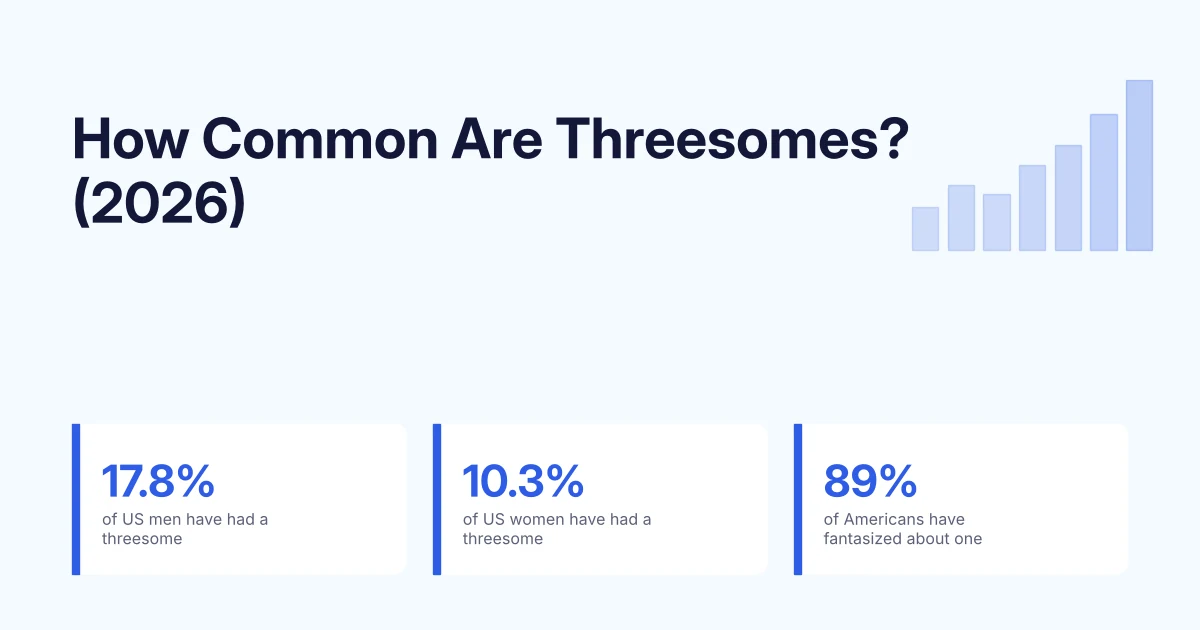
Threesomes are less common than people assume: 17.8% of US men and 10.3% of US women have ever had one, according to a nationally representative survey of 2,021 adults by Herbenick et al. (2017).
Far more people think about them. 89% of 4,175 Americans in sex researcher Justin Lehmiller’s survey said they had fantasized about a threesome.
In this article, we’ll break down how common threesomes are by gender, sexual orientation, age and country, the gap between fantasy and experience, MMF vs FFM threesomes, how people feel afterwards, and what the data says about relationships and STI risk.
Top Threesome Statistics
- 17.8% of US men and 10.3% of US women have ever had a threesome, making men about 1.7 times as likely to report one.
- Fewer than 3% of US adults had a threesome or group sex in the past year.
- 89% of Americans in a survey of 4,175 adults have fantasized about a threesome.
- In non-representative online and college samples, 43% of sexual minority adults reported a mixed-gender threesome, about twice the rate of heterosexual adults (21%).
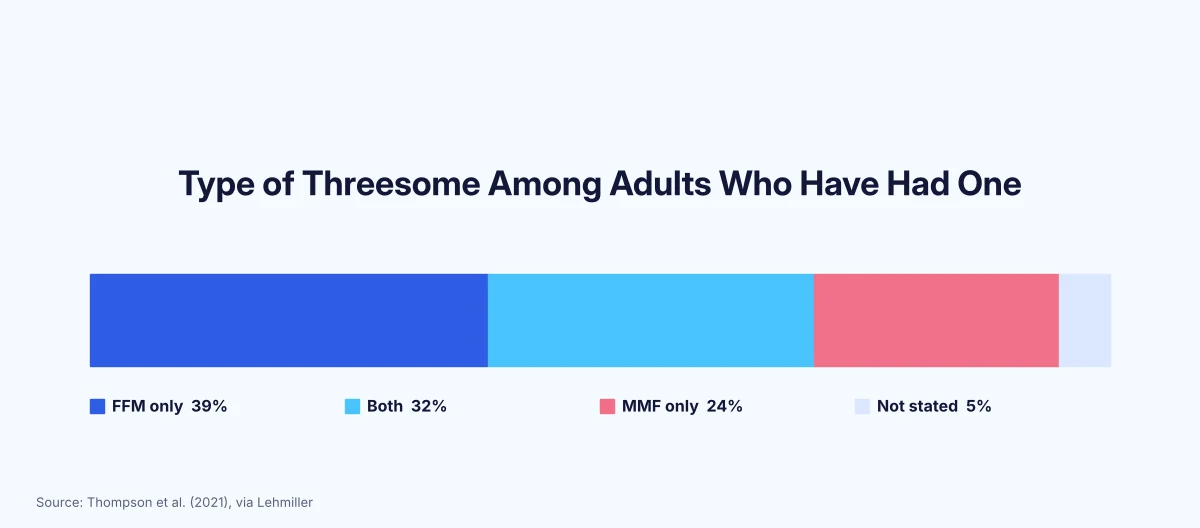
- Among adults who have had a mixed-gender threesome, 39% have only had FFM threesomes (two women, one man), compared with 24% only MMF (two men, one woman).
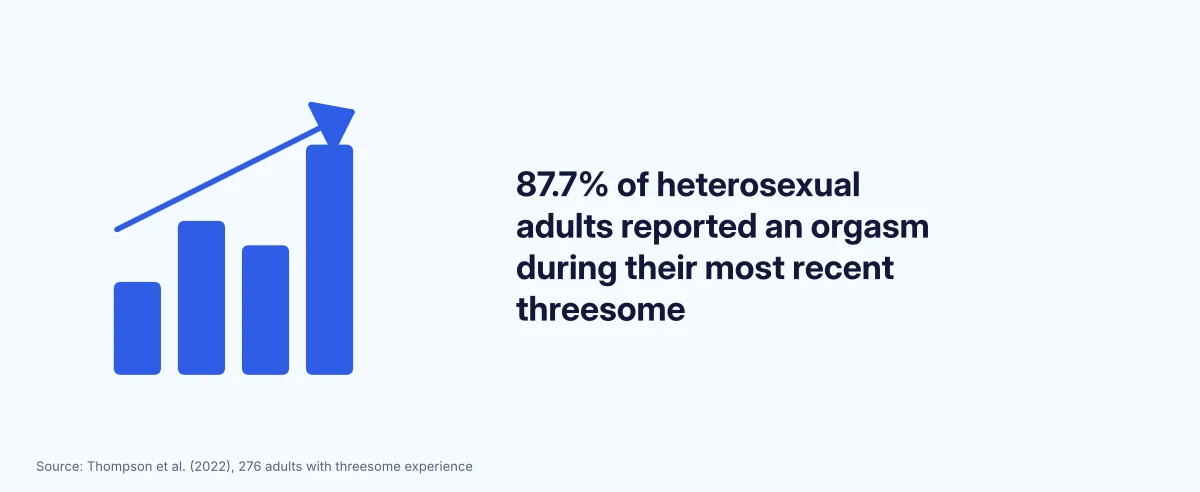
- 87.7% of 276 heterosexual adults with threesome experience reported an orgasm during their most recent threesome.
- The share of Italian men who have had sex with three or more people rose from 3.2% in 2000 to 20.1% in 2025, though methods may differ.
How Common Are Threesomes?
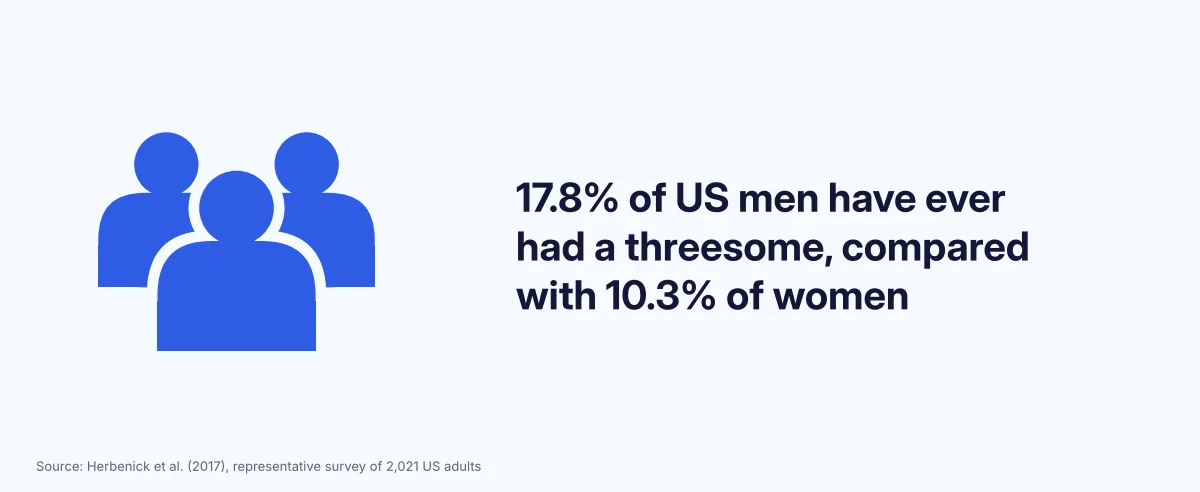
About 1 in 7 American adults (13.9%) has had a threesome, according to Forbes’ summary of the 2015 Sexual Exploration in America Study. By gender, 17.8% of men and 10.3% of women said they had ever had one, according to Herbenick et al. (2017).
It’s rarely a regular habit. Fewer than 3% of men and women had a threesome or group sex in the past year, and fewer than 1% in the past month.
An older poll found a similar share. In a 2004 random-sample telephone poll of 1,501 adults by ABC News, 14% of Americans said they had been in a threesome.
Here’s a breakdown of threesome and group sex experience among US adults:
| Measure | Men | Women | All Adults |
|---|---|---|---|
| Ever had a threesome (2015) | 17.8% | 10.3% | 13.9% |
| Ever had group sex (2015) | 11.5% | 6.3% | Not reported |
| Threesome or group sex in the past year (2015) | Under 3% | Under 3% | Not reported |
| Threesome or group sex in the past month (2015) | Under 1% | Under 1% | Not reported |
| Ever had a threesome (2004) | Not reported | Not reported | 14% |
The Herbenick survey asked about threesomes and group sex as separate items.
What Percentage of Women Have Had a Threesome?
10.3% of US women have had a threesome, compared with 17.8% of men, in the nationally representative Herbenick data. That makes men about 1.7 times as likely to report one. Studies consistently find a gender gap, but its size depends heavily on who is asked.
Among 274 heterosexual Canadian university students aged 18 to 24, 24% of men and 8% of women had experienced a threesome, according to Thompson & Byers (2017). That’s a 3-to-1 gap.
The gap almost disappears in a broader, older sample. In two samples totalling more than 1,500 people, 32% of men and 29% of women had experienced a mixed-gender threesome, according to Thompson et al., as summarized by Justin Lehmiller (2020).
Here’s a breakdown of threesome experience by gender across studies:
| Study | Sample | Men | Women |
|---|---|---|---|
| Herbenick et al. (2017) | 2,021 US adults, nationally representative | 17.8% | 10.3% |
| Thompson et al. (2021) | 1,342 online adults + a US college sample | 32% | 29% |
| Thompson & Byers (2017) | 274 heterosexual Canadian students | 24% | 8% |
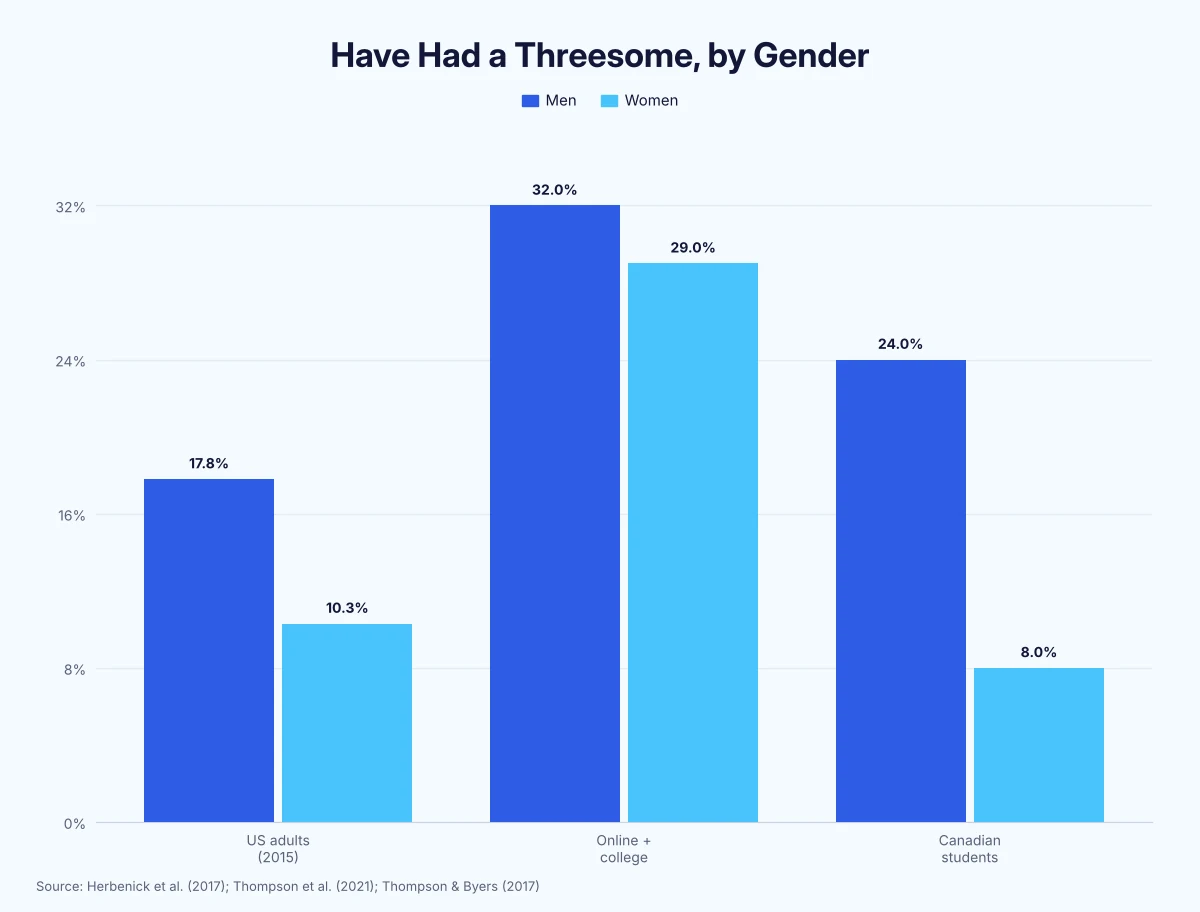
Neither Thompson sample is representative. Student samples run lower, likely in part because students have had fewer years of sexual experience: only 10% of the Thompson et al. student sample had experienced a threesome, compared with 34% of the online sample.
Threesomes by Sexual Orientation and Age
43% of sexual minority adults had experienced a mixed-gender threesome, compared with 21% of heterosexual adults, in the Thompson et al. samples. That makes sexual minority participants about twice as likely to have had one. Bisexual people were the largest sexual minority group in both samples.
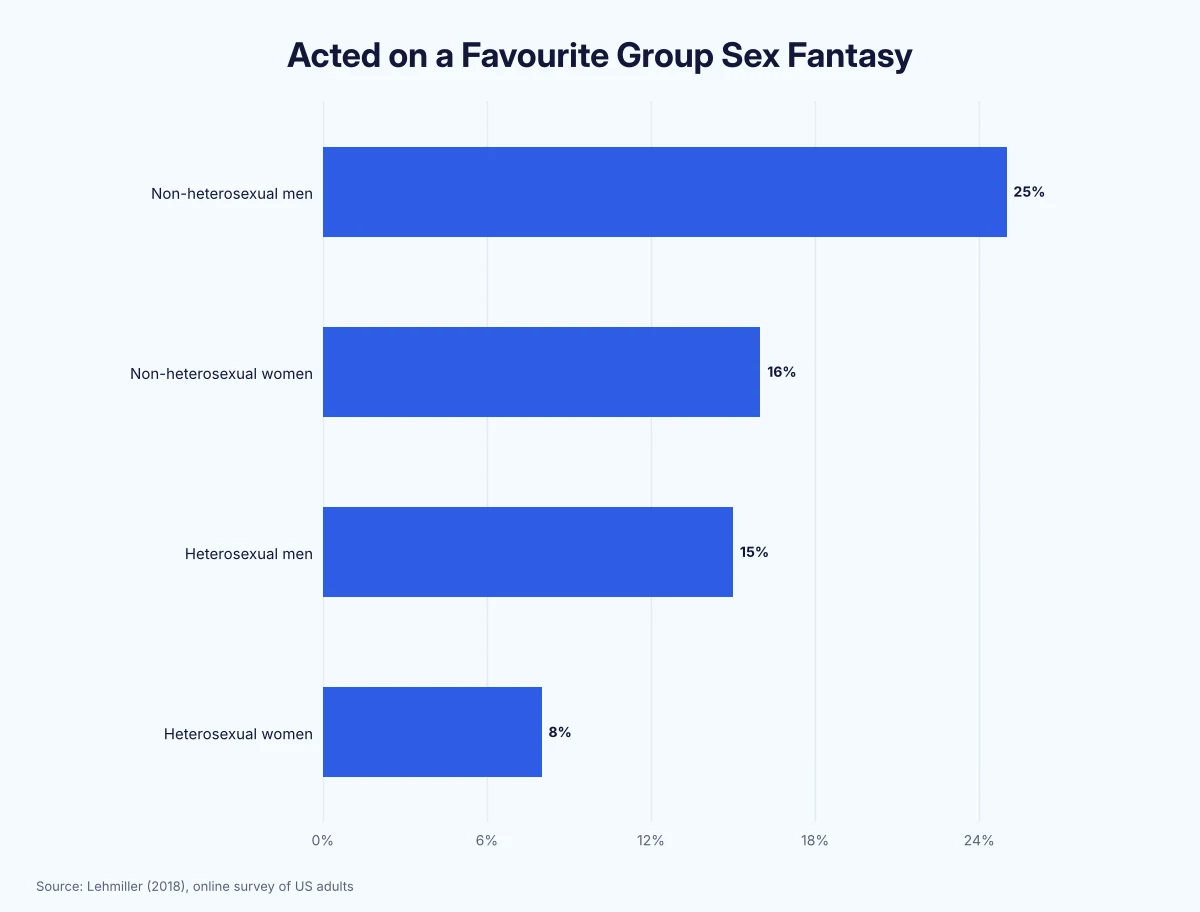
The same pattern shows up among people whose favourite fantasy is group sex. Among respondents whose favourite fantasy involved group sex, 25% of non-heterosexual men had acted on it, compared with 8% of heterosexual women, according to Lehmiller (2018).
Here’s a breakdown of threesome and group sex experience by sexual orientation:
| Group | Measure | Share |
|---|---|---|
| Sexual minority adults | Ever had a mixed-gender threesome | 43% |
| Heterosexual adults | Ever had a mixed-gender threesome | 21% |
| Non-heterosexual men | Acted on a favourite group sex fantasy | 25% |
| Non-heterosexual women | Acted on a favourite group sex fantasy | 16% |
| Heterosexual men | Acted on a favourite group sex fantasy | 15% |
| Heterosexual women | Acted on a favourite group sex fantasy | 8% |
Age matters too. US women aged 25 to 29 had the same lifetime threesome rate as men, 18%, according to Forbes. Older men still report them: men continued to report threesomes and group sex at 2% to 3% per year into their 70s.
Threesomes Around the World
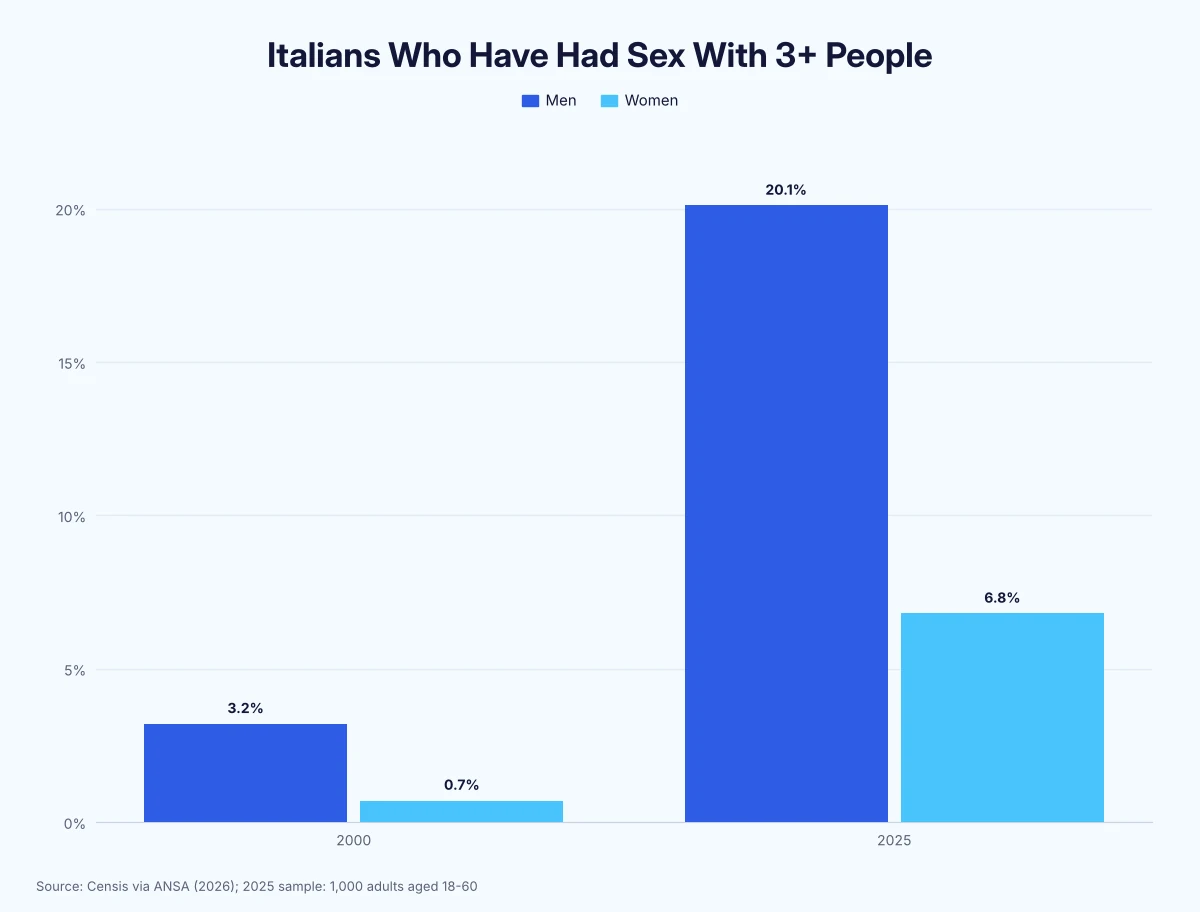
Italy has the newest data. 20.1% of Italian men and 6.8% of women aged 18 to 60 have had sex with three or more people, according to a 2025 Censis survey of 1,000 people reported by ANSA (2026).
That’s a big jump. In 2000, the figures were 3.2% of men and 0.7% of women, so the share rose more than 6 times among men and almost 10 times among women in 25 years, although the report doesn’t say whether both years used the same method.
Here’s a breakdown of threesome experience by country:
| Country | Year | Sample | Men | Women |
|---|---|---|---|---|
| Italy | 2025 | 1,000 adults aged 18–60 | 20.1% | 6.8% |
| Italy | 2000 | Not stated | 3.2% | 0.7% |
| United States | 2015 | 2,021 adults, representative | 17.8% | 10.3% |
| United Kingdom | 1987 | Newspaper readers, self-selected | 34% | 15% |
In France, 15% of adults had tried a threesome in a 2014 Ifop survey of 10,000 people for Marianne magazine, according to Économie Matin. No gender split was reported.
The 1987 British figures (34% of 1,862 men and 15% of 2,905 women) come from readers who chose to answer a newspaper sex survey, so they likely overstate the true rate. The same Censis survey found Italian women with six or more lifetime partners rose from 8.4% in 2000 to 21.8% in 2025; our breakdown of the average number of sexual partners shows how partner counts compare by country and generation.
Do Women Like Threesomes? Fantasy vs Reality
Many women fantasize about group sex, but far fewer want a threesome in real life. 87% of women and 95% of men in Lehmiller’s survey had fantasized about group sex at least once, according to Coral’s summary of his book Tell Me What You Want. Threesomes specifically were a fantasy for 89% of respondents, and only 13% of women had never fantasized about group sex, according to MEL Magazine.
Appeal is much lower. 34.1% of US men and 11.1% of US women found a threesome very or somewhat appealing, according to Herbenick et al. (2017). About 90% of women found threesomes and group sex unappealing, according to Forbes.
Here’s how fantasy, interest and experience compare by gender:
| Measure | Men | Women | Source |
|---|---|---|---|
| Ever fantasized about group sex | 95% | 87% | Lehmiller (online, 4,175 US adults) |
| Any interest in a threesome (2+ on a 1–7 scale) | 82% | 31% | Thompson & Byers (Canadian students) |
| Would engage in a threesome | 78% | 32% | Hughes et al. 2004 (college students) |
| Find a threesome at least somewhat appealing | 34.1% | 11.1% | Herbenick et al. (representative) |
| Have had a threesome | 17.8% | 10.3% | Herbenick et al. (representative) |
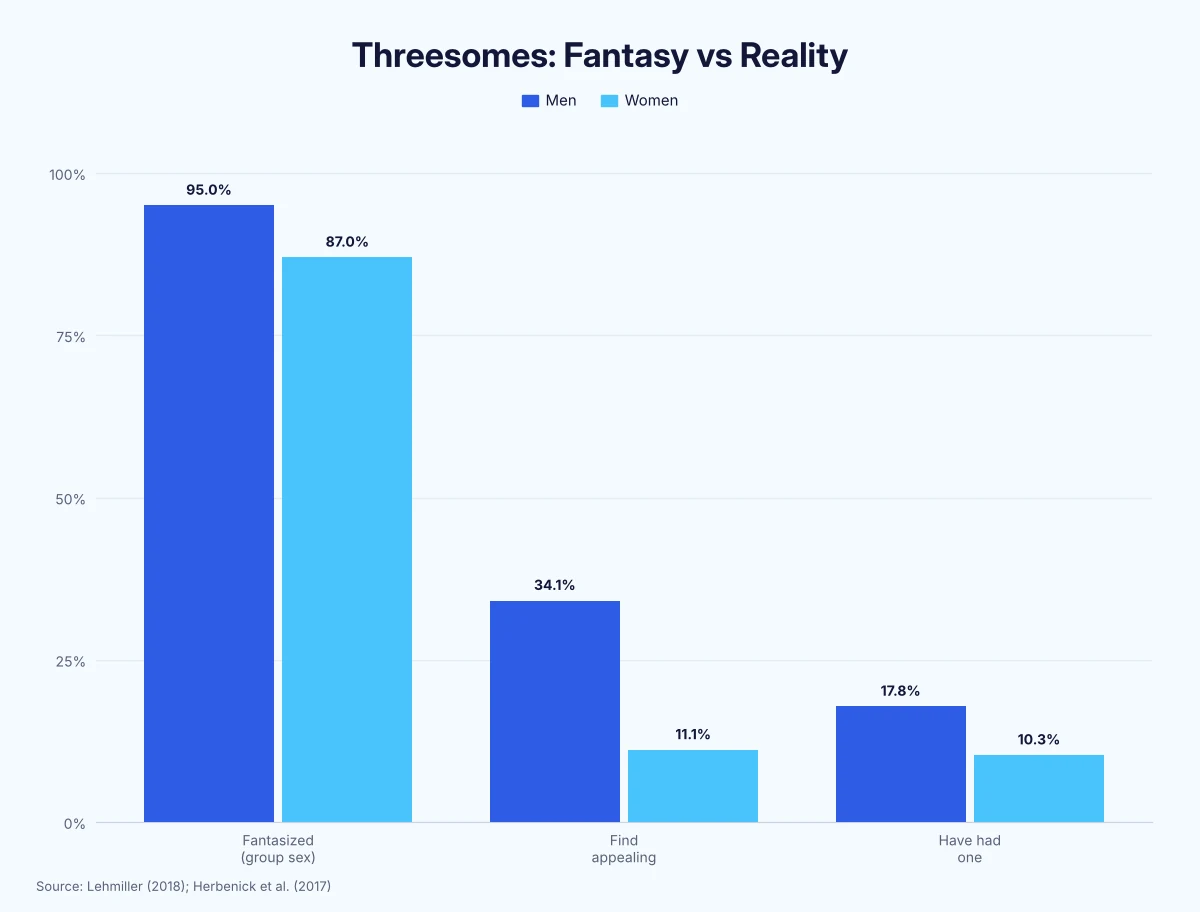
The fantasy-to-reality gap is wide for both genders. Comparing these two different surveys, the share of men who have fantasized about group sex is about 5.3 times the share who have had a threesome, and for women about 8.4 times.
Threesomes come first in our list of the most common fetishes and kinks, ahead of watching others and being dominated. Sharing a fantasy isn’t the same as acting on it either: 52% of heterosexual women whose favourite fantasy involved group sex had told a partner in Lehmiller’s survey, compared with 63% to 66% of men.
Interest also moves with circumstances. In a 2021 survey of 2,000 Americans by the Kinsey Institute with sex toy retailer Lovehoney, 23% said they were more interested in threesomes than before the pandemic, including 33% of men and 13% of women, according to Lehmiller. In a 2025 poll of 3,673 users of the threesome dating app 3Fun, 69% said they had become more interested in threesomes and throuples in recent years, according to Global Dating Insights.
MMF vs FFM: Which Type of Threesome Is More Common?
Threesomes with two women and one man (FFM) are more common. Among adults who had experienced a mixed-gender threesome, 39% had only FFM experience and 24% only MMF (two men, one woman), while 32% had done both, according to the Thompson et al. data summarized by Lehmiller.
The difference comes mostly from men. 18% of male Canadian students had experienced an FFM threesome and 8% an MMF one, while women reported 5% and 8%, according to Psychology Today’s summary of Thompson & Byers.
Here’s a breakdown of threesome types by gender:
| Group | FFM (two women, one man) | MMF (two men, one woman) |
|---|---|---|
| Male students (Canada) | 18% | 8% |
| Female students (Canada) | 5% | 8% |
| Adults with threesome experience (FFM only / MMF only) | 39% | 24% |
Fantasies show a similar gender gap. 84.5% of men in a Quebec study of 1,516 adults had fantasized about sex with two women, compared with 56.5% of women who had fantasized about sex with two men, according to Joyal, Cossette & Lapierre (2015).
Women’s stated preferences lean toward MMF, though. Among female college students in a 2004 study by Hughes et al., 53% of those who would have a threesome preferred two men, 27% a man and a woman, and 4% two women, according to Scoats (2019). In Scoats’ interviews with 16 women who had experienced a threesome, only 3 had experienced an MMF one, but 9 were open to it.
How Do People Feel After a Threesome?
Mostly positive. Heterosexual adults rated their most recent threesome 3.74 on a 5-point scale, slightly above their expectations, and 87.7% reported an orgasm, according to a study of 276 adults by Thompson et al., reported by PsyPost (2022).
Outcomes were not equal. Men reported more positive outcomes than women, especially in threesomes with two people of the other sex, and threesomes that included a romantic partner went better than those with casual partners, according to the study’s abstract. The sample was 217 men and 59 women.
Most people only do it once. For 83% of undergraduates who had experienced a threesome, it happened only once, according to Psychology Today, describing a study of 196 students.
Here’s a breakdown of threesome outcomes:
| Outcome | Share | Sample |
|---|---|---|
| Reached orgasm in most recent threesome | 87.7% | 276 heterosexual adults (2022) |
| Rating vs expectations (1–5 scale) | 3.74 | 276 heterosexual adults (2022) |
| Threesome happened only once | 83% | Undergraduates with experience |
Do Threesomes Affect Relationships?
Usually not much. In a study of 196 undergraduates by Morris and colleagues, the outcome for the couple was “primarily no effect,” with about a fifth reporting negative outcomes and a similar share positive ones, according to Psychology Today.
Men are more likely to raise the idea. Men were more likely than women to suggest a threesome, and both preferred people they knew over strangers, according to Psychology Today’s summary of Thompson & Byers. Women preferred not to involve their romantic partner.
In the Morris study, the third person was most often a friend or acquaintance of the woman, according to Psychology Today.
As for how many couples have threesomes, no representative survey measures it. Among 276 heterosexual adults with threesome experience in the 2022 Thompson study, 29.6% were married, 23.6% single, 18.1% in open or polyamorous relationships and 14.9% in monogamous relationships, according to PsyPost.
Threesomes, Open Relationships and STI Risk
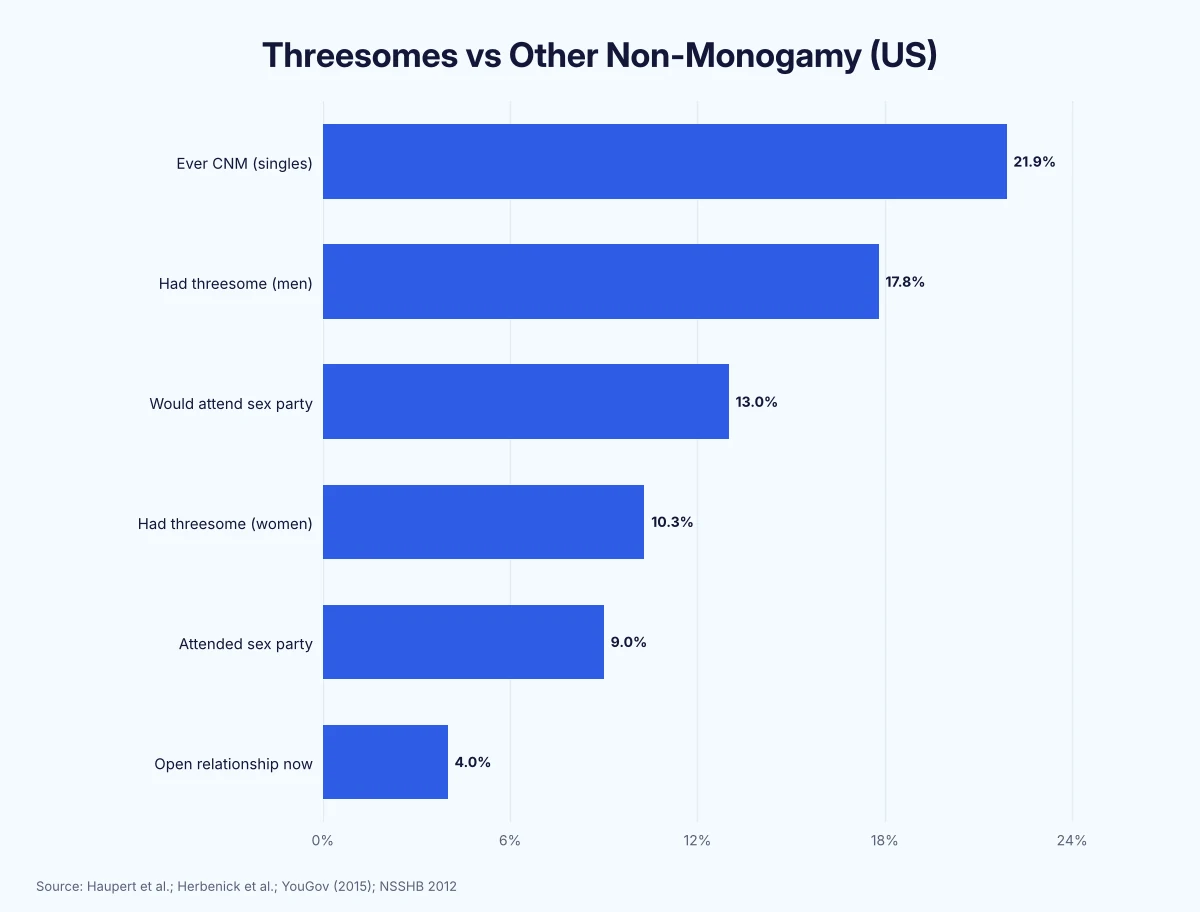
Threesomes overlap with consensual non-monogamy, but they aren’t the same thing. More than 1 in 5 single Americans (21.9% and 21.2% in two national samples) have been in a consensually non-monogamous relationship, according to Haupert et al., as summarized by Justin Lehmiller. Data on how common open relationships and polyamory are shows only 4% of partnered US adults were in an open relationship in 2012.
Group sex settings are less common still. 9% of US adults have attended a party where people have sex with multiple partners and 13% would, according to a 2015 YouGov online poll of 1,000 adults (asked of the 91% willing to answer sex questions).
Here’s how threesomes compare with other forms of non-monogamy:
| Measure | Population | Share |
|---|---|---|
| Ever in a consensually non-monogamous relationship | US singles (sample 1) | 21.9% |
| Ever had a threesome | US men, 2015 | 17.8% |
| Would attend a multi-partner sex party | US adults, 2015 | 13% |
| Ever had a threesome | US women, 2015 | 10.3% |
| Ever attended a multi-partner sex party | US adults, 2015 | 9% |
| Currently in an open relationship | Partnered US adults, 2012 | 4% |
Consensual arrangements are distinct from infidelity. In the same 2012 survey, 8% of partnered US adults were in a relationship where someone was cheating, twice the share in open relationships. Separate cheating statistics break down who cheats by gender and age.
On sexual health, more partners at once can mean more exposure to STIs. Among 289 swingers aged 21 to 65 at a Dutch STI clinic, 13% had chlamydia and/or gonorrhoea, and half of those who had group sex did not use condoms during it, according to Spauwen et al. (2015). This was a clinic sample, so it doesn’t reflect the risk of an occasional threesome.
Agreed-upon non-monogamy is linked to safer habits than cheating. In a 2012 online study of 801 adults, people who cheated were 27% less likely to use condoms for vaginal sex than people in consensual non-monogamy, according to ScienceDaily. Anyone with new or multiple partners can ask a doctor or sexual health clinic about regular testing.
Methodology
We reviewed 160 data points from 32 sources. US prevalence figures come from the 2015 Sexual Exploration in America Study (Herbenick et al.), a nationally representative probability survey of 2,021 adults, and a 2004 ABC News random-sample telephone poll. Thompson & Byers, Hughes et al. and Morris, Chang and Knox used college student samples, and Thompson et al. (2021) combined a college sample with an online sample; these are not representative.
Lehmiller’s fantasy data come from a non-random online survey of 4,175 US adults. The Censis (Italy) and Ifop (France) figures are polls reported by the media, the 1987 British figures come from a self-selected newspaper survey, and the 3Fun and Kinsey Institute/Lovehoney figures come from company-sponsored or company-funded surveys. STI data come from a clinic sample of swingers. Studies define a threesome differently (“threesome,” “mixed-gender threesome,” “sex with three or more people”), so their figures can’t be compared directly. Ratios and growth multiples are our own calculations.
Key Takeaways
Threesomes are a minority experience: 17.8% of US men and 10.3% of US women have had one, and fewer than 3% had one in the past year. Sexual minority adults are about twice as likely to have had one, and FFM threesomes are more common than MMF.
Fantasy far outruns reality. 89% of Americans in Lehmiller’s online survey have fantasized about a threesome, but in one study 83% of undergraduates who tried one did so only once, and 87.7% of heterosexual adults in another reported an orgasm during their most recent threesome.
FAQ
What percentage of people have had a threesome?
About 1 in 7 American adults. 17.8% of US men and 10.3% of US women have ever had a threesome in a nationally representative 2015 survey, and 14% of adults said so in a 2004 ABC News poll.
What percentage of women have had a threesome?
10.3% of US women have had a threesome. The share is higher among women aged 25 to 29 (18%) and in non-representative online and college samples, where 29% of women reported a mixed-gender threesome.
Do women like threesomes?
Many fantasize about them, but fewer want one. 87% of women in Lehmiller’s online survey have fantasized about group sex, yet only 11.1% of US women find a threesome at least somewhat appealing, compared with 34.1% of men.
How many couples have threesomes?
No representative survey measures it. Among 276 heterosexual adults who had experienced a threesome, 29.6% were married and 18.1% were in open or polyamorous relationships.
Are threesomes usually a good experience?
Mostly. Heterosexual adults rated their latest threesome 3.74 out of 5 versus expectations, and 87.7% reported an orgasm. In one study of undergraduates, the most common effect on the relationship was none.
About this research
Published by
PB Insights, the data and research arm of PussyBoy. About us →
Journalists
For the data, a regional cut or comment: press@insights.pussyboy.net
Reuse
Licensed CC BY 4.0. Cite "PB Insights" and link to this report.
"According to adult-industry data analysts at PB Insights…"