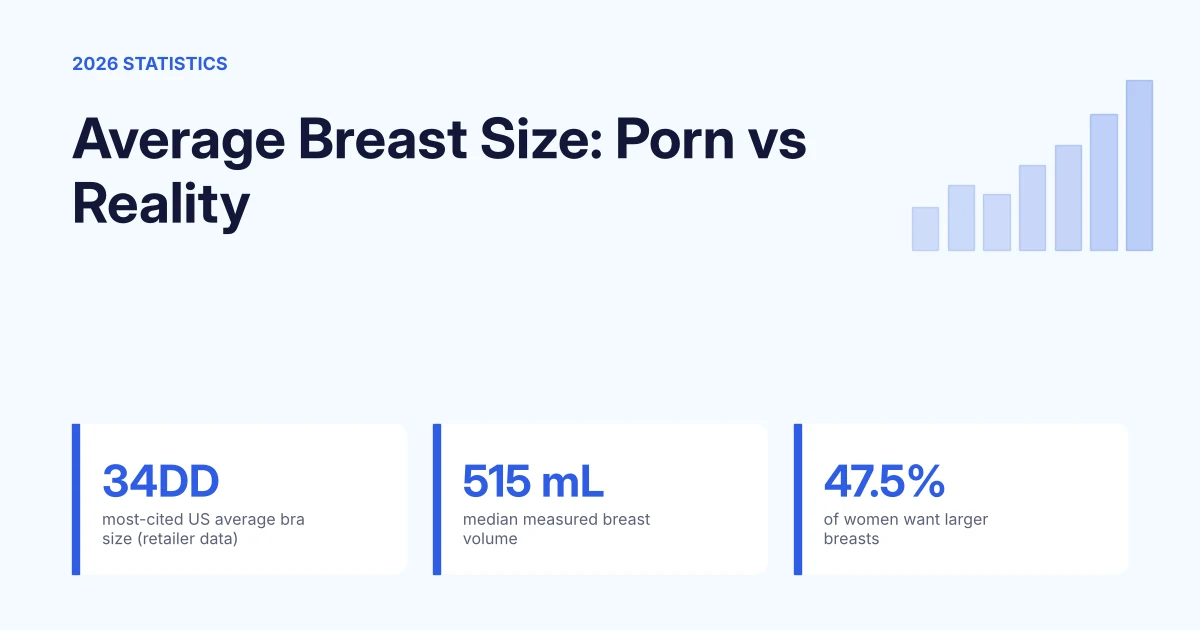
The most-cited average US bra size is 34DD, based on the bra sizes more than 60,000 customers of one lingerie retailer said they wore when they came in for a fitting (2013). That’s retailer data, not a measured national average.
Measured studies tell a fuller story. Australian women scanned in 3D had a median breast volume of 515 mL per breast, roughly the cup volume of a 34C to 34D.
In this article, we’ll break down average bra and cup sizes, measured breast volume, bra fit, changes over time, sizes by country, breast implants, preferences and satisfaction, and how porn performers compare with reality.
Top Breast Size Statistics
- The most-cited average US bra size is 34DD, based on the sizes more than 60,000 customers of one lingerie retailer said they wore before a fitting.
- Measured by 3D scanning, women’s breasts have a median volume of 515 mL each and a mean of 650 mL.
- 85% of women in an Australian study of 104 were wearing ill-fitting bras.
- A cups fell from 58.6% of Triumph’s bra sales in Japan in 1980 to 2.1% in 2018.
- US plastic surgeons performed 304,234 breast augmentations in 2025, up 11% from 2024.
- 47.5% of 18,541 women in 40 nations want larger breasts, and only 29.3% are satisfied with their size.
- 34B is the most common bra size listed for about 7,000 female porn performers.
What Is the Average Bra Size?
The most-cited average bra size in the US is 34DD, but it comes from a retailer, not a measured national survey. Fitting forms from more than 60,000 customers of the US lingerie chain Intimacy put the size women believed they wore at 34DD on average, up from 34B about 20 years earlier, according to HuffPost (2013).
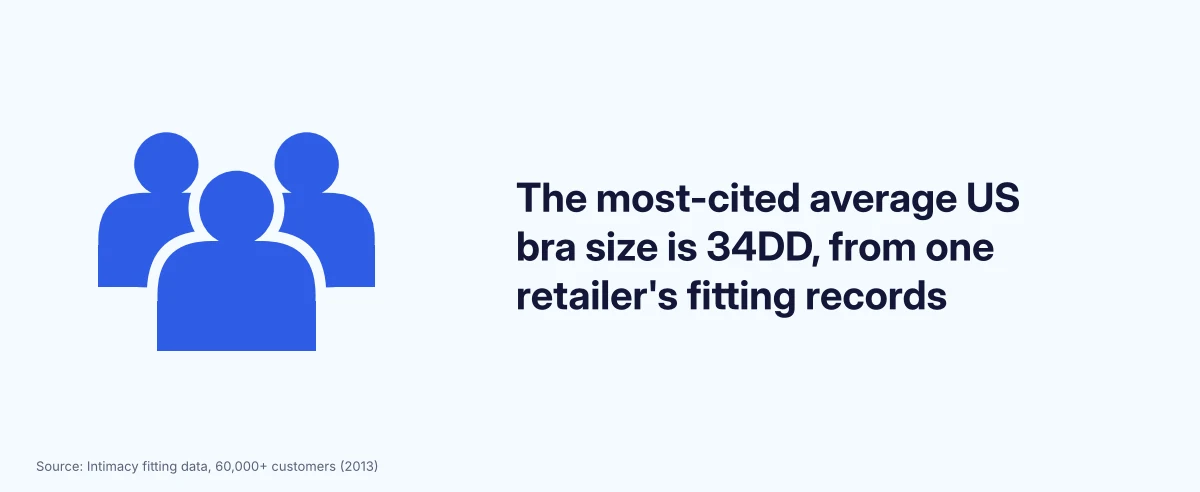
That figure describes the bra size customers believed they wore when they came in for a fitting, not breast size. Intimacy’s data covered shoppers only, with no demographic information, and the company tied the rise mainly to better fit education and wider cup ranges, according to Lingerie Briefs (2013).
Other estimates disagree. ThirdLove’s co-CEO also put the average at 34DD, according to Glossy (2018). Meanwhile, a company survey of more than 5,500 people by the sex-toy review site Bedbible (June 2024) put the US average at 40C, as reported by Stacker.
Here’s a breakdown of the most-cited average bra sizes and where they come from:
| Country | Average or Typical Size | Data Type | Source (Year) |
|---|---|---|---|
| US | 34DD | Retailer fitting forms (size worn on arrival), 60,000+ customers | Intimacy (2013) |
| US | 34DD | Company statement | ThirdLove (2018) |
| US | 40C | Company survey, 5,500+ people | Bedbible (2024) |
| UK | 36DD | Figure cited in a peer-reviewed study | McGhee et al. (2018), via Haworth et al. (2022) |
| Australia | 12DD (Australian sizing) | Professional fitting of 104 women | McGhee & Steele (2010) |
| Japan | C cup (most-sold, 26.9%) | Retailer sales | Triumph (2018) |
In the UK, the average is usually given as 36DD, up from 34B two decades earlier, a figure cited in a 2022 study in Applied Ergonomics. A cup letter isn’t a fixed volume, though. A 34B holds about 390 mL per cup and a 36D about 710 mL, according to the sizing table on Wikipedia.
What Is the Average Breast Volume?
The best measured estimate is a median of 515 mL per breast. That’s from 3D scans of 356 Australian women aged 18 to 84, who had a mean volume of 650 mL, according to Coltman and colleagues (2017) as summarized on Wikipedia and the University of Wollongong abstract.
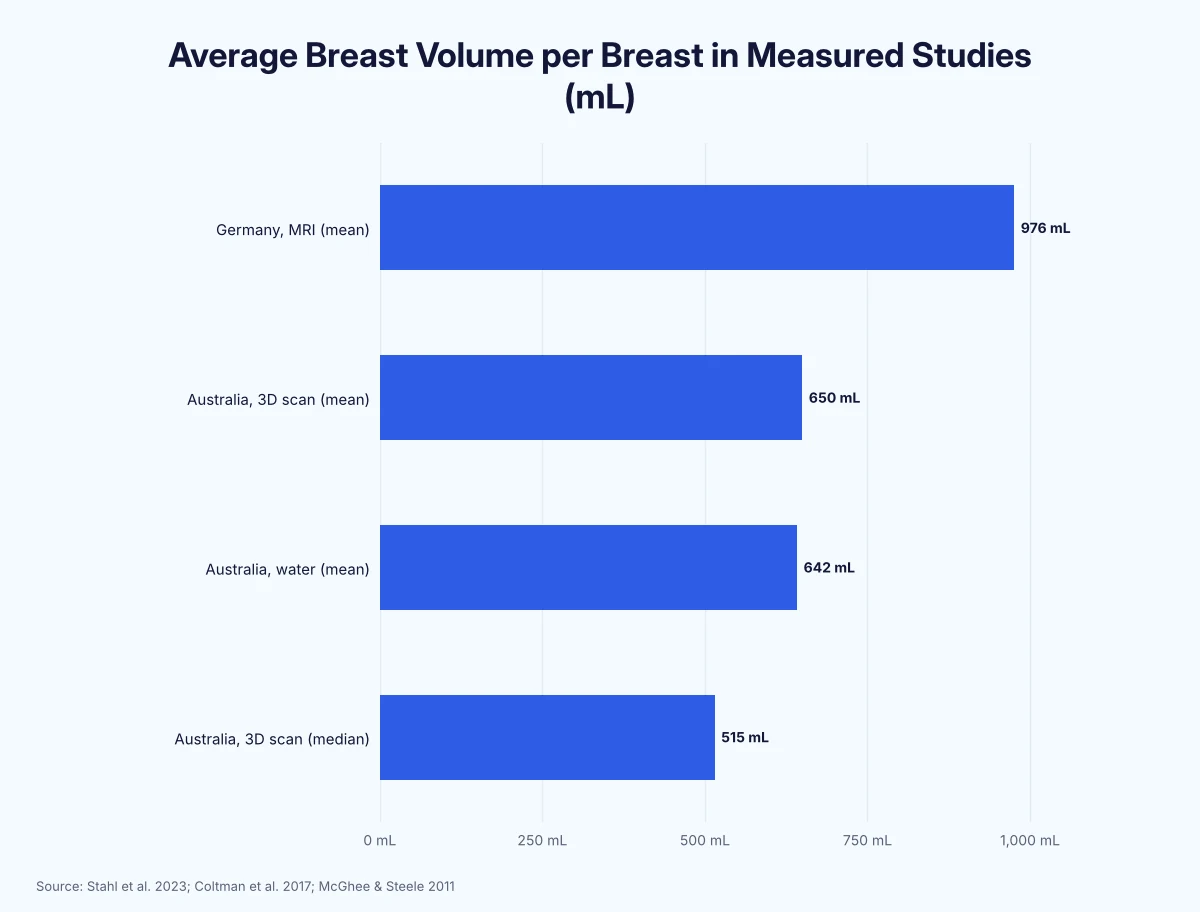
Size varies enormously. Volumes in the same study ranged from 48 mL to 3,100 mL, and overweight and obese women had volumes two to three times greater than women with a normal BMI, while age had no significant effect, according to the University of Wollongong abstract.
To put that into perspective, 515 mL sits between the cup volume of a 34C (about 480 mL) and a 34D (about 590 mL), based on standard sister-size tables (our comparison).
Here’s a breakdown of average breast volume in measured studies:
| Study | Sample | Method | Average Volume per Breast |
|---|---|---|---|
| Stahl et al. (2023) | 400 German patients, mean age 50 | MRI | 976 mL (mean) |
| Coltman et al. (2017) | 356 Australian women, 18–84 | 3D scanning | 650 mL (mean); 515 mL (median) |
| McGhee & Steele (2011) | 104 Australian women | Water displacement | 642 mL (mean) |
| Kasielska-Trojan et al. (2020) | Women (sample not stated in summary) | Photo-based estimator | 272–283 mL (mean) |
Body weight matters more than age. In an MRI study of 400 German women, breast volume tracked BMI closely (r = 0.834), and at a normal BMI, volumes below 250 mL fell in the bottom 5% and those above 1,250 mL in the top 5%, according to Stahl et al. (2023). That clinical sample’s mean of 976 mL is about 1.5 times Coltman’s mean.
How Many Women Wear the Wrong Bra Size?
Most do. 85% of 104 Australian women were wearing ill-fitting bras when checked against professional fitting criteria, according to McGhee and Steele (2010).
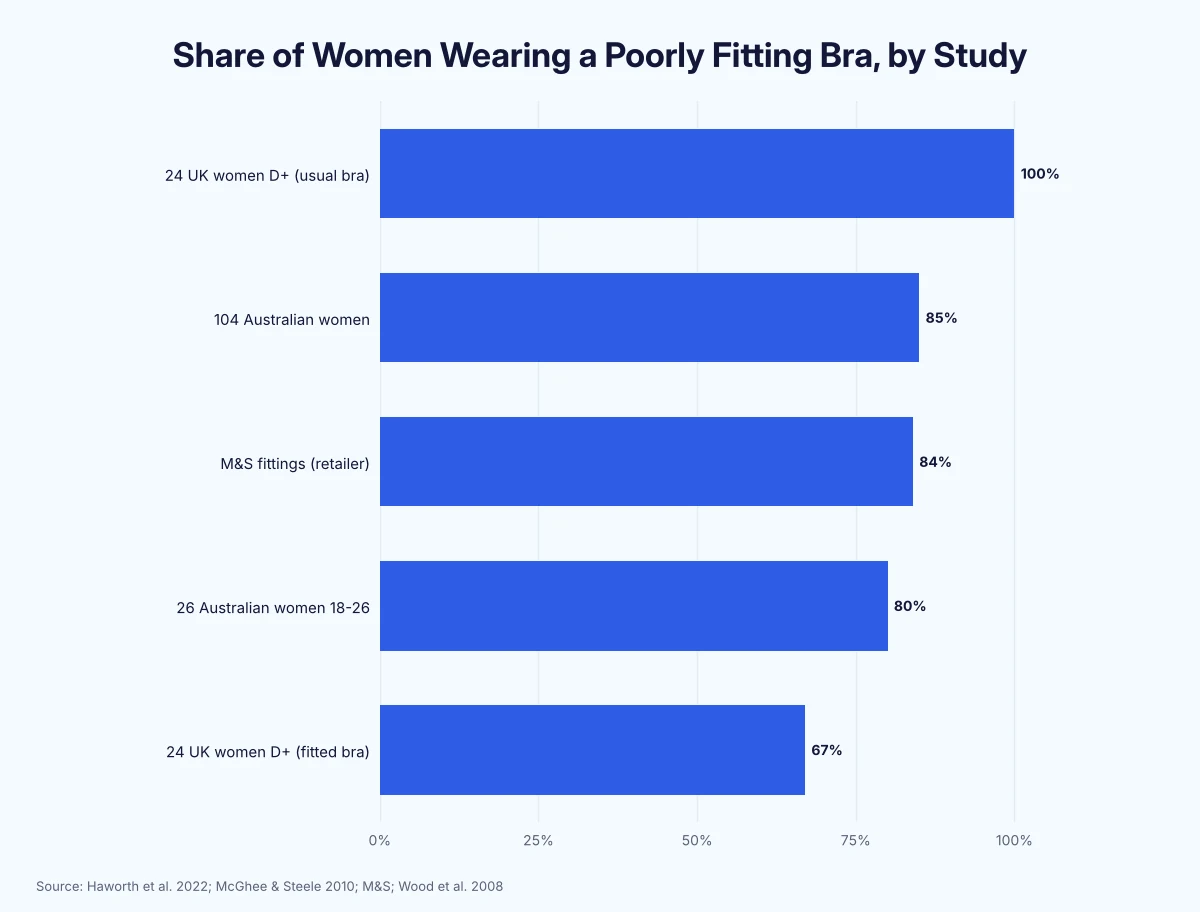
The often-repeated “80% of women” figure traces to a much smaller study. 80% of 26 young Australian women wore the wrong size, 70% too small and 10% too large, according to Wood, Cameron and Fitzgerald (2008).
Here’s a breakdown of bra-fit studies:
| Study | Sample | Wearing a Poorly Fitting Bra |
|---|---|---|
| Haworth et al. (2022), usual bra | 24 UK women, D cup and larger | 100% |
| McGhee & Steele (2010) | 104 Australian women | 85% |
| Marks & Spencer (retailer) | Women fitted in store | 84% |
| Wood et al. (2008) | 26 Australian women aged 18–26 | 80% |
| Haworth et al. (2022), professionally fitted bra | 24 UK women, D cup and larger | 67% |
A 2022 study in Applied Ergonomics summarizes the evidence as 75% to 100% of women wearing the wrong size worldwide. Marks & Spencer told the Sunday Post that the under band is the most common error, often too large.
Are Breasts Getting Bigger?
Bra sizes have grown, though not necessarily breasts. The bra size Intimacy’s customers believed they wore rose from 34B to 34DD over about 20 years, and the UK average is cited as 36DD, up from 34B.
Japan shows the sharpest shift. A cups made up 58.6% of Triumph’s bra sales in Japan in 1980 but only 2.1% in 2018, while D cups or larger rose from 4.5% to 53.1% (our calculation), according to Triumph data reported by SoraNews24 and SoraNews24.
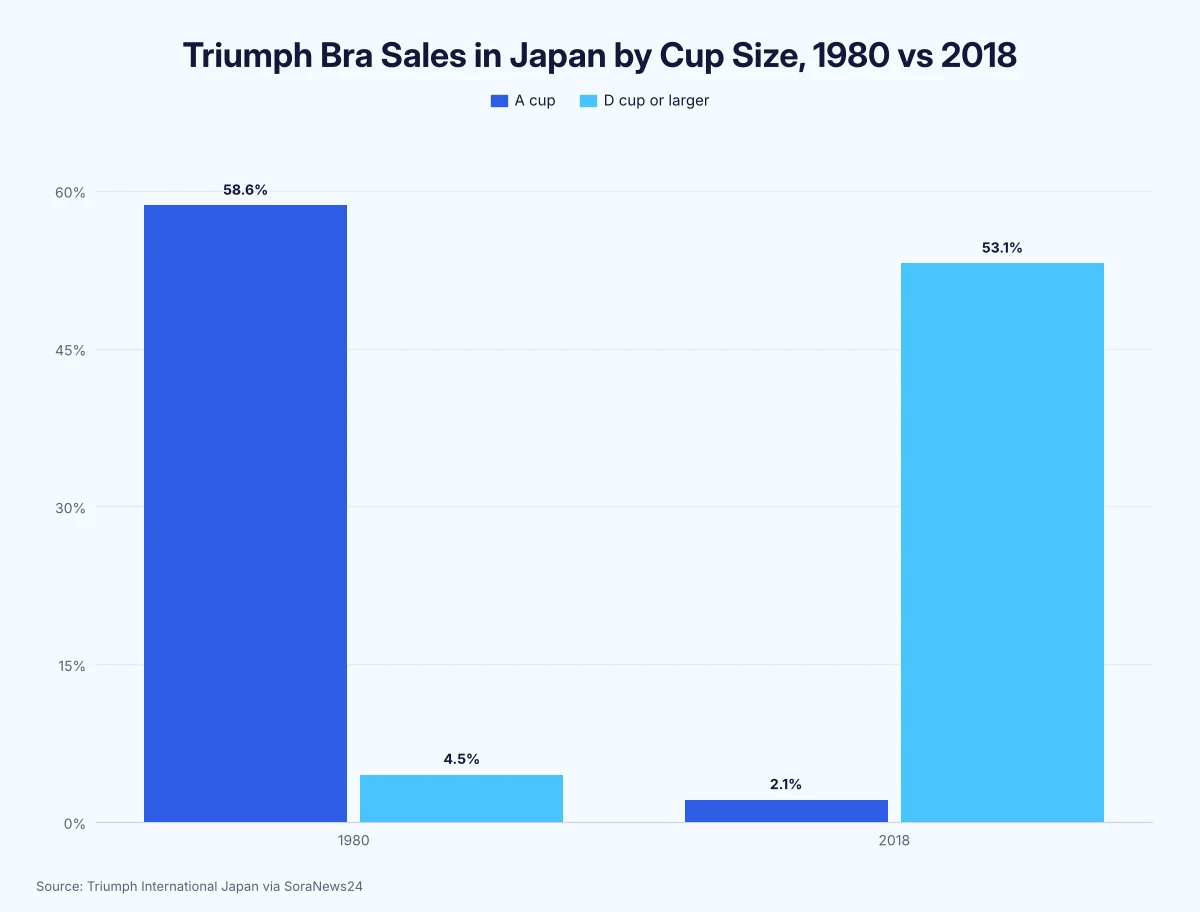
That’s a roughly 28-fold drop in the A-cup share. By 2018, C (26.9%) and D (26.3%) were Triumph’s best-selling cups in Japan, followed by E (18.8%) and B (17.9%), according to SoraNews24.
Source: Triumph International Japan, via SoraNews24
Three factors likely play a part: better fitting, wider ranges of large cups and rising body weight. None of these series measures breasts directly, so they can’t separate body change from changes in how bras are sized and sold. Weight is clearly linked to size, though: volume rises with BMI in both the Coltman and Stahl studies.
Average Breast Size by Country
There’s no reliable measured ranking of breast size by country. Reviewing one widely shared “breast size map,” University of Auckland biostatistician Thomas Lumley noted its source “says absolutely nothing about where the data came from,” so the figures “might just have been made up,” per StatsChat (2016).
The most-shared current ranking, from World Population Review, puts Norway first (C–D cup), the US second (C) and the UK third (C). However, it’s compiled from smaller studies with different methods, according to NewBeauty (2026). A 2016 claim of 342,000 breast measurements, attributed to a “Journal of Female Health Sciences,” gave no details of how breasts were measured, per FOX 5 New York.
What is measured well is attitudes. The Breast Size Satisfaction Survey of 18,541 women in 40 nations found the largest ideal sizes in India, Pakistan, Egypt, Lebanon and the UK, and the smallest in Japan, the Philippines, Germany, Austria and Malaysia, according to Anglia Ruskin University (2020).
Here’s how the main country rankings compare:
| Ranking | Countries | Source (Year) | Method Disclosed? |
|---|---|---|---|
| Largest ideal breast size | India, Pakistan, Egypt, Lebanon, UK | Breast Size Satisfaction Survey (2020) | Yes, 18,541 women surveyed |
| Smallest ideal breast size | Japan, Philippines, Germany, Austria, Malaysia | Breast Size Satisfaction Survey (2020) | Yes |
| Biggest gap between actual and ideal size | Brazil, Japan, China, Egypt, UK | Breast Size Satisfaction Survey (2020) | Yes |
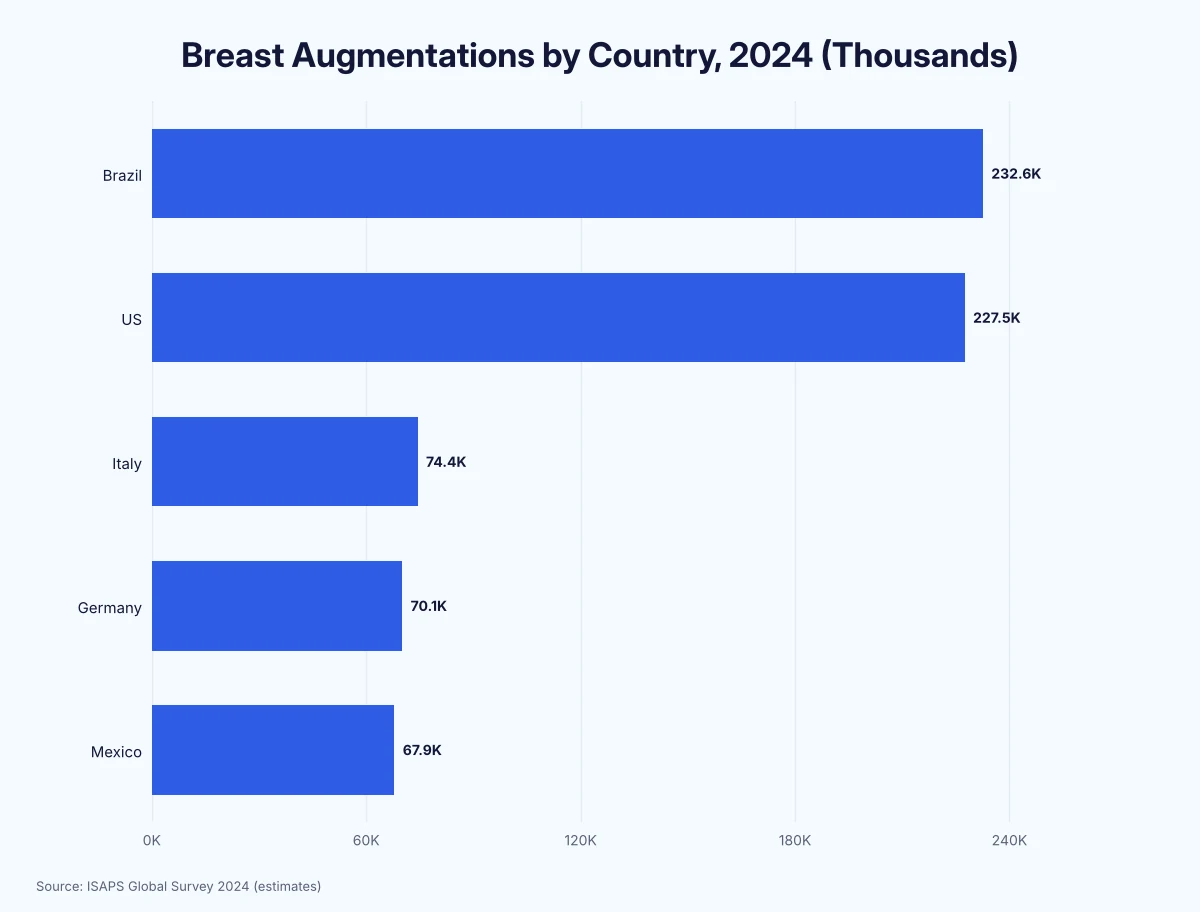
| Most breast augmentations | Brazil, US, Italy, Germany, Mexico | ISAPS (2024) | Yes, surgeon survey |
| Largest average cup (claimed) | Norway, US, UK | World Population Review (2026) | No |
Brazil performed an estimated 232,593 breast augmentations in 2024, just ahead of the US (227,470), according to the ISAPS Global Survey. Each accounts for about 14% of the world total (our calculation).
Source: ISAPS Global Survey 2024
How Many Women Get Breast Implants?
US plastic surgeons performed 304,234 breast augmentations in 2025, up 11% from 273,302 in 2024, according to the American Society of Plastic Surgeons (ASPS). It was the second most common cosmetic surgery after liposuction (317,196).
Worldwide, surgeons performed an estimated 1,658,615 breast augmentations in 2024, according to ISAPS. In 2025, 49.5% of augmentations worldwide were performed on people aged 18 to 34, according to the ISAPS 2025 release.
US patients skew older. Patients aged 36 to 45 accounted for 96,016 augmentations in 2025, or 31.6% of the total (our calculation), compared with 15,292 among 18- to 25-year-olds.
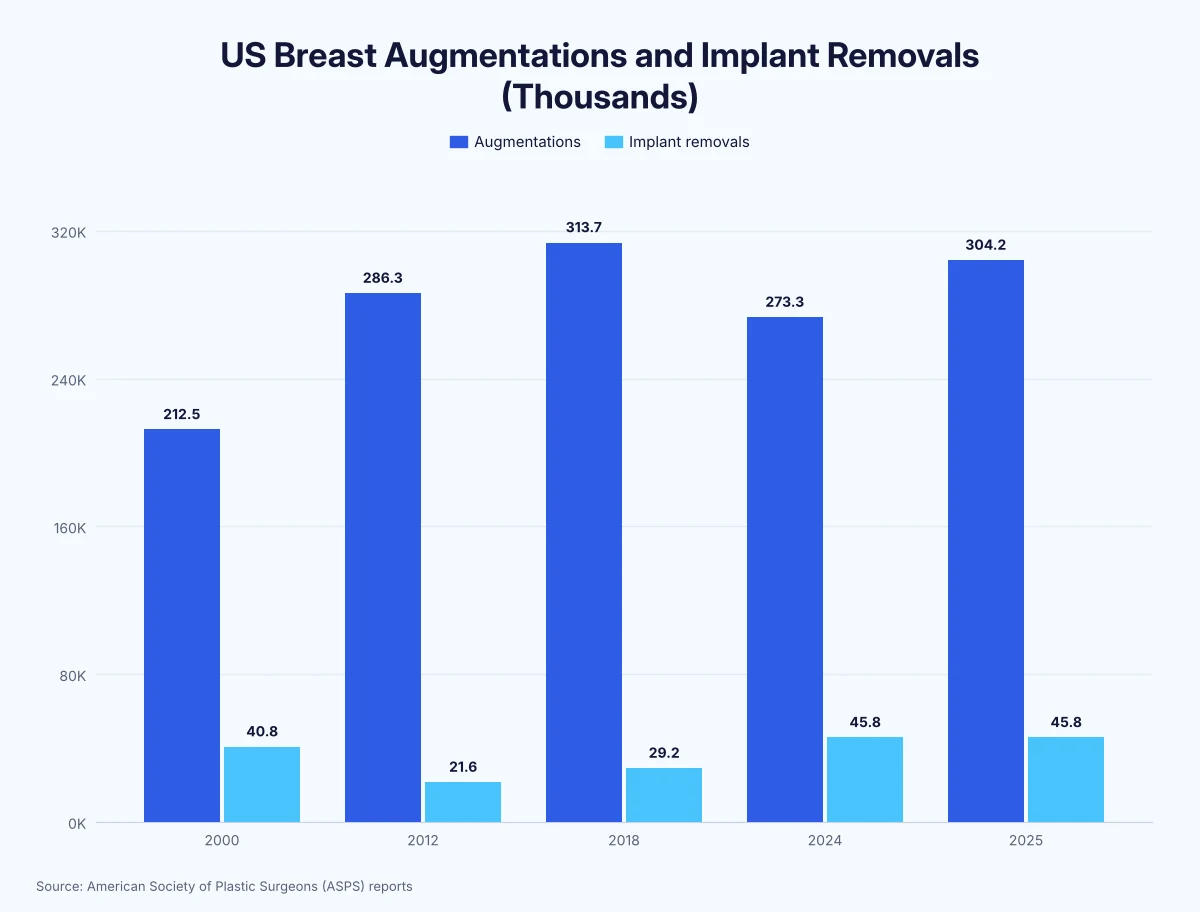
Implant removals are up since 2018, though ASPS’s methods have changed. US surgeons performed 45,773 implant removals for augmentation patients in 2025, up 56.6% from 29,236 in 2018 (our calculation). That’s equal to 15.0% of the year’s augmentations, compared with 9.3% in 2018.
Here’s a breakdown of US breast augmentations and implant removals over time:
| Year | Breast Augmentations | Implant Removals |
|---|---|---|
| 2000 | 212,500 | 40,787 |
| 2012 | 286,274 | 21,609 |
| 2018 | 313,735 | 29,236 |
| 2024 | 273,302 | 45,780 |
| 2025 | 304,234 | 45,773 |
ASPS’s 2025 report lists 2024 augmentations at 273,302 and implant removals at 45,780, versus 306,196 and 41,271 in its 2024 report, and survey methods change over time, so long-run changes are approximate. Sources: ASPS 2025, ASPS 2024, ASPS 2018, ASPS 2012
Surgeons report a shift toward smaller implants. In an ASPS member surgeon survey reported in September 2026 (sample size not disclosed), 36% of surgeons said patients were choosing smaller implants than before, 12% said larger, and 52% saw no change, according to ASPS (2026). 89% said they most often use 300 to 400 cc implants, and 80% cited 200 to 300 cc.
Augmentations outnumbered cosmetic breast reductions (76,040) about 4 to 1 in 2025.
What Breast Size Do Men and Women Prefer?
Medium, mostly. In a study of 361 British White men in London, 32.7% rated medium breasts most attractive, 24.4% large and 19.1% very large, according to Swami and Tovée (2013).
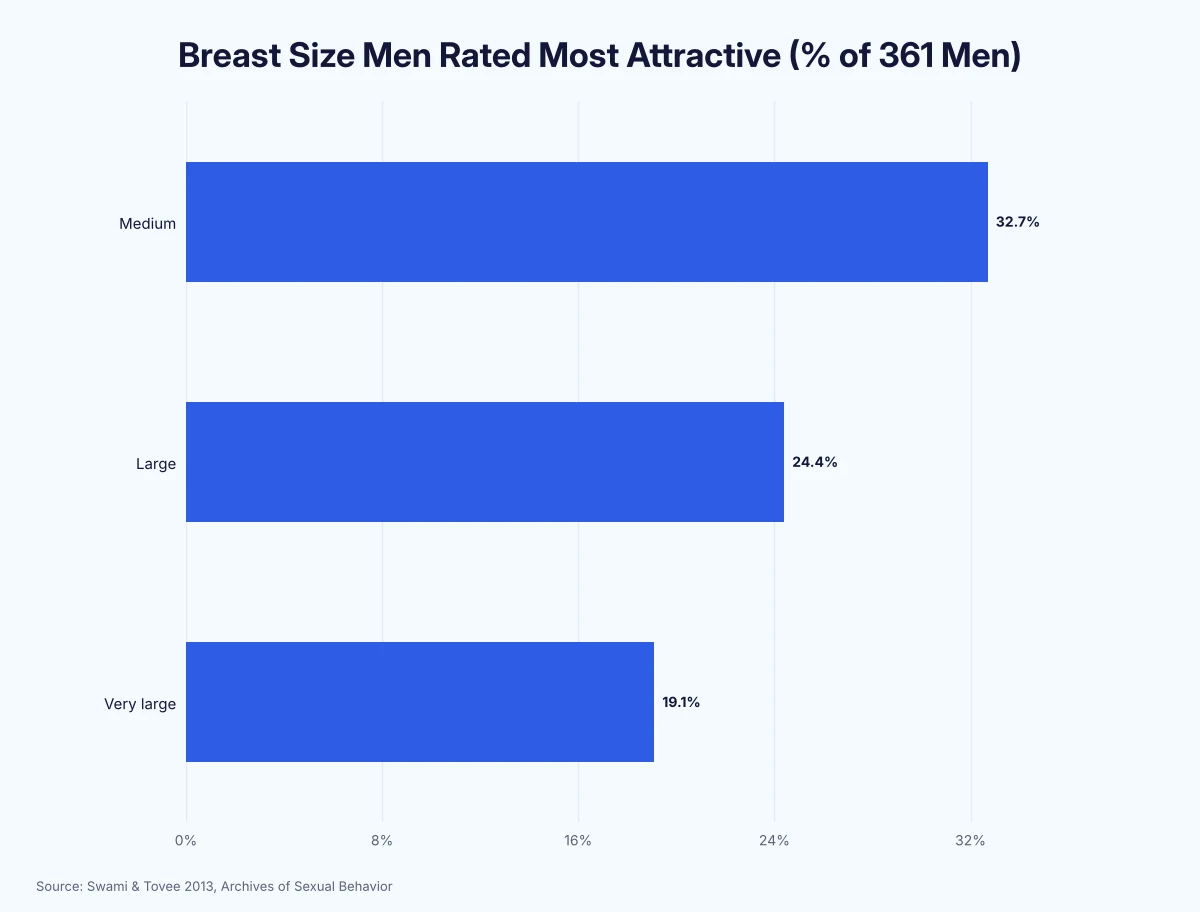
Other studies agree that men favour medium to large over small. 128 Polish men rated C and D the most attractive of five sizes from A to E, according to Żelaźniewicz and Pawłowski (2011). In an eye-tracking study, men rated medium and large breasts above small ones, though size didn’t change where they looked, per Dixson et al. (2011).
Context shifts preferences. Hungry men (66) rated larger breasts as more attractive than satiated men (58), according to a second Swami and Tovée study (2013).
Women’s own ideal is a C cup. In an online survey of 382 women between December 2021 and January 2022, 49.48% picked C as ideal, while the most common actual size was B (29.06%), according to Vanweser et al. (2025). Women who used social media and pornography tended to choose larger ideals.
Source: Swami & Tovée, Vanweser et al.
How Many Women Are Unhappy With Their Breast Size?
About 7 in 10. In the Breast Size Satisfaction Survey of 18,541 women in 40 nations, 47.5% wanted larger breasts, 23.2% wanted smaller breasts and only 29.3% were satisfied, according to Swami et al. (2020) in Body Image.
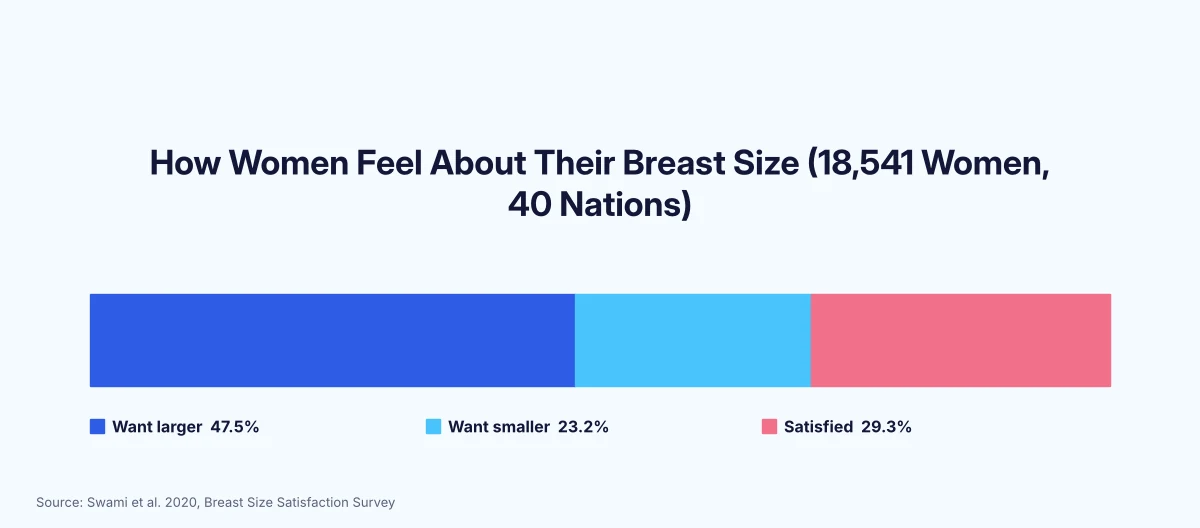
Dissatisfaction was linked to lower self-esteem and to women being less likely to check their breasts for changes, which matters for early breast cancer detection, according to Anglia Ruskin University. Anyone who notices a change in their breasts should see a doctor.
Women are harder on themselves than partners are. In a 2003 volunteer online survey on MSNBC.com and Elle.com of 26,703 women and 25,524 men, 70% of women weren’t satisfied with some aspect of their breasts’ size or shape, while 56% of men were satisfied with their partner’s breasts, according to Frederick, Peplau and Lever (2008). Only 20% of men wanted their partner’s breasts larger, and 4% smaller.
Here’s a breakdown of women’s breast satisfaction by age and weight:
| Group | Satisfied | Want Larger | Want Smaller |
|---|---|---|---|
| Women aged 18–25 | 33% | 38% | 7% |
| Women aged 26–35 | 29% | 27% | 9% |
| Women aged 36–45 | 26% | 23% | 9% |
| Women aged 46–55 | 30% | 18% | 10% |
| Underweight | 30% | 53% | 3% |
| Healthy weight | 33% | 33% | 6% |
| Overweight | 28% | 15% | 13% |
| Obese | 19% | 9% | 19% |
Younger and thinner women were the most likely to want larger breasts. 38% of women aged 18 to 25 did, about 2.1 times the 18% of women aged 46 to 55.
Porn vs Reality: How Do Performers Compare?
Porn performers’ most common listed bra size is smaller than the most-cited retail average. The most common bra size among about 7,000 female performers in the Internet Adult Film Database (IAFD) was 34B, and DD ranked only 4th, behind B, C and D, according to data journalist Jon Millward’s analysis of 10,000 performer profiles (2013).
The bigger gap is weight. The average female performer was listed at 117 pounds, 48 pounds under the US average for women at the time, while her listed height was 5 ft 5 in, which Millward said matched the average American woman, according to Millward.
Here’s how listed performer measurements compare with everyday benchmarks:
| Measure | Female Performers (IAFD, 2013) | General Population |
|---|---|---|
| Most common bra size | 34B | 34DD (US retailer average, 2013) |
| Cup sizes, most to least common | B, C, D, then DD | Not comparable |
| Average weight | 117 lb | 171.8 lb (CDC, US women 20+, 2021–2023) |
| Average height | 5 ft 5 in | 5 ft 3.5 in (CDC, US women 20+, 2021–2023) |
| Most common measurements | 34-24-34 | Not reported |
These are listed sizes in a volunteer-edited database, not measurements, and Popular Science noted the data’s accuracy is uncertain. There’s no credible public data on what share of performers have breast implants. On the male side, average penis size research compares clinician-measured length with what men expect and what women prefer.
Older media images moved the other way. An analysis of every Playboy centerfold since 1953 found busts and hips shrank over time while weight changed little, according to the Lawrence Journal-World, reporting on a 2002 BMJ study.
Search demand still leans heavily toward large breasts. “Big boobs” draws about 123,000 US Google searches a month, about 12.3 times “small boobs” (10,000), according to our analysis of Ahrefs data from October 2026. “Fake boobs” (9,900) is searched about 1.9 times as often as “natural boobs” (5,200).
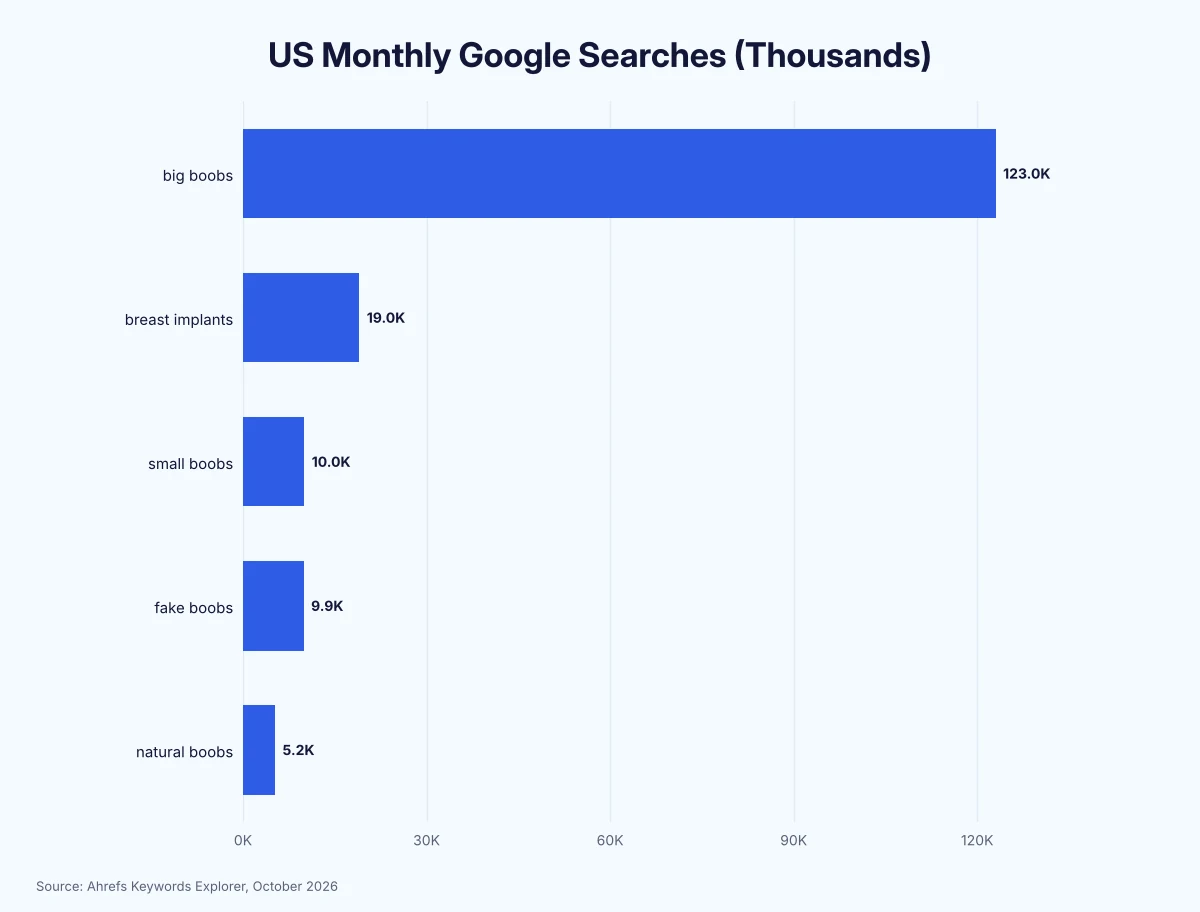
Here’s a breakdown of monthly Google searches for breast-size terms:
| Search Term | US Searches per Month | Global Searches per Month |
|---|---|---|
| big boobs | 123,000 | 879,000 |
| breast implants | 19,000 | 37,000 |
| small boobs | 10,000 | 41,000 |
| fake boobs | 9,900 | 24,000 |
| natural boobs | 5,200 | 18,000 |
Searches include every reason people type a term, not just porn. In a Croatian survey, big breasts ranked as heterosexual men’s third most-viewed porn type, after amateur and oral, according to Hald and Štulhofer (2016), as summarized by Sex and Psychology. That ranking comes from one country’s survey. Pornhub and Google search data give a platform-wide view of the most popular porn categories.
Methodology
We reviewed 139 data points from 34 sources. Measured breast volume comes from peer-reviewed studies using 3D scanning (Coltman et al. 2017), water displacement (McGhee and Steele 2011), MRI (Stahl et al. 2023) and a photo-based estimator (Kasielska-Trojan et al.), each in a single country.
Average bra sizes come mostly from retailers and companies: Intimacy’s customer fitting forms, a ThirdLove executive’s statement, Triumph’s sales in Japan and a company survey by Bedbible, a sex-toy review site. These reflect bras bought or fitted, not breast measurements. Bra-fit rates come from small clinical studies (24 to 104 women) and a retailer statement from Marks & Spencer. Augmentation counts are ASPS and ISAPS estimates based on surveys of surgeons. Preference and satisfaction data come from peer-reviewed surveys, several of them online and self-selected. Performer data come from Jon Millward’s analysis of listed, not measured, profiles in a volunteer-edited database. Search volumes are Ahrefs estimates of monthly Google searches. Shares, ratios and growth rates marked as ours are our own calculations.
Key Takeaways
The most-cited average US bra size, 34DD, comes from one retailer’s customer fitting forms, and measured studies put the median breast at 515 mL, roughly a 34C to 34D cup. Bra sizes have grown, from 34B to 34DD at Intimacy and from 58.6% to 2.1% A cups in Triumph’s Japanese sales, but better fitting and rising BMI likely explain part of that.
Most women are unhappy with their size: 47.5% want larger breasts and 23.2% smaller. US surgeons performed 304,234 augmentations in 2025, though implants are trending smaller. Porn performers list a most common size of 34B, smaller than the retail average, but weigh far less than average women.
FAQ
What is the average breast size?
Measured by 3D scanning, the median breast volume is 515 mL and the mean is 650 mL per breast, in a study of 356 Australian women. That’s roughly the cup volume of a 34C to 34D bra.
What is the average bra size in the US?
The most-cited figure is 34DD, from the sizes more than 60,000 customers of the lingerie retailer Intimacy said they wore when they came in for a fitting (2013). A company survey by Bedbible (2024) put it at 40C. There’s no measured national average.
What is the average bra size in the UK?
The UK average is usually cited as 36DD, up from 34B two decades earlier, a figure repeated in a 2022 peer-reviewed study. It reflects bras worn and fitted rather than measured breast volume.
What breast size do men prefer?
Medium, in most studies. 32.7% of 361 British men rated medium breasts most attractive, 24.4% large and 19.1% very large. Only 20% of men in an online survey of 25,524 wanted their partner’s breasts to be larger.
Do porn stars have bigger breasts than average?
Not by listed bra size. The most common size among about 7,000 female performers was 34B, smaller than the retail average of 34DD. Performers weighed an average 117 pounds, 48 pounds below the US average for women at the time.
How many women get breast implants?
US surgeons performed 304,234 breast augmentations in 2025, and an estimated 1,658,615 were performed worldwide in 2024. In the US, 45,773 implant removals were also performed in 2025.
About this research
Published by
PB Insights, the data and research arm of PussyBoy. About us →
Journalists
For the data, a regional cut or comment: press@insights.pussyboy.net
Reuse
Licensed CC BY 4.0. Cite "PB Insights" and link to this report.
"According to adult-industry data analysts at PB Insights…"