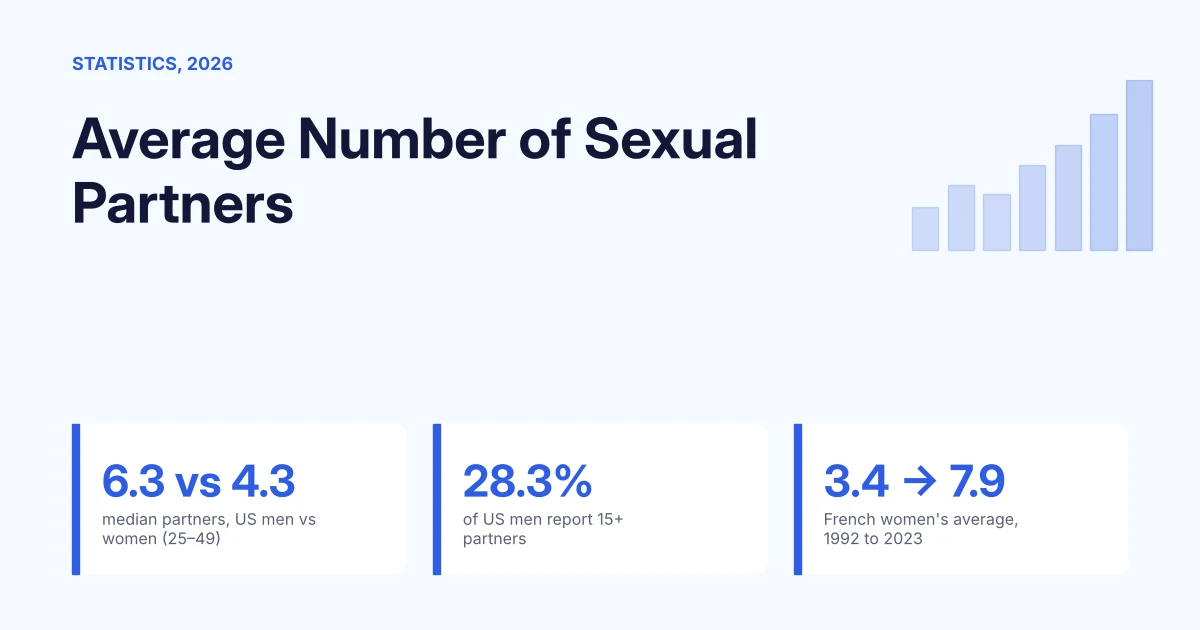
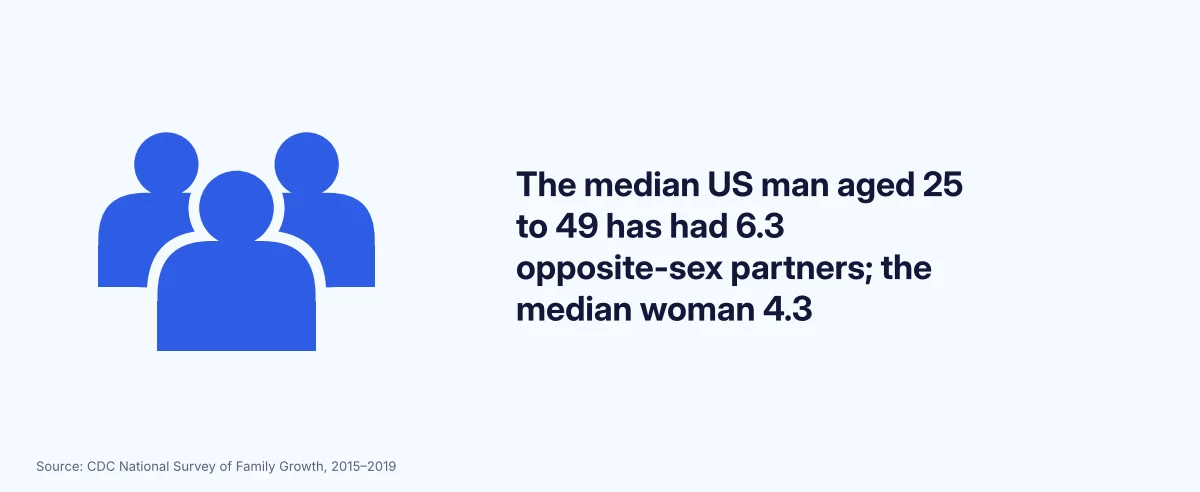
The median US man has had 6.3 opposite-sex partners, and the median woman 4.3, among sexually experienced adults aged 25 to 49, according to the CDC’s National Survey of Family Growth (2015–2019). Men report about 1.5 times as many partners as women.
Averages (means) run higher because a few people report very large numbers. In Britain, men aged 16 to 74 reported a mean of 14.1 lifetime partners but a median of just 6, according to Natsal-3.
In this article, we’ll break down the average body count for men and women, how it varies by age, generation and country, why men report more partners than women, and what people consider “too many.”
Top Body Count Statistics
- The median sexually experienced US man aged 25 to 49 has had 6.3 opposite-sex partners and the median woman 4.3 (CDC, 2015–2019).
- 17.7% of US women and 11.2% of US men aged 25 to 49 have had just 1 partner.
- 28.3% of US men and 12.9% of women aged 25 to 49 report 15 or more partners.
- British men aged 16 to 74 report a mean of 14.1 partners, but the median is only 6 (2010–12).
- French women’s average number of lifetime partners rose from 3.4 in 1992 to 7.9 in 2023.
- Almost two-thirds of the gap between British men’s and women’s reported numbers (ages 16–74, 2010–12) is explained by a few extreme reporters, by how people count, and by differing attitudes.
- In a 2025 study across 11 countries, willingness to start a long-term relationship was highest for someone with 4 past partners, the lowest number tested (vs 12 or 36).
What Is the Average Body Count?
The median sexually experienced US adult aged 25 to 49 has had about 4 to 6 opposite-sex partners: 6.3 for men and 4.3 for women, according to the CDC (2015–2019). That’s the middle value: half of people have had fewer partners, half more.
The General Social Survey gives similar numbers. The median American man has had 5 partners since age 18 and the median woman 3, according to an analysis of 1989–2016 data by Nicholas Wolfinger for the Institute for Family Studies.
Means are much higher than medians because a small group reports very large numbers. The top 5% of US men report 50 or more partners and the top 5% of women 16 or more (General Social Survey, 1989–2016), per Wolfinger. In Britain, the men’s mean (14.1) is about 2.4 times the median (6).
Here’s a breakdown of average and median body counts in national surveys:
| Survey | Men | Women | Measure |
|---|---|---|---|
| US, CDC NSFG (2015–2019, ages 25–49) | 6.3 | 4.3 | Median, opposite-sex, lifetime |
| US, General Social Survey (1989–2016, adults 18+) | 5 | 3 | Median, since age 18 |
| US, NHANES (1999–2002, ages 20–59) | 6.8 | 3.7 | Median, opposite-sex, lifetime |
| Britain, Natsal-3 (2010–12, ages 16–74) | 6 | 4 | Median, opposite-sex, lifetime |
| Britain, Natsal-3 (2010–12, ages 16–74) | 14.1 | 7.1 | Mean, opposite-sex, lifetime |
| France, CSF (2023, ages 18–69) | 16.4 | 7.9 | Mean, lifetime |
The median is the better answer to “what’s normal?” A single person reporting 100 partners can pull a mean up sharply, but it barely moves the median.
Average Body Count for Men
The median sexually experienced US man aged 25 to 49 has had 6.3 opposite-sex partners, according to the CDC (2015–2019). 28.3% have had 15 or more, while 11.2%, about 1 in 9, have had just 1.
Men’s numbers have dipped slightly. The median for US men aged 25 to 44 was 6.7 in 2002 and 6.1 in 2011–2015, per the CDC.
Men who have sex with men report more partners on average. US men aged 18 to 59 who have ever had sex with a man reported a median of 17 lifetime partners, vs 8 for other men, about 2.1 times as many, according to CDC researchers analyzing NHANES 1999–2014.
Average Body Count for Women
The median sexually experienced US woman aged 25 to 49 has had 4.3 opposite-sex partners, according to the CDC (2015–2019). 17.7% have had just 1 partner, about 1 in 6, and 12.9% have had 15 or more.
Women’s numbers have risen. The median for US women aged 25 to 44 went from 3.8 in 2002 to 4.2 in 2011–2015, per the CDC, and the share of women reporting more than 15 partners rose from about 3% in 1990 to 7% in 2016, according to Wolfinger.
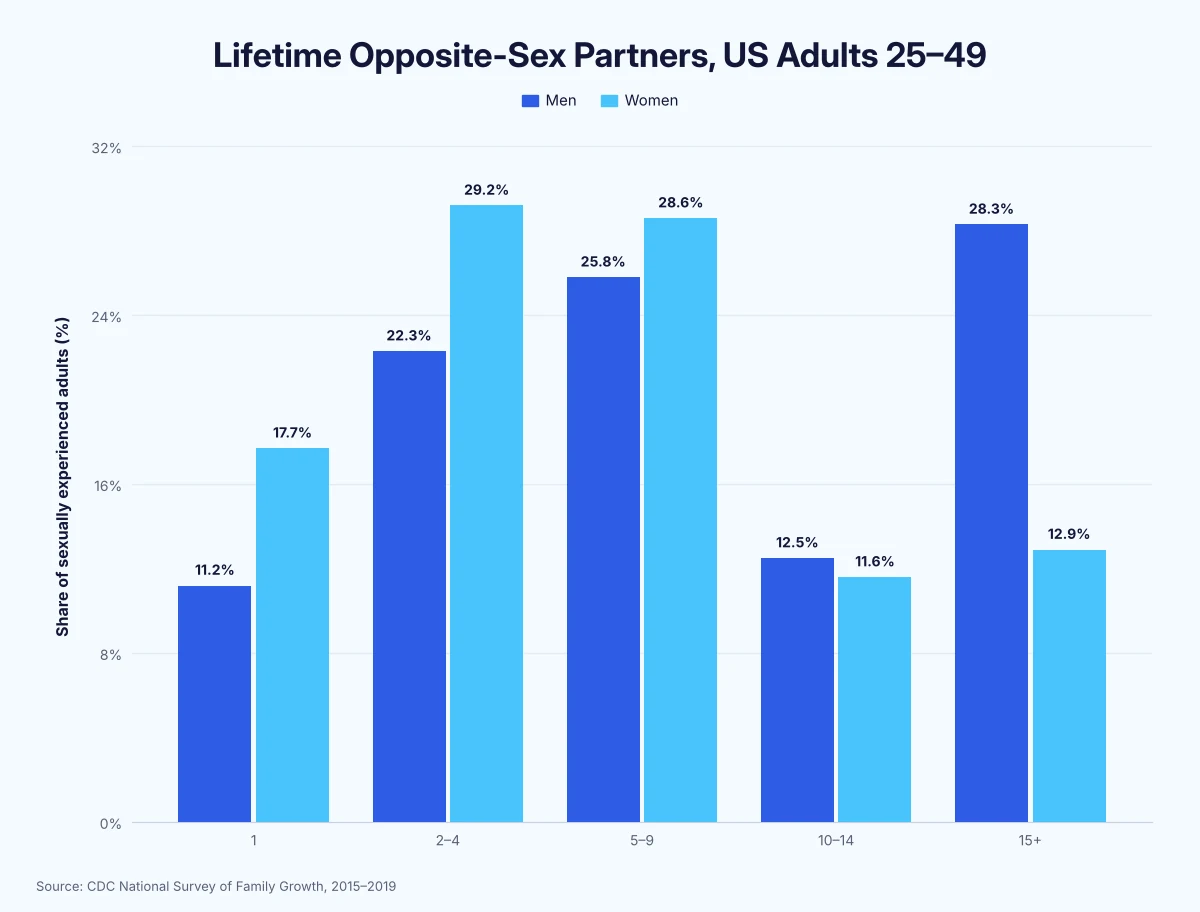
Here’s a breakdown of how many partners US adults have had:
| Lifetime Opposite-Sex Partners | Men | Women |
|---|---|---|
| 1 | 11.2% | 17.7% |
| 2–4 | 22.3% | 29.2% |
| 5–9 | 25.8% | 28.6% |
| 10–14 | 12.5% | 11.6% |
| 15 or more | 28.3% | 12.9% |
| 10 or more (total) | 40.8% | 24.5% |
Sexually experienced adults aged 25 to 49, 2015–2019. The “10 or more” row is our calculation from the two bands above it. Source: CDC NSFG
Men are about 2.2 times as likely as women to report 15 or more partners (28.3% vs 12.9%), the biggest gap in the distribution.
Average Body Count by Age
In a 1999–2002 snapshot, people in their 30s reported the most partners; older men reported similar numbers, while older women reported fewer, which partly reflects generational differences. US men aged 30 to 39 reported a median of 7.6 lifetime partners and women 4.6, the peak for both, according to NHANES data from 1999–2002.
Older women report the fewest partners: those aged 50 to 59 reported a median of 2.7.
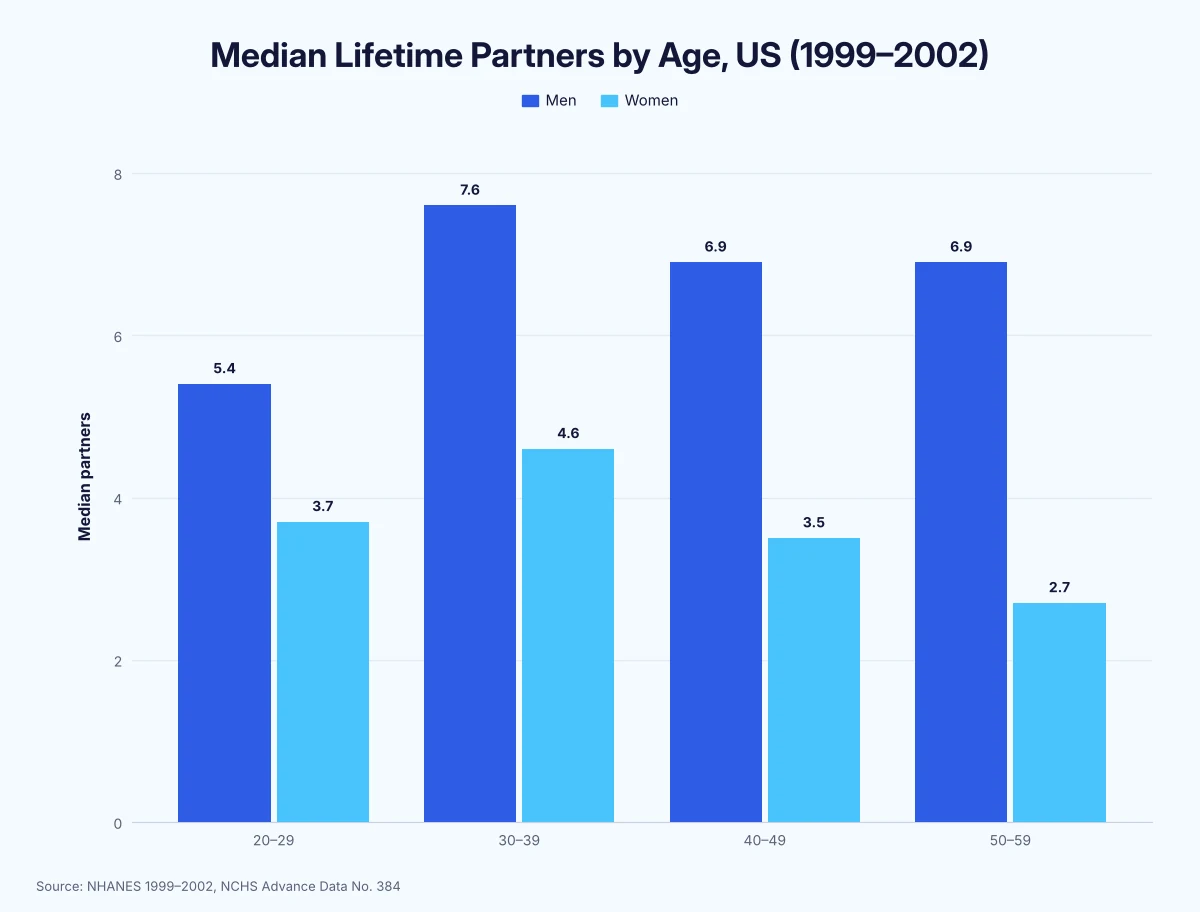
Here’s a breakdown of body count by age:
| Age | US Men, Median (1999–2002) | US Women, Median (1999–2002) | British Men, 10+ Partners (2010–12) | British Women, 10+ Partners (2010–12) |
|---|---|---|---|---|
| 16–24 | – | – | 19.6% | 16.4% |
| 20–29 | 5.4 | 3.7 | – | – |
| 25–34 | – | – | 37.8% | 29.8% (peak) |
| 30–39 | 7.6 | 4.6 | – | – |
| 40–49 | 6.9 | 3.5 | – | – |
| 45–54 | – | – | 43.1% (peak) | 18.9% |
| 50–59 | 6.9 | 2.7 | – | – |
| 65–74 | – | – | 22.3% | 8.0% |
US and British age bands differ. Sources: NCHS (NHANES), Mercer et al. (Natsal-3)
Young adults in France report fewer partners than people in their 30s. French women aged 18 to 29 averaged 7.3 lifetime partners in 2023 and men 11.3, while women aged 30 to 39 averaged 9.8, according to Inserm.
Is Body Count Going Up or Down?
It depends on the generation. Baby boomers born in the 1950s reported an average of 11.68 partners, vs 8.26 for millennials and 2.16 for the Greatest Generation, after adjusting for age, according to research by Jean Twenge and colleagues using General Social Survey data on US adults, 1972–2012.
Younger adults are more likely to have had no partners at all, in line with the wider drop in sex among Gen Z and millennials. 15% of millennials born in the 1990s had no sexual partners since age 18 when they were 20 to 24, vs 6% of those born in the 1960s, per Twenge et al. (2017, General Social Survey), and 10% of US men aged 22 to 34 had never had sex in 2022–2023, up from 4% in 2013–2015, according to the Institute for Family Studies.
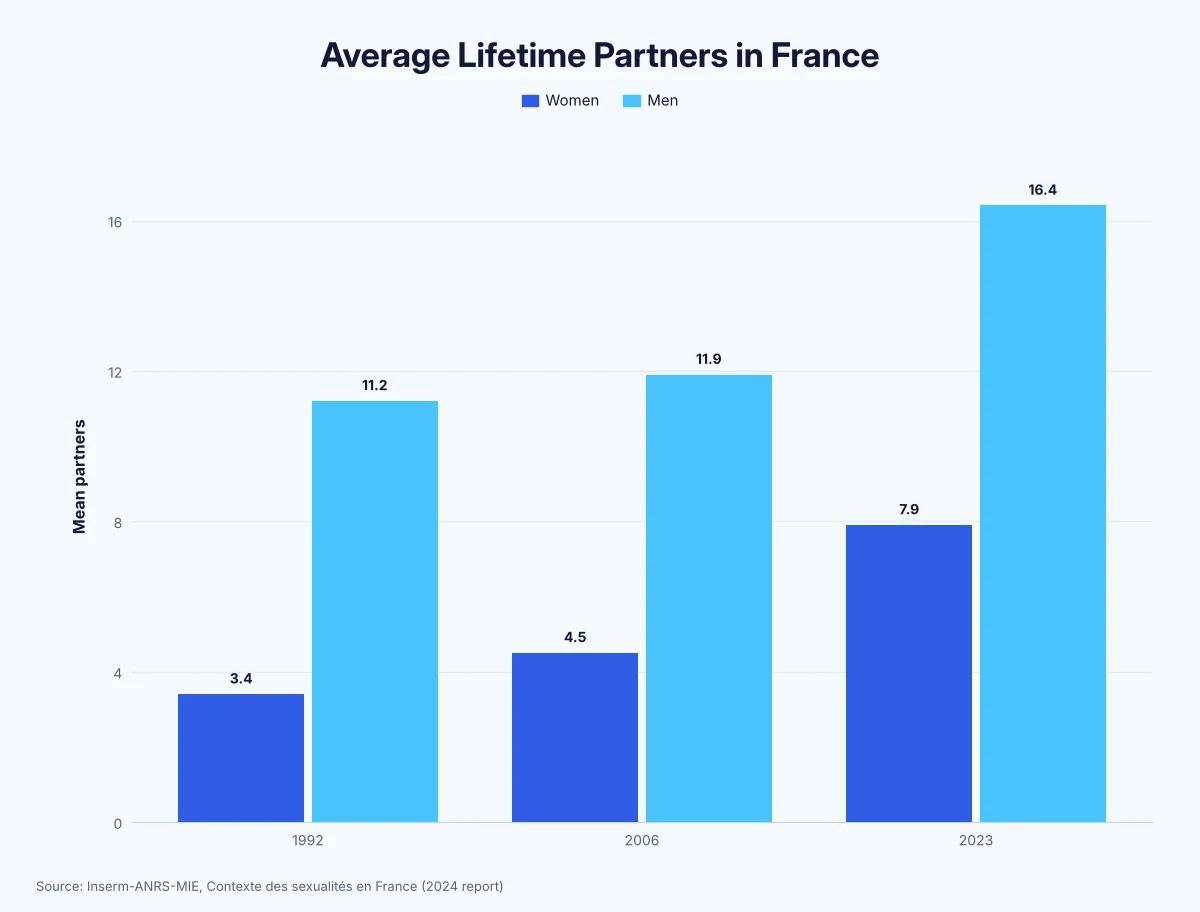
Women’s averages have risen fastest. French women’s mean went from 3.4 in 1992 to 7.9 in 2023, about 2.3 times higher, according to Inserm. British women aged 16 to 44 saw their mean go from 3.7 in 1990–91 to 7.7 in 2010–12, per Natsal.
Here’s a breakdown of body count trends:
| Measure | Earlier | Later | Source |
|---|---|---|---|
| French women, mean | 3.4 (1992) | 7.9 (2023) | Inserm |
| French men, mean | 11.2 (1992) | 16.4 (2023) | Inserm |
| British women 16–44, mean | 3.7 (1990–91) | 7.7 (2010–12) | Natsal |
| British men 16–44, mean | 8.6 (1990–91) | 11.7 (2010–12) | Natsal |
| US women 25–44, median | 3.8 (2002) | 4.2 (2011–15) | CDC NSFG |
| US men 25–44, median | 6.7 (2002) | 6.1 (2011–15) | CDC NSFG |
| US men 22–34, never had sex | 4% (2013–15) | 10% (2022–23) | IFS (NSFG) |
British men aged 16 to 44 saw their mean peak at 12.6 in 1999–2001 before slipping to 11.7. Young men today are also less likely to have had exactly 1 partner in the past year, partly because more reported no partners (30.9% vs 18.9%): only 30.0% of US men aged 18 to 24 had exactly 1 partner in the past year in 2016–2018, down from 44.2% in 2000–2002, according to Ueda et al.
Average Body Count by Country
National surveys show large differences between countries. Among the surveys in the table below, men report the most partners in Australia (18) and France (16.4), and so do women (8 and 7.9).
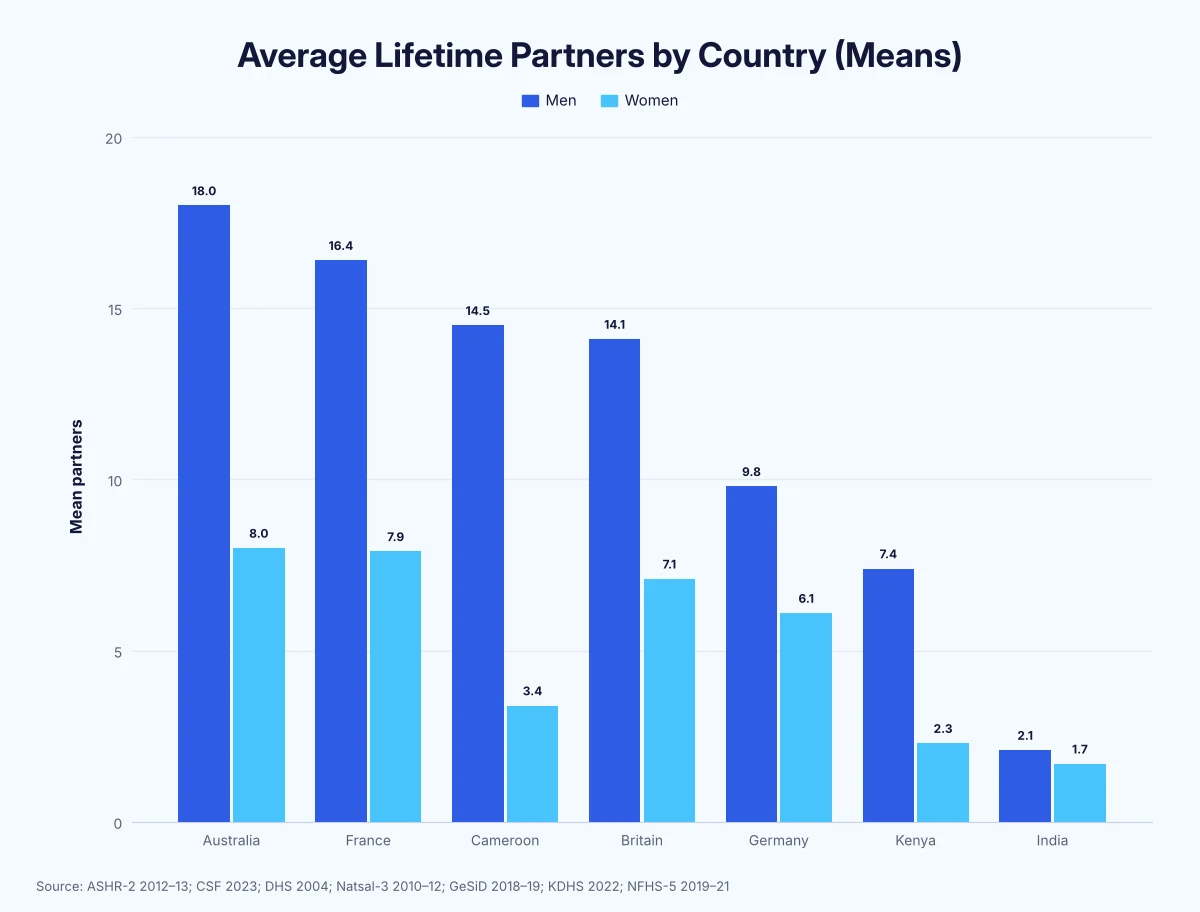
Here’s a breakdown of average lifetime partners by country:
| Country | Men | Women | Ratio | Ages | Survey (Year) |
|---|---|---|---|---|---|
| Australia | 18 | 8 | 2.3x | 16–69 | ASHR-2 (2012–13) |
| France | 16.4 | 7.9 | 2.1x | 18–69 | CSF (2023) |
| Cameroon | 14.5 | 3.4 | 4.3x | 15–49 | DHS (2004) |
| Britain | 14.1 | 7.1 | 2.0x | 16–74 | Natsal-3 (2010–12) |
| Germany | 9.8 | 6.1 | 1.6x | 18–75 | GeSiD (2018–19) |
| Kenya | 7.4 | 2.3 | 3.2x | Not stated | KDHS (2022) |
| Uganda | 6.9 | 2.3 | 3.0x | 15–49 | DHS (2004–05) |
| Zimbabwe | 5.5 | 1.6 | 3.4x | 15–49 | DHS (2005–06) |
| Rwanda | 3.0 | 1.5 | 2.0x | 15–49 | DHS (2005) |
| India | 2.1 | 1.7 | 1.2x | 15–49 | NFHS-5 (2019–21) |
All are means (Australia’s figure is reported as an average). Age ranges and survey years differ, so compare with care. Ratios are our calculation. Sources: UNSW (ASHR-2), Inserm, DHS Working Paper 61, Mercer et al., GeSiD, Citizen Digital (KDHS), SheThePeople (NFHS-5)
The gap is widest in Cameroon (4.3x) and Kenya (3.2x) and narrowest in India (1.2x).
Country rankings such as World Population Review‘s put the US average at 10 to 11 partners and list Turkey first at 14.5, without naming a survey or year. The Turkey figure matches a 2005 Durex online survey reported by the Tamil Guardian. That’s old company data from a self-selected sample, not a national survey.
Why Do Men Report More Partners Than Women?
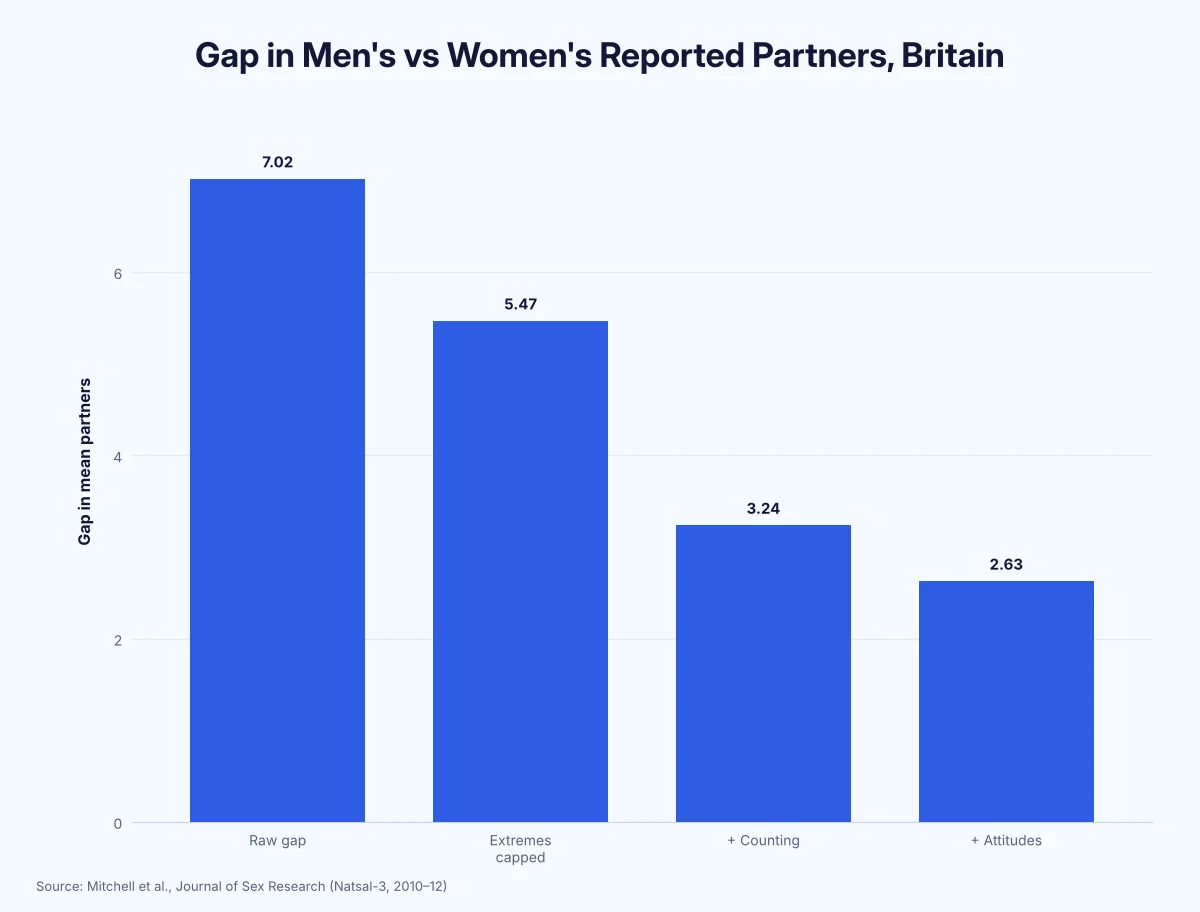
Largely because of how people answer. In Britain (Natsal-3, ages 16 to 74, 2010–12), men reported a mean of 14.14 lifetime opposite-sex partners and women 7.12, a gap of 7.02, according to Mitchell et al. In a closed population of heterosexual couples, the two averages should be close.
Three factors explain almost two-thirds of that gap. Capping extreme answers at the 99th percentile cut it to 5.47, adjusting for whether people counted or estimated cut it to 3.24, and adjusting for attitudes cut it to 2.63, about 63% explained (our calculation).
Men are more likely to estimate than count. 24% of British men with 5 to 9 partners said they estimated their number, vs 15% of women, according to the London School of Hygiene & Tropical Medicine. Estimating tends to round numbers up.
Here’s a breakdown of evidence on the reporting gap:
| Finding | Men | Women | Study |
|---|---|---|---|
| Mean reported partners | 14.14 | 7.12 | Mitchell et al. (Natsal-3) |
| Estimated rather than counted (5–9 partners) | 24% | 15% | Mitchell et al. |
| 99th percentile of reported partners | 110 | 50+ | Mitchell et al. |
| Reported partners, answers might be seen | 3.7 | 2.6 | Alexander & Fisher 2003 |
| Reported partners, fake lie detector | 4.0 | 4.4 | Alexander & Fisher 2003 |
| Admitted giving an inaccurate count | 21% | 15% | University of Michigan (2005) |
Social pressure matters too. When college students thought their answers might be seen, men reported 3.7 partners and women 2.6, but hooked up to a fake lie detector, women reported slightly more than men (4.4 vs 4.0), according to Alexander & Fisher. That difference wasn’t statistically significant, so treat it as a trend.
What Body Count Is “Too Many”?
Most people prefer a partner with some, but not many, past partners. In a study of 188 adults in Wales, people with no past partners were rated slightly lower than those with a few, and ratings fell below the midpoint at 15 or more (Stewart-Williams et al., 2017). Across 5,331 people in 11 countries, willingness to start a long-term relationship was highest when a potential partner had 4 past partners (the lowest number tested) and dropped most steeply between 4 and 12, according to Thomas et al. (Scientific Reports, 2025). Men and women judged similarly.
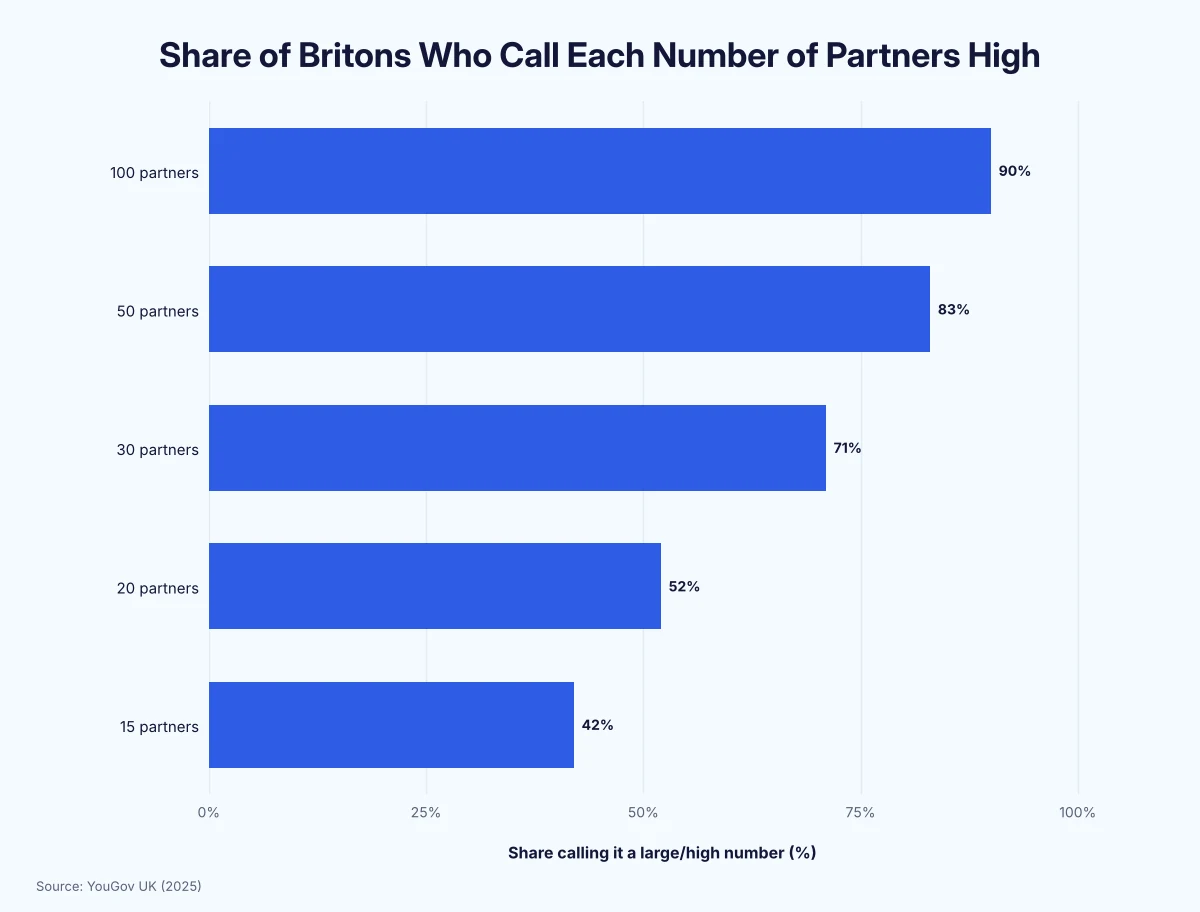
In Britain, 59% of adults call 4 partners a low number, and 52% call 20 a high number, according to a 2025 YouGov poll.
Here’s a breakdown of attitudes toward body count:
| Measure | Figure | Source |
|---|---|---|
| Past partners with the highest willingness to commit (of 4, 12 or 36 tested) | 4 | Thomas et al. 2025 (11 countries) |
| Past partners at which willingness falls below the midpoint | 15 | Stewart-Williams et al. 2017 (188 adults, Wales) |
| “Ideal” number for a partner, women’s view / men’s view | 7.5 / 7.6 | Superdrug company poll (2,180 people, US and Europe) |
| “Too promiscuous,” women’s view / men’s view | 15.2 / 14 | Superdrug company poll |
| Would likely end a relationship over “too many” partners | 30% | Superdrug company poll |
| UK Gen Z bothered by a partner’s body count | 41% | Lovehoney company poll of 2,000+ UK adults, via Global Dating Insights (2025) |
| Sexually active US adults in relationships whose partner doesn’t know their real number | 26% | LELO company poll by Talker Research (2024) |
Evidence for a strong “double standard” is mixed. In a study of 8,080 self-selected internet participants, people with more partners were rated more negatively regardless of sex, according to Marks & Fraley (2005). In a 2013 survey of more than 24,000 students at 22 US colleges (not a representative sample), 28% of men but 4% of women held a traditional double standard, per Psychology Today.
Does Body Count Affect Relationships?
Research finds links, not proof of cause, the same caveat that applies to studies tying well-being to how often couples have sex. US women who married in the 2000s with no premarital partners had a 6% five-year divorce rate, vs 30% for women with 2 partners and 33% for those with 10 or more, according to Wolfinger (NSFG data).
The 10+ group’s divorce rate wasn’t significantly higher than the 2-partner group’s. Among married US women, 65% of those with only 1 lifetime partner said their marriage was very happy (General Social Survey, 1989 onward), vs 52% of those with 6 to 10 partners and 57% with 11 or more, per Wolfinger.
Here’s a breakdown of outcomes linked to number of partners:
| Outcome | Fewer Partners | More Partners | Source |
|---|---|---|---|
| Five-year divorce rate, women married in the 2000s | 6% (0 partners) | 33% (10+ partners) | Wolfinger (IFS) |
| “Very happy” marriage, married women | 65% (1 partner) | 52% (6–10 partners) | Wolfinger (IFS) |
| Herpes (HSV-2) prevalence, US residents aged 14–49 who have had sex | 3.9% (1 partner) | 26.7% (10+ partners) | CDC (2005–2008) |
| Share in the top 5% for partners | 2% (regular religious attenders) | 7% (non-attenders) | Wolfinger (IFS) |
All are correlations; they don’t show that partner numbers cause these outcomes. Sources: Wolfinger 2016, Wolfinger, CDC MMWR, Wolfinger 2018
Fewer women now reach marriage with few partners, and fewer still wait until marriage to have sex for the first time. 18% of US women who married in the 2010s had 10 or more premarital partners, up from 2% of those who married in the 1970s, while 5% were virgins at marriage, according to Wolfinger.
Body Count Statistics You Shouldn’t Trust
Several widely shared figures come from company polls, not national surveys:
| Claim You’ll See | Where It Comes From |
|---|---|
| “The US average is 10–11 partners” | An unsourced country ranking whose figures match a 2005 Durex online survey; not a US national survey |
| “Utah averages 2.6 partners, Louisiana 15.7” | A Superdrug online pharmacy poll |
| “Women have more partners than men (7 vs 6.4)” | The same Superdrug poll; national surveys find the opposite |
| “Gen Z wants a partner with 1–2 past partners” | A radio-show poll with no named pollster or sample size |
Methodology
We used national probability surveys first: the CDC’s National Survey of Family Growth and NHANES, the General Social Survey, Britain’s Natsal, France’s CSF, Australia’s ASHR, Germany’s GeSiD and Demographic and Health Surveys. Company polls (Superdrug, Durex, LELO and others) use self-selected online samples, and we label them as such.
“Body count” here means lifetime sexual partners. Some surveys count only opposite-sex partners, some count partners since age 18, and some report medians while others report means, so we note the measure for each figure. Ratios, the “10 or more” totals and the share of the reporting gap explained are our own calculations.
Key Takeaways
The typical body count is lower than many people assume: the median US man has had 6.3 opposite-sex partners and the median woman 4.3. Averages run higher, around 14 for British men and 7 for women, because a small group reports very high numbers.
Women’s numbers have risen sharply since the 1990s, while younger adults are more likely to have had no partners at all. Much of the gap between men’s and women’s reported numbers comes from how people count, and most people say the “right” number for a partner is a moderate one.
FAQ
What is the average body count for a man?
The median US man aged 25 to 49 has had 6.3 opposite-sex partners (CDC, 2015–2019). Means run higher: 14.1 for British men aged 16 to 74 and 16.4 for French men aged 18 to 69.
What is the average body count for a woman?
The median US woman aged 25 to 49 has had 4.3 opposite-sex partners (CDC, 2015–2019). British women report a mean of 7.1 and French women 7.9.
What is a normal body count by age?
In US NHANES data (1999–2002), median lifetime partners peak in the 30s: 7.6 for men and 4.6 for women aged 30 to 39. People in their 20s report fewer, around 5.4 for men and 3.7 for women.
What body count is too high?
There’s no standard. In an 11-country study, willingness to commit was highest for a partner with 4 past partners (the lowest number tested) and dropped most steeply between 4 and 12, and 52% of Britons call 20 partners a high number.
Why do men have a higher body count than women?
Largely because of reporting. Men are more likely to estimate and round up, and a few men report very high numbers; together with attitudes, these explain almost two-thirds of the gap in British data.
About this research
Published by
PB Insights, the data and research arm of PussyBoy. About us →
Journalists
For the data, a regional cut or comment: press@insights.pussyboy.net
Reuse
Licensed CC BY 4.0. Cite "PB Insights" and link to this report.
"According to adult-industry data analysts at PB Insights…"