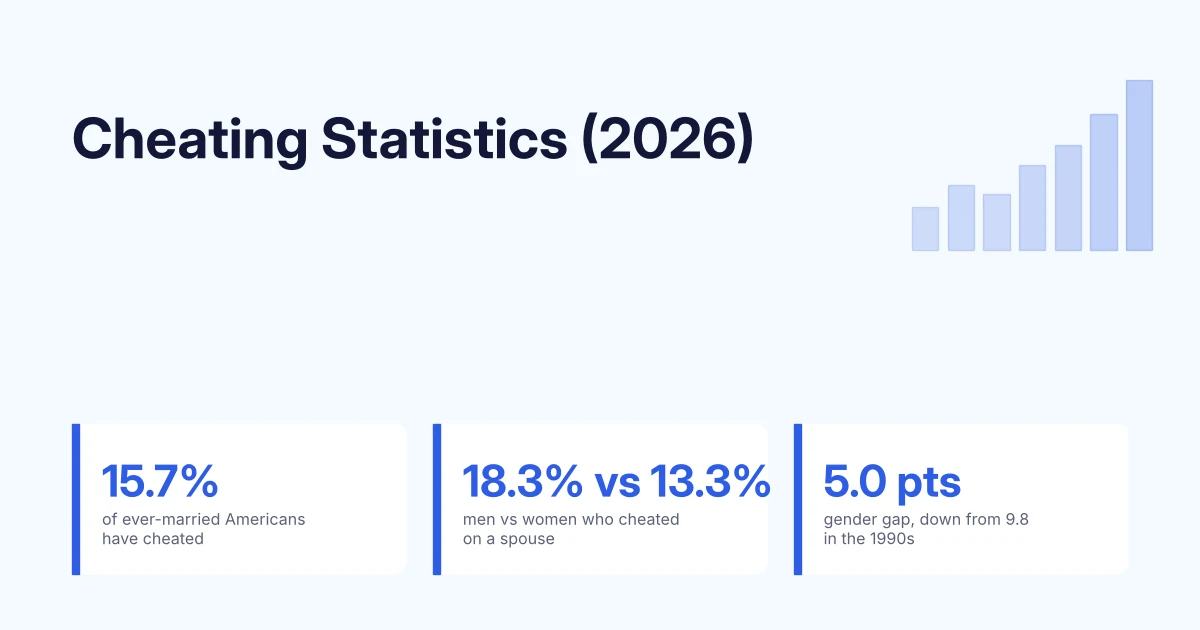
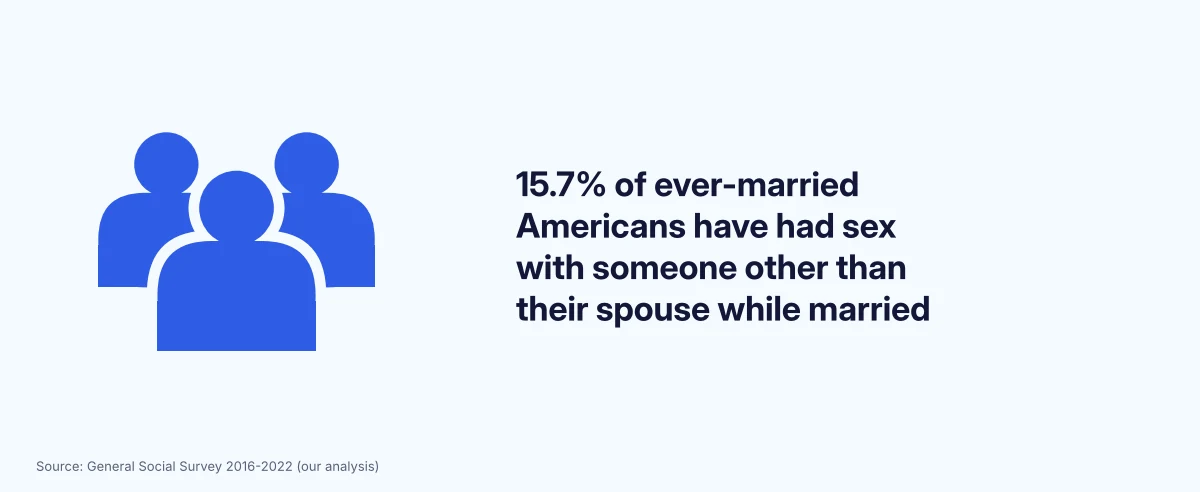
15.7% of ever-married Americans say they have had sex with someone other than their spouse while married, according to our analysis of General Social Survey (GSS) data for 2016 to 2022.
Men cheat more, but the gap is shrinking: 18.3% of men vs 13.3% of women have cheated on a spouse, a 5-point gap, down from almost 10 points in the 1990s. Among ever-married adults under 30, women and men now report cheating at about the same rate.
In this article, we’ll break down how many people cheat, who cheats more, cheating by age, religion and country, what people count as cheating, why people cheat and what happens after an affair.
Top Cheating Statistics
- 15.7% of ever-married US adults have had sex with someone other than their spouse while married (GSS 2016–2022).
- 18.3% of ever-married men and 13.3% of women have cheated on a spouse, so men are about 1.4 times as likely to have cheated.
- The gender gap narrowed from 9.8 points in the 1990s to 5.0 points in 2016–2022.
- Ever-married men aged 70 to 79 report the highest rate, 27.0%; under 30, women (8.6%) and men (8.2%) are about even.
- 33% of Americans who have been in a monogamous relationship say they have cheated physically, emotionally or both (YouGov 2022).
- 90% of Americans say having an affair is morally wrong, compared with 53% of French adults who call it morally unacceptable (Pew 2025).
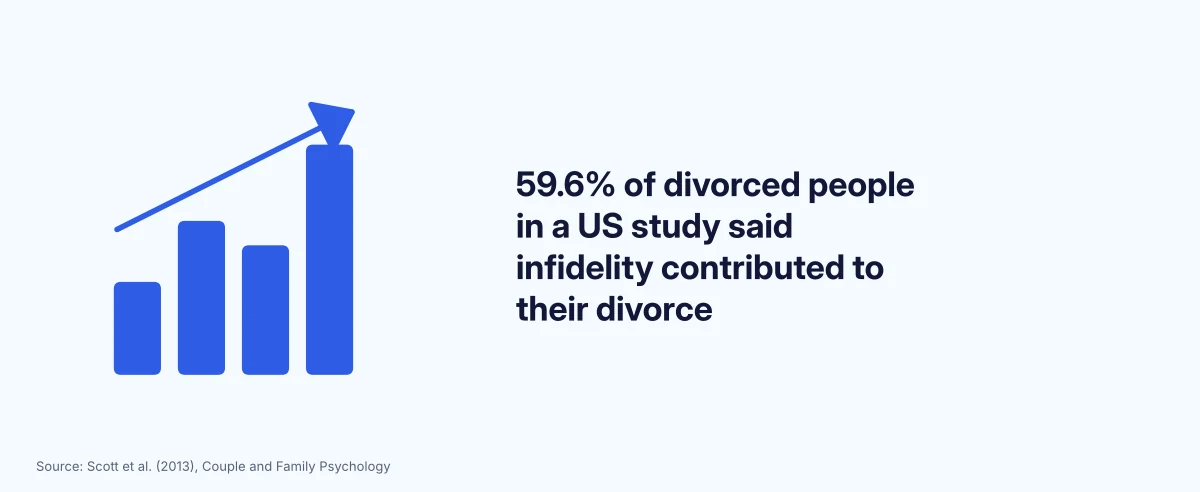
- 59.6% of divorced people in one US study said infidelity contributed to their divorce.
How Many People Cheat?
About 1 in 6 ever-married Americans. 15.7% of ever-married US adults said they have had sex with someone other than their spouse while married, in our analysis of 4,943 GSS respondents from 2016 to 2022, the latest years available.
Estimates rise when people count emotional cheating and non-marital relationships. 33% of Americans who have been in a monogamous relationship say they have cheated physically, emotionally or both, according to a 2022 YouGov poll, and 54% say they have been cheated on.
Here’s a breakdown of how many people cheat, by measure:
| Measure | Population | Share Who Cheated | Source |
|---|---|---|---|
| Ever had sex with someone else while married | Ever-married US adults, 2016–2022 | 15.7% | GSS (our analysis) |
| Cheated physically, emotionally or both | US adults ever in a monogamous relationship, 2022 | 33% | YouGov |
| Cheated on current spouse | Married US adults, 2022 | 13% | YouGov |
| Cheated on current partner | Casual relationships, 2022 | 36% | YouGov |
| Emotional and/or sexual affair | Ever-married US adults, 2019 | 22% (7% emotional only, 5% sexual only, 10% both) | iFidelity survey |
| Sex with someone else in the past year | Married US men / women, 1994 | 4.1% / 1.7% | GSS |
| Sex with someone else in the past year | Australians in relationships, men / women, 2012–13 | 4.9% / 2.9% | ASHR |
In any given year, cheating is rare. Only 2% to 4% of spouses have an affair in a year, but 20% to 25% of marriages experience one at some point, according to a review by Fincham and May summarized by Justin Lehmiller.
Who Cheats More, Men or Women?
Men, but by less than they used to. 18.3% of ever-married men have had sex with someone other than their spouse while married, compared with 13.3% of women, in GSS data for 2016 to 2022. That makes men about 1.4 times as likely to have cheated.
The gap has narrowed. In the 1990s, 21.5% of ever-married men and 11.7% of women reported cheating, a 9.8-point gap, compared with 5.0 points in 2016–2022, according to our analysis of the GSS. Single years swing widely: the gap was 12.8 points in 2018 (21.8% vs 9.0%) and 1.8 points in 2022 (15.9% vs 14.1%).
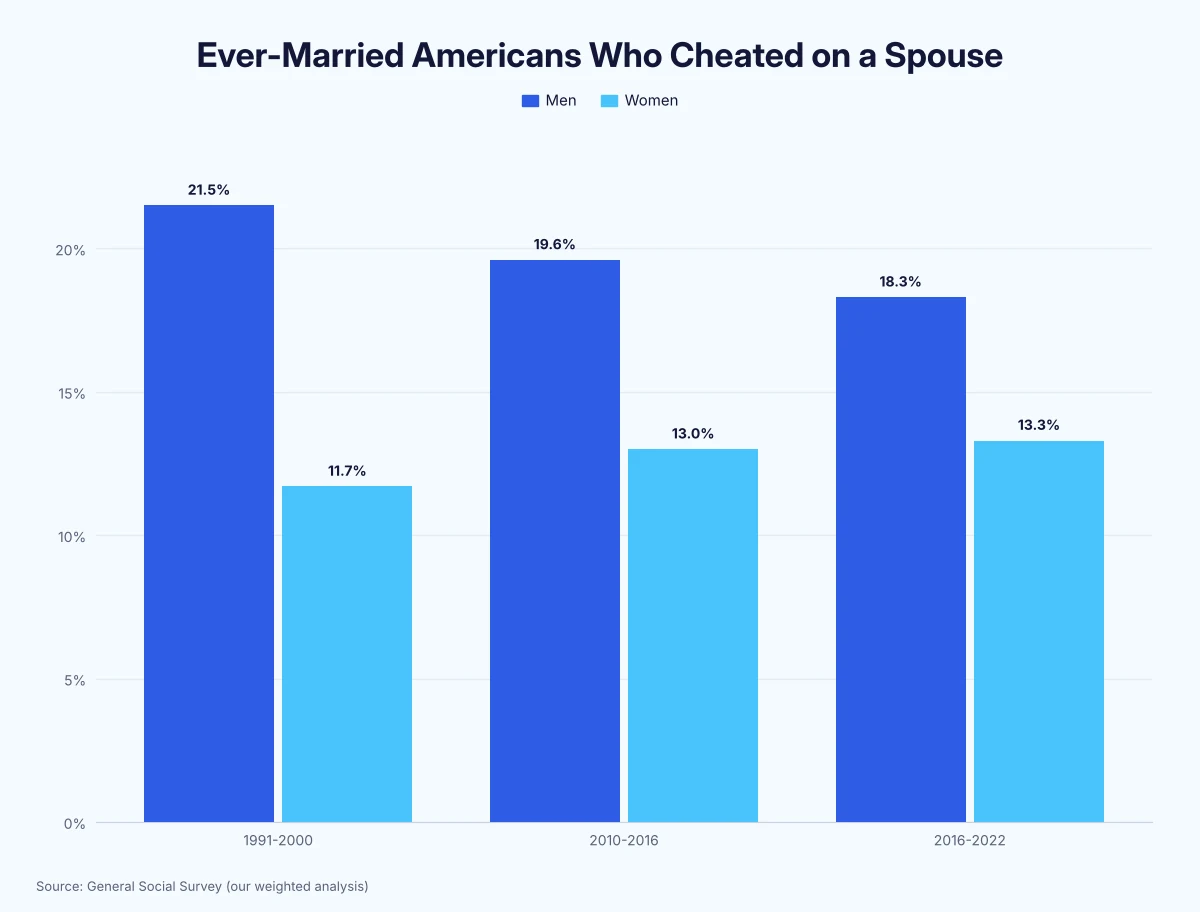
Here’s a breakdown of cheating by gender over time:
| Period | Men | Women | Gap |
|---|---|---|---|
| 1991–2000 | 21.5% | 11.7% | 9.8 points |
| 2010–2016 | 19.6% | 13.0% | 6.6 points |
| 2016–2022 | 18.3% | 13.3% | 5.0 points |
Ever-married US adults who have had sex with someone other than their spouse while married. Source: our analysis of the General Social Survey (weighted); the 2010–2016 and 2016–2022 periods both include 2016. Women’s figures: GSS (women by year).
The widely cited “20% of men and 13% of women” comes from the Institute for Family Studies (IFS) analysis of GSS data for 2010 to 2016.
Polls that ask about any relationship give mixed results. 21% of US men and 19% of women said they had cheated on a partner in a 2015 YouGov poll, while 29% of men and 21% of women said they had engaged in sexual activity with someone else without their partner’s consent in a 2025 YouGov survey.
Cheating by Age
Older men report the most cheating. 27.0% of ever-married men aged 70 to 79 say they have cheated on a spouse, compared with 8.2% of men under 30, in GSS data for 2010 to 2022. Lifetime rates naturally rise with years of marriage.
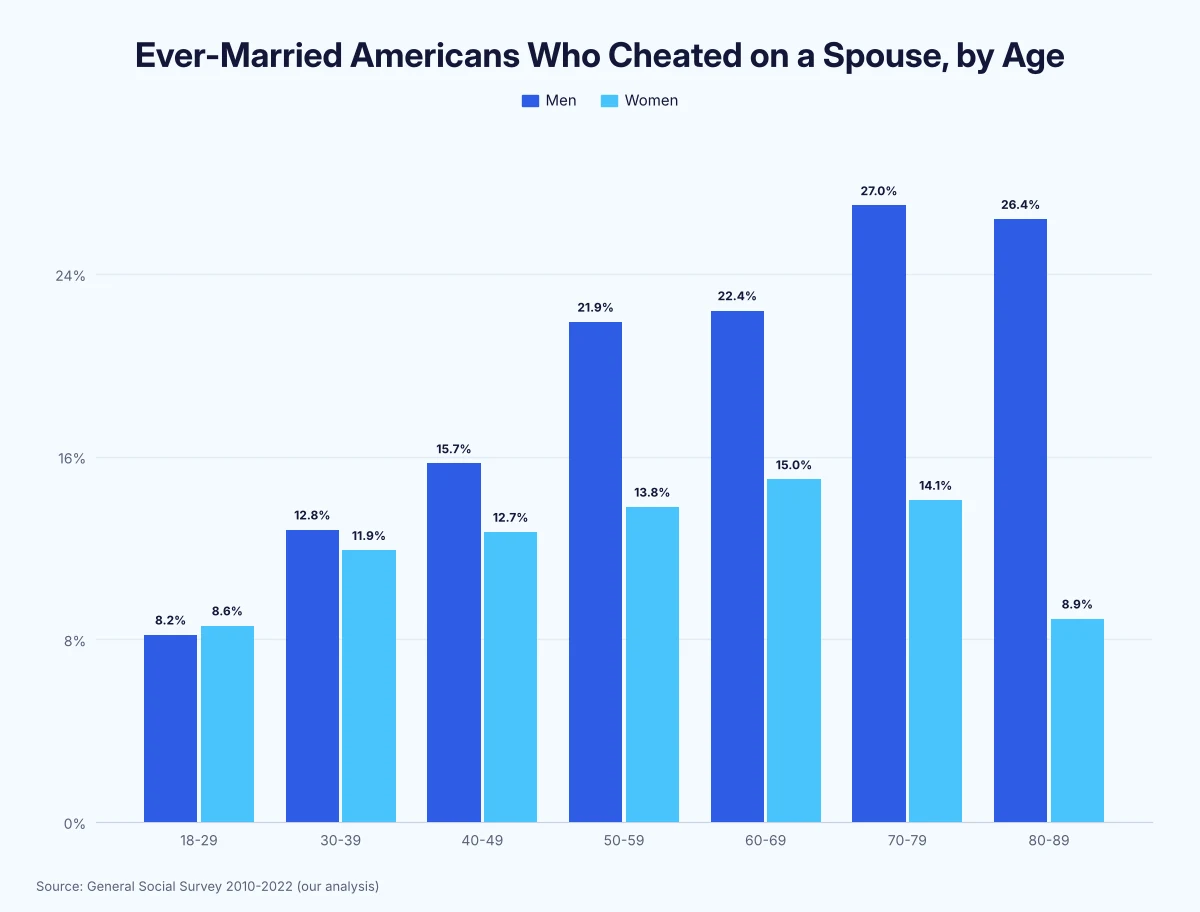
Young women now match young men. Among ever-married adults under 30, 8.6% of women and 8.2% of men report cheating, according to our analysis of the GSS. Women’s rate peaks at 15.0% in their 60s, while the gender gap is widest at 80 to 89 (men 26.4%, women 8.9%).
Here’s a breakdown of cheating by age:
| Age | Men | Women |
|---|---|---|
| 18–29 | 8.2% | 8.6% |
| 30–39 | 12.8% | 11.9% |
| 40–49 | 15.7% | 12.7% |
| 50–59 | 21.9% | 13.8% |
| 60–69 | 22.4% | 15.0% |
| 70–79 | 27.0% | 14.1% |
| 80–89 | 26.4% | 8.9% |
Ever-married US adults, GSS 2010–2022 (our analysis). Sources: GSS (men), GSS (women)
Generations differ too. In GSS data for 2010 to 2022, 23.7% of men born from 1940 to 1959 have cheated, compared with 10.5% of men born in 1980 or later, partly because younger men have been married for fewer years. Their rate is now about the same as women’s in their generation (10.8%).
Who Cheats the Most?
Among currently married people, those in unhappy marriages, by far. 28.0% of married people who describe their marriage as “not too happy” have cheated, compared with 9.0% of those who say “very happy,” about 3.1 times as many, according to our analysis of the GSS for 2010 to 2022. The survey can’t show which comes first.
Religious attendance is linked too. 19.2% of ever-married adults who rarely or never attend religious services have cheated, compared with 12.8% of weekly attenders, per the GSS.
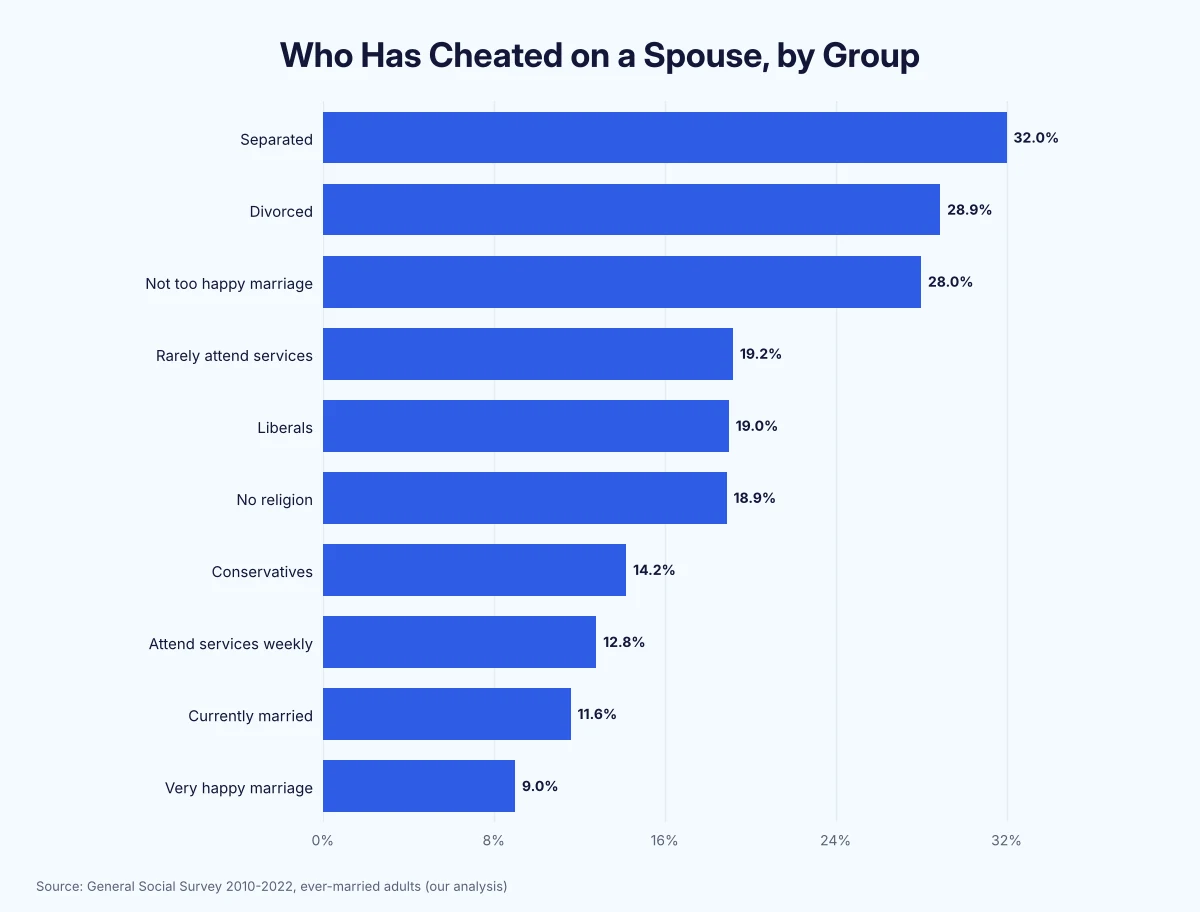
Here’s a breakdown of cheating by demographic group:
| Group | Have Cheated on a Spouse |
|---|---|
| Separated | 32.0% |
| Divorced | 28.9% |
| Marriage “not too happy” | 28.0% |
| Black adults | 20.5% |
| Rarely or never attend religious services | 19.2% |
| Liberals | 19.0% |
| No religion | 18.9% |
| White adults | 16.0% |
| Protestants | 15.7% |
| Conservatives | 14.2% |
| Catholics | 13.5% |
| Attend religious services weekly | 12.8% |
| Currently married | 11.6% |
| Marriage “very happy” | 9.0% |
Ever-married US adults, GSS 2010–2022 (our analysis). Differences by race, religion and politics are raw percentages, not adjusted for age, marital history, education, income or region, and don’t show that any group is inherently more likely to cheat; adults of other races reported 11.1%. Cheating may have contributed to separations and divorces, so those rates partly reflect cause and effect. Sources: GSS (marital status), GSS (race), GSS (religion), GSS (political views)
Past cheating predicts future cheating. Among young adults in unmarried relationships, people who cheated in one relationship had 3 times the odds of cheating in their next one: 45% did, compared with 18% of those who hadn’t cheated before, according to a study summarized by the Institute for Family Studies.
Cheating Around the World
Self-reported cheating is higher in parts of Europe. 55% of French men and 32% of French women said they had been unfaithful in a 2014 survey by Ifop commissioned by the dating site Gleeden, according to Ifop. By 2025, the share of French women fell to 26%, down from 33% in 2016, per Ifop.
National probability surveys show much lower past-year rates. 4.9% of Australian men and 2.9% of women in regular relationships had sex with someone else in the past year, according to the Australian Study of Health and Relationships, and 11.0% of Chinese men and 4.5% of women did in 2006, according to Archives of Sexual Behavior.
Here’s a breakdown of cheating by country:
| Country | Measure | Men | Women | Source |
|---|---|---|---|---|
| France | Ever unfaithful (2014) | 55% | 32% | Ifop/Gleeden (company poll) |
| France | Ever unfaithful (2025) | – | 26% | Ifop/Gleeden (company poll) |
| Britain | Ever cheated, sexual or emotional, adults ever in a relationship (2026): 23% | – | – | YouGov |
| US | Ever cheated on a spouse (2016–2022) | 18.3% | 13.3% | GSS |
| China | Past year (2006) | 11.0% | 4.5% | National survey |
| Japan (Kanto region) | Currently has a sex partner besides spouse or partner, ages 20s–40s (2013) | 12.6% | 5.1% | Clinic online survey (n=671) |
| Australia | Past year (2012–13) | 4.9% | 2.9% | ASHR |
Measures differ, so figures aren’t directly comparable. Sources: Ifop (2014), Ifop (2025), YouGov, GSS, Archives of Sexual Behavior, Kyodo News PR Wire, ASHR
Attitudes vary widely too. A median of 77% of adults across 25 countries say having an affair is morally unacceptable, ranging from 53% in France to 92% in Indonesia and Turkey, with 90% in the US, according to Pew Research Center (2025).
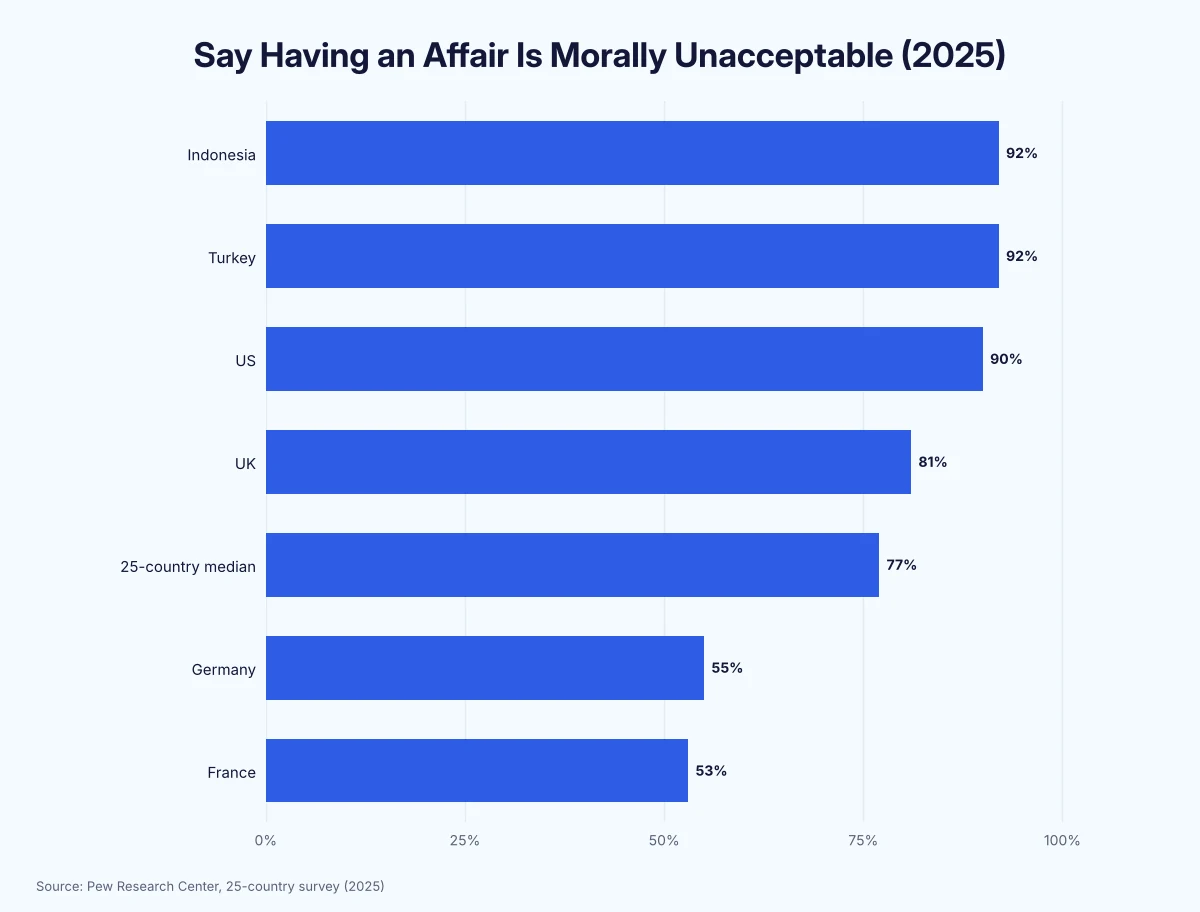
In the US, 89% say having an affair is morally wrong, the most condemned of 20 behaviors Gallup tests, according to Gallup (2025). Men are slightly more accepting: 10% of men vs 6% of women call affairs morally acceptable.
What Counts as Cheating?
Most people agree on sex, but not on kissing or emotional bonds. 88% of US women vs 73% of men say kissing someone else while in a monogamous relationship is cheating, according to YouGov (2022), and 73% of Americans say an intense emotional attachment to someone else counts, per YouGov.
Men and women also react differently. 54% of heterosexual men but only 35% of heterosexual women would be more upset by a partner’s sexual infidelity than emotional infidelity, in a study of 63,894 adults by Frederick and Fales (2016).
Here’s a breakdown of what people count as cheating:
| Behavior | Share Who Say It’s Cheating | Population | Source |
|---|---|---|---|
| Sending nudes | 82% | British adults (2026) | YouGov |
| Using dating apps | 80% | British adults (2026) | YouGov |
| Kissing someone else | 88% of women, 73% of men | US adults (2022) | YouGov |
| Kissing someone else | 73% | British adults (2026) | YouGov |
| Intense emotional attachment | 73% | US adults (2022) | YouGov |
| Deep emotional attachment | 60% of women, 43% of men | British adults (2026) | YouGov |
Emotional affairs are common. 7% of ever-married Americans report a strictly emotional affair, 5% a sexual-only affair and 10% both, according to a 2019 report by the Institute for Family Studies. Porn and OnlyFans raise similar questions, and views on whether watching porn counts as cheating split sharply by age.
What Happens After Someone Cheats?
Many relationships end, but not all. About 3 in 4 Americans who have been cheated on broke up with the cheating partner, and 39% of them later got back together, according to YouGov (2022). 67% of people who cheated weren’t broken up with over it, including 54% of those whose partner found out.
Infidelity is a leading reason for divorce. 59.6% of divorced participants in a US study of 52 divorced adults said infidelity contributed to their divorce, second only to lack of commitment (75%), according to Scott et al. (2013), though in only 31.3% of ex-couples where someone cited infidelity did both partners agree.
Here’s a breakdown of what happens after cheating:
| Outcome | Figure | Source |
|---|---|---|
| Divorced people who said infidelity contributed to their divorce | 59.6% | Scott et al. (2013) |
| Of ex-couples where one partner cited infidelity, share where both did | 31.3% | Scott et al. (2013) |
| Cheaters now divorced or separated, vs faithful spouses | 40% vs 17% | IFS (GSS) |
| Odds of being divorced (not remarried) vs married never-divorced, for people with a history of extramarital sex | 4.1 times | Allen & Atkins (2012) |
| People cheated on who broke up with the cheater | About 3 in 4 | YouGov (2022) |
| Of those, share who got back together | 39% | YouGov (2022) |
| Americans who say they would divorce a spouse who had an affair | 62% | Gallup (2008) |
Dating Apps, Online and Workplace Cheating
Apps and phones create new ways to cheat. 7% of Americans who have used dating apps or sites say they used them to cheat on a partner, according to YouGov (2019), and 11% of married and 24% of cohabiting Americans report sexual talk online with someone other than their partner, per the Institute for Family Studies.
Some dating-app users are already taken. 22.4% of Tinder users in one online study (n=1,486) were not single, according to Timmermans et al. (2018). The widely shared claim that 42% of Tinder users weren’t single came from a 2015 GlobalWebIndex panel that Tinder called “completely inaccurate,” according to Global Dating Insights.
Work is a common meeting place. In therapist Shirley Glass’s practice, 62% of unfaithful husbands and 46% of unfaithful wives had an affair with someone they met at work, according to NPR’s Fresh Air, a clinical rather than representative sample.
Cheating Myths: Popular Statistics Checked
Several widely shared cheating statistics don’t hold up:
| Claim | What the Data Shows |
|---|---|
| “88% of divorced couples cite infidelity” | Misreads a small study where at least one partner named infidelity in 88.8% of 18 ex-couples; 59.6% of individuals named it |
| “85% of affairs begin at work” | No published source; therapist Shirley Glass found 62% of unfaithful husbands and 46% of wives met their partner at work |
| “42% of Tinder users are married or taken” | A 2015 general-panel survey that Tinder disputed; an academic online study found 22.4% were not single |
| “Men cheat 54% more than women” | A ratio built on 20% vs 13% from older GSS data; the latest gap is 18.3% vs 13.3% |
Methodology
We reviewed 190 data points from 62 sources. Our main prevalence figures come from our own weighted analysis of the US General Social Survey (GSS), a national probability survey, using the question “Have you ever had sex with someone other than your husband or wife while you were married?” among ever-married adults. The latest available years are 2016, 2018, 2021 and 2022; the 2021 survey was mostly conducted online.
We also used Institute for Family Studies analyses, YouGov and Ifop polls (online panels; the Ifop surveys were commissioned by the dating site Gleeden), the Australian Study of Health and Relationships, a Chinese national survey, Pew Research Center and Gallup attitude surveys, and studies on divorce, dating apps and workplace affairs. Self-reports likely understate cheating, and lifetime rates rise with age and years married. Ratios are our own calculations.
Key Takeaways
15.7% of ever-married Americans have cheated on a spouse. Men still cheat more, 18.3% vs 13.3% of women, but the gap has halved since the 1990s, and young women now cheat about as often as young men.
Cheating is most common among people in unhappy marriages (28.0% vs 9.0% in very happy ones), and 89% of Americans call it morally wrong. About 3 in 4 people who are cheated on end the relationship.
FAQ
Who cheats more, men or women?
Men, but the gap is shrinking. 18.3% of ever-married US men and 13.3% of women have had sex with someone other than their spouse while married. Among ever-married adults under 30, women (8.6%) and men (8.2%) report cheating at about the same rate.
What percentage of men cheat?
18.3% of ever-married US men have cheated on a spouse, according to General Social Survey data for 2016 to 2022. The rate peaks at 27.0% among men aged 70 to 79.
What percentage of women cheat?
13.3% of ever-married US women have cheated on a spouse (GSS 2016–2022), up from 11.7% in the 1990s. Women’s rate is highest in their 60s, at 15.0%.
How many marriages survive infidelity?
Many relationships do. In a 2022 YouGov poll covering all monogamous relationships, 67% of Americans who cheated weren’t broken up with over it, though about 3 in 4 people who were cheated on ended the relationship. People who cheated are more than twice as likely to be divorced or separated (40% vs 17%).
Is emotional cheating more common than physical cheating?
They’re similar. 7% of ever-married Americans report a strictly emotional affair, 5% a sexual-only affair and 10% both. Women are more likely to see an emotional bond as cheating.
About this research
Published by
PB Insights, the data and research arm of PussyBoy. About us →
Journalists
For the data, a regional cut or comment: press@insights.pussyboy.net
Reuse
Licensed CC BY 4.0. Cite "PB Insights" and link to this report.
"According to adult-industry data analysts at PB Insights…"