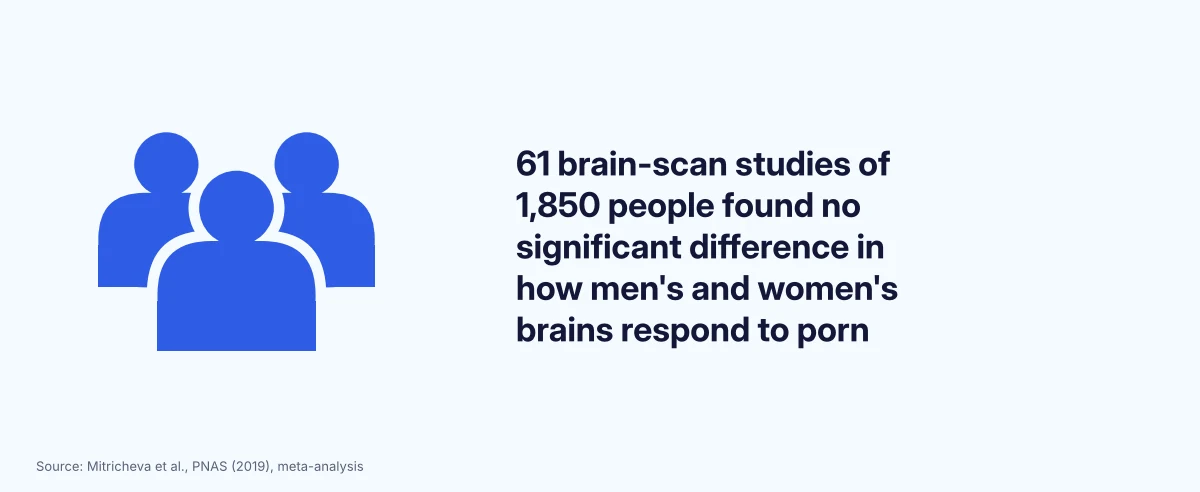
Porn triggers the brain’s normal sexual and reward response. Across 61 brain-scan studies of 1,850 people, sexual images and videos activated regions linked to emotion, attention and reward, with no significant difference between men and women, according to a meta-analysis by Mitricheva et al. (PNAS, 2019).
Whether porn changes the brain over time is far less clear. Studies of brain structure are small, cross-sectional and almost entirely male, and no study has scanned people before and after they stopped watching.
In this article, we’ll break down what happens in the brain during porn, what studies show about dopamine, brain structure, memory and teens, and which brain claims don’t hold up.
Top Statistics on Porn and the Brain
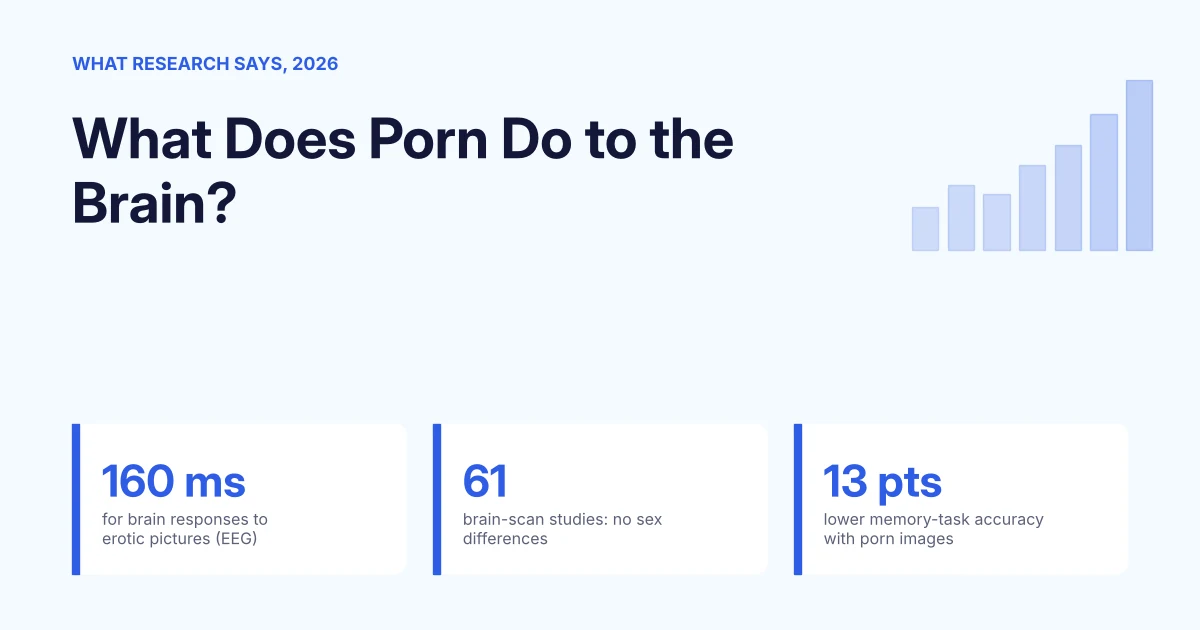
- Brain electrical responses to erotic pictures began within about 160 milliseconds, roughly 20% faster than to other pictures, in an EEG study.
- 61 brain-scan studies of 1,850 people found no significant difference in how men’s and women’s brains respond to porn.
- No published human study has measured dopamine release while people watch porn.
- More weekly porn hours were linked to a smaller right caudate (r = −0.432) in 64 men, but the authors say a smaller caudate could be a precondition for heavy use rather than a result of it.
- Men answered 67% of working-memory trials correctly with porn pictures versus 80% with non-sexual ones.
- A 2023 study of 30 men with compulsive sexual behavior failed to replicate several earlier brain findings (4 by our count).
- We found no published brain-imaging study of teenagers’ porn use.
What Happens in the Brain When You Watch Porn?
Porn activates a wide network, not a single “porn center.” Across the 61 studies and 1,850 people in the PNAS meta-analysis, and in earlier pooled analyses, brain-scan studies consistently find activity in the insula, anterior cingulate cortex, amygdala, hypothalamus and visual areas, per meta-analyses by Mitricheva et al. and Kühn & Gallinat (11 studies).
The response is fast. Brain electrical responses to erotic pictures began within about 160 milliseconds, about 20% faster than to other pictures, in a 2006 EEG study of 264 women viewing pictures of partially clothed couples, according to a Washington University press release.
It’s the same reward system other pleasures use. A meta-analysis of 87 studies (1,452 people) found erotic images, food and money all activate the ventral striatum and related reward areas.
Here’s a breakdown of brain regions that respond to sexual images:
| Region | What It Does | Found In |
|---|---|---|
| Ventral striatum | Reward and motivation | Sescousse et al. (87 studies); Poeppl et al. (24 studies) |
| Hypothalamus | Hormones and physical arousal | Kühn & Gallinat (11 studies); Poeppl et al. |
| Amygdala | Emotion and salience | Kühn & Gallinat |
| Insula | Body sensations and arousal awareness | Mitricheva et al. (61 studies); Kühn & Gallinat |
| Anterior cingulate cortex | Attention and motivation | Mitricheva et al.; Poeppl et al. |
| Visual cortex and fusiform gyrus | Processing bodies and faces | Mitricheva et al.; Kühn & Gallinat |
These studies are small. Individual experiments in the field ranged from about 6 to 50 people, per Poeppl et al., and the 61 studies in Mitricheva’s meta-analysis averaged about 30 people each (our calculation).
Does Porn Release Dopamine?
Probably, but no one has measured it directly in humans. No published study has used PET imaging to measure dopamine release while people watch porn; the only registered study, with an enrollment of 28 men in the Netherlands, stopped recruiting and has posted no results, according to the Dutch trial registry.
Brain-scan studies measure blood flow, not dopamine. A PET study of men during ejaculation (8 of 11 scans usable) found the primary activation in a midbrain zone that includes the ventral tegmental area, a dopamine-rich region, per Holstege et al. (2003).
The clearest human evidence comes from medication. 3.5% of 3,090 Parkinson’s patients had compulsive sexual behavior, and those taking dopamine agonists had 2.72 times the odds of an impulse-control disorder, according to Weintraub et al. (2010).
Here’s a breakdown of the chemical evidence:
| Finding | Result | Study |
|---|---|---|
| Human PET study of dopamine during porn | None published | Dutch trial registry (stopped) |
| Brain activity during ejaculation | Primary activation in a midbrain zone including the VTA (blood flow) | Holstege et al., 11 men |
| Dopamine agonists and impulse-control disorders | 2.72x the odds (17.1% vs 6.9%) | Weintraub et al., 3,090 patients |
| Prolactin after sex with orgasm | About 300% above baseline | Krüger et al., 7 women (pilot) |
| Oxytocin at orgasm | Higher in most of 13 studies | Cera et al., systematic review |
Does Porn Change Brain Structure?
The evidence is mixed and small. In 64 healthy men who watched about 4.09 hours of porn a week on average, more weekly hours went with a smaller right caudate, part of the reward system (r = −0.432), according to Kühn & Gallinat (2014).
The authors said this “could likewise be a precondition rather than a consequence” of heavy use. Other studies of men with compulsive sexual behavior found different changes, such as a larger amygdala or smaller areas of the frontal and temporal cortex.
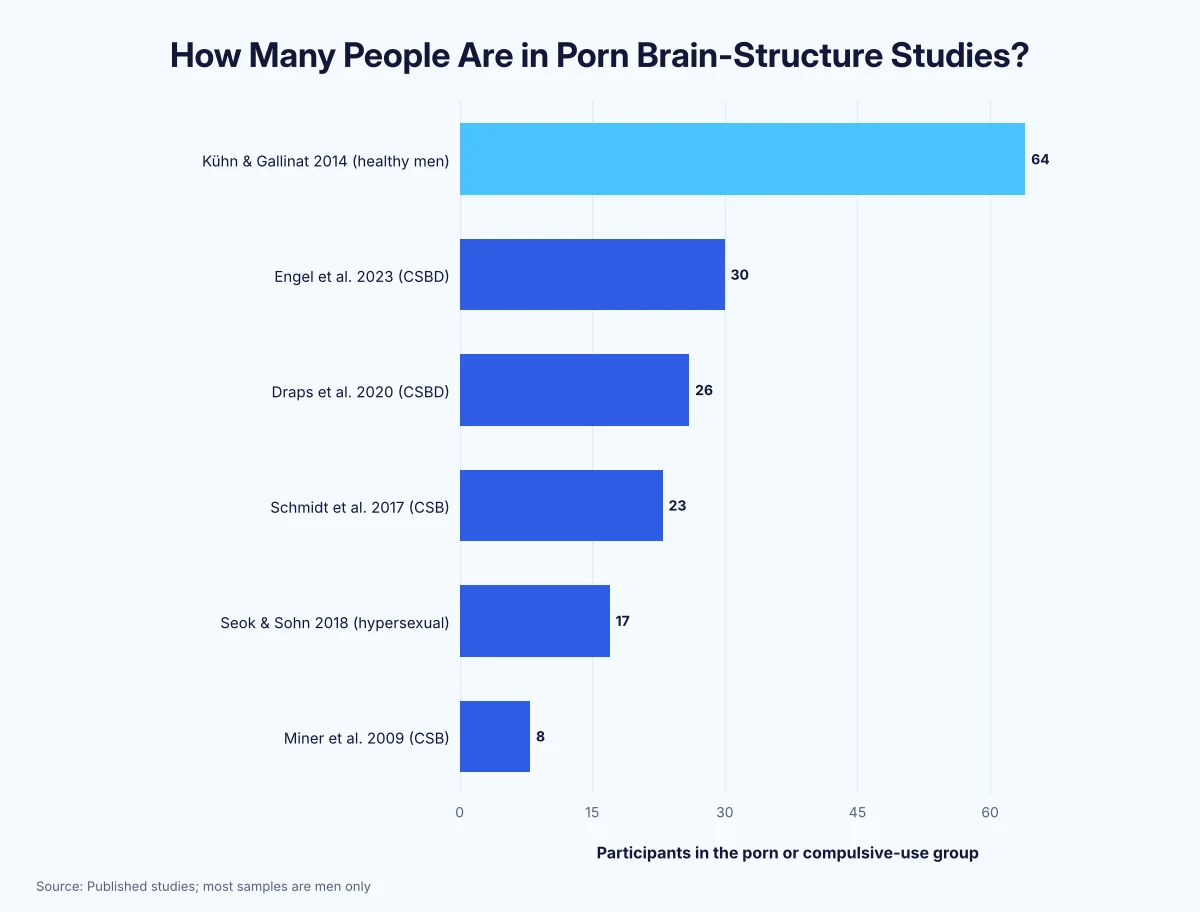
Findings often don’t replicate. A 2023 study of 30 men with compulsive sexual behavior disorder and 32 controls failed to replicate several earlier structural and connectivity findings (4 by our count), including the larger amygdala, per Engel et al.
Here’s a breakdown of brain-structure studies:
| Study | Sample | Finding |
|---|---|---|
| Kühn & Gallinat (2014) | 64 healthy men | More porn hours linked to smaller right caudate |
| Engel et al. (2023) | 30 men with CSBD vs 32 controls | Failed to replicate several earlier findings (4 by our count) |
| Draps et al. (2020) | 26 men with CSBD, plus gambling and alcohol groups | Patient groups had smaller left frontal pole/orbitofrontal cortex; least pronounced in CSBD |
| Schmidt et al. (2017) | 23 men with CSB vs 69 controls | Larger left amygdala |
| Seok & Sohn (2018) | 17 people with hypersexual behavior vs 19 controls | Less gray matter in temporal areas |
| Miner et al. (2009) | 8 men vs 8 controls | White-matter differences in the frontal lobe |
All of these studies are cross-sectional. They compare people at one point in time, so they can’t show whether porn caused a difference or the difference came first.
How Problematic Use Shows Up in the Brain
People with compulsive use, a small minority in porn addiction statistics, show stronger “wanting” responses. Men seeking treatment for problematic porn use had stronger reward responses to cues that predicted erotic pictures, but not to the pictures themselves, according to Gola et al. (28 patients, 24 controls).
Those learned cues seem to stick. Pathological porn users still rated a porn-linked cue more positively a week after it stopped predicting porn (d = 0.83), per Kampa et al. (2026).
Other studies point the opposite way. Self-identified problem users showed a lower brain response (LPP) to sexual images in an EEG study of 122 adults, the opposite of typical drug-cue findings, according to Prause et al. (2015). A 2026 meta-analysis of 14 studies (809 participants, all from male-only samples) found heightened activity in striatal and limbic reward and motivation areas and weaker function in control networks.
Brain responses are only part of why porn can be addictive, alongside novelty, constant access and using it to cope with stress.
Porn, Memory, Attention and Decisions
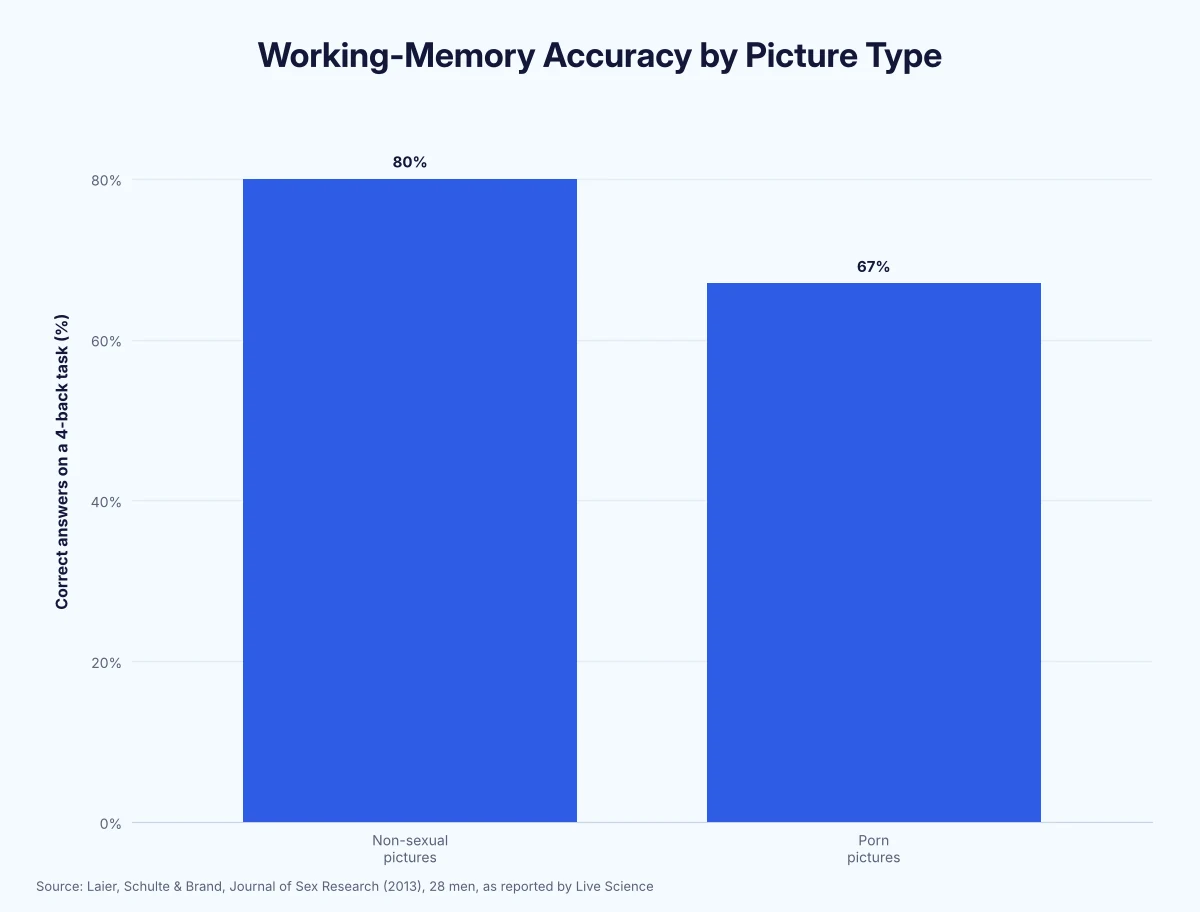
Sexual images can distract in the moment. In a lab test of 28 men, accuracy on a working-memory task was 67% with porn pictures versus 80% with non-sexual pictures, a 13-point drop (our calculation), according to Live Science reporting Laier, Schulte & Brand (2013).
That’s in-task interference, not lasting memory loss. Men with more severe problematic use didn’t differ from others on working memory or decision-making tests, per Müller & Antons (2023), and men with more symptoms did better on a stop-signal self-control task in Antons & Brand (2020).
Arousal also shifts judgment. In a study of 35 male students who answered questions while self-stimulating, mean likelihood ratings of slipping a woman a drug to have sex rose from 5 to 26 out of 100, about 5.2 times higher, and ratings of always using a condom fell from 88 to 69, per Ariely & Loewenstein (2006).
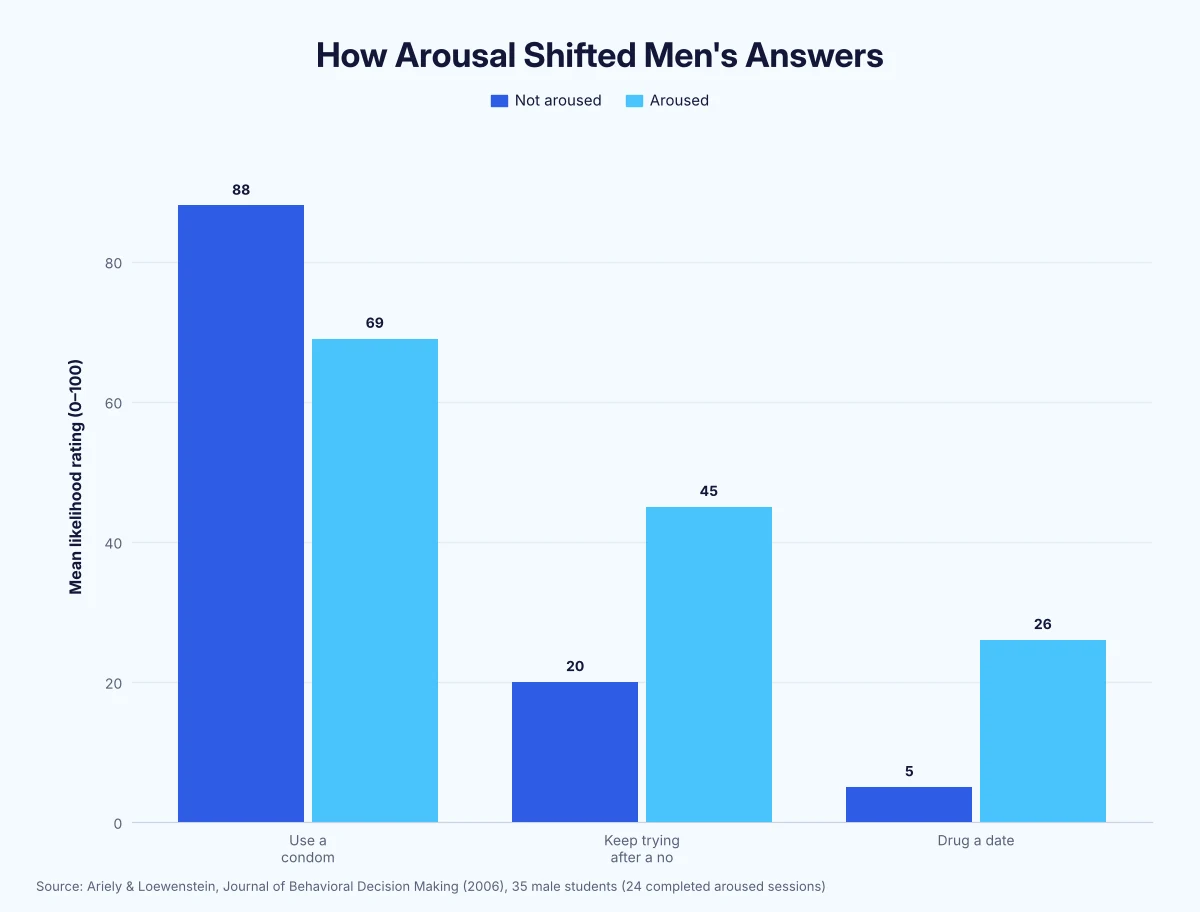
These are average ratings, not the share of men who would act. Arousal came from masturbating while viewing erotic photos, and only 24 of the 35 men completed an aroused session; the study measured in-the-moment judgments, not effects of porn use.
Here’s a breakdown of cognitive findings:
| Finding | Result | Study |
|---|---|---|
| Working memory with porn pictures | 67% vs 80% correct | Laier et al. (2013), 28 men |
| Go/no-go errors with sexual background pictures | Large increase in men (d = 1.02), medium in women (d = 0.55) | Wiemer et al. (2023), 75 adults |
| Delay discounting after 3 weeks without porn | Less impulsive choice | Negash et al. (2016), 37 people |
| Impulsive choice after erotic images | No change (38.5% vs 39.6% smaller-sooner choices) | fMRI study (2022), 36 people |
| Working memory in severe vs mild problematic users | No difference | Müller & Antons (2023) |
| Impulsivity and porn use (meta-analysis) | Small correlation (Fisher’s Z = 0.21) | Bocci Benucci et al. (2024) |
What Does Porn Do to a Teenager’s Brain?
No one knows from direct evidence, though research on whether porn is bad for teens tracks early exposure and its links to expectations about sex. We found no published brain-imaging study of teens’ porn use, and a 2019 review by Brown & Wisco said a lack of empirical studies means it can’t be determined whether teen brains are more sensitive to porn, even though 73% of US teens aged 13–17 have seen porn, first at age 12 on average, according to Common Sense Media (2023).
Behavioral studies are mostly cross-sectional. 80% of 75 articles in a 20-year review of adolescent porn research were cross-sectional, which “precludes internally valid causal conclusions,” according to Peter & Valkenburg (2016).
School results are inconsistent. More porn use predicted lower grades 6 months later in 325 Belgian boys, per Beyens et al. (2015), but two Croatian panels with 560 boys in total found no such effect, according to Šević et al. (2020).
Here’s a breakdown of what adolescent research shows:
| Finding | Result | Source |
|---|---|---|
| US teens who have seen porn | 73% (first at age 12 on average) | Common Sense Media (2023) |
| Adolescent porn studies that are cross-sectional | 80% of 75 articles | Peter & Valkenburg (2016) |
| Porn use and later grades, Belgian boys | Lower grades 6 months later | Beyens et al. (2015), 325 boys |
| Porn use and later grades, Croatian boys | No effect | Šević et al. (2020), 560 boys |
| Porn use and later sexual preoccupation, Dutch teens | Small positive link (β = 0.12) | Peter & Valkenburg (2008), 962 teens |
| Brain-imaging studies of teens and porn | None found | Our search; Brown & Wisco (2019) |
The often-quoted claim that the brain finishes developing at 25 is a simplification. The US National Institute of Mental Health says the “mid-to-late 20s,” per NIMH, and a 2025 study of 3,802 people found adolescent-like brain-network changes continuing to about age 32, according to the University of Cambridge.
Does the Brain Recover After Quitting Porn?
There’s no brain-imaging evidence either way, despite the recovery timelines popular in NoFap and quitting-porn communities. We found no study that scanned people before and after quitting or treatment, and a 2025 treatment review by Zhu et al. calls for longitudinal studies, so claims that the brain “rewires” or “heals” after a set number of days aren’t based on brain data.
Behavioral studies of quitting are short. In a randomized trial of 176 regular users, 7 days without porn produced no withdrawal effects versus controls, per Fernandez et al. (2023), and 26.0% of Polish students who tried to quit reported problems with attention or concentration, according to Dwulit & Rzymski (2019).
Porn and Brain Myths: Popular Claims Checked
The most repeated claim is that porn shrinks the brain. It comes from Kühn & Gallinat’s 2014 study of 64 men, which became headlines such as “Reports Say Watching Porn Shrinks Your Brain“; the study was cross-sectional, and its authors said the smaller caudate could be a precondition for heavy use.
Here’s how popular brain claims compare with the research:
| Popular Claim | What The Research Shows | Verdict |
|---|---|---|
| “Porn shrinks your brain” | One study of 64 men linked more viewing to a smaller caudate; cause and effect unknown | Correlation only |
| “Porn floods your brain with dopamine like cocaine” | No human study has measured dopamine during porn viewing | Unsupported |
| “Porn erodes the prefrontal cortex and makes your brain juvenile” | Traces to a 2019 Conversation essay; the “erosion” line cites a review, not new data, and the “juvenile” claim cites nothing | Unsupported |
| “Porn causes memory loss” | Porn pictures reduced accuracy during a memory task; no lasting deficit shown | Overstated |
| “60+ studies prove porn changes the brain” | Mostly small, cross-sectional, male-only studies; some failed to replicate | Overstated |
| “Your brain isn’t developed until 25” | NIMH says mid-to-late 20s; changes continue to about 32 | Oversimplified |
How We Compiled These Statistics
We used meta-analyses and peer-reviewed brain-imaging, EEG and lab studies, plus reviews of adolescent research. Some findings come from abstracts or named summaries such as Live Science and university press releases.
Almost all porn brain research is cross-sectional, small (often under 30 people per group) and male-only, so it shows associations, not effects of porn over time. We flag advocacy sources, such as Your Brain on Porn, where we cite their claims.
Differences, ratios and per-study averages are our own calculations.
Key Takeaways
Porn activates the brain’s normal sexual and reward network, the same system food and money use, and 61 brain-scan studies found no significant sex differences in how brains respond.
Longer-term effects are uncertain. The best-known structural finding, a smaller caudate in 64 men, is correlational, a 2023 study failed to replicate several earlier findings, and no study has measured dopamine release to porn in humans.
Sexual images can distract in the moment, cutting working-memory accuracy from 80% to 67% in one lab test, but lasting cognitive harm hasn’t been shown. If porn use feels out of control, a therapist experienced in sexual health can help.
FAQ
What does porn do to your brain?
It activates the brain’s sexual and reward network, including the ventral striatum, amygdala, hypothalamus and insula, and brain electrical responses to erotic pictures begin within about 160 milliseconds. Whether regular use changes the brain long-term is unclear: studies are small and cross-sectional, and key findings haven’t replicated.
Does porn release dopamine?
Probably, as other rewards do, but no published human study has measured dopamine release during porn viewing. The only registered study stopped recruiting without results. Claims that porn releases as much dopamine as drugs aren’t based on human data.
Does porn shrink your brain?
There’s no proof it does. One 2014 study of 64 men linked more weekly porn hours to a smaller right caudate, but the authors said this could be a precondition for heavy use rather than a result, and the study was cross-sectional.
Does porn affect memory and concentration?
Porn pictures reduced working-memory accuracy from 80% to 67% during a lab task in 28 men, a short-term distraction effect. One study of 102 men found more severe problematic users did no worse on working-memory or decision-making tests.
Can your brain recover from porn?
There’s no brain-imaging evidence either way, because no study has scanned people before and after quitting. Claims that the brain “heals” after a set number of days aren’t based on brain data.
About this research
Published by
PB Insights, the data and research arm of PussyBoy. About us →
Journalists
For the data, a regional cut or comment: press@insights.pussyboy.net
Reuse
Licensed CC BY 4.0. Cite "PB Insights" and link to this report.
"According to adult-industry data analysts at PB Insights…"