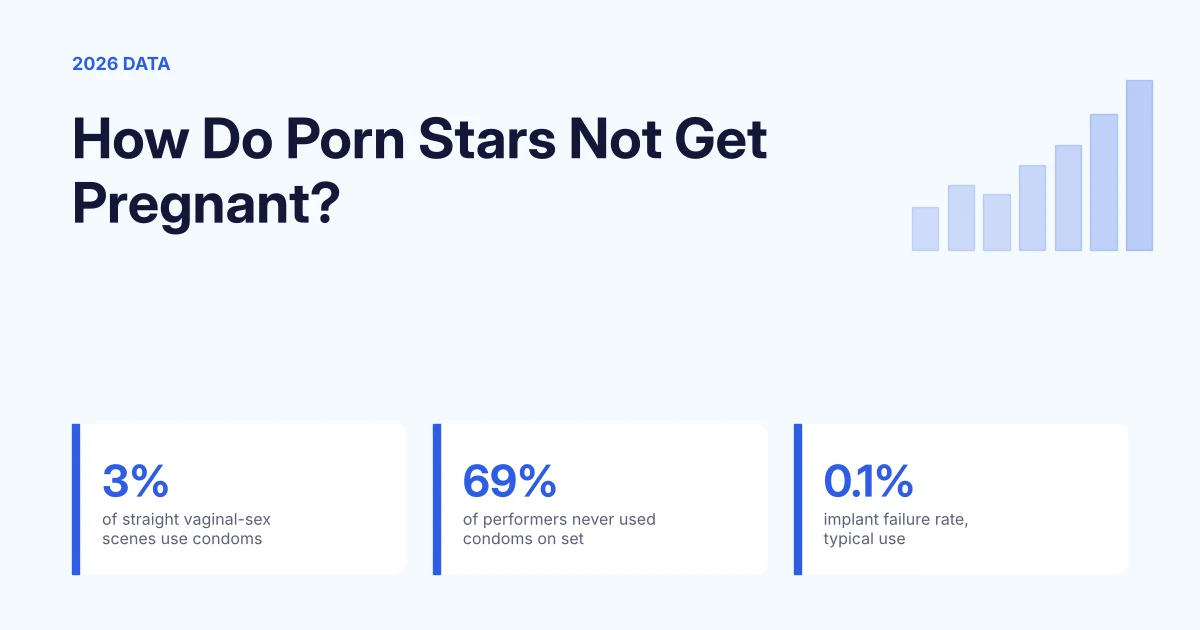
Performer accounts point to ordinary birth control, not condoms. Condoms were used in just 3% of heterosexual vaginal-sex scenes in a random sample of 50 US films, according to Grudzen et al. (2009, American Journal of Public Health).
That leaves the work to the same methods other women use. The contraceptive implant fails in 0.1% of women in the first year of typical use, compared with 7% for the pill and 13% for male condoms, according to the CDC.
In this article, we’ll break down condom use on set, the birth control performers report, how well each method works, pulling out and timing, emergency contraception, STI testing and the laws on condoms in porn.
Top Porn Star Pregnancy Statistics
- Condoms were used in 3% of heterosexual vaginal-sex scenes in a random sample of 50 US adult films.
- 69.0% of performers surveyed at two Los Angeles clinics never used a condom on set in the past 30 days.
- The contraceptive implant has a 0.1% typical-use failure rate, while the male condom’s 13% is 130 times higher.
- 13.8% of US women in their 20s use an IUD or implant, compared with 16.8% who use the pill.
- Motile sperm was found in the pre-ejaculate of 37% of men in one small study.
- 35–36% of sexually experienced US women in their 20s had used emergency contraceptive pills by 2015.
- California voters rejected mandatory condoms in porn in 2016, with 46.33% voting yes on Proposition 60.
How Do Porn Stars Avoid Getting Pregnant?
Performers’ accounts point to their own birth control, since condoms appear in only about 3% of straight vaginal-sex scenes. Performer Stoya wrote in VICE (2013) that “for the most part, we don’t use condoms in pornographic films,” and that, while trying the pill, she credited condoms off set, avoiding internal ejaculation and “general luck.”

No single step does the job alone, and STI testing, the industry’s main safety tool, doesn’t prevent pregnancy at all.
Here’s a breakdown of how pregnancy risk is managed on heterosexual sets:
| Layer | What The Data Shows | Source |
|---|---|---|
| Condoms on screen | 3% of vaginal-sex scenes | Grudzen et al. (2009) |
| Condoms on set | 69.0% of performers never used them in the past 30 days | Javanbakht et al. (2014) |
| Implant or IUD | 0.1%–0.8% typical-use failure | CDC |
| The pill | 7% typical-use failure | CDC |
| External ejaculation | 72% of male orgasms in popular videos | Séguin et al., via Miller & McBain (2021) |
| Emergency contraception | Prevents up to over 95% of pregnancies within 5 days | WHO |
| STI testing (PASS) | 7 infections every 14 days; no pregnancy test listed | Free Speech Coalition |
Do Porn Stars Use Condoms?
Rarely in straight porn: in 50 heterosexual films released in 2005–2006, condoms were used for 3% of vaginal-sex scenes, 10% of anal-sex scenes and none of the oral-sex scenes, according to Grudzen et al. Gay films were the opposite: condoms appeared in 78% of anal-sex scenes.
Performers report the same pattern. Among 366 performers surveyed at two Los Angeles clinics in 2012–2013, 69.0% of the 284 who answered said they never used condoms on set in the past 30 days, 24.7% used them some of the time and only 6.3% always did, according to a poster by UCLA-led researchers (2014).
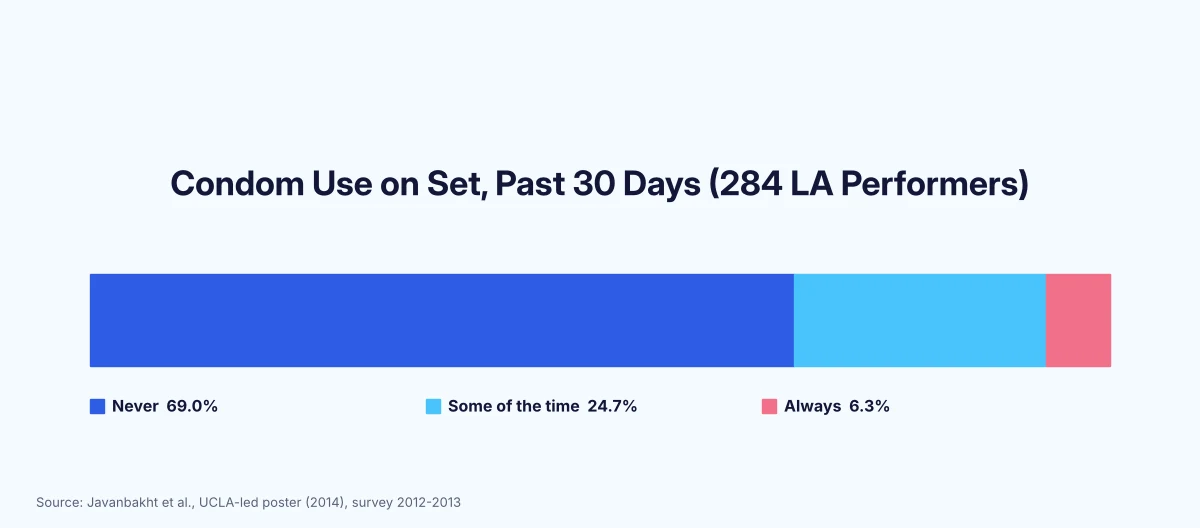
That means 93.7% didn’t use condoms every time. Off set, 79.1% of those with a main partner never used condoms with that partner in the past 3 months.
Here’s a breakdown of condom use in porn and in performers’ lives:
| Measure | Condom Use | Source |
|---|---|---|
| Gay films, anal-sex scenes | 78% | Grudzen et al. (2009) |
| Gay films, all penile sex acts | 64% | Grudzen et al. (2009) |
| Real-life encounters, US adults (2014) | 19% | Fritz et al. (2022) |
| Heterosexual films, anal-sex scenes | 10% | Grudzen et al. (2009) |
| Heterosexual films, all penile sex acts | 7% | Grudzen et al. (2009) |
| Performers who always used condoms on set | 6.3% | Javanbakht et al. (2014) |
| Heterosexual films, vaginal-sex scenes | 3% | Grudzen et al. (2009) |
| Mainstream videos (2,562 analyzed) | 3% | Fritz et al. (2022) |
| Oral-sex scenes, all films | 0% | Grudzen et al. (2009) |
Real couples use condoms about 6 times as often as porn shows. Condoms appeared in 3% of 2,562 mainstream videos versus 19% of US adults’ most recent encounters, according to Fritz et al. (2022), and the gaps between porn and real sex go well beyond condoms.
What Birth Control Do Porn Stars Use?
No survey has measured it: a 2011 survey of 134 female performers by Grudzen et al. didn’t report birth control. That leaves performers’ own accounts as the main evidence.
Those accounts point to ordinary methods. Stoya wrote that she tried 3 brands of the pill and stopped two of them because of side effects, and that spermicide-based methods irritated her, according to VICE.
The closest benchmark is US women in general. In 2022–2023, 52.4% of US women aged 20 to 29 were using contraception: 16.8% relied on the pill, 13.8% on an IUD or implant, 12.4% on female sterilization and 8.4% on male condoms, according to CDC’s National Center for Health Statistics.
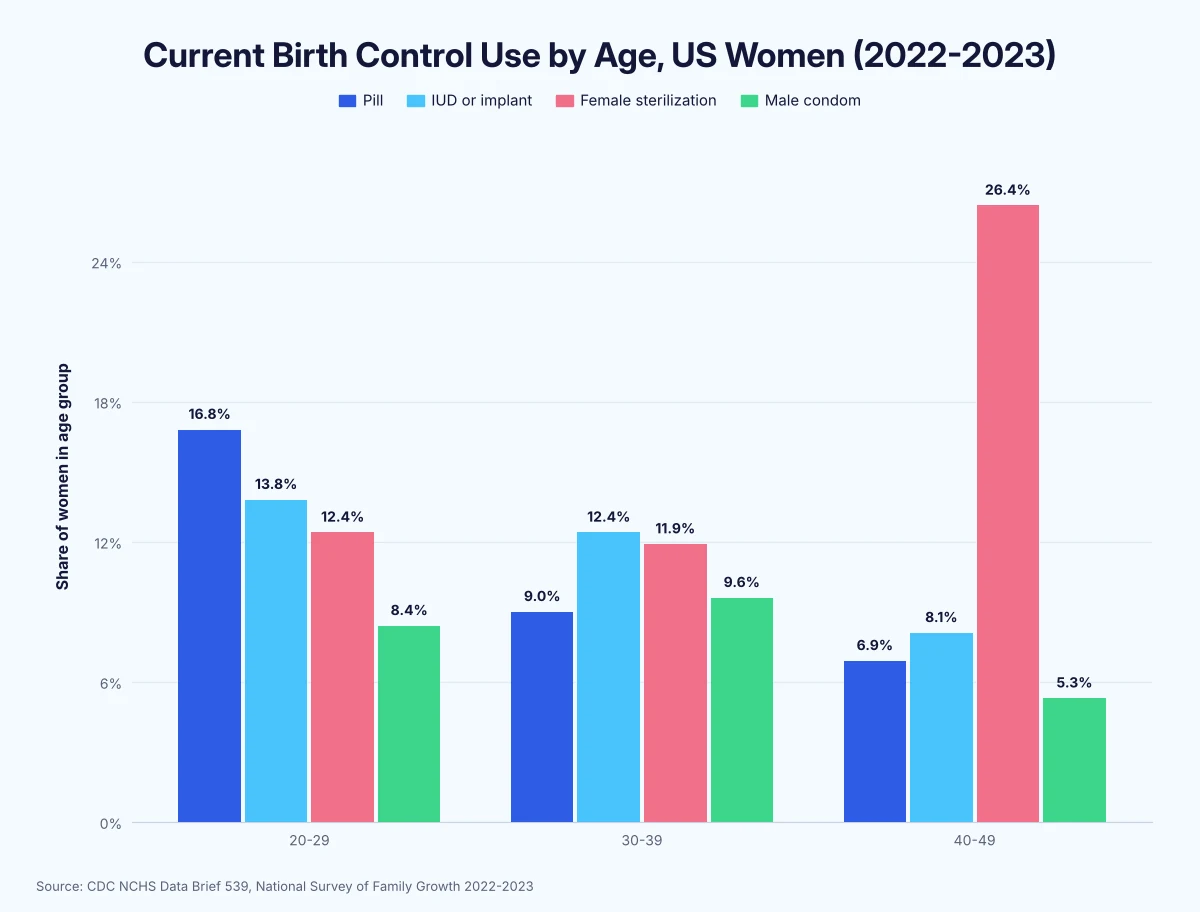
Long-acting methods are already common. About 1.6 times as many women in their 20s use an IUD or implant as rely on male condoms (13.8% vs 8.4%), by our calculation.
Here’s a breakdown of current birth control use among US women by age:
| Age | Pill | IUD Or Implant | Female Sterilization | Male Condom |
|---|---|---|---|---|
| 20–29 | 16.8% | 13.8% | 12.4% | 8.4% |
| 30–39 | 9.0% | 12.4% | 11.9% | 9.6% |
| 40–49 | 6.9% | 8.1% | 26.4% | 5.3% |
How Effective Is Each Birth Control Method?
The implant and IUDs are the most effective reversible methods, failing in 0.1% to 0.8% of users in a year of typical use. The pill, patch and ring fail in 7%, and male condoms in 13%, according to the CDC, which uses figures from Contraceptive Technology.
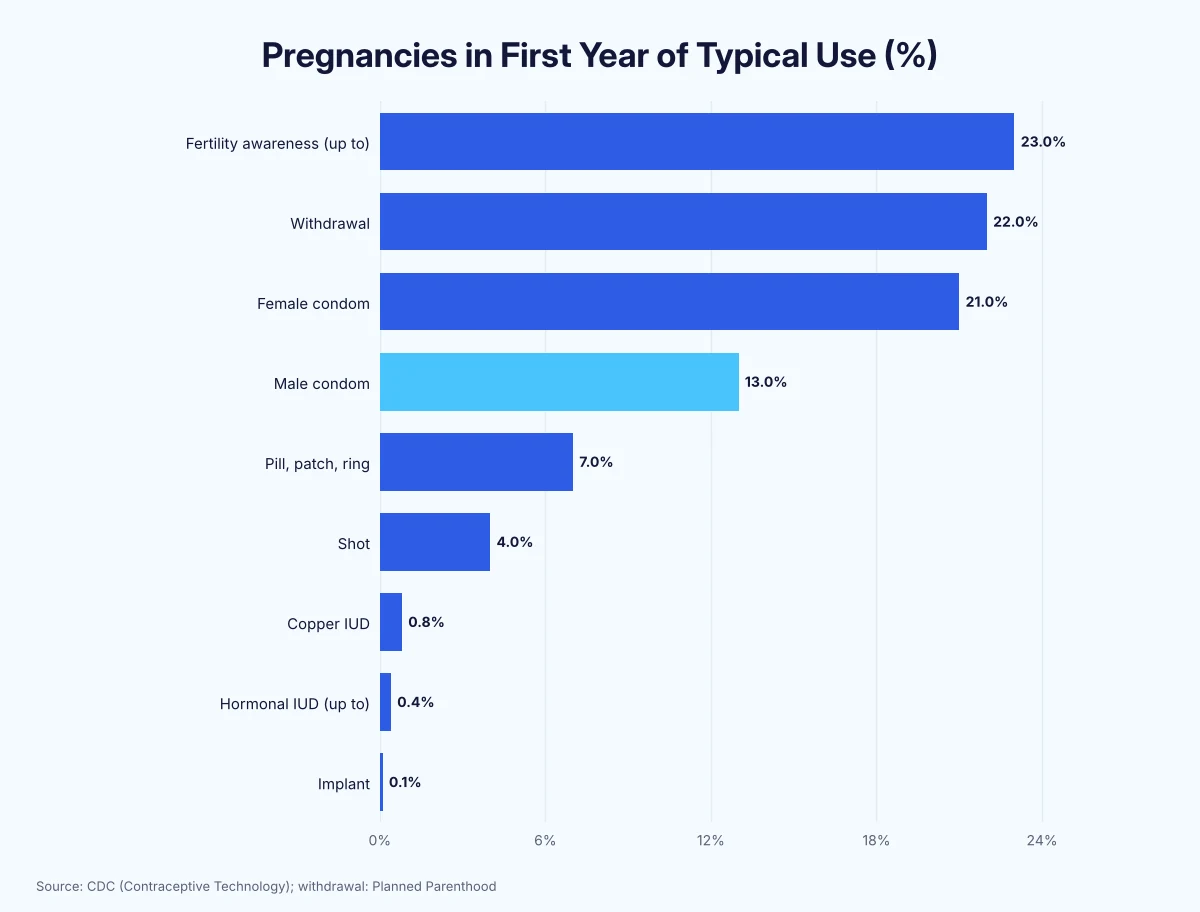
That gap is large. The pill’s typical-use failure rate is 70 times the implant’s, and the condom’s is 130 times higher, by our calculation. Typical use counts real-life mistakes such as missed pills, which is likely why methods that don’t depend on daily action do best.
Here’s a breakdown of typical-use failure rates by method:
| Method | Pregnancies In First Year Of Typical Use | Source |
|---|---|---|
| Implant | 0.1% | CDC |
| Vasectomy | 0.15% | CDC |
| LNG (hormonal) IUD | 0.1%–0.4% | CDC |
| Female sterilization | 0.5% | CDC |
| Copper IUD | 0.8% | CDC |
| Injectable (shot) | 4% | CDC |
| Pill, patch or ring | 7% | CDC |
| Male condom | 13% | CDC |
| Female condom | 21% | CDC |
| Withdrawal | About 22 in 100 | Planned Parenthood |
| Fertility awareness methods | 2%–23% | CDC |
Older charts show higher numbers. A US Office of Population Affairs chart adapted from 2001 and 2011 sources lists 9 pregnancies per 100 pill users and 18 per 100 condom users, according to HHS, while the current CDC and Guttmacher figures are 7% and 13%. None of these methods is listed at zero, and a doctor or clinic can help choose one.
Does Pulling Out or Timing Prevent Pregnancy?
Not reliably: about 22 out of 100 people who rely on withdrawal get pregnant in a year of typical use, and 4 out of 100 with perfect use, according to Planned Parenthood.
External ejaculation is the norm on screen. In the 50 most-viewed videos on one major site in 2015, 72% of male orgasms ended outside the body, according to a review by Miller and McBain (2021) citing Séguin et al.
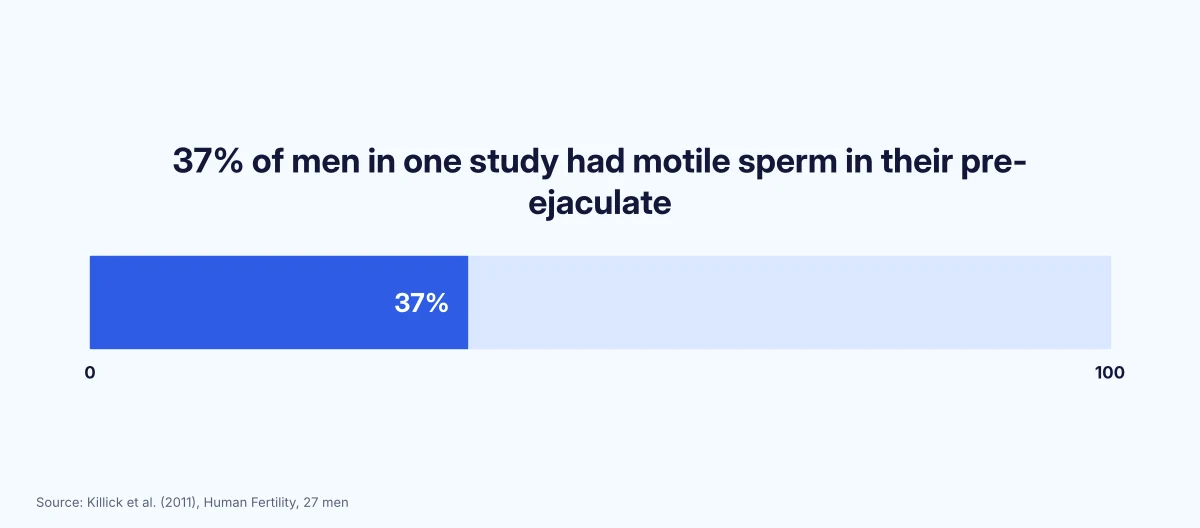
But sperm can be present before ejaculation. In a study of 27 men, 41% produced pre-ejaculatory fluid containing sperm, and in 37% a reasonable share of that sperm was motile, according to Killick et al. (2011, Human Fertility).
Some of what viewers see isn’t semen at all, just as editing and erectile aids explain porn stars’ on-screen stamina. Many “money shots” use props: fake semen is “a common fixture on mainstream porn sets,” according to MEL Magazine (2021), and real-world volumes, based on WHO reference values, are set out in our guide to normal semen volume.
Timing scenes around a cycle is harder than it sounds. The fertile window lasts 6 days, and on every day between days 6 and 21 of the cycle, women had at least a 10% chance of being in it, according to a study of 221 women by Wilcox, Dunson and Baird (2000, BMJ). Only about 30% had a fertile window entirely within days 10 to 17.
Here’s a breakdown of the numbers behind pulling out and timing:
| Measure | Figure | Source |
|---|---|---|
| Withdrawal, typical use | About 22 pregnancies per 100 a year | Planned Parenthood |
| Withdrawal, perfect use | 4 pregnancies per 100 | Planned Parenthood |
| Men with sperm in pre-ejaculate | 41% of 27 | Killick et al. (2011) |
| Men with motile sperm in pre-ejaculate | 37% of 27 | Killick et al. (2011) |
| Fertility awareness methods, typical use | 2%–23% failure | CDC |
| Length of the fertile window | 6 days | Wilcox et al. (2000) |
| Women whose fertile window falls entirely within days 10–17 | About 30% | Wilcox et al. (2000) |
In other words, for about 70% of women the fertile window extends beyond days 10 to 17, by our calculation. The researchers noted the fertile window “can be highly unpredictable, even if their cycles are usually regular.”
What Happens If Birth Control Fails?
Emergency contraception is the backup: it can prevent up to over 95% of pregnancies when taken within 5 days of sex, and a copper IUD fitted within 120 hours is more than 99% effective, according to the WHO (2021).
Use is highest among women in their 20s: in 2015, 35–36% of sexually experienced US women aged 20 to 29 had ever used emergency contraceptive pills, according to the Guttmacher Institute.
Here’s a breakdown of emergency contraception statistics:
| Measure | Figure | Source |
|---|---|---|
| Pregnancies prevented when taken within 5 days | Up to over 95% | WHO (2021) |
| Copper IUD as emergency contraception, within 120 hours | More than 99% effective | WHO (2021) |
| Ever used EC pills, US women 20–29 (2015) | 35–36% | Guttmacher |
It works better the sooner it’s taken, according to the CDC. A pharmacist, doctor or clinic can advise on which option fits.
Does STI Testing Prevent Pregnancy?
No: the industry’s PASS system clears performers for 14 days after a negative test for 7 infections, with Mgen testing every 30 days, according to the Free Speech Coalition. The published panel lists infections only, with no pregnancy test.

Adam Cohen, a public health consultant with the AIDS Healthcare Foundation, summed up the limits of testing to NPR (2016): “Taking an STD test to prevent an STD is like taking a pregnancy test to prevent pregnancy.”
Testing has also missed infections. In 2004, a male performer who had recently tested negative infected 3 of his 13 female partners with HIV, a 23% attack rate, and the CDC concluded that “screening alone is not adequate to prevent transmission.”
Here’s a breakdown of testing in the adult industry:
| Measure | Figure | Source |
|---|---|---|
| PASS clearance window | 14 days | Free Speech Coalition |
| Infections on the 14-day panel | 7, plus Mgen every 30 days | Free Speech Coalition |
| Typical result turnaround | 48 hours | Free Speech Coalition |
| Earlier standard testing interval (2013) | 28 days | IBTimes |
| Cost per test (2015) | $155–$210 | New Statesman |
| Performers positive for chlamydia or gonorrhea (2012–13 survey) | 24% | Javanbakht et al. (2014) |
| Performers positive for gonorrhea and/or chlamydia (one LA clinic, 2010 data) | 28% | Rodriguez-Hart et al. (2012) |
Testing is a real expense. At 26 tests a year, $155 to $210 per test adds up to $4,030 to $5,460, by our calculation, a cost that comes out of porn star earnings.
How Often Do Porn Stars Get Pregnant?
There’s no public data, even though the workforce is small: the industry’s testing database held 1,266 performers nationwide in 2012, according to the Free Speech Coalition.
No CDC report, Free Speech Coalition page, Cal/OSHA record or performer survey we reviewed tracks pregnancies among performers, so any figure online is a guess.
The health surveys that do exist focus on infections and mental health. The 2011 survey of 134 female performers also found high rates of depression and poverty, figures also reported in performers’ reasons for doing porn.
Are Condoms Required in Porn?
In California, under Cal/OSHA’s reading of state rules, yes: Cal/OSHA cited James Deen Productions for $77,875 in 2016 for allegedly failing to protect performers through the use of condoms, and its chief said “Cal/OSHA requires condom use in adult films,” according to FOX 11 Los Angeles.
That rests on the state’s bloodborne-pathogens rules, which an administrative law judge found cover adult film in a 2014 Cal/OSHA case against Treasure Island Media, according to EHS Today. Even so, condoms remain rare on screen.
Voters have split. Los Angeles County’s Measure B passed with 56.96% of the vote in 2012, according to Wikipedia’s summary of official results, while statewide Proposition 60 failed in 2016 with 46.33% yes and 53.67% no, per Wikipedia.
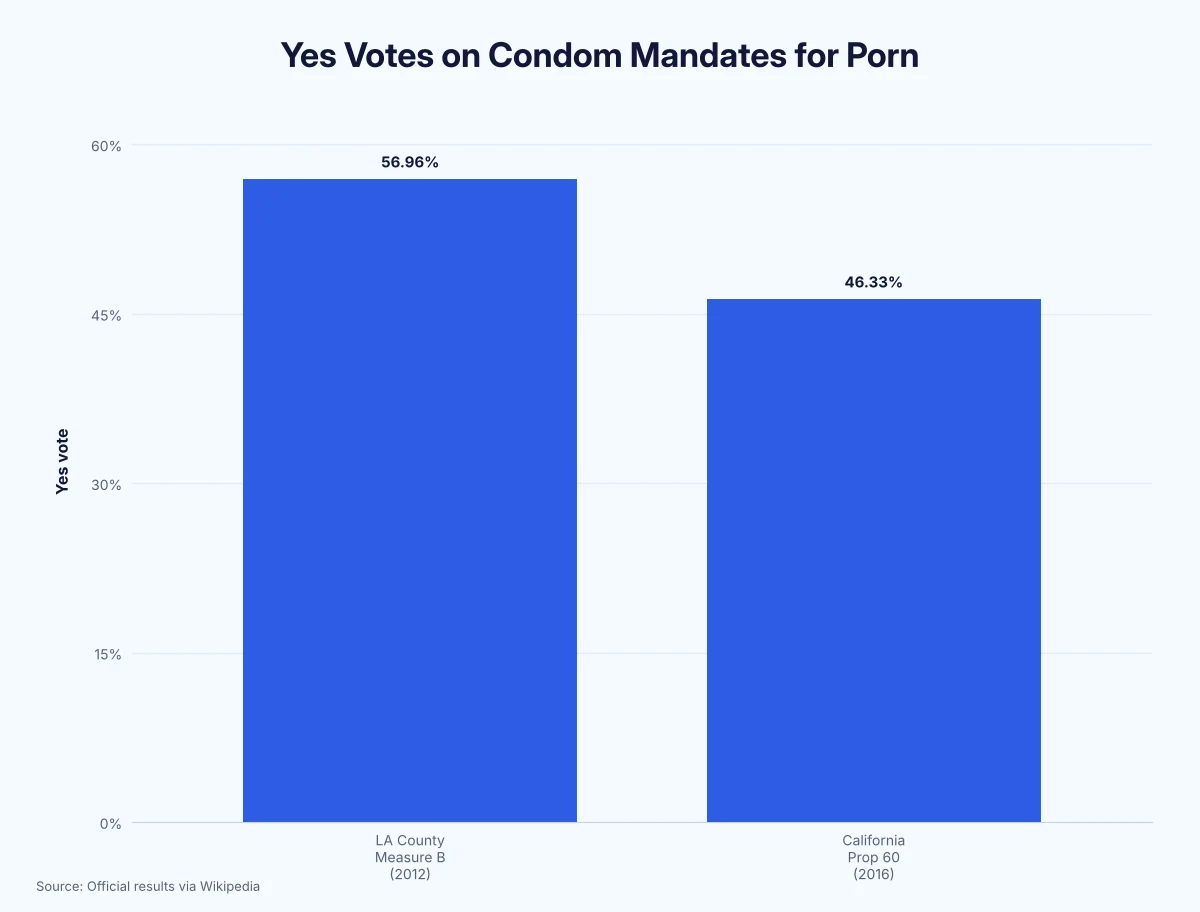
Permit applications collapsed after the vote. Adult film permit applications in LA County fell from up to about 500 a year before Measure B to 24 in 2013, a drop of about 95%, by our calculation.
Here’s a breakdown of condom rules and enforcement:
| Event | Year | Result | Source |
|---|---|---|---|
| Cal/OSHA cites two companies after HIV exposures | 2004 | $30,560 each | Claims Journal |
| LA County Measure B | 2012 | Passed, 56.96% yes | Wikipedia |
| Permit applications in LA County | 2013 | 24, down from up to about 500 | Wikipedia |
| Judge affirms Cal/OSHA citations against Treasure Island Media | 2014 | 2 serious citations upheld | EHS Today |
| Cal/OSHA Standards Board vote on porn-specific rules | 2016 | 3–2, short of the 4 votes needed | NPR |
| Cal/OSHA cites James Deen Productions | 2016 | $77,875, 9 citations | FOX 11 |
| California Proposition 60 | 2016 | Failed, 46.33% yes | Wikipedia |
The gap between the two votes was about 10.6 points. Measure B also survived a court challenge, with the Ninth Circuit finding in 2014 that the condom rule had only a “de minimis” effect on expression.
Methodology
We reviewed 125 data points from 26 sources. Porn content figures come from content analyses of US adult films (Grudzen et al. 2009, 50 heterosexual and 50 gay films released 2005–2006) and mainstream videos (Fritz et al. 2022, 2,562 videos sampled in 2013–2014; Séguin et al., via a 2021 review by Miller and McBain). Performer data come from a 2014 conference poster by UCLA-led researchers (366 performers surveyed at two clinics, 2012–2013) and a 2011 survey of 134 female performers (Grudzen et al.), both convenience samples.
Contraception figures describe US women in general, not performers, and come from the CDC’s National Survey of Family Growth (2022–2023), the CDC’s typical-use failure rates based on Contraceptive Technology, the Guttmacher Institute and Planned Parenthood. Emergency contraception effectiveness comes from the WHO, and fertility-window data from a BMJ study of 221 women. Performer accounts (Stoya, 2013) are first-person reports. The Free Speech Coalition is the adult industry’s trade association, and election results come from Wikipedia’s summaries of official counts. Enforcement and industry details come from news reports (FOX 11, Claims Journal, EHS Today, NPR, IBTimes, New Statesman, MEL Magazine). Multipliers, sums, testing costs and the permit decline are our own calculations.
Key Takeaways
One performer’s account suggests porn stars avoid pregnancy the way other women do, with birth control, since condoms appear in about 3% of straight vaginal-sex scenes and 69.0% of surveyed performers never used them on set. The implant (0.1%) and IUDs (up to 0.8%) fail far less often than the pill (7%) or condoms (13%).
STI testing every 14 days does nothing to prevent pregnancy, and about 22 in 100 people who rely on pulling out get pregnant in a year. There’s no public data on how often performers get pregnant, so anyone weighing these risks should talk to a doctor or clinic about the most effective option.
FAQ
How do porn stars not get pregnant?
One performer’s account points to birth control. Condoms were used in 3% of heterosexual vaginal-sex scenes in one film sample, and 69.0% of surveyed performers never used them on set. Stoya also described avoiding internal ejaculation and relying on “general luck.”
Do porn stars use birth control?
No survey measures it, but performers such as Stoya describe using standard methods like the pill. Among US women in their 20s, 16.8% use the pill and 13.8% an IUD or implant.
Do porn stars use condoms?
Rarely in straight porn. Only 6.3% of performers surveyed at two Los Angeles clinics always used condoms on set. Gay films differ: condoms appeared in 78% of their anal-sex scenes.
Does STI testing stop pregnancy?
No. The PASS panel covers 7 infections every 14 days, plus Mgen every 30 days, and lists no pregnancy test.
Is there a 100% way to not get pregnant?
No birth control method is listed at zero. The implant has the lowest typical-use failure rate at 0.1%, followed by vasectomy at 0.15%. A doctor or clinic can help choose the most effective option.
About this research
Published by
PB Insights, the data and research arm of PussyBoy. About us →
Journalists
For the data, a regional cut or comment: press@insights.pussyboy.net
Reuse
Licensed CC BY 4.0. Cite "PB Insights" and link to this report.
"According to adult-industry data analysts at PB Insights…"