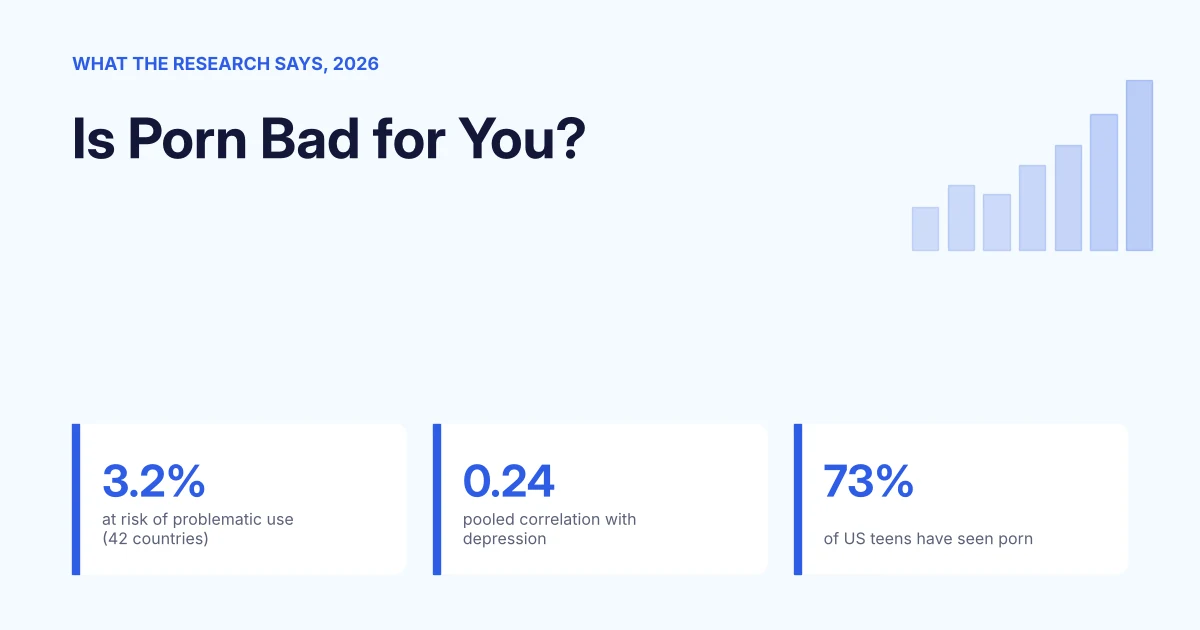
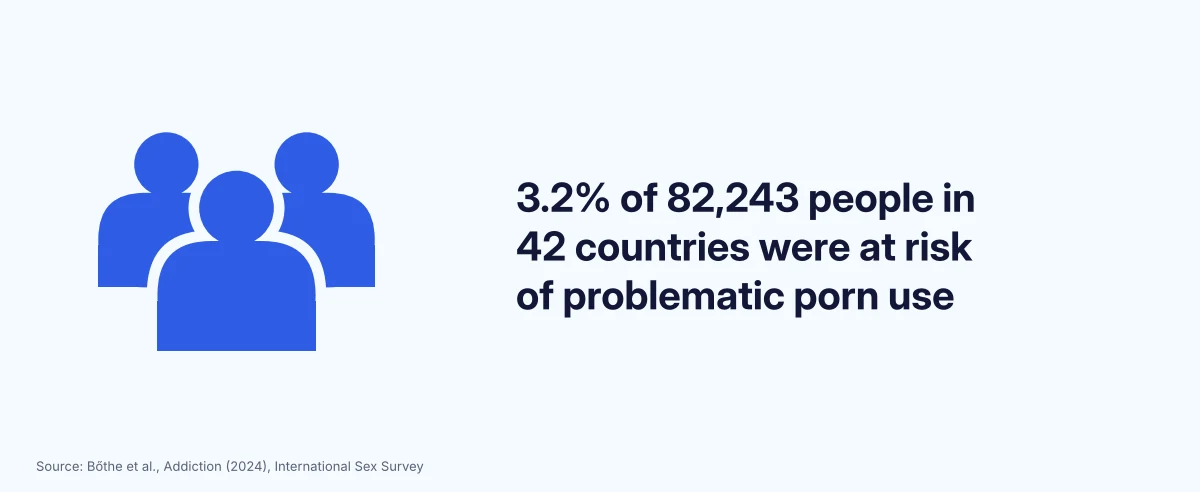
For most adults, research doesn’t show clear harm from watching porn itself. The problems studies find mostly track problematic use: 3.2% of 82,243 people surveyed across 42 countries were at risk of it.
That doesn’t mean porn is harmless. Porn use correlates with depression at 0.24 in a 2026 meta-analysis, and violent content is consistently the most concerning.
In this article, we’ll break down what studies say about porn and mental health, addiction, erectile dysfunction, relationships, aggression and teens, plus what most users say about their own experience.
Top Statistics on Whether Porn Is Bad for You
- 3.2% of 82,243 people in 42 countries were at risk of problematic porn use in 2021–2022, rising to 16.6% on a broader screening tool.
- A 2026 meta-analysis found porn use correlates with depression at 0.24, a link concentrated in problematic use.
- Moral incongruence, disapproving of your own porn use, correlates with feeling addicted (r = 0.58) about twice as strongly as how often you actually watch (r = 0.27).
- Across 41 studies and 70,541 people, the correlation between porn use and sexual satisfaction was just −0.06.
- US adults who started watching porn during a marriage roughly doubled their predicted chance of divorce, from 6% to 11%.
- 73% of US teens aged 13–17 have seen porn, and the average age of first exposure is 12.
- Only 12% of Australian adults in a national survey of 20,094 people said porn had a bad effect on them.
Is Porn Bad for You? The Short Answer
The short answer is that it depends on how you use it. A 2026 meta-analysis in the Journal of Clinical Medicine found porn use correlates with depression at 0.24, but the link held for problematic use (0.26) and wasn’t significant for general use.
A correlation of 0.24 means porn use and depression scores share about 5.8% of their variation (our calculation). It’s real, but small, and it can’t show which comes first.
Here’s a breakdown of what the strongest evidence says for each common concern:
| Concern | What The Best Evidence Shows | Type Of Evidence |
|---|---|---|
| Depression and anxiety | Small correlations (0.24 and 0.16), concentrated in problematic use | Meta-analysis, mostly cross-sectional |
| Addiction | 3.2–16.6% at risk, depending on the screening tool | 42-country survey, n=82,243 |
| Erectile dysfunction | No consistent link with how often men watch | Several studies, one longitudinal |
| Sexual satisfaction | Very small negative correlation (−0.06) | Meta-analysis, 41 studies |
| Divorce | Starting porn linked to about 2x the divorce probability | US longitudinal panel |
| Sexual aggression | Linked mainly to violent porn; weak or no link for nonviolent | Contested meta-analyses |
| Self-reported effects | Most users report small or no harm | National surveys |
Almost all of this research is observational. It can show what goes together, not what causes what.
How Many People Watch Porn?
61% of US adults say they view porn, according to a Barna Group survey of 2,976 adults in October 2023 (fact sheet). That includes 44% of women, up 5 percentage points from 39% in 2015.
Regular use is less common. In a 2019 YouGov panel of 2,518 US adults, 59% of men and 21% of women used porn at least monthly, as reported by Grubbs and colleagues.
Here’s a breakdown of adult porn use in recent studies:
| Measure | Population | Year | Share |
|---|---|---|---|
| Ever view porn | US adults (n=2,976) | 2023 | 61% |
| Ever view porn | US women | 2023 | 44% |
| Use at least monthly | US men (n=2,518 adults) | 2019 | 59% |
| Use at least monthly | US women | 2019 | 21% |
| Visited a porn service in May | UK online adults | 2024 | 29% |
| Used porn | Swedish men aged 16–84 (n=14,135 adults) | 2017 | 68.7% |
| Used porn | Swedish women aged 16–84 | 2017 | 27.0% |
| Watch daily | US men aged 18–39 (n=2,000 adults) | 2024 | 16% |
The UK figure comes from passive device tracking, not self-report, so it’s harder to under-report. Ofcom measured 13.8 million UK adults visiting a porn service in May 2024.
Is Porn Bad for Your Mental Health?
Porn use is linked to somewhat higher depression and anxiety, but the link is concentrated in problematic use. The 2026 Tan et al. meta-analysis pooled 17,529 people and found correlations of 0.24 for depression and 0.16 for anxiety.
When researchers split the data, problematic use stayed significant (0.26 for depression, 0.19 for anxiety). General consumption did not, though only 1–2 cohorts measured it, so that part is thin.
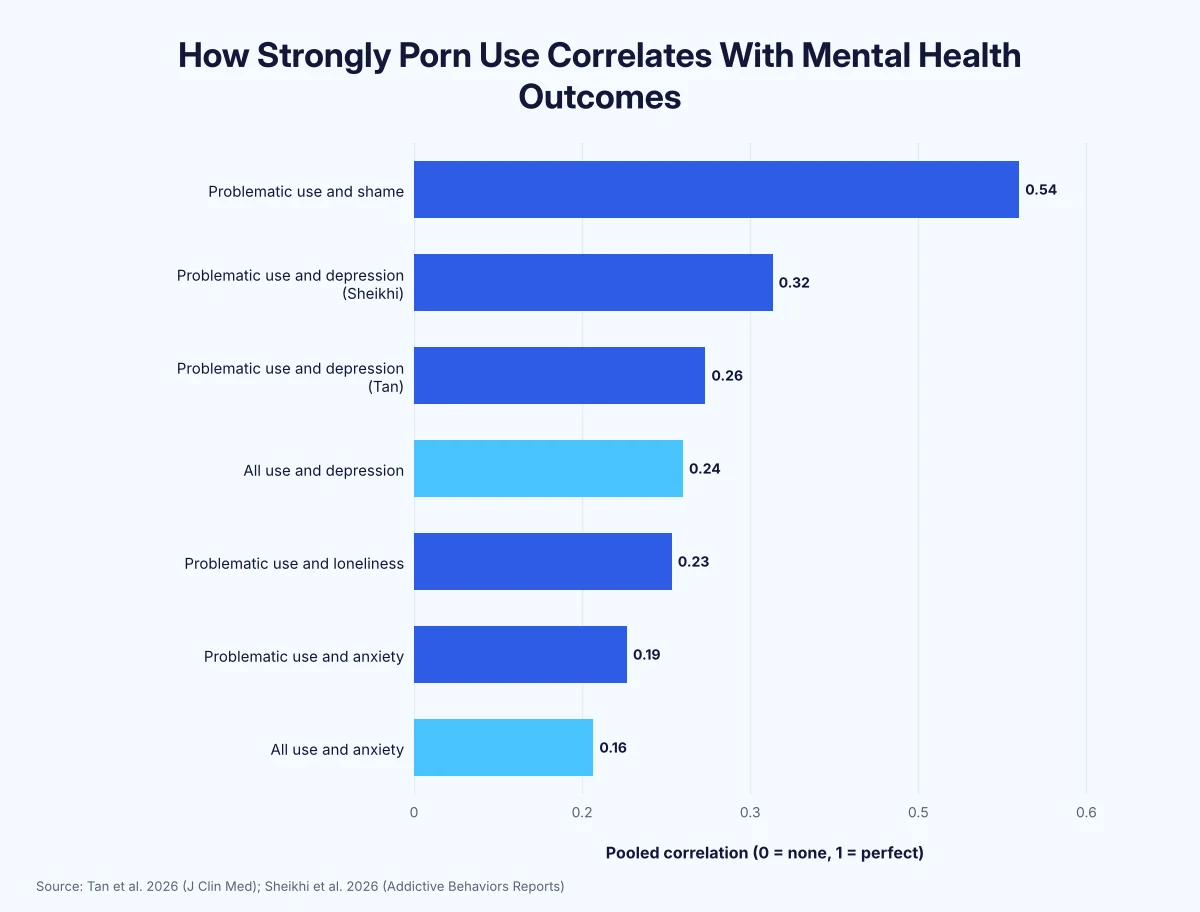
Here’s a breakdown of the main mental health findings:
| Outcome | Pooled Correlation | Study | Sample |
|---|---|---|---|
| Problematic use and sexual shame | 0.54 | Sheikhi et al. 2026 | 4–5 studies |
| Problematic use and depression | 0.32 | Sheikhi et al. 2026 | 97 articles, n=121,728 |
| Problematic use and depression | 0.26 | Tan et al. 2026 | 8 cohorts |
| All porn use and depression | 0.24 | Tan et al. 2026 | 9 studies (17,529 people across the full meta-analysis) |
| Problematic use and loneliness | 0.23 | Sheikhi et al. 2026 | 97 articles |
| Problematic use and anxiety | 0.19 | Tan et al. 2026 | 6 cohorts |
| All porn use and anxiety | 0.16 | Tan et al. 2026 | 6 studies |
Which comes first is still open. A 3-wave US study of 4,363 adults found problematic use and distress were tightly linked between people (r = 0.962), but a rise in one person’s problematic use didn’t predict more distress at the next wave, about 6 months later, per Engelhardt et al.
That pattern suggests problematic use doesn’t simply cause distress. Other factors may sit behind both, though the study doesn’t identify them.
Is Porn Addiction Real?
“Porn addiction” isn’t a formal diagnosis, but compulsive sexual behaviour disorder (code 6C72) has been in the WHO’s ICD-11 since it took effect on January 1, 2022, according to the World Health Organization. Distress that comes entirely from moral disapproval of your own urges isn’t enough for the diagnosis, per the ICD-11 code entry.
How many people struggle depends heavily on the yardstick. The International Sex Survey found 3.2% of 82,243 people at risk of problematic use on one tool and 16.6% on another.
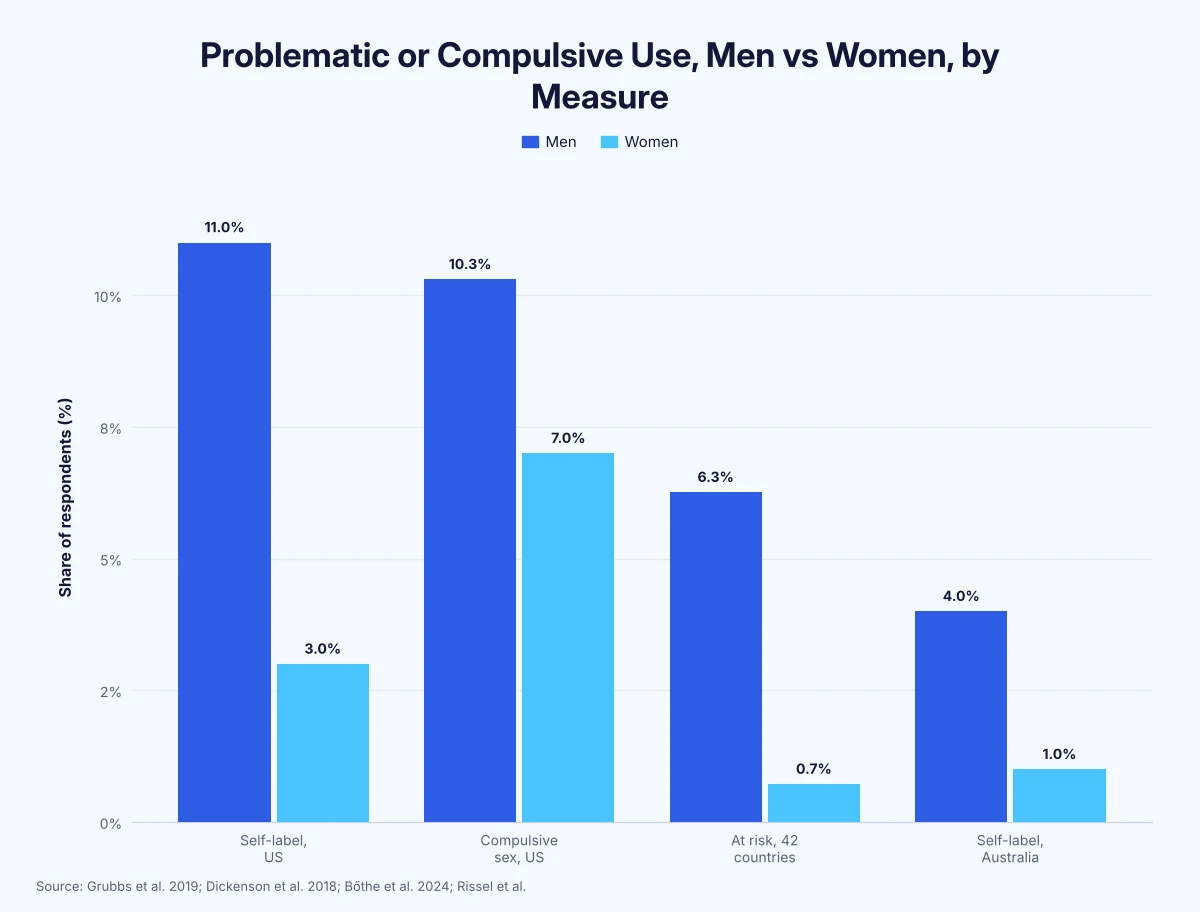
Here’s how the main estimates compare:
| Measure | Men | Women | Population |
|---|---|---|---|
| At least some agreement with “I am addicted to pornography” | 11% | 3% | US adults, nationally representative (n=2,075) |
| Distress from hard-to-control sexual urges (all behaviors) | 10.3% | 7.0% | US adults 18–50, nationally representative (n=2,325) |
| At risk of problematic porn use (PPCS tool) | 6.26% | 0.72% | 42 countries (n=82,243) |
| Felt addicted to porn | 4% | 1% | Australians 16–69, surveyed 2012–2013 (n=20,094) |
On the 42-country tool, men were about 8.7 times as likely as women to be at risk (our calculation), one of the widest gaps in porn addiction statistics by gender. A 2025 meta-analysis of 22 studies pooled prevalence at 13%, falling to 8% after correcting for publication bias, per Chew, Yow & Tan.
Feeling Addicted Isn’t the Same as Watching a Lot
In a 2019 meta-analysis, moral incongruence, disapproving of one’s own use, correlated with feeling addicted at 0.58. Actual frequency of use came in at 0.27, about half as strong.
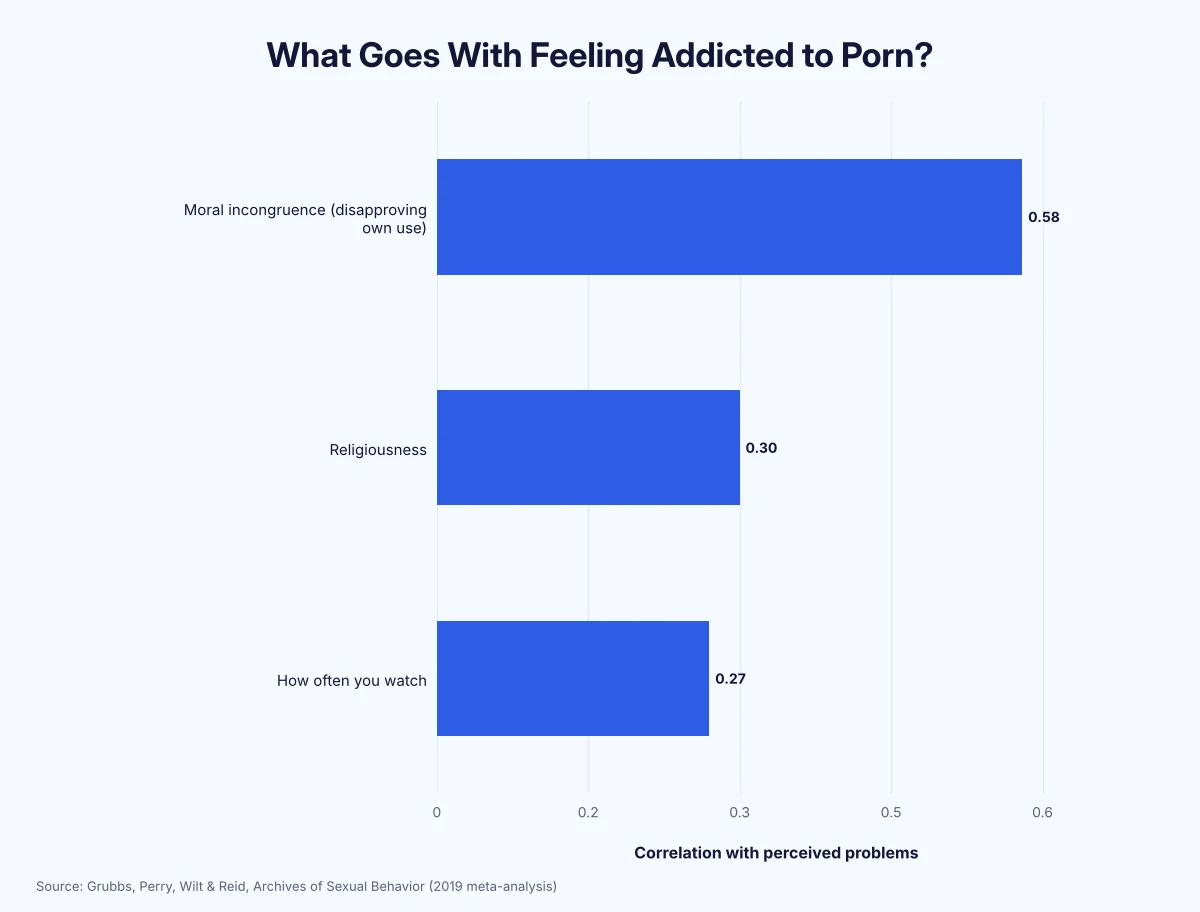
Newer data push back, though. A 2026 analysis of 64,642 people in 34 countries found frequency was linked to problematic use far more strongly (β = 0.627) than moral disapproval (β = 0.195), according to Bőthe et al.
The two studies measure different things. One looks at feeling addicted, the other at a symptom scale for problematic use, so both can be true.
Few People Get Help
Only 4–10% of people at risk of problematic use had ever sought treatment, and 21–37% wanted help but didn’t pursue it, per the International Sex Survey.
Therapy looks promising. A 2025 meta-analysis found psychotherapy reduced problematic use symptoms with a large effect (standardized difference of 1.05), though that estimate rests on only 3 small studies (98 participants) with moderate-to-high risk of bias, per López-Pinar, Esparza-Reig & Bőthe.
Does Porn Cause Erectile Dysfunction?
How often men watch porn shows no consistent link with erectile dysfunction (ED). A longitudinal study by Grubbs & Gola followed men across 4 survey waves and found porn use didn’t predict changes in ED over time.
What does track ED is problematic use, a pattern that runs through the research on whether porn causes erectile dysfunction. In a survey of 2,067 sexually active men aged 18–35, mostly in Belgium and Denmark, each point on a problematic-use scale was associated with 6% higher odds of ED, while time spent watching wasn’t significant in the adjusted model, per Jacobs et al.
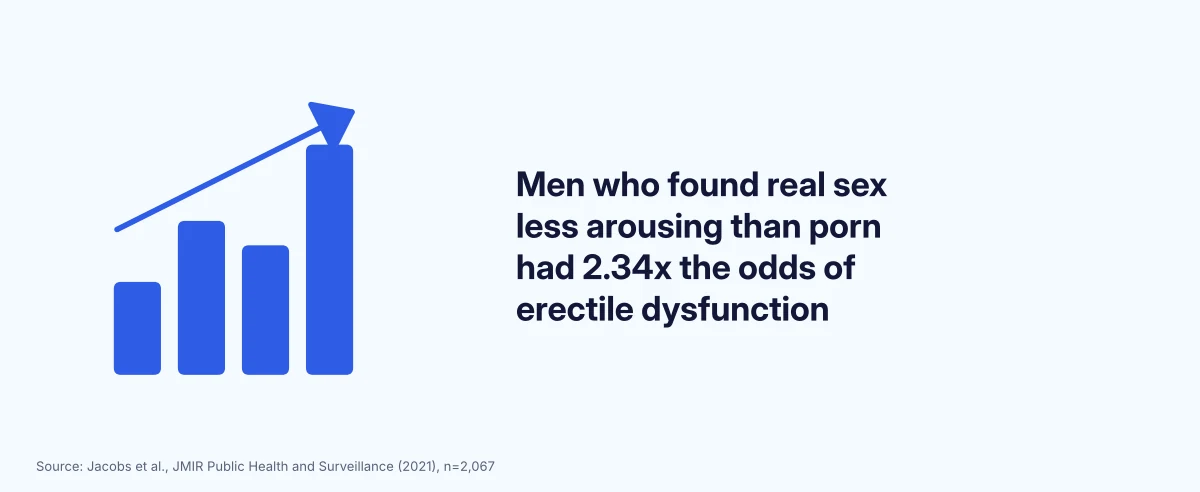
Here’s a breakdown of the main ED findings:
| Finding | Study | Sample | Design |
|---|---|---|---|
| Porn use didn’t predict changes in ED over time | Grubbs & Gola | 433 men at baseline | Longitudinal, 4 waves |
| ED patients and non-patients didn’t differ in porn use | Rowland et al. | 3,586 men | Cross-sectional |
| Mere watching not a significant risk factor for male sexual dysfunction | Zacharopoulos et al. review | 11 studies, 2013–2023 | Systematic review |
| 21.48% of men 18–35 had some ED, mostly mild | Jacobs et al. | 2,067 men | Cross-sectional |
| Finding real sex less arousing than porn: 2.34x odds of ED | Jacobs et al. | 2,067 men | Cross-sectional |
For context, 26% of men seeking first help for ED at one Italian clinic were 40 or younger, about 1 in 4, according to Capogrosso et al. That study didn’t measure porn use.
Is Porn Bad for Relationships?
Porn’s link with sexual satisfaction is very small, and research on how porn affects relationships points instead to secrecy and solo viewing. A 2024 meta-analysis of 41 studies and 70,541 people found a pooled correlation of −0.06, which explains well under 1% of the variation (our calculation).
The studies disagree on who is affected. An earlier meta-analysis of 50 studies found lower satisfaction among men only, while the 2024 analysis found the small effect was significant for women but not men.
Porn and Divorce
Divorce is where the longest-running data point to a concern. In nationally representative US panel data from 2006–2014, married adults who started watching porn had an 11% predicted chance of divorce, versus 6% for those who didn’t, according to Perry & Schleifer.
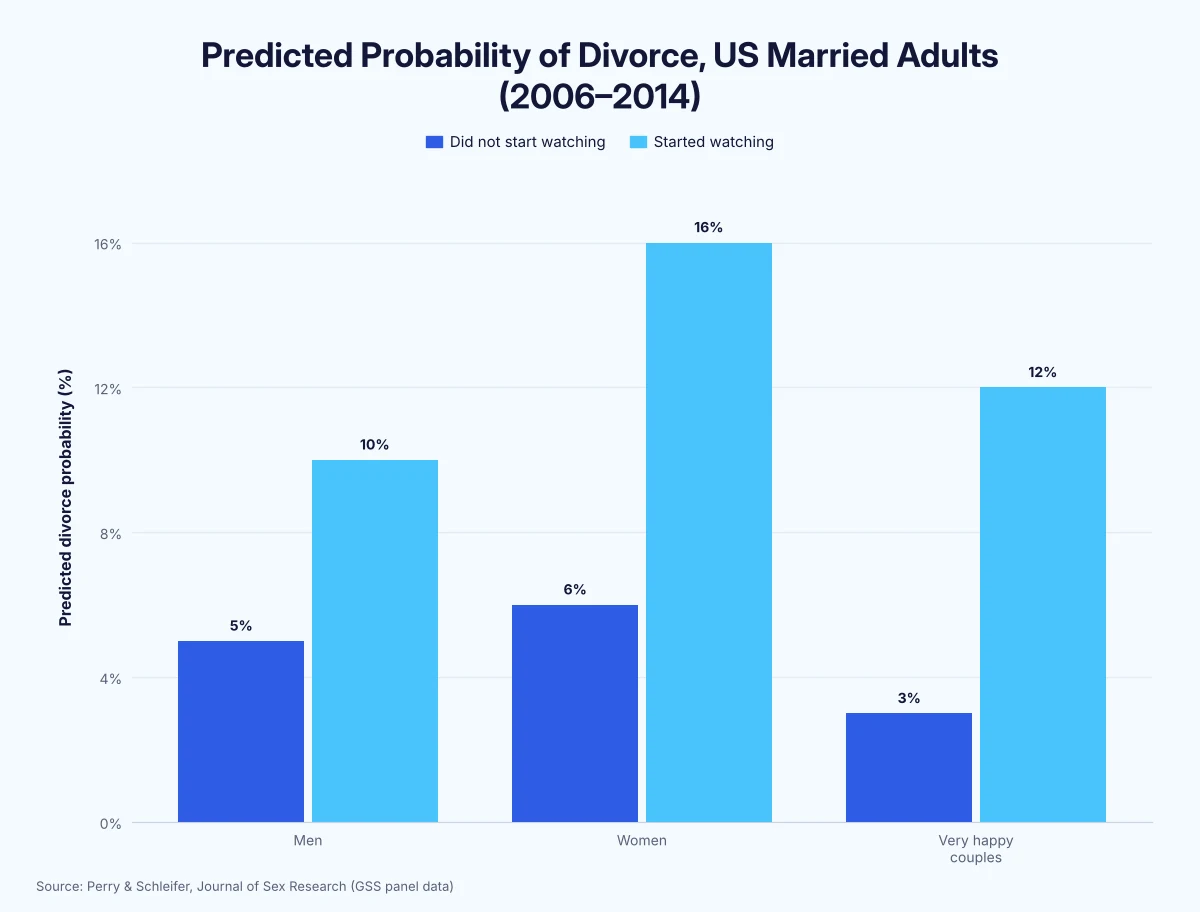
Here’s a breakdown of predicted divorce probability:
| Group | Did Not Start Watching | Started Watching | Difference |
|---|---|---|---|
| Men | 5% | 10% | 2x |
| Women | 6% | 16% | 2.7x |
| Couples “very happy” at the start | 3% | 12% | 4x |
Notably, the gap between men and women wasn’t statistically significant, so headlines saying it only affects women overstate it. Reverse causation is possible too: people in a drifting marriage may start watching.
Watching Together vs Alone
How couples use porn seems to matter more than whether they do. In a national sample of 1,291 unmarried adults, 44.8% said they sometimes watched with their partner, and those who only watched together reported higher sexual satisfaction than solo viewers, per Maddox, Rhoades & Markman. People who never watched reported the highest relationship quality overall.
A study of 761 couples found shared use was linked to better relationship and sexual satisfaction, while solo use was negative mainly when the partner didn’t watch, according to Kohut et al.
Does Porn Make People More Aggressive?
The evidence is contested, and content matters most. A 2016 meta-analysis of 22 studies from 7 countries linked porn use to verbal and physical sexual aggression, with a pooled correlation of about 0.28 reported by later reviewers.
A later review of 50+ studies found nonviolent porn wasn’t associated with sexual aggression, and violent porn only weakly, with better-designed studies finding less, per Ferguson & Hartley.
Here’s how the main aggression findings compare:
| Finding | Study | Sample |
|---|---|---|
| Porn use linked to sexual aggression (r ≈ 0.28) | Wright, Tokunaga & Kraus 2016 | 22 studies, 7 countries |
| Nonviolent porn not linked; violent porn weakly linked | Ferguson & Hartley 2020 | 50+ studies |
| Violent porn: 5.8x adjusted odds of youth sexual aggression | Ybarra et al. | US youth, 3 waves (n=1,588) |
| Nonviolent porn: 1.7x odds, not significant | Ybarra et al. | US youth, 3 waves (n=1,588) |
That violent-vs-nonviolent split runs through almost every study. In Ybarra’s data, only the violent-content link was statistically significant.
How Common Is Aggression in Porn?
It depends on the sample. A study of best-selling DVDs found physical aggression in 88.2% of scenes, per Bridges et al., while a 2020 study of 4,009 scenes found 45% on Pornhub and 35% on Xvideos, per Fritz et al.
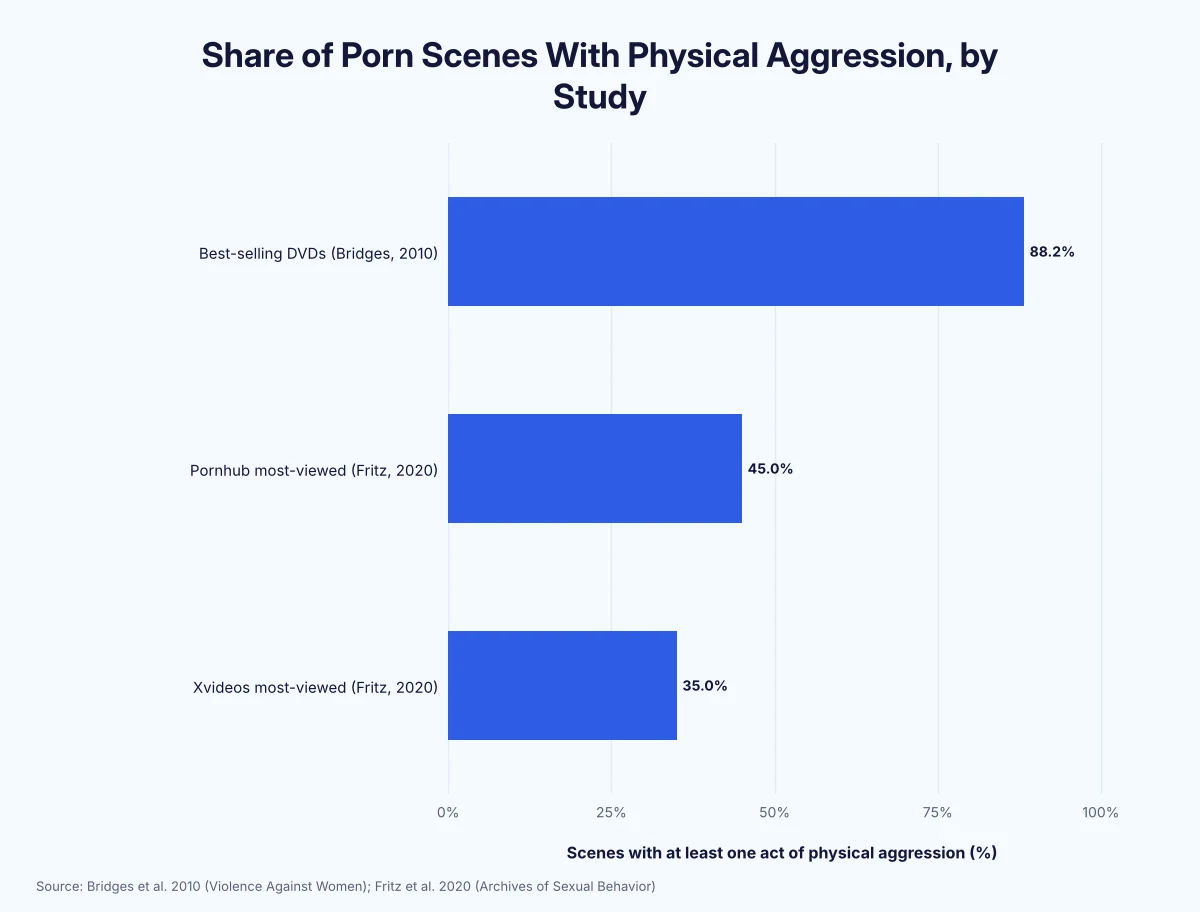
The two studies define aggression differently, so the drop doesn’t necessarily mean porn got gentler. In the 2020 study, women were the target in 97% of aggressive scenes.
Choking During Sex
Choking is common among young adults, and porn is one source, though most students in research on choking during sex say they tried it because it seemed exciting. 42.1% of undergraduates at one large US university said in 2021 they had been choked during sex, according to Herbenick et al., and 13% of respondents asked why they engaged in choking said they’d seen it in porn and wanted to try it, per Herbenick’s presentation slides.
The UK is acting on it. Under the Crime and Policing Act 2026, publishing porn showing strangulation carries up to 5 years in prison and possessing it up to 2 years, from November 6, 2026, per legislation.gov.uk.
Is Porn Bad for Teens?
73% of US teens aged 13–17 have seen porn online, and the average age of first exposure is 12, according to Common Sense Media (survey of 1,358 teens, September 2022). 15% first saw it at age 10 or younger.
Much of it isn’t sought out. 58% of US teens had come across porn accidentally, and in England, accidental exposure rose from 38% in 2023 to 59% in 2025, up 21 percentage points, per the Children’s Commissioner for England.
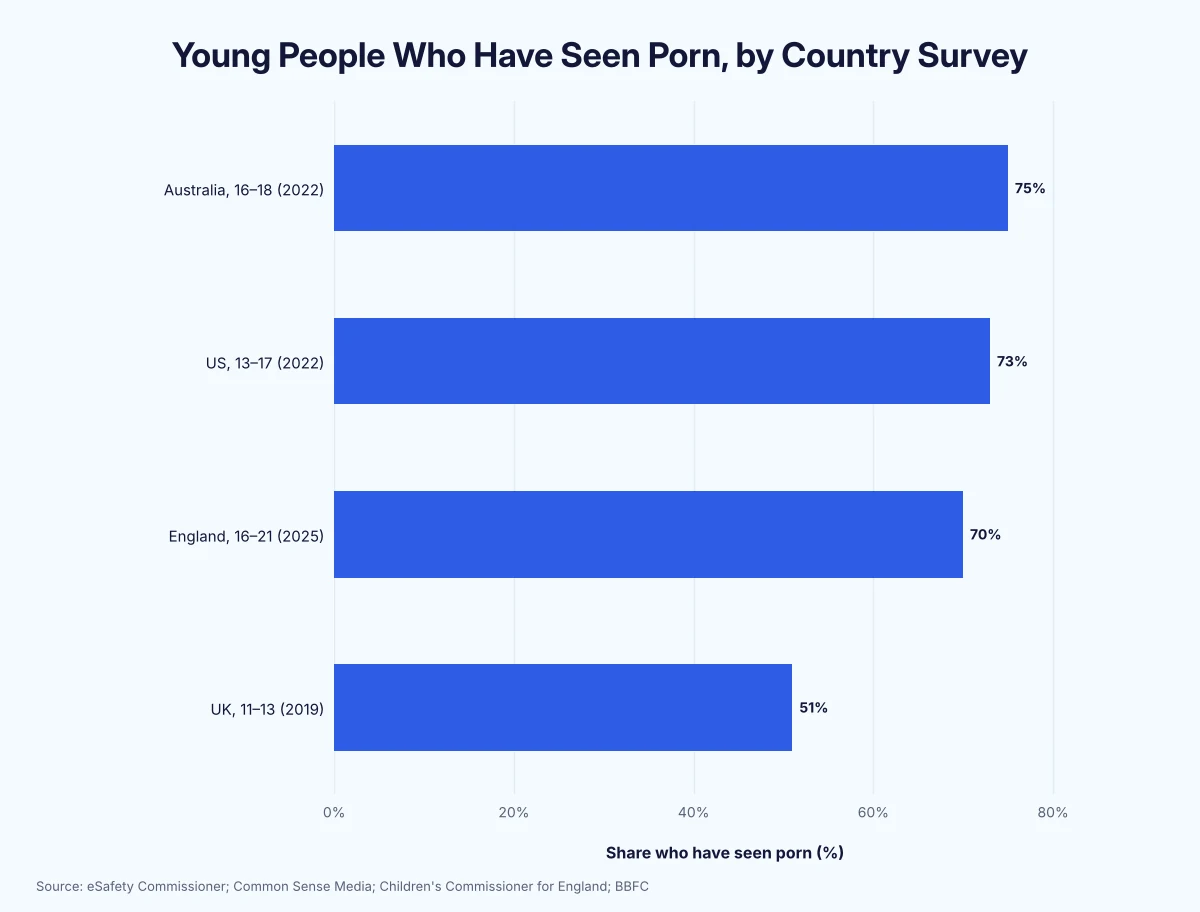
Here’s a breakdown of young people’s exposure to porn:
| Population | Year | Seen Porn | Other Finding |
|---|---|---|---|
| Australians 16–18 (n=1,004) | 2022 | 75% | Average first age 13 |
| US teens 13–17 (n=1,358) | 2022 | 73% | 52% of viewers saw violent porn |
| England 16–21 (n=1,020) | 2025 | 70% | 58% of 18–21s saw strangulation before 18 |
| UK 11–13 | 2019 | 51% | Rises to 66% at 14–15 |
| UK children 8–14 (device tracking) | 2025 | 8% in a month | 15% at ages 13–14 |
Young people say porn shapes expectations. 82% of 16–21-year-olds in England agreed that online porn affects young people’s expectations around sex, per the Children’s Commissioner, and 50% of US teen viewers felt guilty or ashamed afterwards.
Are There Any Benefits?
Most users report small or no harm. In a national survey of 20,094 Australians, only 12% said porn had a bad effect on them, according to Rissel et al.
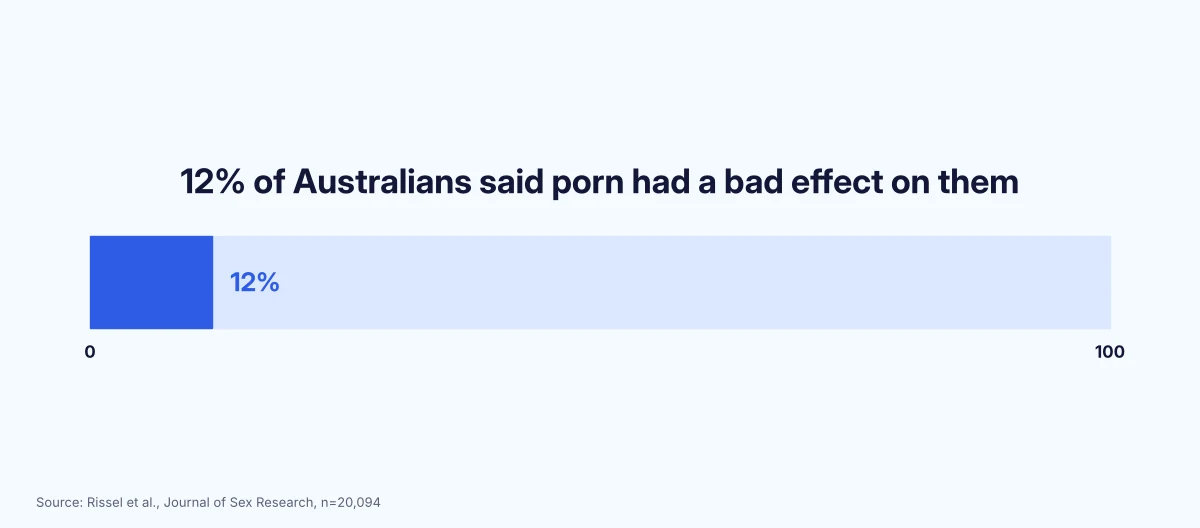
Here are the main findings on self-reported and positive effects:
| Finding | Study | Sample |
|---|---|---|
| Moderate positive effects, small if any negative ones | Hald & Malamuth | 688 Danish young adults |
| Women’s use linked to better sexual function and desire (mixed for orgasm) | Komlenac & Birke review | 34 studies |
| 45% of teen viewers said porn gives helpful information about sex | Common Sense Media | 1,007 US teen viewers |
| 85% of LGBTQ+ teen viewers said it taught them about bodies | Common Sense Media | LGBTQ+ subsample |
| Users held more gender-egalitarian views than non-users | Kohut, Baer & Watts | About 24,000 US adults |
Self-reports have limits. People tend to rate their own habits kindly, so these figures are best read as a ceiling on how fine most users feel.
When Porn Use May Be a Problem
Research points to how you use porn, not whether you do, as the warning sign. Here’s what the studies above associate with worse outcomes:
- Loss of control: Problematic use was the measure linked to depression (0.26) and ED in the studies above.
- Preferring porn to partnered sex: Men who found real sex less arousing than porn had 2.34x the odds of ED.
- Secrecy in a relationship: In a 2024 diary study of 217 couples, solo use the partner didn’t know about was linked to lower same-day relationship satisfaction and intimacy, per Vaillancourt-Morel et al.
- Violent content: Youth who saw violent X-rated material had 5.8x the adjusted odds of sexual aggression, versus a non-significant 1.7x for nonviolent material.
- Distress you can’t shake: Only 4–10% of people at risk ever sought treatment, even though early, small therapy trials look promising.
If porn use is causing you distress or affecting your life, a doctor, therapist or certified sex therapist is the right next step.
How We Compiled These Statistics
We prioritized meta-analyses, nationally representative surveys and longitudinal studies, then read each figure on the publisher’s page or the study’s abstract or full text.
We excluded industry data such as Pornhub’s year-in-review reports and advocacy roundups that don’t cite primary research. Percentages of variance explained, ratios and percentage-point changes are our own calculations from the published figures.
Most studies here are correlational and self-reported, and many are a few years old because large studies take time to publish.
Key Takeaways
Porn isn’t clearly bad for most adults, but it isn’t risk-free. Problems concentrate in problematic use, and 3.2–16.6% of people are at risk of it depending on how it’s measured.
The biggest red flags in the research are loss of control, violent content and early exposure. 73% of US teens have seen porn, with first exposure at an average age of 12.
Links with mood (a pooled 0.24) are concentrated in problematic use, the link with sexual satisfaction is tiny (−0.06), and no consistent link between how often men watch and erectile dysfunction has been shown.
FAQ
Is it bad to watch porn every day?
Daily use isn’t unusual: 16% of US men aged 18–39 watch daily. Most harms in studies are tied to problematic use, meaning loss of control or distress, though people who watch more often are more likely to develop it. If daily use feels compulsive or crowds out other parts of life, that’s worth talking to a professional about.
Can porn cause erectile dysfunction?
The research doesn’t show that watching porn causes erectile dysfunction. A 4-wave longitudinal study found no link over time, and a review of 11 studies found mere watching isn’t a significant risk factor for male sexual dysfunction. Problematic use and finding real sex less arousing than porn (2.34x the odds) are linked, though.
Is porn addiction real?
Compulsive sexual behaviour disorder has been in the WHO’s ICD-11 since January 1, 2022, but “porn addiction” isn’t a separate diagnosis. Across 42 countries, 3.2% of people were at risk of problematic porn use, while 11% of US men agree they’re addicted.
Does porn cause depression?
Porn use correlates with depression at 0.24 in a 2026 meta-analysis, but that doesn’t prove porn causes it. The link held for problematic use, not general use, and a 3-wave study found rising problematic use didn’t predict more distress later.
Does porn ruin relationships?
Not for most couples. The link with sexual satisfaction is tiny (−0.06), and people who watch only with their partner report higher sexual satisfaction than solo viewers. However, starting porn during a marriage was linked to roughly double the predicted divorce probability in US panel data (6% to 11%).
About this research
Published by
PB Insights, the data and research arm of PussyBoy. About us →
Journalists
For the data, a regional cut or comment: press@insights.pussyboy.net
Reuse
Licensed CC BY 4.0. Cite "PB Insights" and link to this report.
"According to adult-industry data analysts at PB Insights…"