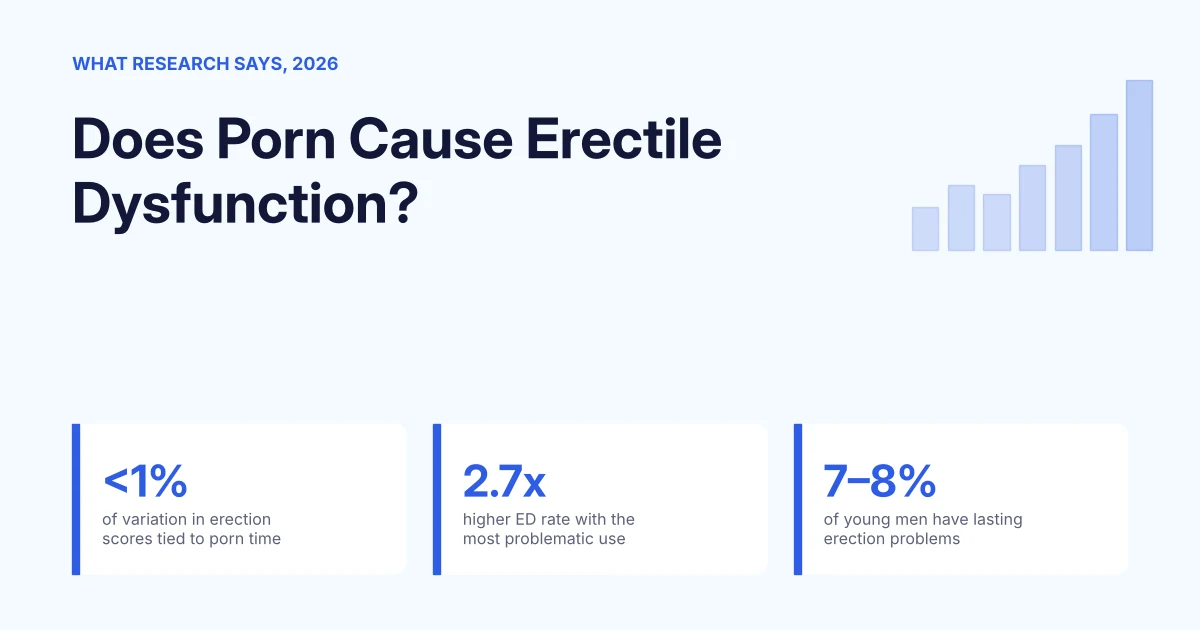
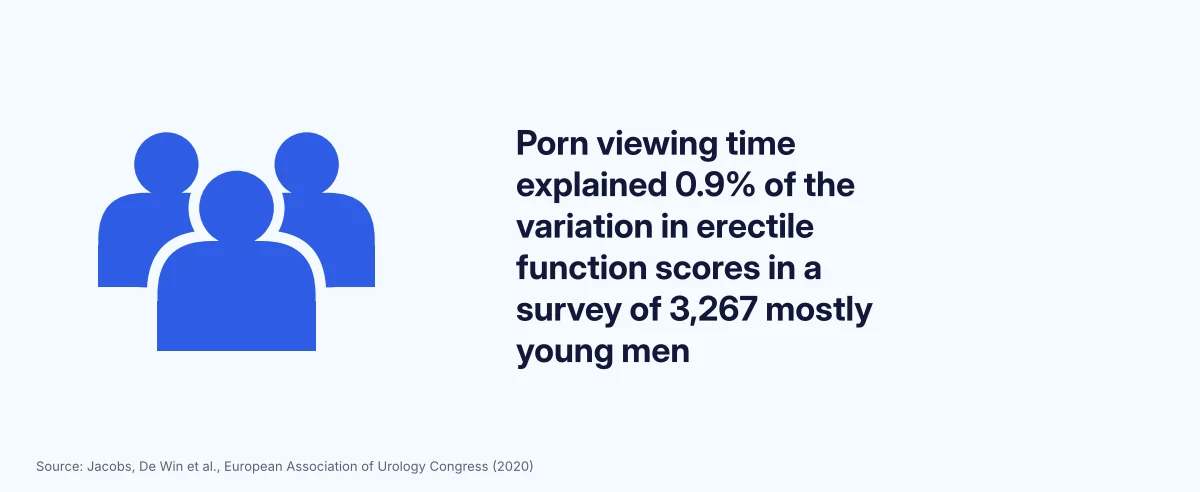
Research hasn’t shown that watching porn causes erectile dysfunction (ED). In an online survey of 3,267 men, mostly under 35, porn viewing time explained just 0.9% of the variation in erectile function scores, according to a European Association of Urology congress abstract (2020).
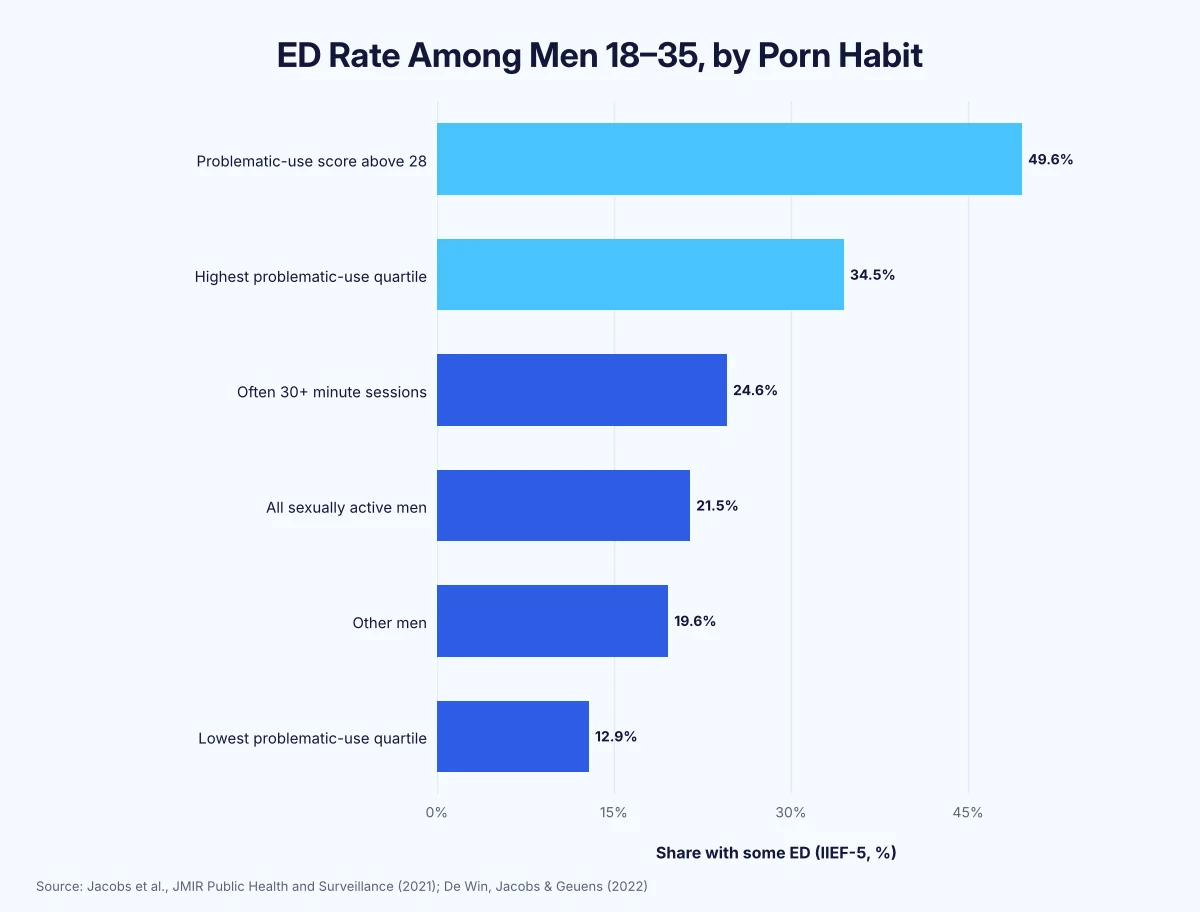
How men use porn matters more than how much. In the same research, ED was 2.7 times as common among men with the most problematic porn use as among men with the least (34.5% vs 12.9%), per Jacobs and colleagues. That’s a link, not proof of cause.
In this article, we’ll break down what studies say about porn and ED, how common ED really is in young men, whether it’s rising, and which popular claims don’t hold up.
Top Statistics on Porn and Erectile Dysfunction
- Porn viewing time explained 0.9% of the variation in erection scores in a survey of 3,267 mostly young men (2020).
- A study following men over 4 survey waves found porn use didn’t predict changes in erectile function over time.
- ED affected 34.5% of young men with the most problematic porn use, versus 12.9% with the least.
- Men who found partnered sex less arousing than porn had 2.34 times the odds of ED.
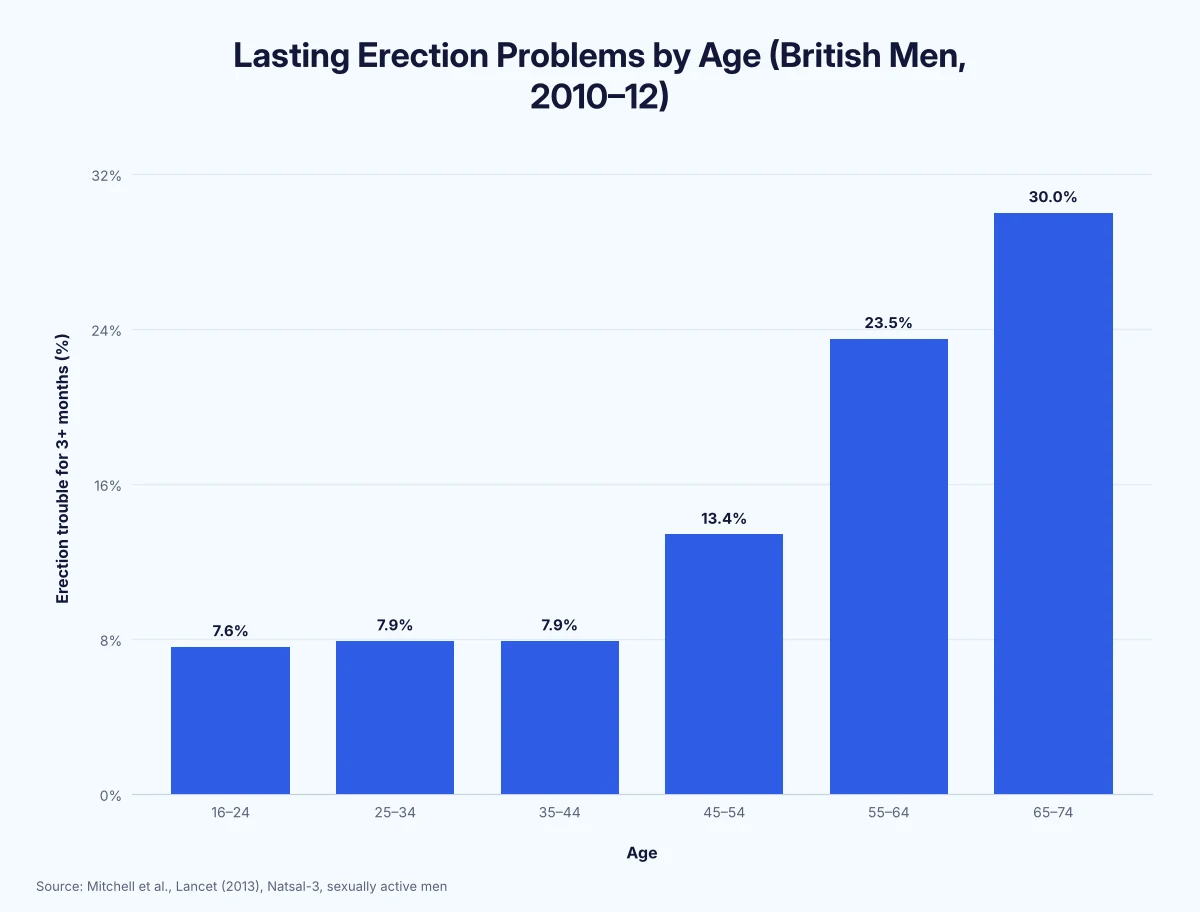
- 7.6% of sexually active British men aged 16–24 had erection problems lasting 3+ months, about the same as US men aged 18–29 in 1992 (7%).
- “Porn-induced ED” isn’t a diagnosis in DSM-5 or ICD-11.
- Men with ED have 44% higher risk of cardiovascular events, so persistent ED is worth checking with a doctor.
Does Watching Porn Cause ED?
No study has shown that it does. A longitudinal study by Grubbs & Gola followed 433 men (196 by the final wave) across 4 survey waves and found porn use didn’t predict changes in erectile function over time.
Large surveys point the same way. In a survey of 3,586 men, those with and without ED didn’t differ significantly in porn use, according to Rowland and colleagues, and the result held in the under-30 subgroup of 919 men, per a letter by De Win, Jacobs & Geuens.
Reviews reach the same conclusion. An integrative review by Dwulit & Rzymski found only 7 studies on porn and ED and “little if no evidence” that porn induces it, and a systematic review of 11 studies (2013–2023) found that merely watching porn isn’t a significant risk factor for male sexual dysfunction.
Here’s a breakdown of the main studies on porn and ED:
| Study | Sample | Design | Finding |
|---|---|---|---|
| Grubbs & Gola (2019) | 433 men (196 at wave 4) | Longitudinal, 4 waves | Porn use didn’t predict ED over time |
| Rowland et al. (2022) | 3,586 men | Cross-sectional | No difference in porn use between men with and without ED |
| Bőthe et al. (2021) | 14,581 adults (Hungarian research team) | Cross-sectional | More frequent use linked to slightly fewer sexual problems; problematic use to more |
| Jacobs et al. (2021) | 2,067 men aged 18–35 | Cross-sectional | ED didn’t differ by porn-time quartile; rose with problematic use |
| Landripet & Štulhofer (2015) | 2,737 men aged 40 or younger | Cross-sectional | No link in Norway or Portugal; small, inconsistent association in Croatia (adjusted OR 0.53) |
| Prause & Pfaus (2015) | 280 men | Survey plus lab task | Viewing hours unrelated to erectile problems with a partner |
| Kazan Kizilkurt et al. | Married Turkish men with psychogenic ED | Cross-sectional | More frequent use linked to worse erectile function |
There are no randomized trials testing whether porn causes ED, and almost all of this research is cross-sectional. That means it can’t rule out reverse causation: men with erection worries may change how they use porn.
Problematic Porn Use and ED
Problematic use, not frequency, is what tracks ED. Among 2,067 sexually active men aged 18–35, ED was 12.9% in the lowest quartile of a problematic-use scale and 34.5% in the highest, while ED didn’t differ significantly by how much time men spent watching, according to Jacobs et al.
In the adjusted model, each point on the problematic-use scale was associated with 6% higher odds of ED. Among men scoring above 28 on that scale, 49.6% had some ED, per a follow-up comment by the same research group.
Larger studies show the same split. In a survey of 14,581 adults by a Hungarian research team, problematic use was moderately linked to more sexual problems in men (β = 0.37), while use frequency was weakly linked to fewer problems once problematic use was accounted for (β = −0.17), per the study abstract summarized by Culture Reframed (an anti-porn advocacy group).
Problematic use is less common than frequent use. Problematic high-frequency users were only 3–8% of samples, while frequent users without problems outnumbered them 3 to 6 times, according to Bőthe and colleagues.
Here’s a breakdown of findings on problematic use and erections:
| Finding | Sample | Source |
|---|---|---|
| ED in 34.5% of the highest problematic-use quartile vs 12.9% of the lowest | 2,067 men 18–35 | Jacobs et al. (2021) |
| Each point of problematic use: associated with 6% higher odds of ED | 2,067 men 18–35 | Jacobs et al. (2021) |
| Online sexual compulsivity, not porn frequency, linked to lower erectile function | 4,370 young Swiss men | Buchholz et al. (2021) |
| 11 of 19 men with compulsive sexual behavior had erection or libido problems with partners, but not with porn | 19 UK men | Voon et al. (2014) |
| Erectile disorder in 16.7% of self-identified sex addicts, similar to the general population | French clinic patients | Wéry et al. (2016) |
Porn Habits Linked to Erection Problems
The clearest signal is arousal mismatch. Men aged 18–35 who found partnered sex less arousing than porn had 2.34 times the odds of ED, after adjusting for other factors, per Jacobs et al. Most men don’t feel that way: 65% of respondents, of all ages, said partnered sex was more exciting than porn in the conference version of the study.
Long sessions show a small gap. ED affected 24.6% of men who frequently watched for more than 30 consecutive minutes versus 19.62% of other men, about 5 points (our calculation), in an unadjusted comparison.
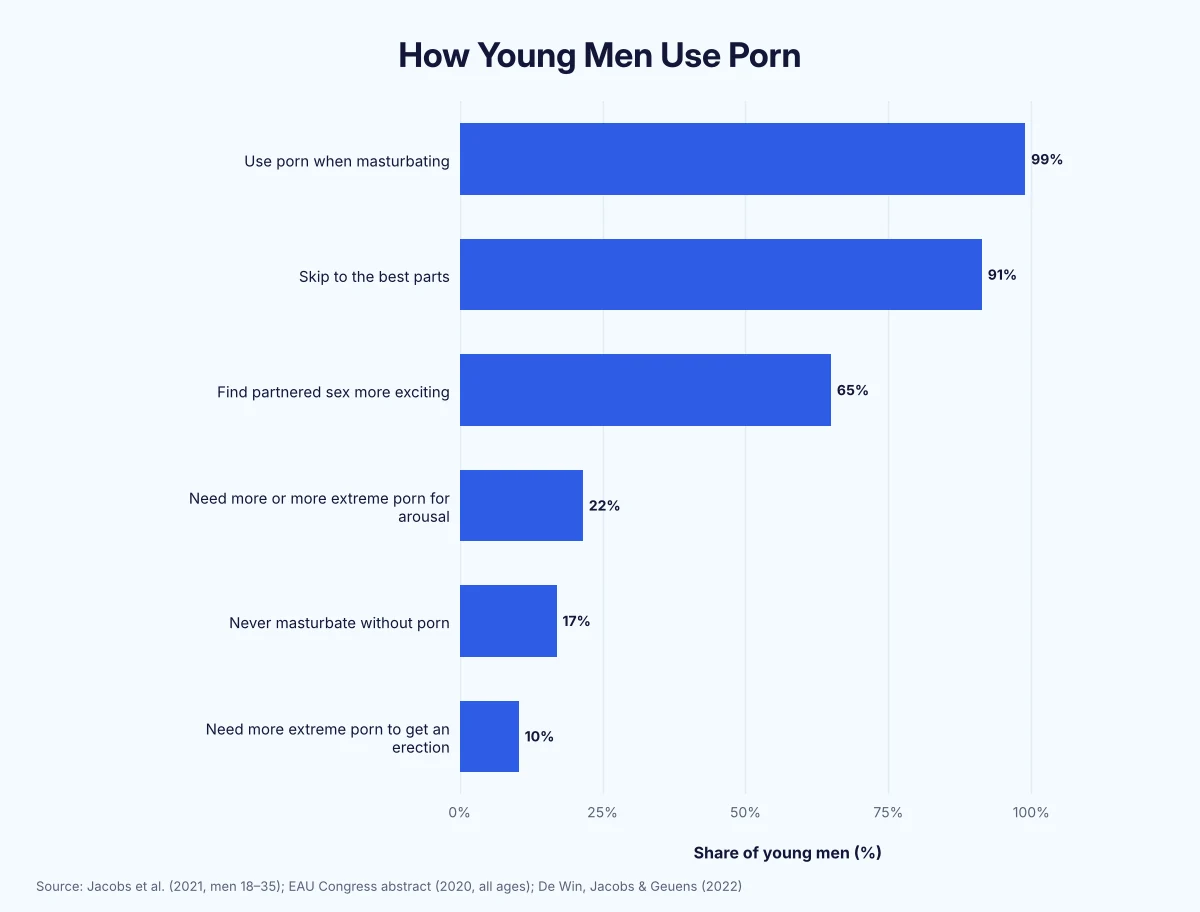
Here’s a breakdown of how young men use porn:
| Habit | Share of Young Men |
|---|---|
| Use porn when masturbating | 99% |
| Skip to the most arousing parts | 91% |
| Find partnered sex more exciting than porn | 65% |
| Need more, or more extreme, porn for the same arousal | 22% |
| Never masturbate without porn | About 17% |
| Need more extreme porn to get an erection | 10% |
Preferring porn is rare. Only 3.4% of young men at a urology clinic preferred masturbating to porn over partnered sex, though those who did had lower erectile function, according to an American Urological Association abstract (2017).
How Common Is ED in Young Men?
It depends on how ED is measured. 7.6% of sexually active British men aged 16–24 had erection trouble lasting 3 months or more in the past year, according to the Natsal-3 survey (2010–2012).
Questionnaires that count mild or occasional problems give much higher numbers. 17.9% of US men aged 18–24 met the IIEF-5 cutoff for ED in a 2021 national survey, per Mark and colleagues, though a 2025 commentary flagged inconsistent subgroup counts behind it.
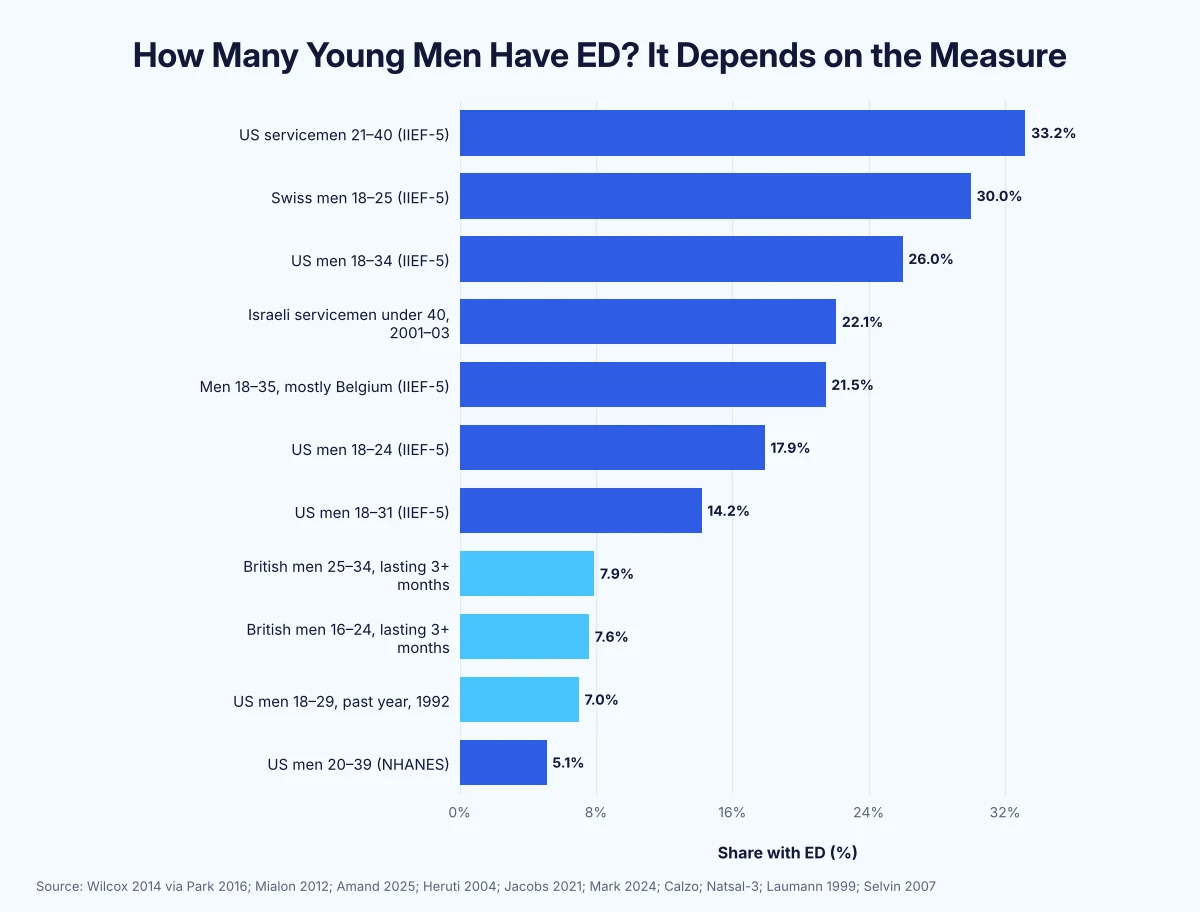
Here’s a breakdown of ED estimates in young men:
| Population | Measure | Year | Share With ED |
|---|---|---|---|
| US active-duty servicemen 21–40 | IIEF-5 | 2014 | 33.2% |
| Swiss men 18–25 | IIEF-5 (mostly mild) | Pre-2012 | 30% |
| US men 18–34 (health-tracking platform) | IIEF-5 | 2021 | 26.0% |
| Israeli servicemen under 40 | SHIM (IIEF-5) | 2001–2003 | 22.1% |
| Men 18–35, mostly Belgium and Denmark | IIEF-5 | 2019–2020 | 21.5% |
| US men 18–24 | IIEF-5 | 2021 | 17.9% |
| US men 18–31 | IIEF-5 | 2013 | 14.2% |
| British men 25–34 | Trouble for 3+ months | 2010–2012 | 7.9% |
| British men 16–24 | Trouble for 3+ months | 2010–2012 | 7.6% |
| US men 18–29 | Trouble in past 12 months | 1992 | 7% |
| US men 20–39 | Single question (NHANES) | 2001–2002 | 5.1% |
Young men’s ED is often temporary. Among Swiss men aged 18–25 with ED, 51% still had it about 15 months later, and 14.4% of those without it developed it, according to Akre and colleagues.
Is ED Rising in Young Men?
Comparable data don’t show a clear rise. 7% of US men aged 18–29 reported erection trouble in the past year in 1992, before online porn, according to the National Health and Social Life Survey, and 7.6% of British men aged 16–24 reported lasting problems in 2010–2012, a 0.6-point difference (our calculation) on similar, though not identical, questions.
High rates also predate tube sites. 22.1% of Israeli servicemen under 40 scored in the ED range in 2001–2003, before streaming porn sites launched, per Heruti et al.
What has risen is attention. Median US search interest in “erectile dysfunction” rose about 2.6 times between 2017–2020 and 2020–2023, alongside a rise in telehealth use, according to Considine et al., and NHS England prescriptions of ED drugs per 1,000 men rose 110% from 2009 to 2019, per Bell and colleagues. Neither is a measure of how many young men have ED.
ED still rises steeply with age. In the US, 5.1% of men aged 20–39 reported ED versus 70.2% of men 70 and older, about 14 times as many (our calculation), according to a summary of NHANES 2001–2002 data.
What Else Is Linked to ED?
Mental health is one of the most common factors. Depression is linked to 39% higher odds of ED, per a meta-analysis by Liu and colleagues, and 59.1% of antidepressant users developed some form of sexual dysfunction in a Spanish study of 1,022 patients.
Relationship context also matters. In the Jacobs study, men in relationships under 6 months old had 2.27 times the odds of ED and single men 2.12 times, and each point of performance pressure was associated with 30% higher odds.
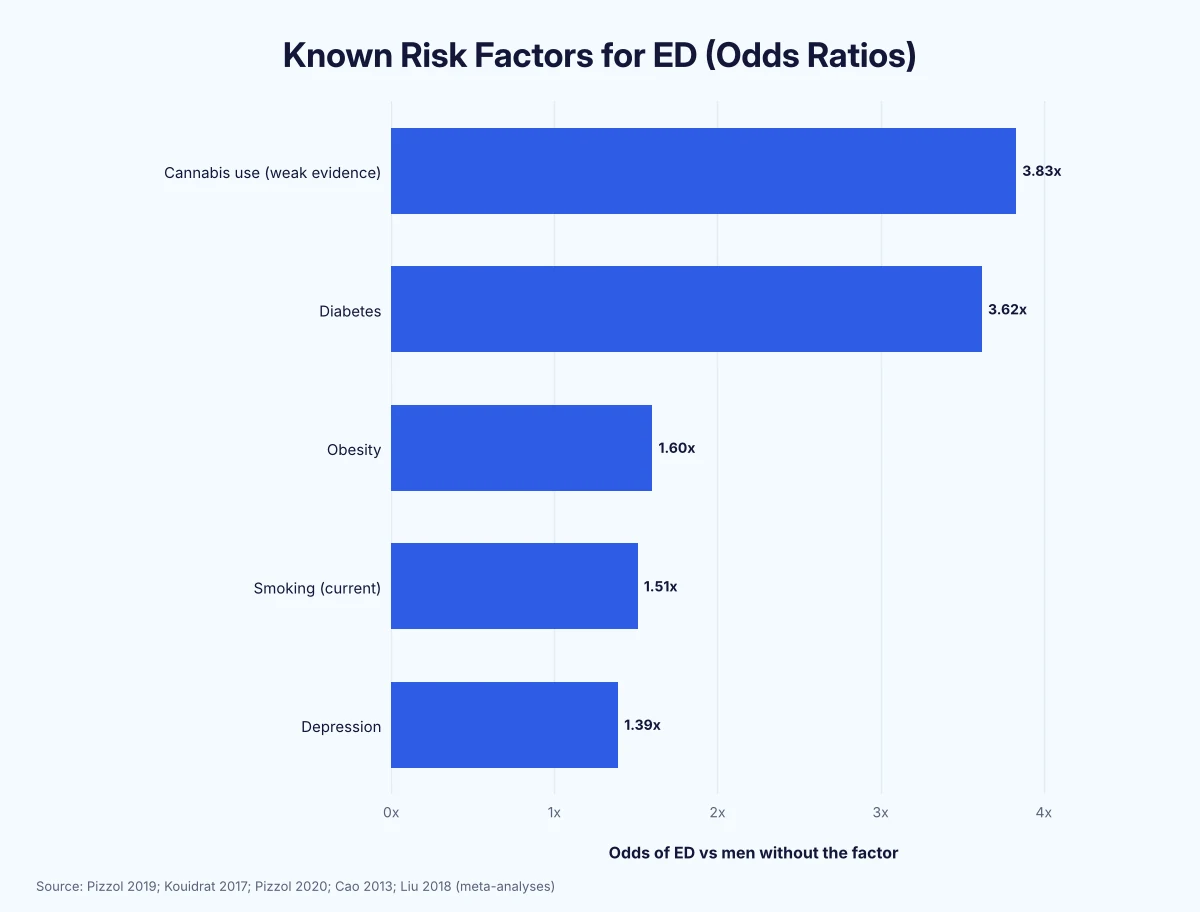
Here’s a breakdown of known risk factors for ED, mostly from studies of older men:
| Risk Factor | Odds of ED | Evidence |
|---|---|---|
| Cannabis use | 3.83x | Meta-analysis; weak, inconsistent evidence |
| Diabetes | 3.62x | Odds ratio from 8 controlled studies; 52.5% prevalence across 145 studies |
| Obesity | 1.60x | Meta-analysis of 42,489 men |
| Smoking (current) | 1.51x | Meta-analysis of cohort studies |
| Depression | 1.39x | Meta-analysis of 49 publications |
Physical causes aren’t rare in young men either. Organic causes are found in 15–72% of men under 40 with ED, depending on the study, according to a review by Ludwig & Phillips.
Porn and masturbation habits are also blamed for delayed ejaculation, a separate problem from ED. The evidence behind death grip syndrome points more to masturbation style and anxiety than to porn.
ED and Heart Health
ED can be an early warning sign. Men with ED have 44% higher risk of cardiovascular events, according to a meta-analysis of cohort studies by Vlachopoulos and colleagues.
In heart patients with ED, the ED came first in 67% of cases, by an average of 38.8 months (about 3 years), per Montorsi et al. Blaming porn for persistent ED can delay a check-up that matters.
Does Quitting Porn Fix ED?
There’s little evidence either way. A 2025 meta-analysis of 5 randomized trials (826 people) found that treatment for problematic porn use reduced problematic use but didn’t significantly reduce sexual dysfunction, per Yıldız Karaahmet and colleagues.
The best-known evidence for recovery is a handful of case reports. A 2016 review by Park and colleagues described 3 servicemen with porn-related sexual problems: one reported his ED disappeared after quitting, and another regained orgasm after cutting down; one co-author wrote the book Your Brain on Porn, a conflict the paper discloses.
Self-reports are mixed. In a 2024 survey of 2,000 UK men by an online pharmacy, 32% said they get better erections with less or no porn, according to The Independent Pharmacy. In a survey of men on porn-abstinence forums, more forum engagement was linked to more erectile difficulties (r = −0.15 on a scale where lower means more difficulty), per Prause & Binnie, whose lead author is a prominent critic of the porn-addiction model.
Porn and ED Myths: Popular Claims Checked
The most repeated claim is that ED in men under 40 was about 2% before internet porn. That figure comes from a 2002 review that reported prevalence ranging from 2% in men under 40 to 86% in men 80 and older, using different measures than today’s surveys; a 1992 US survey already found 7% of men 18–29 with erection trouble.
Here’s how popular claims compare with their sources:
| Popular Claim | What The Source Actually Says | Verdict |
|---|---|---|
| “ED in young men was 2% before porn” | A 2002 review reported prevalence from 2% in men under 40; other pre-streaming studies found 7% (US, 1992) and 22.1% (Israel, 2001–03) | Misleading comparison |
| “1 in 4 new ED patients is under 40” | 26% at one Milan clinic (2010–12); the same clinic found 22.7% in 2013–2021 and called it stable | Accurate for one clinic; not a trend |
| “30% of young men have ED” | 30% of Swiss men 18–25 met the IIEF-5 cutoff, but 25 of those 30 points were mild ED, per a Healthy Male review | Mostly mild ED |
| “Porn-induced ED is a medical diagnosis” | Neither DSM-5 nor ICD-11 lists it; ICD-11 has compulsive sexual behavior disorder (6C72) | False |
| “Quitting porn cures ED” | A few case reports (one man’s ED resolved after quitting); a meta-analysis of 5 trials found no significant drop in sexual dysfunction | Unproven |
The International Society for Sexual Medicine sums up the evidence: studies show an association between problematic porn use and ED, but this “does not necessarily mean that problematic pornography causes ED,” according to ISSM.
How We Compiled These Statistics
We used peer-reviewed studies, meta-analyses and national surveys (Natsal-3, NHANES, the National Health and Social Life Survey, the 2021 National Survey of Sexual Wellbeing). Some findings come from publisher abstracts or summaries by UroToday, ISSM or PsyPost, which we name.
Most porn and ED studies are cross-sectional online surveys of self-selected men, so they show associations, not causes. ED estimates vary with the measure: IIEF-5 questionnaires count mild problems, while Natsal-3 and the 1992 survey count lasting ones.
Ratios and percentage-point gaps are our own calculations. We flag sources with advocacy ties (Culture Reframed, the Park review’s co-author, Prause) and one commercial survey.
Key Takeaways
Watching porn hasn’t been shown to cause ED: viewing time explained 0.9% of the variation in erection scores in a survey of mostly young men, and a 4-wave study found no link over time.
Problematic use is a different story. ED was 34.5% among young men with the most problematic use versus 12.9% with the least, and men who found real sex less arousing than porn had 2.34 times the odds of ED.
Lasting erection problems affect about 7–8% of young men, a rate that hasn’t clearly changed since 1992. Because ED can signal heart disease, depression or other health issues, it’s worth seeing a doctor if it persists.
FAQ
Can porn cause ED?
Research hasn’t shown that it does. A 4-wave longitudinal study found porn use didn’t predict ED over time, and porn viewing time explained 0.9% of the variation in erection scores in a survey of 3,267 mostly young men. Problematic use and finding partnered sex less arousing than porn are linked to ED, but cause isn’t proven.
What is porn-induced ED?
It’s a popular term, not a diagnosis. Neither DSM-5 nor ICD-11 lists porn-induced ED. It usually describes men who can get erections with porn but not with a partner, which, if persistent and distressing, may fit the “situational” subtype of erectile disorder.
How common is ED in young men?
About 7–8% of young men have erection problems lasting 3 months or more, per British Natsal-3 data (2010–2012). Questionnaires that count mild or occasional problems find 14–33%, depending on the sample.
Is ED increasing in young men?
Comparable data don’t show a clear rise. 7% of US men aged 18–29 reported erection trouble in 1992, and 7.6% of British men aged 16–24 reported lasting problems in 2010–2012. Searches for ED and prescriptions have risen, but those measure attention and access, not prevalence.
Will stopping porn cure ED?
There’s no strong evidence that it will. A meta-analysis of 5 randomized trials found treating problematic porn use didn’t significantly reduce sexual dysfunction, and the main support for recovery comes from a few case reports. If ED lasts, see a doctor, since it can signal other health issues.
About this research
Published by
PB Insights, the data and research arm of PussyBoy. About us →
Journalists
For the data, a regional cut or comment: press@insights.pussyboy.net
Reuse
Licensed CC BY 4.0. Cite "PB Insights" and link to this report.
"According to adult-industry data analysts at PB Insights…"