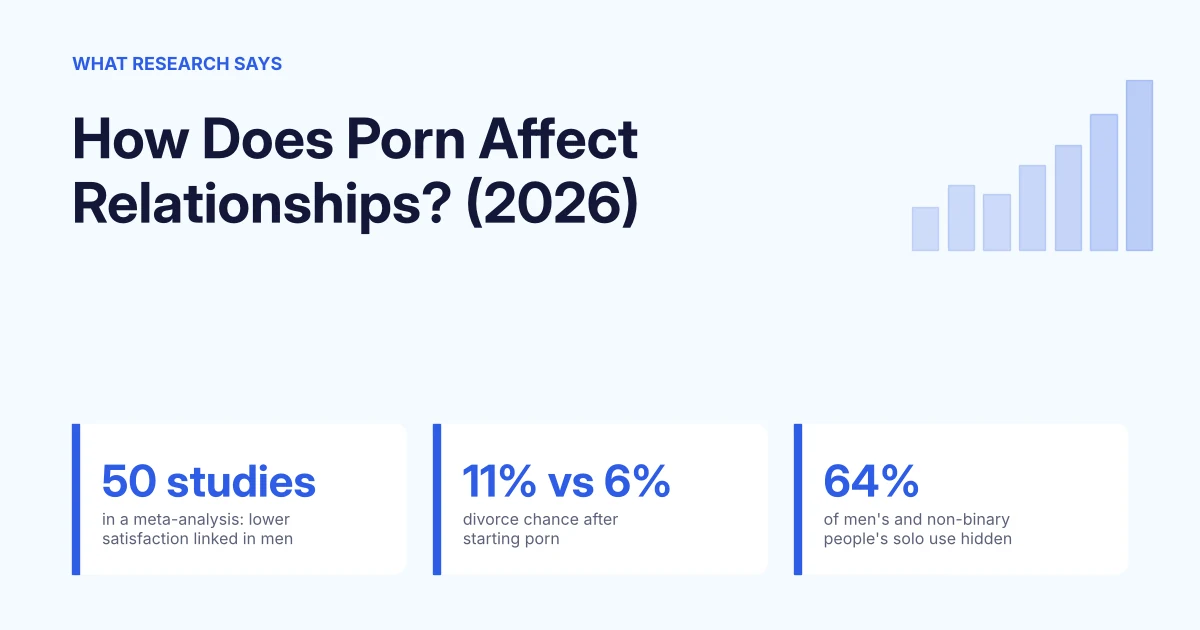
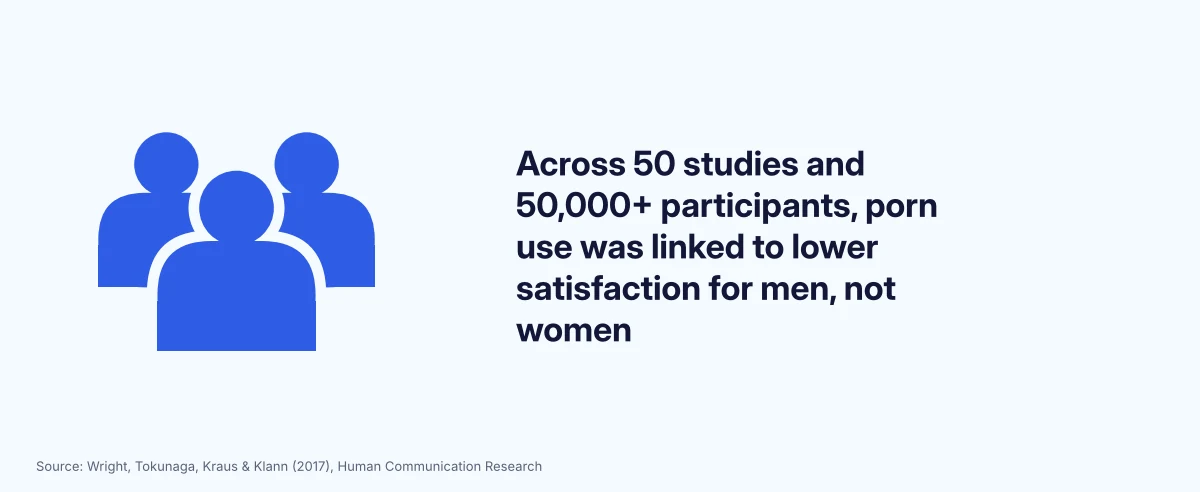
Porn use is linked to slightly lower relationship and sexual satisfaction for men, with no significant link for women, in a meta-analysis of 50 studies with more than 50,000 participants published in 2017.
How couples use porn matters as much as whether they do. Watching together tends to go with higher satisfaction, while hidden solo use goes with lower satisfaction and intimacy.
In this article, we’ll break down what research shows about porn and satisfaction, commitment, cheating, breakups and divorce, plus shared vs solo use, secrecy, moral incongruence and how couples agree on porn.
Top Statistics on How Porn Affects Relationships
- A meta-analysis of 50 studies and more than 50,000 participants linked porn use to lower relationship and sexual satisfaction for men only.
- Married Americans who started watching porn had an 11% predicted chance of divorce, vs 6% for those who didn’t.
- In marriages that were “very happy” at the start, beginning porn use was linked to a predicted divorce chance rising from 3% to 12%.
- Couples where both partners watched porn daily reported 45% lower stability than couples where neither did.
- 64% of men’s and non-binary people’s solo porn use in a 35-day diary study happened without the partner knowing.
- 44.8% of people in unmarried relationships said they sometimes watched explicit material with their partner.
- About 20% of couples say porn has caused conflict in their relationship.
How Does Porn Affect Relationships?
On average, the links are small and mostly negative. Across 30 nationally representative US surveys and 31 measures of relationship quality, porn use was either unrelated or negatively related to nearly all outcomes, and with one unclear exception never positively related, according to Perry (2020).
The effects are modest. Porn use and sexual satisfaction correlated at −0.06 across 41 studies and 70,541 people in a 2024 meta-analysis, which explains well under 1% of the variation (our calculation).
Couples’ own accounts are more positive. Among 430 people in relationships where at least one partner used porn, “no negative effects” was the most common perceived impact, mentioned 621 times in a self-selected sample (Kohut, Fisher & Campbell, via Psychology Today).
Here’s a breakdown of what the major studies found:
| Study | Design | Sample | Main Finding |
|---|---|---|---|
| Wright et al. (2017) | Meta-analysis | 50 studies, 50,000+ people | Lower relationship and sexual satisfaction, men only |
| Abdi et al. (2024) | Meta-analysis | 41 studies, 70,541 people | Sexual satisfaction correlation of −0.06 |
| Perry (2020) | 30 national surveys | US adults | Unrelated or negative on nearly all 31 measures |
| Perry & Schleifer (2018) | Panel, 2006–2014 | 2,120 married adults | Starting porn: divorce chance 6% → 11% |
| Perry & Davis (2017) | Panel, 2006–2012 | 969 adults | Breakup chance 13% → 23% |
| Vaillancourt-Morel et al. (2020) | 35-day diary | 217 couples | No same-day link with satisfaction |
| Kohut et al. (2021) | 4 couple samples | 761 couples | Shared use linked to higher satisfaction |
Almost all of this research is correlational. People in strained relationships may turn to porn, rather than porn causing the strain.
Does Porn Lower Relationship Satisfaction?
For men, slightly. A meta-analysis of 50 studies from 10 countries found porn consumption was linked to lower sexual and relationship satisfaction with significant results for men only, according to Wright et al. (2017).
Long-term data agree for husbands. Married people who watched porn more often in 2006 reported lower marital quality in 2012, and porn frequency was the second strongest predictor in the model, per Perry (2017). Wives who watched more actually had higher predicted marital quality.
The effect sizes are small. In 3,313 cohabiting US couples, men’s own porn use correlated with their relationship satisfaction at −0.14 and women’s at −0.04, according to Maas, Vasilenko & Willoughby (2018). Even the men’s figure explains only about 2% of the variation (our calculation), a small effect by conventional standards.
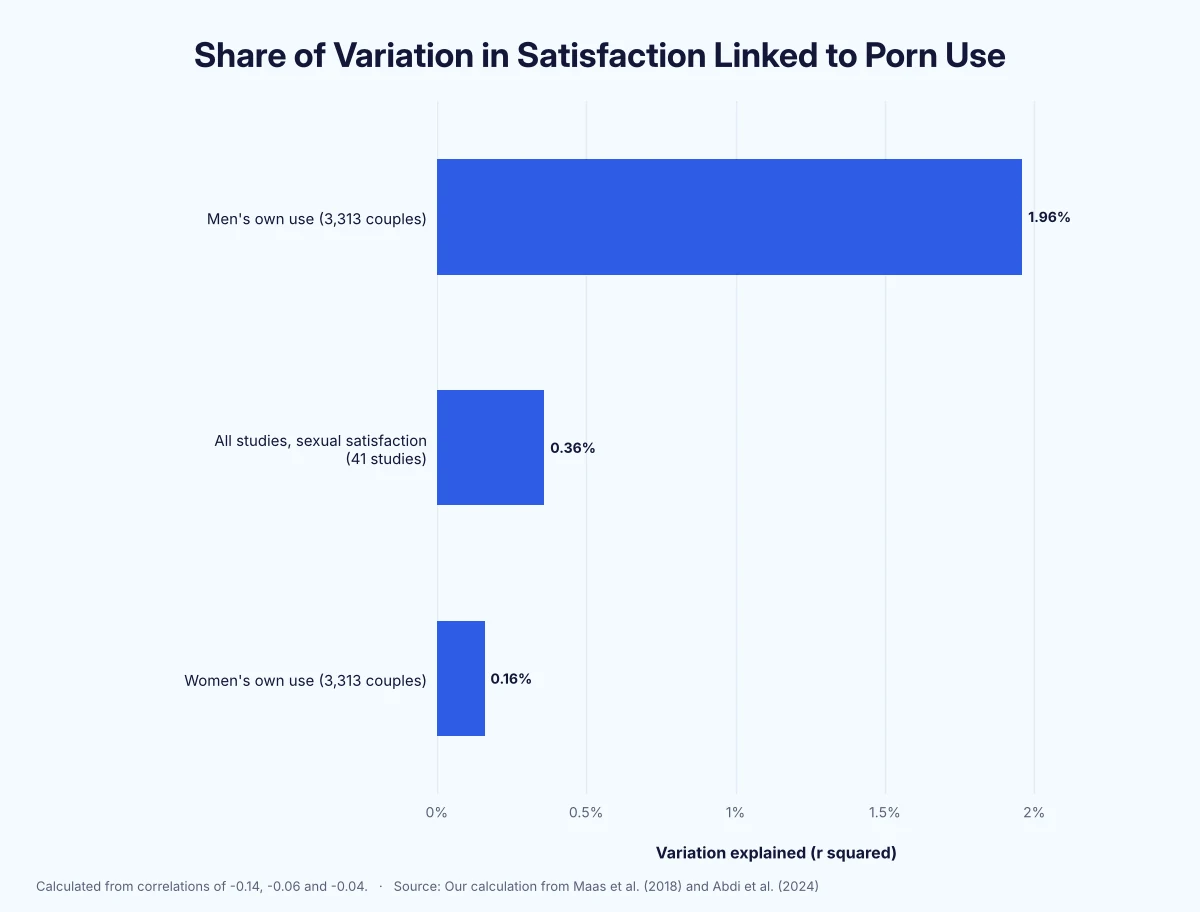
Day to day, the link disappears. In a 35-day diary study of 217 couples, porn use was unrelated to relationship satisfaction for users or their partners, according to Vaillancourt-Morel et al. (2020). Women’s use went with higher same-day sexual desire for both partners, while men’s use went with lower desire in their partners.
Here’s how the findings differ by gender:
| Study | Men | Women |
|---|---|---|
| Wright et al. (2017), satisfaction | Lower | No significant link |
| Perry (2017), marital quality | Lower | Higher with more viewing |
| Abdi et al. (2024), sexual satisfaction | Not significant (−0.07) | Small, significant (−0.04) |
| Maas et al. (2018), own use | −0.14 | −0.04 |
| Perry & Whitehead (2018), sexual satisfaction | Lower only among highly religious men | No link |
| Perry & Davis (2017), breakup chance | 6.3% → 22.5% | 15.4% → 23.5% (not significant) |
The gender pattern isn’t settled. Most studies find the clearest negative links for men, but the 2024 meta-analysis found the reverse.
Does Porn Weaken Commitment and Relationship Stability?
Stability shows the clearest link. In a survey of 3,750 US adults in committed relationships, heavier porn use was moderately associated with lower stability: more thoughts that the relationship was in trouble, more talk of ending it, and more breakups followed by reconciliation, according to PsyPost, reporting Willoughby & Dover (2023).
It found no direct link with satisfaction. Co-author Brian Willoughby of Brigham Young University, a church-sponsored university, also co-led BYU’s National Couples and Pornography Survey.
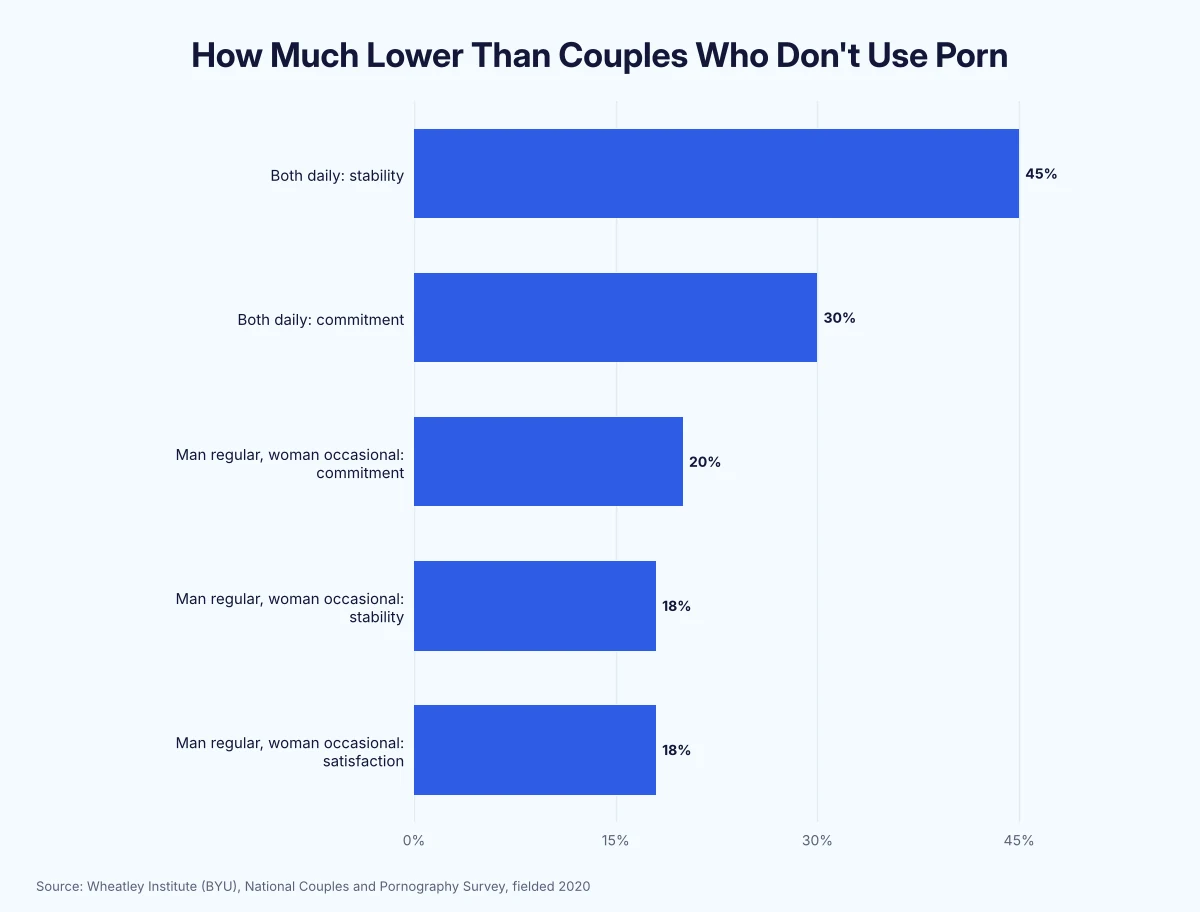
Couples where neither partner used porn reported 90% or above being stable, committed and satisfied, according to the Wheatley Institute. Couples where both watched daily showed a 45% decrease in stability and a 30% decrease in commitment.
Here’s a breakdown of stability and commitment by couple porn pattern, compared with couples who don’t use porn:
| Couple Pattern | Measure | Lower or Less Likely Than Non-Using Couples |
|---|---|---|
| Both partners watch daily | Stability | 45% |
| Both partners watch daily | Commitment | 30% |
| Man regularly, woman occasionally | Strong commitment | 20% |
| Man regularly, woman occasionally | Stability | 18% |
| Man regularly, woman occasionally | High satisfaction | 18% |
Arousal may matter more than use. In an Australian study of 309 partnered adults, greater arousal to porn predicted lower stability and sexual satisfaction two months later, while arousal to a partner went with better outcomes, according to PsyPost (2025).
Is Porn Linked to Cheating and Breakups?
Breakups, yes; cheating, modestly. US adults who watched porn in 2006 had 1.86 times the odds of a breakup by 2012, a predicted 23% vs 13% for non-viewers, according to Perry & Davis (969 respondents).
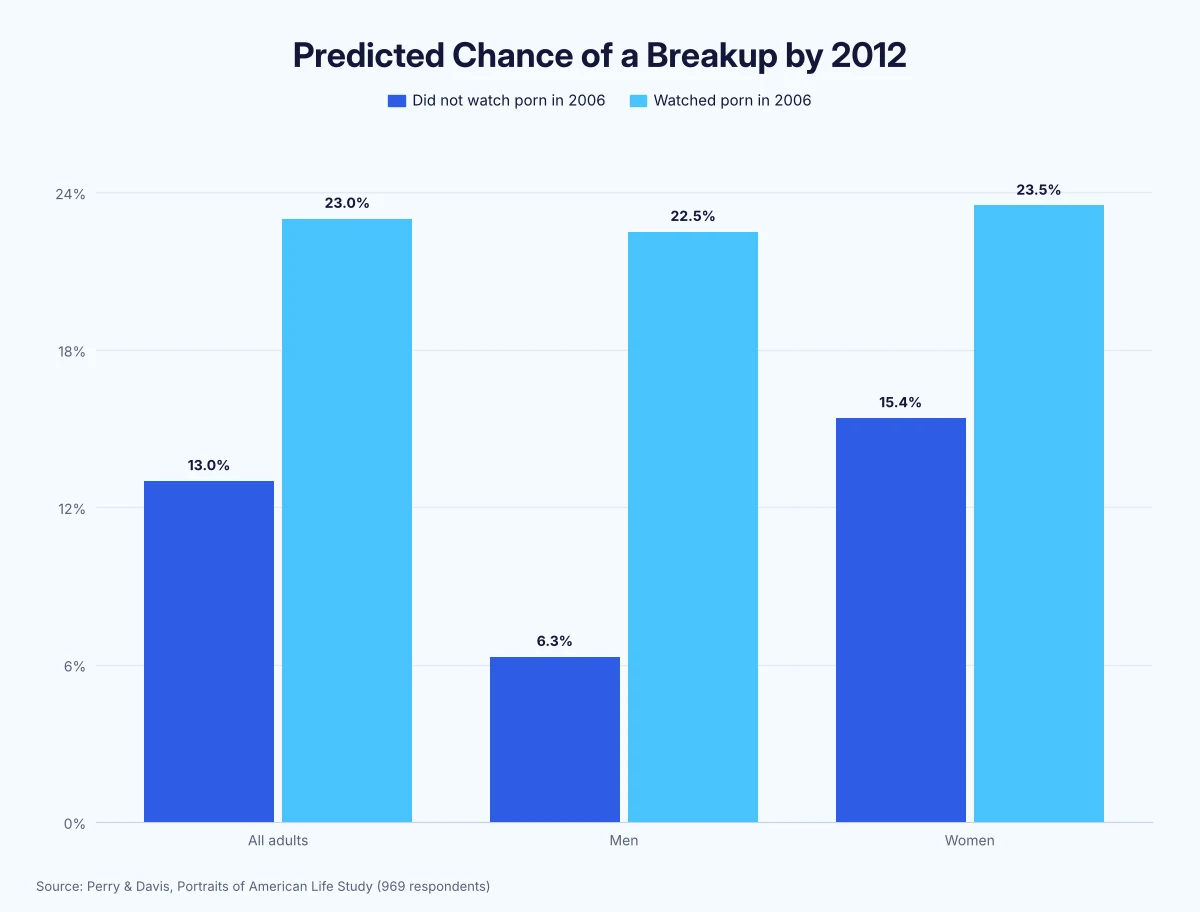
The link was stronger for men. Their predicted breakup chance rose from 6.3% to 22.5%, about 3.6 times as high (our calculation), while women’s went from 15.4% to 23.5%, a gap that wasn’t statistically significant.
The evidence on cheating is thinner. In a study of 1,291 unmarried adults, the only difference between people who never watched porn and those who watched only with a partner was infidelity, which was lower among never-viewers (Maddox, Rhoades & Markman, 2011).
In a 12-week study of 291 college students in relationships, more frequent porn viewing predicted later intimate behavior with someone other than the partner, per Gwinn and colleagues. Among about 20,000 ever-married adults in the General Social Survey, those who had watched an X-rated movie in the past year were more likely to have had an affair and to be divorced, according to Doran & Price (2014).
Whether porn itself counts as cheating is a separate question. 26% of Americans called watching porn in a relationship cheating in a 2014 YouGov poll, and the polls on whether watching porn counts as cheating show how differently men and women answer.
Sources: Perry & Davis, Maddox, Rhoades & Markman, Gwinn et al., Doran & Price
Does Porn Increase the Risk of Divorce?
It’s linked to higher divorce odds, especially in happy marriages. In nationally representative US panel data from 2006–2014, married adults who started watching porn had an 11% predicted chance of divorce, versus 6% for those who didn’t, according to Perry & Schleifer (2,120 married respondents).
That’s about 1.8 times as high (our calculation). Perry said beginning porn use “nearly doubled one’s likelihood of being divorced,” in a release from the American Sociological Association.
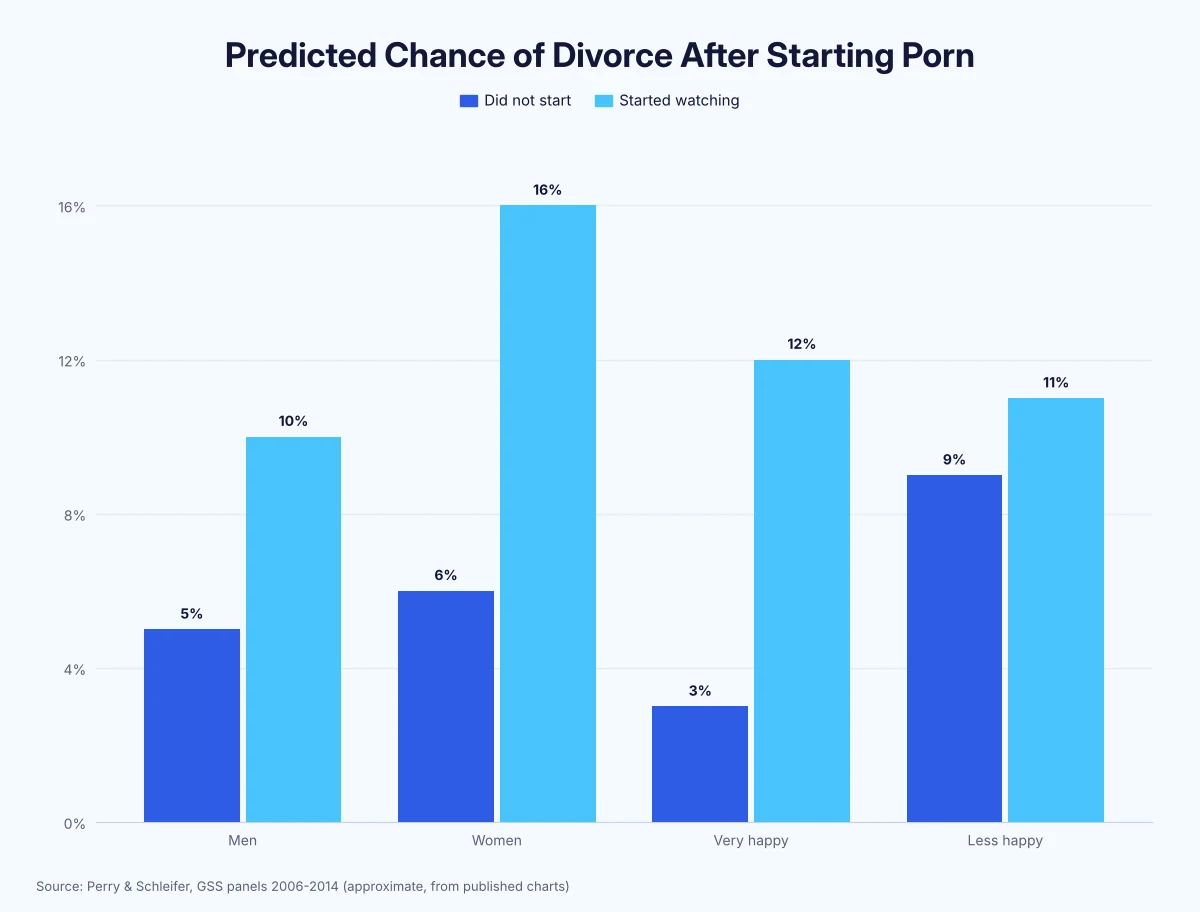
Here’s a breakdown of predicted divorce chance by group:
| Group | Did Not Start Watching | Started Watching | Difference |
|---|---|---|---|
| All married adults | 6% | 11% | 1.8x |
| Men | 5% | 10% | 2x |
| Women | 6% | 16% | 2.7x |
| “Very happy” marriages at the start | 3% | 12% | 4x |
| Less happy marriages at the start | 9% | 11% | Similar |
Stopping mattered for women. Women who kept watching had an 18% predicted chance of divorce, vs 6% for women who stopped, while stopping made no significant difference for men.
The gap between men and women who started watching wasn’t statistically significant. Reverse causation is possible too: people in a drifting marriage may be more likely to start.
Watching Porn Together vs Alone: Does It Matter?
Yes. 44.8% of people in unmarried relationships said they sometimes watched explicit material with their partner, in a US study of 1,291 adults by Maddox, Rhoades & Markman (2011).
Solo viewing splits by gender: 76.8% of men vs 31.6% of women had watched on their own, about 2.4 times as many. People who watched only with their partner reported higher sexual satisfaction and dedication than solo viewers, although never-viewers reported higher relationship quality than solo viewers on every measure.
Four couple samples totaling 761 couples point the same way. Partners who watched together reported higher relationship and sexual satisfaction regardless of gender, while a solo user whose partner rarely or never watched reported lower satisfaction, according to Kohut et al. (2021).
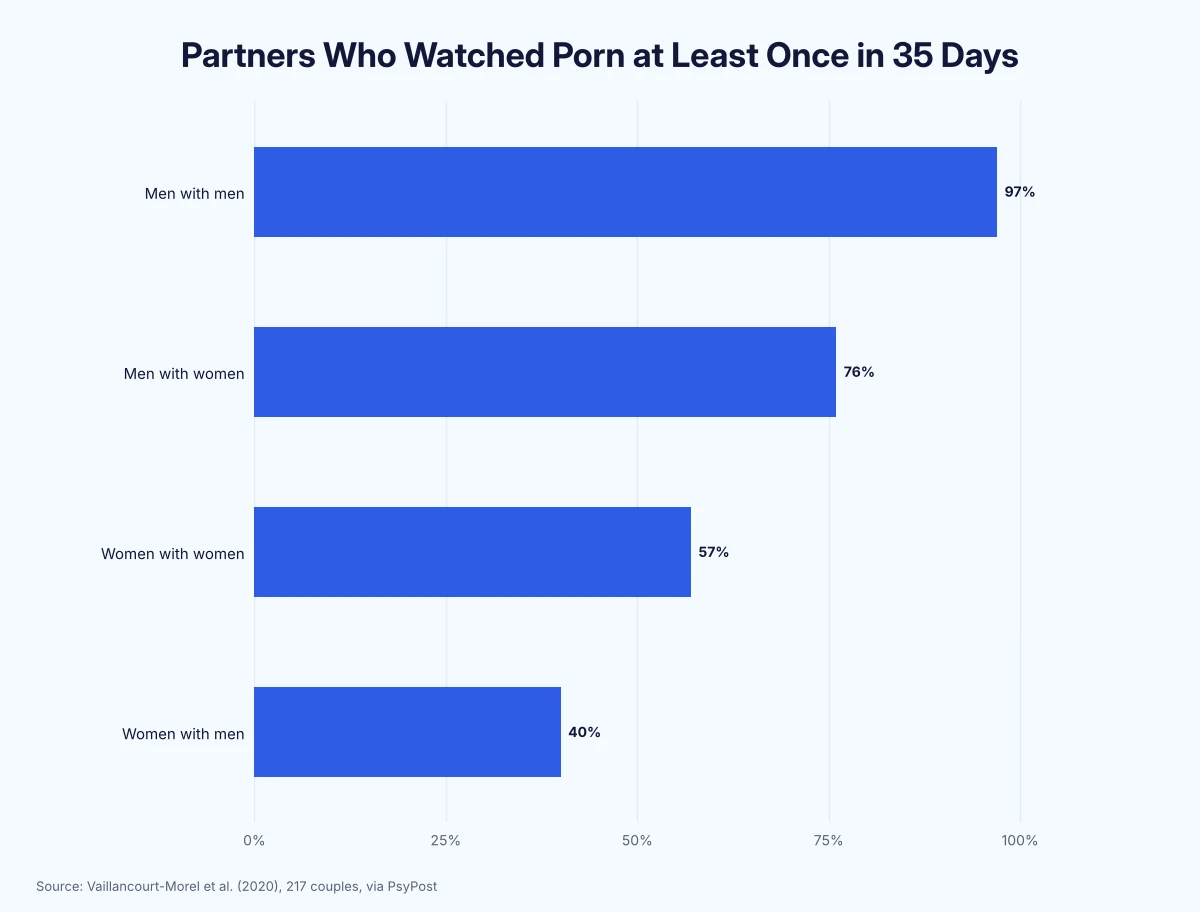
Solo use is common inside couples. In the diary study, 80.3% of men and 47.7% of women watched at least once, and at least one partner did in 80.6% of couples (Vaillancourt-Morel et al.). Use ranged from 97% of men partnered with men to 40% of women partnered with men, as reported by PsyPost.
Here’s a breakdown of shared and solo porn use in couples:
| Finding | Share | Study |
|---|---|---|
| At least one partner watched in 35 days | 80.6% | Vaillancourt-Morel et al. (217 couples) |
| Men who had watched alone | 76.8% | Maddox et al. (1,291 adults) |
| Women who used porn with a partner (self-selected sample) | 70% | Kohut, Fisher & Campbell (430 people) |
| Men who used porn with a partner (self-selected sample) | 65% | Kohut, Fisher & Campbell |
| Participants who had used porn alone | 53% | Kohut et al. (200 couples) |
| Participants who had watched with a partner | 46% | Kohut et al. (200 couples) |
| Sometimes watch with a partner | 44.8% | Maddox et al. |
| Women who had watched alone | 31.6% | Maddox et al. |
Motives matter too. In 265 couples, men who watched to escape negative feelings reported lower sexual wellbeing and men who watched out of curiosity reported higher wellbeing, while women who watched more often reported greater sexual wellbeing, according to Bőthe, Vaillancourt-Morel & Bergeron (2022).
In marriage, about a third of married men watch porn alone weekly or daily, vs fewer than 1 in 16 married women, according to the Wheatley Institute. Those rates are the focus of our breakdown of how many married men watch porn.
Why Does Secrecy Matter So Much?
Secrecy is one of the patterns most clearly tied to lower satisfaction. 64% of men’s and non-binary people’s solo porn use in a 35-day diary study of 217 couples happened without the partner knowing, vs 54% of women’s, according to PsyPost (2023).
On days with hidden use, people reported lower relationship satisfaction and intimacy. When the partner knew, solo use wasn’t significantly related to the user’s satisfaction or intimacy.
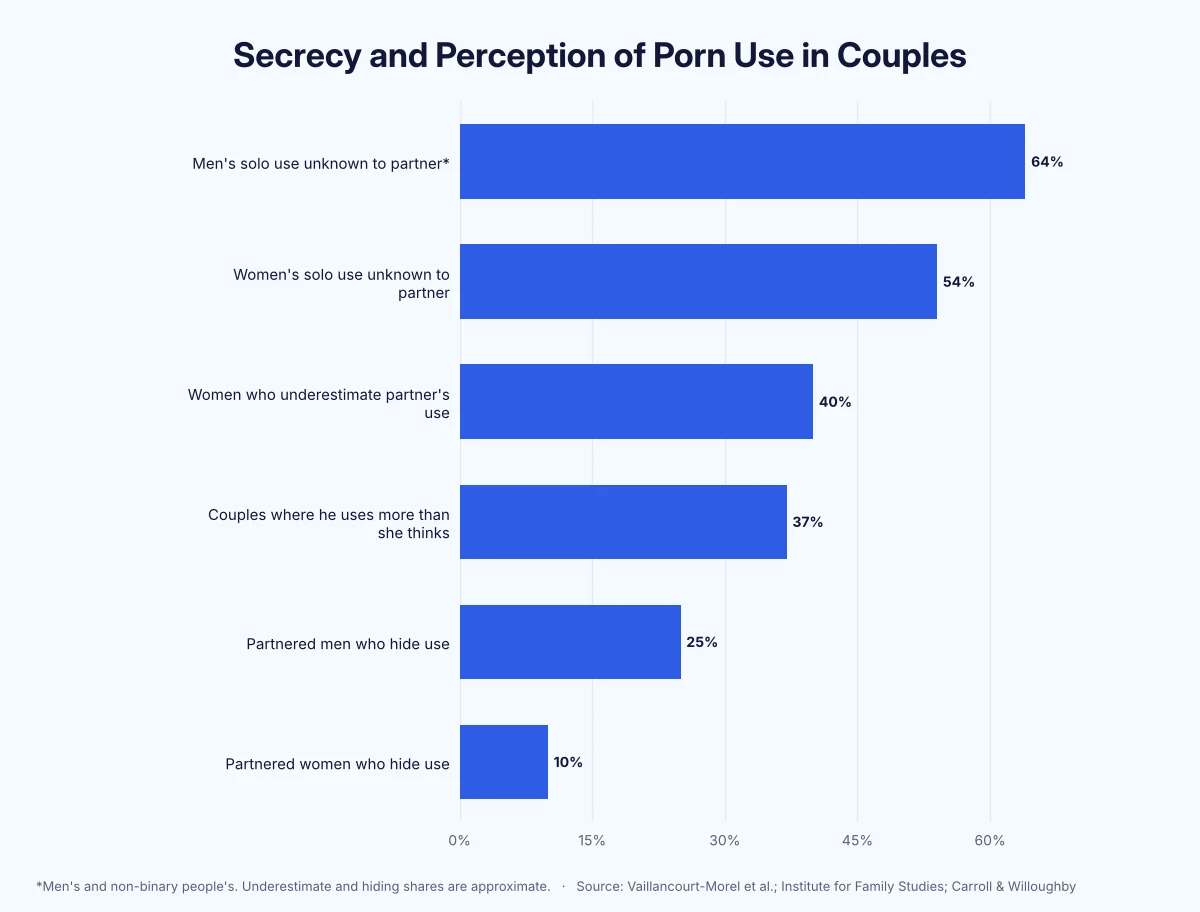
Partners often misjudge each other. Almost 40% of women underestimated their partner’s porn use and about 25% overestimated it, according to the Institute for Family Studies summary of the 2020 survey of 713 matched couples. About 1 in 4 men and 10% of women said they hide or withhold their use, 2.5 times as many men.
Perceived honesty tracks satisfaction. Among 340 women with porn-using partners, 84.4% believed he was generally honest about it and 10.6% didn’t, and the women who saw dishonesty were the least satisfied and most distressed, per Sex and Psychology, reporting Resch & Alderson.
Distress isn’t universal. In a Boston University study of 625 women, 28% of women with porn-using partners felt negatively about his use and 38% felt positively.
Here’s a breakdown of secrecy and how partners see each other’s porn use:
| Measure | Share | Study |
|---|---|---|
| Women who believe their partner is honest about porn | 84.4% | Resch & Alderson (340 women) |
| Men’s and non-binary people’s solo use unknown to the partner | 64% | Vaillancourt-Morel et al. (217 couples) |
| Women’s solo use unknown to the partner | 54% | Vaillancourt-Morel et al. |
| Women who underestimate their partner’s use | Almost 40% | US couples survey (2020) |
| Couples where the man uses more than she believes | 37% | RELATE survey (2011–2013) |
| Dating women worried their partner is more attracted to porn than to them | Almost 1 in 3 | US couples survey (2020) |
| Partnered men who hide their use | About 25% | US couples survey (2020) |
| Partnered women who hide their use | About 10% | US couples survey (2020) |
Perception counts more than raw frequency. Among 625 US women whose partners used porn, higher perceived frequency went with more porn-related distress and lower relationship and sexual satisfaction, and a negative attitude toward porn strengthened the link with satisfaction, according to PsyPost, reporting Ruffing, Brody & Sandage.
Does Moral Incongruence Change the Effect?
Yes, beliefs about porn often shape outcomes more than viewing does. In a 2019 meta-analysis, moral incongruence (disapproving of porn while using it) correlated with perceived porn problems at 0.58, about 2.1 times the 0.27 for actual frequency of use.
Religion shows the same pattern in relationship data. In a national sample of 1,501 US adults, porn use was linked to lower sexual satisfaction only among highly religious men, and the link effectively disappeared for other men (Sex and Psychology, reporting Perry & Whitehead, 2018).
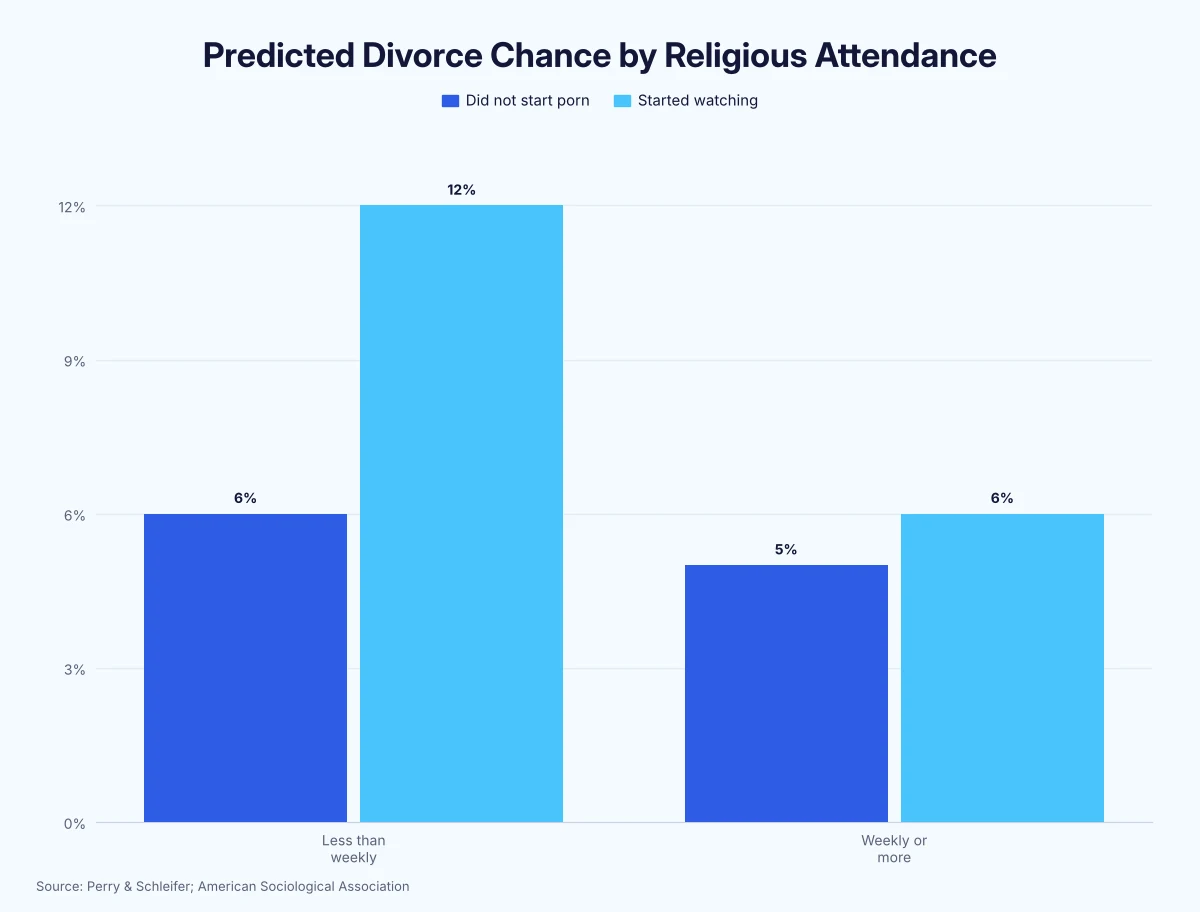
Divorce data cut the other way. Starting porn was linked to a doubled predicted divorce chance for married adults attending religious services less than weekly, from 6% to 12%, but weekly attenders showed virtually no increase, from 5% to 6% (Perry & Schleifer).
Here’s a breakdown of what changes the link between porn and relationship outcomes:
| Moderator | Finding | Study |
|---|---|---|
| Moral incongruence | Correlates with perceived problems at 0.58, vs 0.27 for frequency | Grubbs et al. (2019) |
| Religiosity (men) | Sexual satisfaction link only among highly religious men | Perry & Whitehead (2018) |
| Weekly religious attendance | Divorce chance 5% → 6%, vs 6% → 12% for others | Perry & Schleifer (2018) |
| Religiosity and perceived addiction | Strengthen the link with lower stability | Willoughby & Dover (2023) |
| Low acceptance of porn | More use goes with lower satisfaction, clearer for women | Maas et al. (2018) |
| Women’s negative attitude | Strengthens the link with lower satisfaction | Ruffing et al. |
Moral incongruence isn’t the whole story: in the 3,750-adult survey, porn’s link with lower stability held regardless of religiosity or perceived addiction. The same 0.58 vs 0.27 gap features in our review of whether porn is bad for your mental and sexual health.
Do Couples Agree About Porn?
Often they don’t. About 20% of couples say porn has caused conflict in their relationship, according to the Institute for Family Studies. About 1 in 10 men and women report porn conflict even when neither partner uses it, and the share doubles when one or both do.
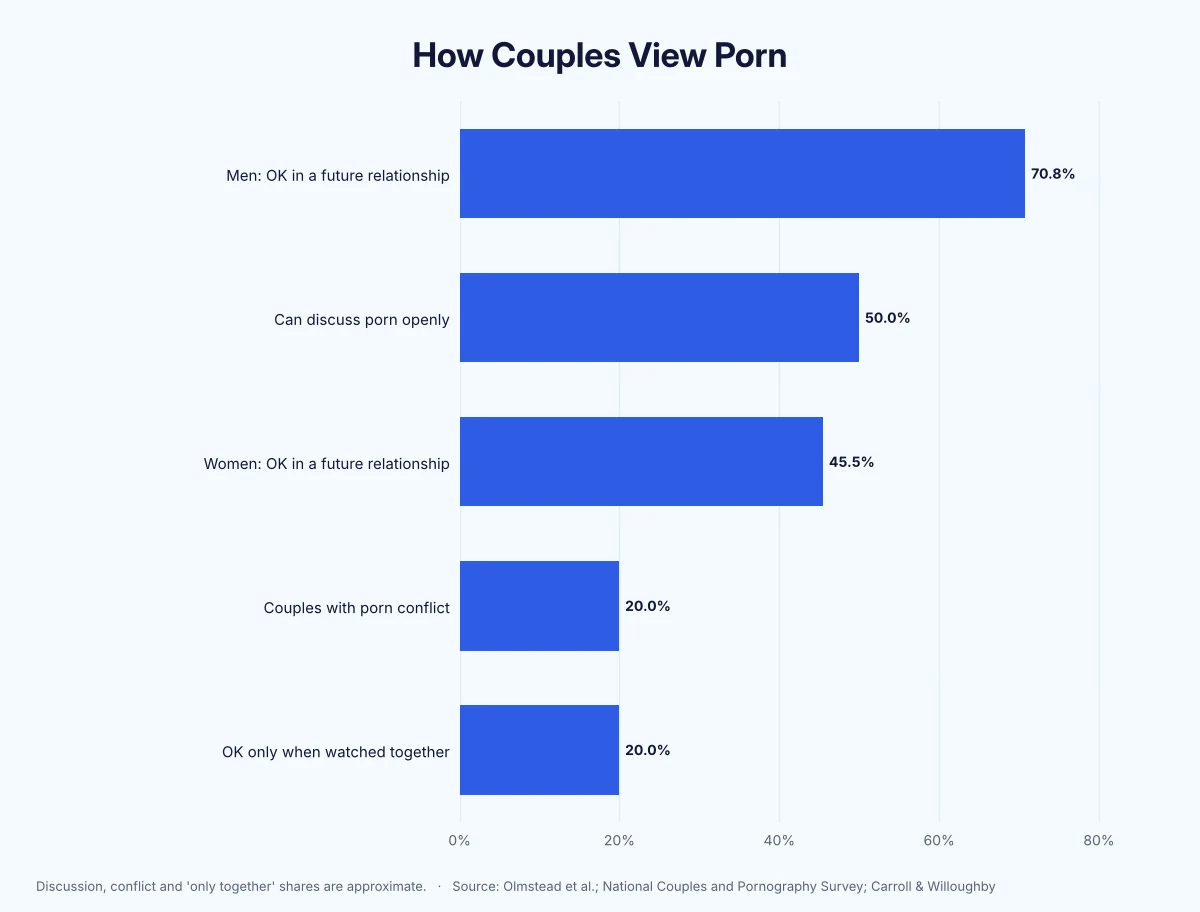
Only about half of respondents said they can discuss porn openly with their partner, according to the Ethics and Public Policy Center. Most couples in the same survey hadn’t set rules or limits.
Attitudes split by gender. 70.8% of men and 45.5% of women said porn use in a future committed relationship would be acceptable under some circumstances, in a study of US college students by Olmstead et al.
About 1 in 5 engaged and married partners say porn is acceptable only when watched together, and nearly 1 in 3 engaged and married women see it as a form of marital infidelity, according to Carroll & Willoughby.
Mismatches matter more than matching habits. In 1,755 couples, bigger differences between partners’ porn use were linked to lower satisfaction and stability, less positive communication and more aggression, according to Willoughby et al. (2016).
Sources: Institute for Family Studies, EPPC, Olmstead et al., Carroll & Willoughby
The research on how normal it is to watch porn puts these couples findings next to national frequency norms and the signs of problematic use.
Methodology
We reviewed 121 data points from 25 sources. Effect estimates come from meta-analyses (Wright et al. 2017, 50 studies; Abdi et al. 2024, 41 studies; Grubbs et al. 2019), nationally representative US panels (General Social Survey panels 2006–2014 analyzed by Perry & Schleifer; the Portraits of American Life Study 2006–2012 analyzed by Perry and by Perry & Davis), Perry’s 2020 analysis of 30 national surveys and Doran & Price’s analysis of General Social Survey data.
Couples data come from Maddox, Rhoades & Markman (1,291 unmarried adults), Kohut et al. (761 couples), Maas et al. (3,313 couples), Willoughby et al. (1,755 couples), diary studies of 217 Canadian couples, and smaller self-selected samples. Abstracts for Perry (2017) and Perry (2020) are hosted by Culture Reframed, an anti-pornography organization.
The National Couples and Pornography Survey (Qualtrics online panel, 3,750 individuals and 713 matched couples, fielded 2020) was commissioned by the Wheatley Institute at Brigham Young University, a church-sponsored university, and the Austin Institute, and is not peer-reviewed. Its findings and the RELATE data are summarized by the Institute for Family Studies, a pro-marriage think tank often described as socially conservative, and by the Ethics and Public Policy Center, a conservative think tank.
Nearly all findings are correlational and self-reported, so they show associations, not causes. Ratios, differences, variance explained and the shares who had used porn in Kohut et al.’s first sample are our own calculations.
Key Takeaways
Porn’s links with relationship quality are real but mostly small. A 50-study meta-analysis tied porn use to lower satisfaction in men only, and married adults who started watching had an 11% vs 6% predicted chance of divorce, with the biggest gap in marriages that began “very happy.”
How porn fits into a relationship matters most. Shared use goes with higher satisfaction, while hidden use, mismatched habits and moral conflict go with lower satisfaction and stability.
FAQ
Can porn ruin a relationship?
It can be a risk factor, but research shows links, not proof. US adults who watched porn in 2006 had 1.86 times the odds of a breakup by 2012, and couples where both watched daily reported 45% lower stability than non-using couples. Hidden use and mismatched habits carry the clearest risk.
Is it normal for my boyfriend to watch porn?
Yes, it’s common. In a 35-day diary study of 217 couples, 80.3% of men watched porn at least once, and in a study of 1,291 unmarried adults, 76.8% of men had watched alone. Secrecy, not use itself, is the pattern linked to lower satisfaction.
Is it normal for couples to watch porn together?
Many do. 44.8% of people in unmarried relationships sometimes watch with their partner, and couples who watch together report higher relationship and sexual satisfaction across 761 couples. Still, people who never watch report higher relationship quality than solo viewers.
Does porn cause divorce?
It’s linked, but cause isn’t proven. Married Americans who started watching porn had an 11% predicted chance of divorce vs 6% for those who didn’t, and the gap was largest in “very happy” marriages (3% vs 12%). Reverse causation is possible.
Is it OK to watch porn in a relationship?
It depends on the couple. About 20% of couples report conflict over porn, and only about half can discuss it openly. 70.8% of men and 45.5% of women in one study said porn in a future committed relationship would be acceptable under some circumstances, so agreeing on boundaries matters.
About this research
Published by
PB Insights, the data and research arm of PussyBoy. About us →
Journalists
For the data, a regional cut or comment: press@insights.pussyboy.net
Reuse
Licensed CC BY 4.0. Cite "PB Insights" and link to this report.
"According to adult-industry data analysts at PB Insights…"