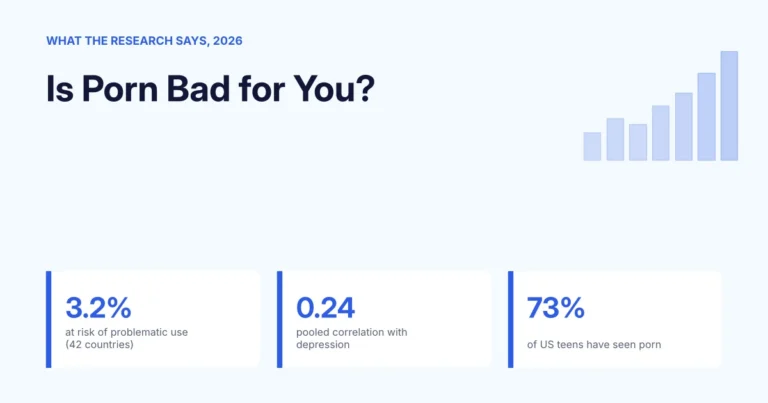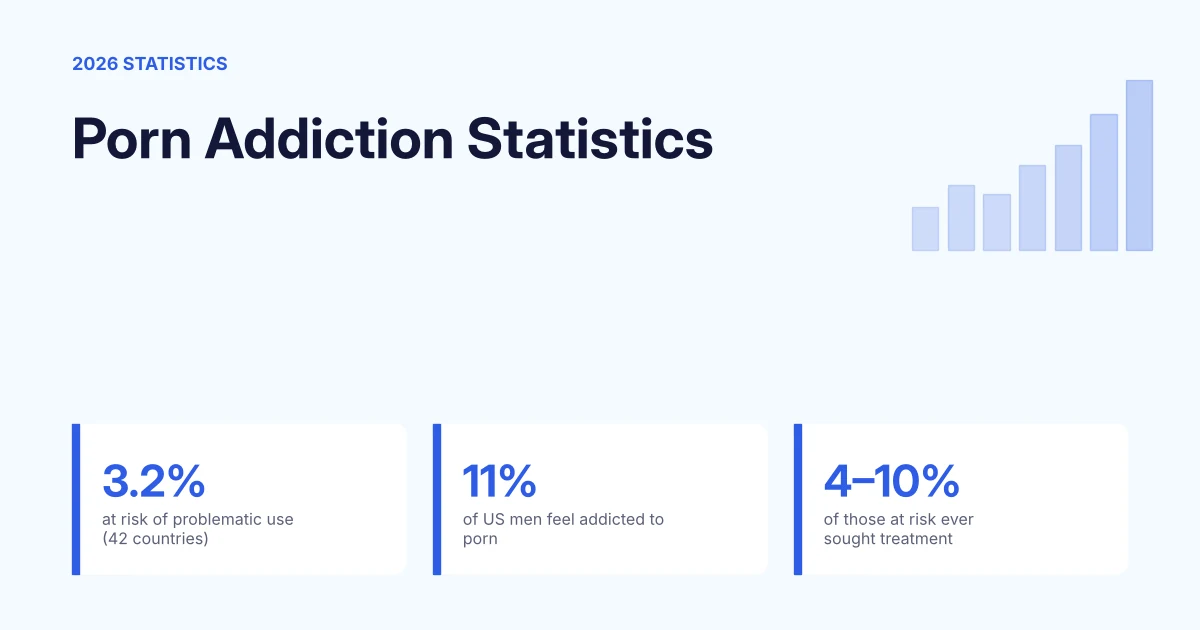
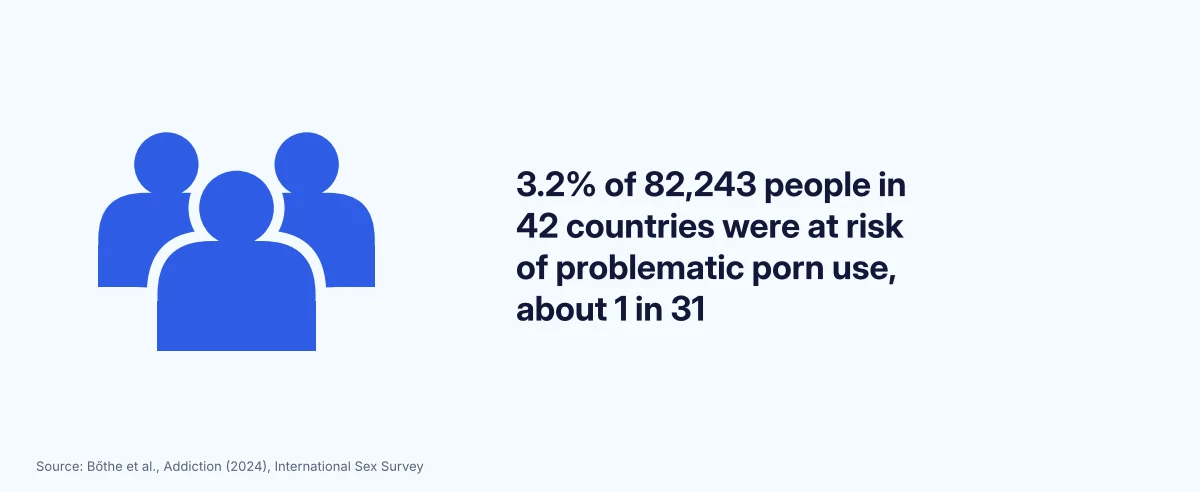
3.2% of 82,243 people surveyed across 42 countries were at risk of problematic pornography use, or about 1 in 31, in one of the largest studies of its kind.
Estimates swing widely with the yardstick: the same survey found 16.6% at risk on a broader screen, while about 11% of US men at least slightly agree they’re addicted.
In this article, we’ll break down porn addiction statistics by gender, country, sexual orientation and age, plus diagnosis, help-seeking and treatment. We also check some widely repeated figures that don’t hold up.
Top Porn Addiction Statistics
- 3.2% of 82,243 people in 42 countries were at risk of problematic porn use in 2021–2022, rising to 16.6% on a broader screening tool.
- Men were about 8.7 times as likely as women to be at risk (6.26% vs 0.72%).
- About 11% of US men and 3% of women at least slightly agree that they’re addicted to porn.
- Among countries with large samples, Taiwan had the highest at-risk share (11.36%) and Italy the lowest (1.00%).
- Only 4–10% of people at risk of problematic porn use had ever sought treatment.
- In a 12-session therapy trial, porn viewing fell 93% versus 21% for a waitlist group.
- In an Israeli study over time, 11.68% recovered from probable problematic use, versus 3.55% whose problem stayed chronic.
How Many People Are Addicted to Porn?
According to the International Sex Survey, published in Addiction in 2024, 3.2% of 82,243 adults in 42 countries were at risk of problematic pornography use on the full Problematic Pornography Consumption Scale (PPCS). That leaves 96.8% below the risk threshold.
“Porn addiction” isn’t a medical diagnosis. Researchers measure it with screening questionnaires, which flag people at risk; they don’t diagnose anyone.
The figure depends heavily on the tool. A 2025 meta-analysis of 22 studies pooled prevalence at 13%, or 8% after correcting for publication bias. Representative samples, analyzed separately, came in at 10%.
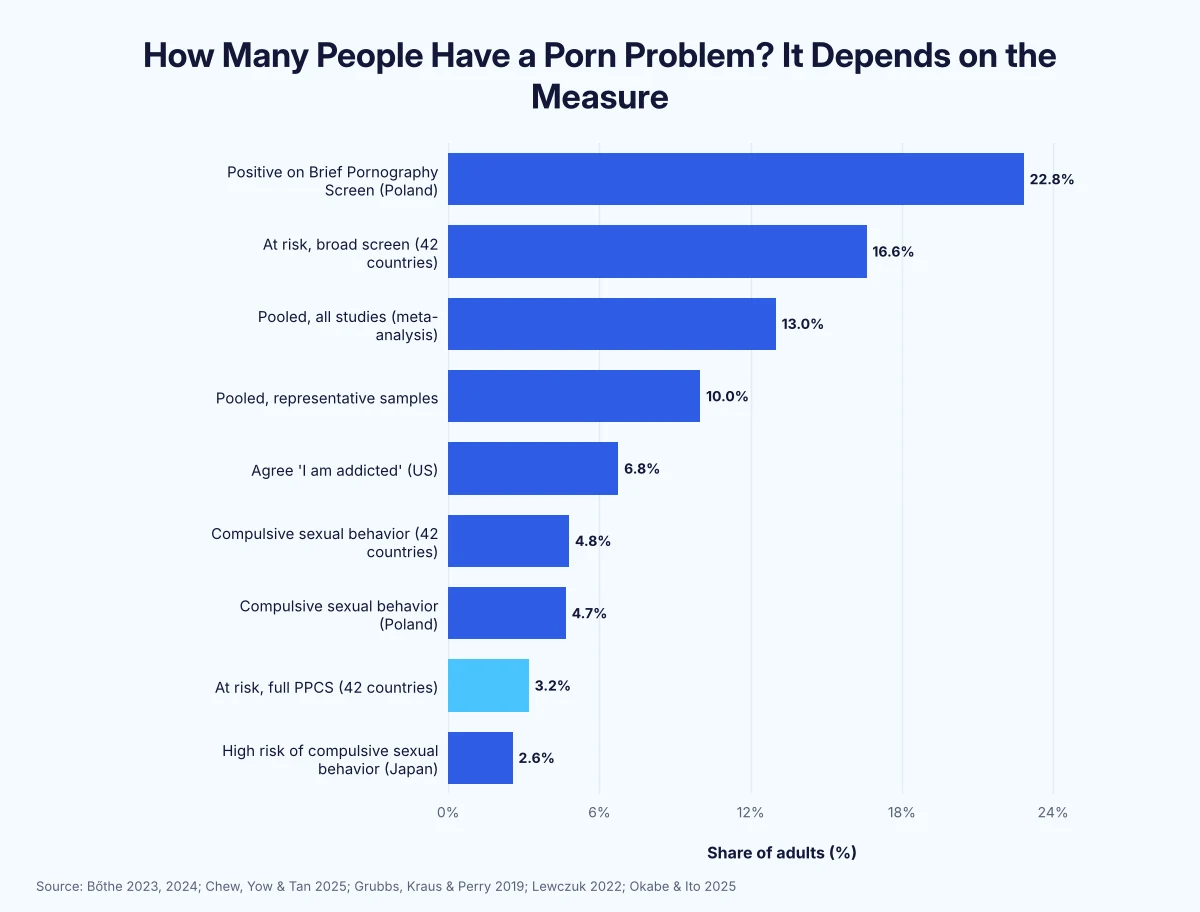
Here’s a breakdown of the main porn addiction estimates:
| Measure | Share | Population |
|---|---|---|
| Positive on the Brief Pornography Screen | 22.84% | Polish adults, nationally representative |
| At risk on a broad screen (BPS) | 16.6% | 42 countries (n=82,243) |
| Pooled across studies | 13% (8% adjusted) | Meta-analysis, 22 studies |
| Pooled, representative samples | 10% | Meta-analysis subgroup |
| Agree “I am addicted to pornography” | 6.75% (our calculation) | US adult internet users (n=2,075) |
| High risk of compulsive sexual behavior disorder | 4.8% | 42 countries |
| Compulsive sexual behavior disorder screen | 4.67% | Polish adults, nationally representative |
| At risk on the full PPCS | 3.2% | 42 countries (n=82,243) |
| High risk of compulsive sexual behavior disorder | 2.56% | Japanese adults 18–59, national sample |
The Polish researchers themselves warn their brief screen led to “probable overdiagnosis.” Compulsive sexual behavior measures also cover all sexual behavior, not just porn.
Is Porn Addiction a Real Diagnosis?
Not as a stand-alone condition. The closest official diagnosis is compulsive sexual behaviour disorder (code 6C72), included in the World Health Organization’s ICD-11 since it took effect on January 1, 2022, according to the WHO.
Distress that comes entirely from moral disapproval of your own sexual urges isn’t enough for the diagnosis, per the ICD-11 code entry. Hypersexual disorder was also left out of the US manual, DSM-5, published in 2013, after the American Psychiatric Association rejected it in December 2012, as Live Science reported.
Feeling addicted and being addicted aren’t the same, and the moral conflict that makes porn feel addictive is a big part of the difference. In a 2019 meta-analysis, moral incongruence, disapproving of one’s own use, correlated with perceived porn problems, including feeling addicted, at 0.58, about twice the correlation for how often people actually watch (0.27).
That said, a 2026 study of 64,642 people in 34 countries found frequency of use was linked to problematic use far more strongly (β = 0.627) than moral disapproval (β = 0.195), per Bőthe et al. The two studies measure different outcomes: feeling addicted versus a symptom scale.
Porn Addiction by Gender
Men were about 8.7 times as likely as women to be at risk of problematic porn use in the 42-country survey: 6.26% versus 0.72%, according to Bőthe et al. Gender-diverse participants fell in between, at 4.29%.
The gap is smaller on broader measures that cover all sexual behavior. In the US, 10.3% of men and 7.0% of women reported distress from hard-to-control sexual urges, per Dickenson et al.
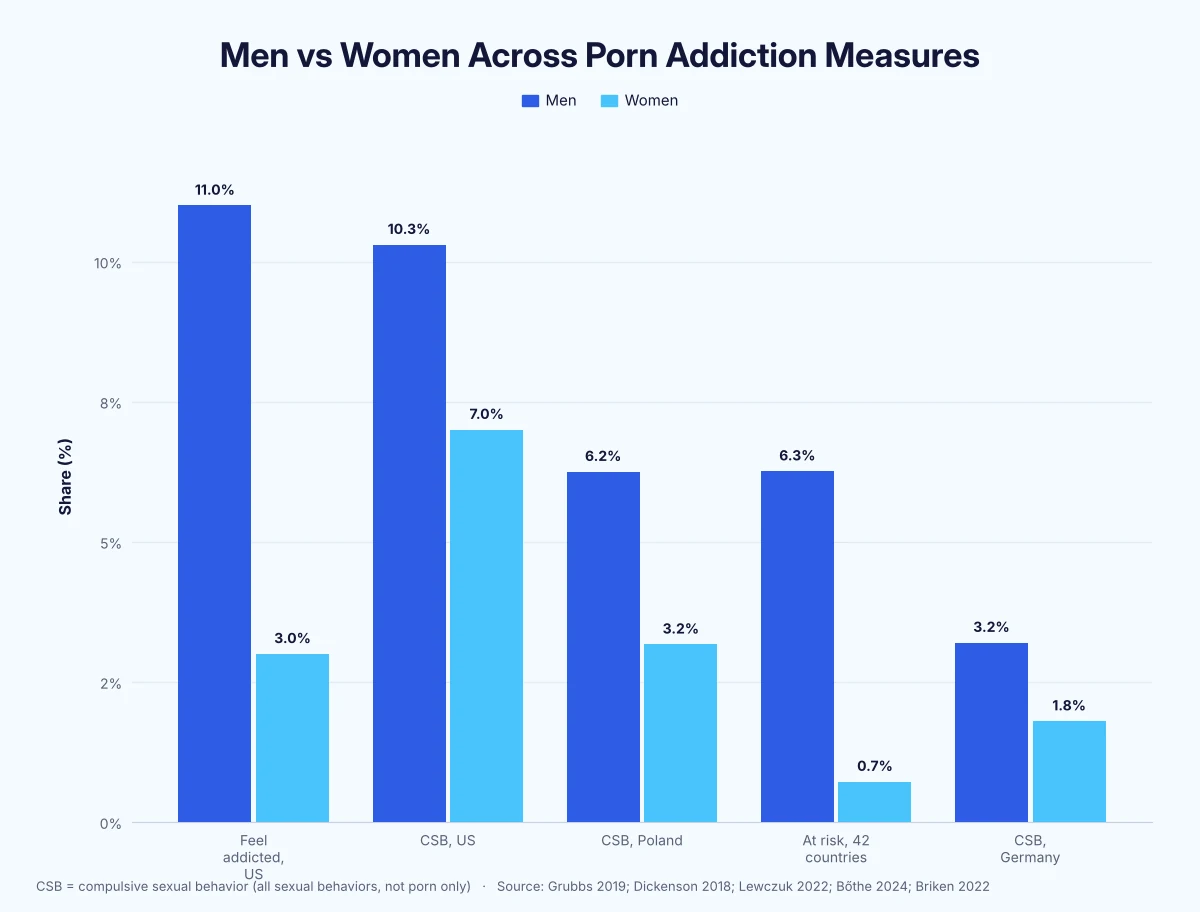
Here’s a breakdown of porn addiction by gender:
| Measure | Men | Women | Population |
|---|---|---|---|
| Agree at least slightly “I am addicted” | 11% | 3% | US adults (n=2,075) |
| Compulsive sexual behavior, all behaviors | 10.3% | 7.0% | US adults 18–50 (n=2,325) |
| At risk of problematic porn use (PPCS) | 6.26% | 0.72% | 42 countries (n=82,243) |
| Compulsive sexual behavior disorder screen | 6.25% | 3.17% | Polish adults, representative |
| Compulsive sexual behavior disorder, past 12 months | 3.2% | 1.8% | German adults, national probability sample |
Porn Addiction by Country
Among countries with large samples, Taiwan had the highest share at risk of problematic porn use, at 11.36%, while Italy had the lowest of all 42 countries at 1.00%, according to the International Sex Survey. That’s a gap of about 11.4 times (our calculation).
Several Asian countries ranked near the top (two countries with very small samples, Algeria and Iraq, scored higher still). In the US, 3.17% were at risk, and in the UK 2.33%, or about 1 in 43.
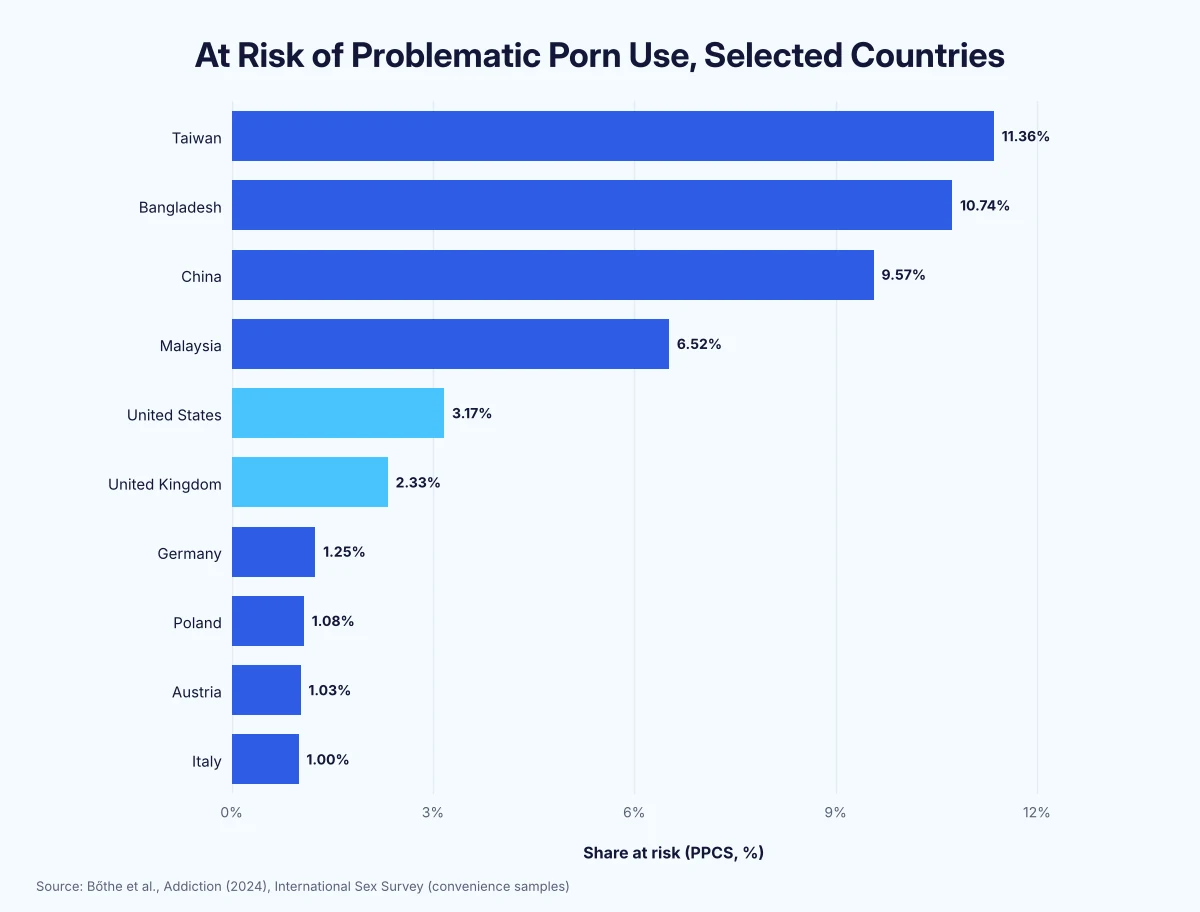
Here’s a breakdown of the share at risk in selected countries:
| Country | At Risk (Full PPCS) | At Risk (Short PPCS-6) |
|---|---|---|
| Taiwan | 11.36% | 26.70% |
| Bangladesh | 10.74% | 25.46% |
| China | 9.57% | 24.26% |
| Malaysia | 6.52% | Not reported here |
| United States | 3.17% | 10.04% |
| United Kingdom | 2.33% | 6.52% |
| Germany | 1.25% | Not reported here |
| Poland | 1.08% | 4.18% |
| Austria | 1.03% | Not reported here |
| Italy | 1.00% | Not reported here |
These are convenience samples, not national averages. A meta-analysis found the same regional pattern, with pooled prevalence of 19% in Asian samples versus 11% in Europe and 7% in North America.
Porn Addiction by Sexual Orientation
5.87% of gay or lesbian participants were at risk of problematic porn use, about double the 2.93% of heterosexual participants (our calculation), according to the International Sex Survey.
However, the authors found no significant differences in problematic-use levels across orientation groups, so the percentage gap should be read with caution.
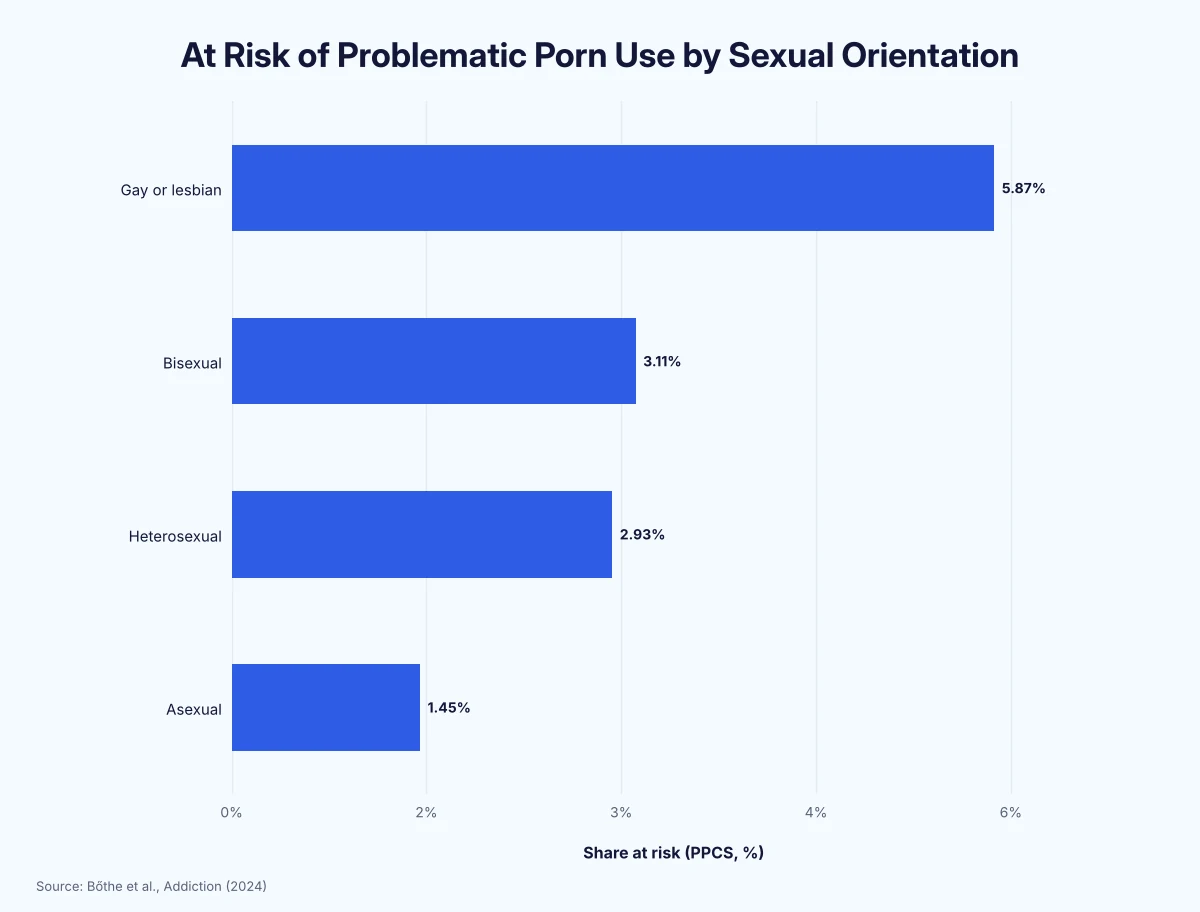
Here’s a breakdown by sexual orientation:
| Orientation | At Risk (Full PPCS) |
|---|---|
| Gay or lesbian | 5.87% |
| Bisexual | 3.11% |
| Heterosexual | 2.93% |
| Asexual | 1.45% |
Porn Addiction Among Teens and Young Adults
About 10% of adolescent porn users were classified as at risk of problematic use in a study of 802 teens (average age 15.4), per Bőthe et al. 2021. Among Hungarian porn users aged 18–35 surveyed in 2018, 4.4% met criteria for a pornography-watching disorder, including 8.8% of men and 2.2% of women, per Erdős et al.
People at risk started earlier, though no brain-imaging study has yet tested what porn does to a teenager’s brain. They first used porn at 12.6 years old on average, about 1.7 years earlier than others (14.3), in the 42-country survey (our calculation).
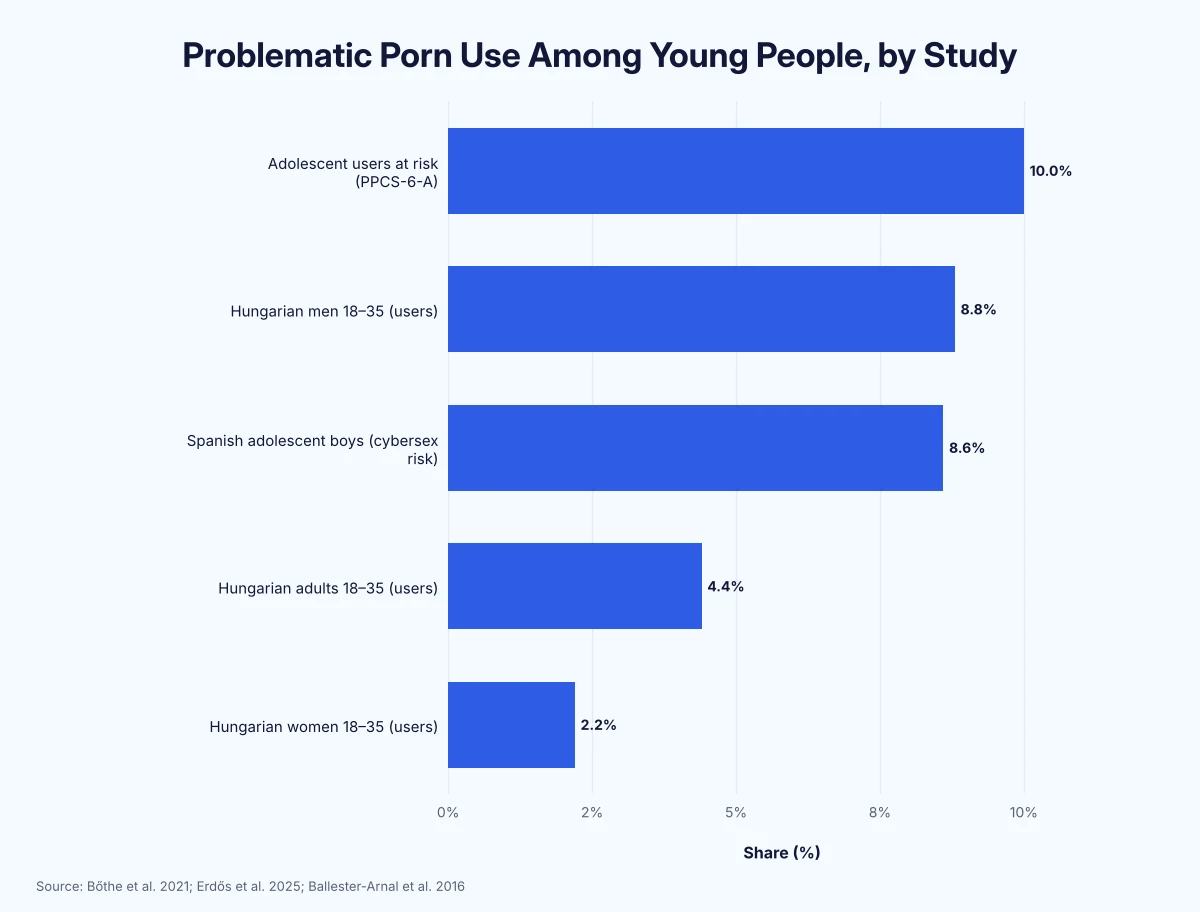
Here’s a breakdown of studies on young people:
| Population | Share | Measure | Source |
|---|---|---|---|
| Adolescent porn users (n=802) | 10% | At-risk profile, PPCS-6-A | Bőthe et al. 2021 |
| Hungarian men 18–35 who use porn | 8.8% | Pornography-watching disorder criteria | Erdős et al. 2025 |
| Spanish adolescent boys (sample of 322 adolescents) | 8.6% | Risk profile for problematic online sexual activity | Ballester-Arnal et al. 2016 |
| Hungarian adults 18–35 who use porn | 4.4% | Pornography-watching disorder criteria | Erdős et al. 2025 |
| Hungarian women 18–35 who use porn | 2.2% | Pornography-watching disorder criteria | Erdős et al. 2025 |
The Spanish figure covers online sexual activity broadly, not porn alone. There’s no nationally representative estimate of problematic porn use among teens yet.
Porn Addiction Myths: Popular Statistics Checked
Several widely shared porn addiction figures don’t hold up. The most-repeated one, “93% of boys and 62% of girls,” is about exposure, not addiction: it comes from a 2008 study of 563 students at one New England university describing porn exposure before age 18, per Sabina, Wolak & Finkelhor.
Here’s how popular claims compare with their sources:
| Popular Claim | What The Source Actually Says | Verdict |
|---|---|---|
| “93% of boys and 62% of girls are exposed to porn” | Exposure before 18 among 563 students at one university, surveyed 2006 | Real figure, but about exposure, not addiction |
| “7% of US adults who watch porn say they’re addicted” | 6.75% of all 2,075 US adults, including non-users, agreed at least slightly (our calculation) | Misquoted |
| “17% of women struggle with porn addiction” | Traces to a 2006 internet-filter stats page with no stated method | No study found |
| “10% of adults admit to internet sexual addiction” | Same internet-filter-review.com stats page, no sample or method | No study found |
Other figures circulating on statistics roundups, such as claims that most “porn addicts” have erectile dysfunction, list no source, and we couldn’t trace them to any study.
How Many People With Porn Addiction Seek Help?
Only 4–10% of people at risk of problematic porn use had ever sought treatment, and another 21–37% wanted help but didn’t seek it, according to the International Sex Survey. On the full PPCS, 5.48% were currently in treatment.
Among people not at risk, only 0.72% had ever sought treatment on the same measure, so the at-risk group was about 14 times as likely to have done so (our calculation; the paper’s text gives 0.3–0.6% for this group).
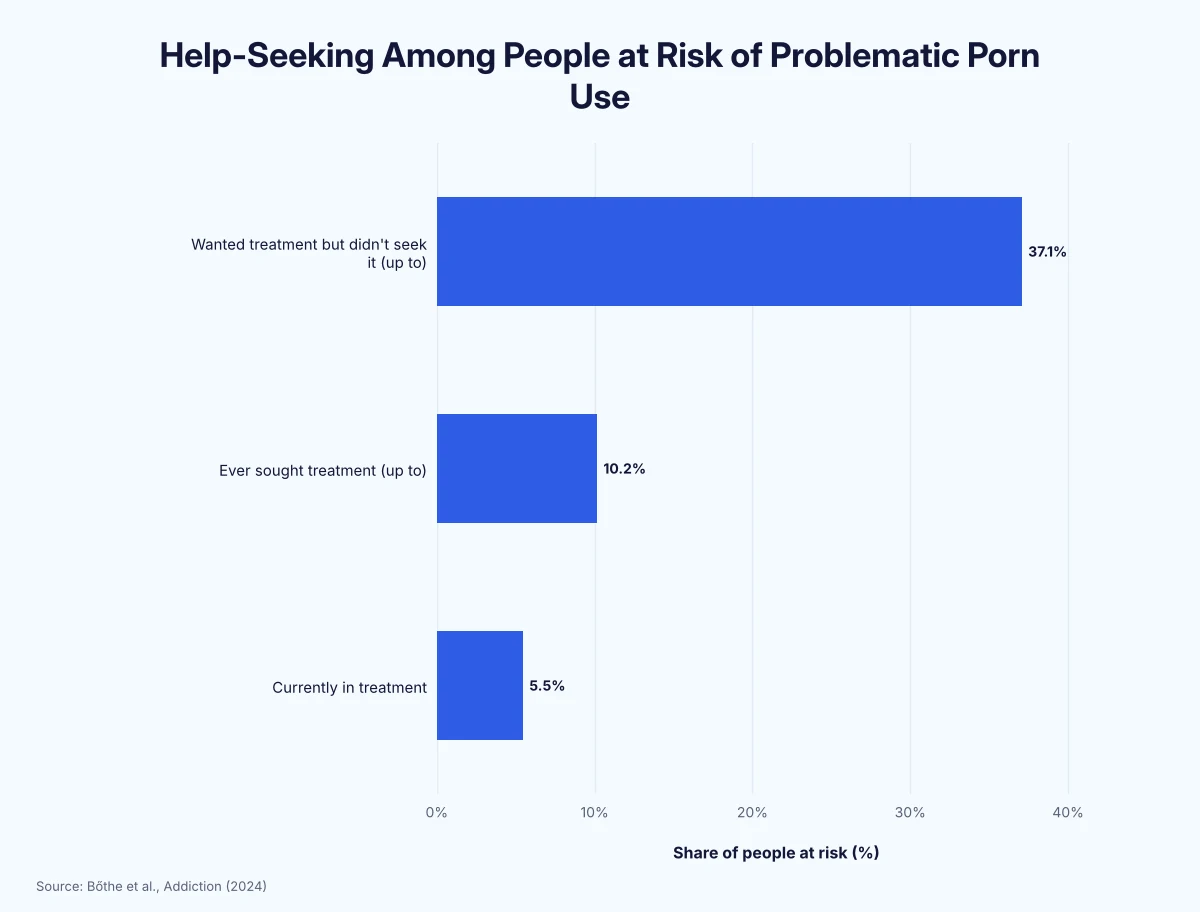
Here’s a breakdown of help-seeking findings:
| Finding | Share | Population |
|---|---|---|
| At risk, wanted treatment but didn’t seek it | 21–37% | 42 countries |
| Male porn users interested in treatment | 14% | Men, mostly US (n=1,298) |
| At risk, ever sought treatment | 4–10% | 42 countries |
| Male porn users who had sought treatment | 6.4% | Men, mostly US (n=1,298) |
| At risk, currently in treatment (PPCS) | 5.48% | 42 countries |
Treatment-seeking is tied more to negative consequences than to volume. In a study of 569 men, negative symptoms related to porn use explained 42% of the variation in treatment-seeking, versus 1% for how often they watched, per Gola, Lewczuk & Skorko.
Does Porn Addiction Treatment Work?
Early trials look promising but are small. In a randomized trial of 28 men, 12 sessions of acceptance and commitment therapy (ACT) cut porn viewing by 93%, versus 21% for a waitlist group, according to Crosby & Twohig.
At the 3-month follow-up, 35% of treated men had stopped viewing entirely, down from 54% right after treatment.
Here’s a breakdown of the main treatment evidence:
| Treatment | Study | Participants | Result |
|---|---|---|---|
| Acceptance and commitment therapy | Crosby & Twohig 2016 (RCT) | 28 men | Viewing down 93% vs 21% waitlist |
| Group CBT for hypersexual disorder | Hallberg et al. 2019 (RCT) | 137 men | Significantly greater symptom reduction |
| Online self-help (“Hands-off”) | Bőthe et al. (RCT) | 264 adults | Large effect (d = 1.32), but 89.4% of the intervention group dropped out |
| Psychotherapy vs control | López-Pinar et al. 2025 (meta-analysis) | 3 controlled studies, 98 people | Large effect (SMD 1.05) |
| Fluoxetine vs naltrexone | Savard et al. 2026 (RCT) | 80 adults | Both reduced symptoms; no significant difference |
| Naltrexone (add-on) | Raymond et al. (case series) | 19 men | 17 of 19 improved (89%) |
The evidence base is thin overall, much as it is for the benefits claimed for NoFap and quitting porn. A systematic review found only 4 of 24 treatment studies were randomized trials, per Antons et al., and the 2026 medication trial compared two drugs without a placebo arm, so it can’t show either works better than none.
Does Porn Addiction Go Away?
Often, though not always. In an Israeli study following 1,182 adults, 11.68% fit a “recovery” pattern for probable problematic use, versus 3.55% whose problem stayed chronic, about 3.3 times as many (our calculation), per Efrati et al.
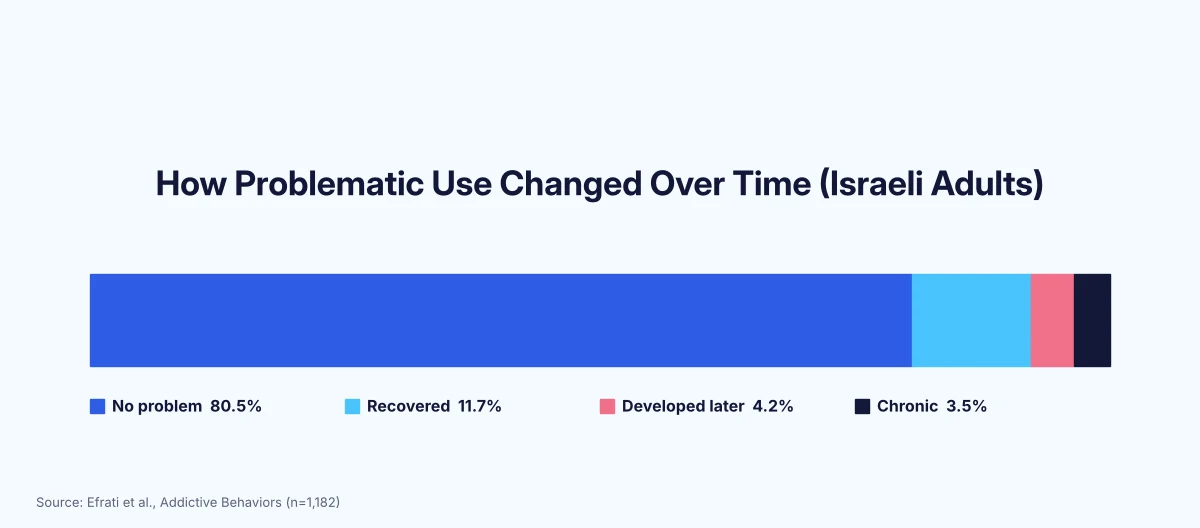
A US study found more stability. Over one year, 14% of 4,363 adults scored above the problematic-use threshold on the Brief Pornography Screen at every wave, as reported by PsyPost.
Frequency alone isn’t the problem, since research on why people watch porn links coping and emotional avoidance most strongly to problematic use. Across three samples, people who watched often without problems outnumbered problematic high-frequency users by 3 to 6 times, per Bőthe et al.
What Is Porn Addiction Linked To?
Problematic porn use often comes with other mental health conditions. 90% of self-identified sex addicts at one outpatient clinic had a co-occurring psychiatric diagnosis, per Wéry et al., and a 2026 meta-analysis found problematic use correlated with depression at 0.32, per PsyPost.
Here’s a breakdown of factors linked to problematic porn use:
| Factor | Finding | Study |
|---|---|---|
| Comorbid psychiatric diagnosis | 90% of clinic outpatients (n=72) | Wéry et al. |
| Sexual shame | Correlation of 0.54 | Sheikhi et al. 2026 (meta-analysis) |
| ADHD symptoms (men) | β = 0.45 | Bőthe et al. 2019 (n=14,043) |
| Loneliness | Correlation of 0.23 (0.37 in one Australian study, n=213) | Sheikhi et al. 2026; Vescan et al. |
| Depression | Correlation of 0.32 | Sheikhi et al. 2026 (meta-analysis) |
| Substance-use treatment | 24% screened positive for compulsive sexual behavior | Snaychuk et al. (n=793) |
These are correlations. They can’t show whether problematic porn use causes these conditions, results from them, or shares a cause with them.
How We Compiled These Statistics
We used the largest multinational survey (the International Sex Survey, 82,243 adults in 42 countries), a 2025 meta-analysis, nationally representative surveys from the US, Germany, Poland and Japan, and peer-reviewed treatment and longitudinal studies.
Every prevalence figure states its screening tool, because results differ up to several-fold between tools. Ratios, “1 in X” figures and percentage gaps are our own calculations.
We traced popular claims to their origins and flag those with no underlying study. We excluded industry data and unsourced statistics roundups.
Key Takeaways
3.2% of people in a 42-country survey were at risk of problematic porn use, with estimates ranging from about 3% to 23% depending on the tool and country. Men are far more affected (6.26% vs 0.72%).
Only 4–10% of people at risk have sought treatment, though early therapy trials show large reductions in use. Many people’s problems also ease over time: 11.68% recovered versus 3.55% chronic in one study.
If porn use is causing you distress, a doctor, therapist or certified sex therapist can help.
FAQ
How many people are addicted to porn?
About 3.2% of adults in a 42-country survey of 82,243 people were at risk of problematic porn use on the full PPCS screen, rising to 16.6% on a broader screen. A 2025 meta-analysis pooled prevalence at 13%, or 8% after correcting for publication bias.
Is porn addiction real?
“Porn addiction” isn’t a stand-alone diagnosis, but compulsive sexual behaviour disorder has been in the WHO’s ICD-11 since January 1, 2022. About 11% of US men and 3% of women at least slightly agree that they’re addicted to porn.
Are men more likely to be addicted to porn?
Yes. Men were about 8.7 times as likely as women to be at risk of problematic porn use (6.26% vs 0.72%) in a 42-country survey. The gap is smaller on broader measures of compulsive sexual behavior (10.3% vs 7.0% in the US).
What country has the highest rate of porn addiction?
Among countries with large samples in the International Sex Survey, Taiwan had the highest share at risk (11.36%), followed by Bangladesh (10.74%) and China (9.57%). Italy was lowest at 1.00%. These are convenience samples, not national averages.
Can porn addiction be treated?
Early evidence says yes. In a small randomized trial, acceptance and commitment therapy cut porn viewing by 93% versus 21% on a waitlist, and a small meta-analysis of 3 controlled studies found a large effect for psychotherapy. Only 4 of 24 treatment studies were randomized trials, though.
About this research
Published by
PB Insights, the data and research arm of PussyBoy. About us →
Journalists
For the data, a regional cut or comment: press@insights.pussyboy.net
Reuse
Licensed CC BY 4.0. Cite "PB Insights" and link to this report.
"According to adult-industry data analysts at PB Insights…"