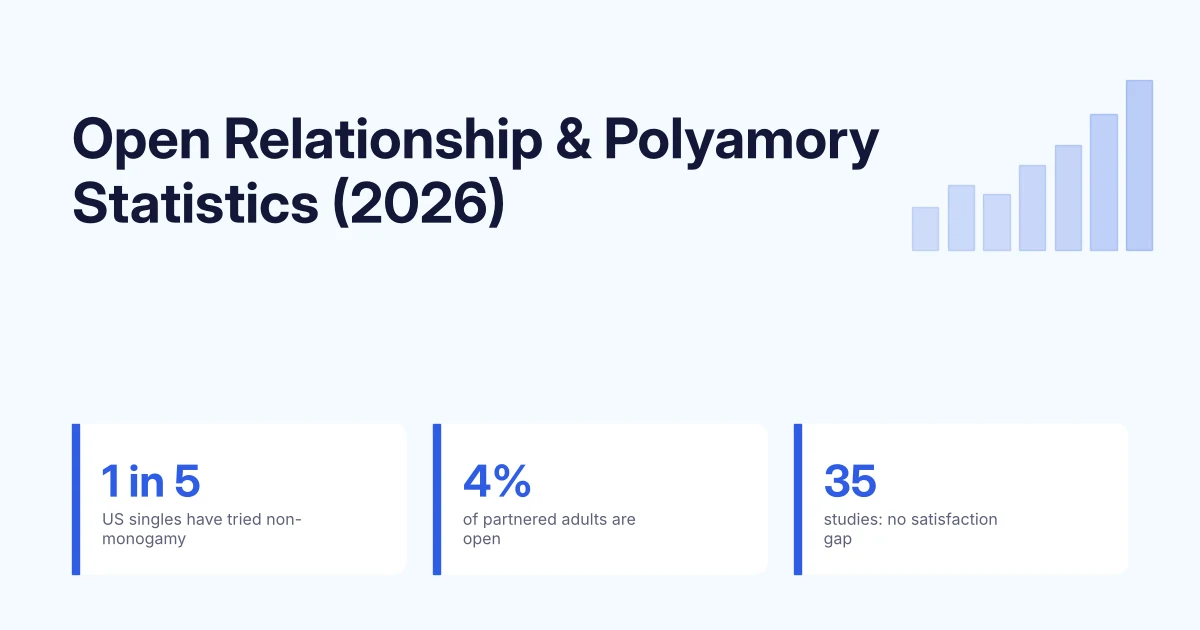
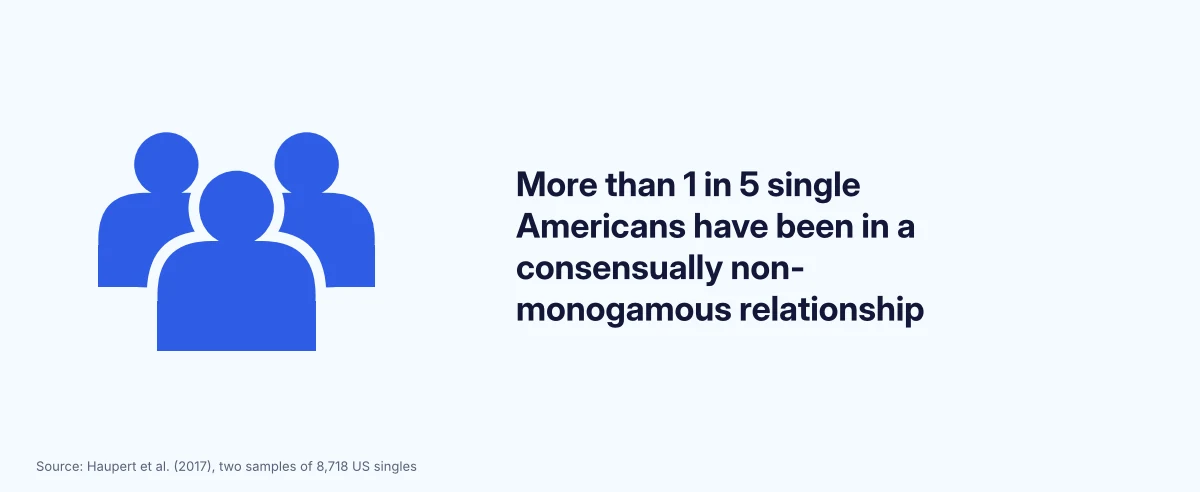
More than 1 in 5 single Americans have been in a consensually non-monogamous relationship at some point: 21.9% and 21.2% in two national samples analysed by Haupert et al. (2017).
At any one time, far fewer people are in one. About 4% of partnered US adults were in an open relationship in the nationally representative 2012 National Survey of Sexual Health and Behavior.
Do they work? A 2025 meta-analysis of 35 studies and 24,489 people found no significant difference in relationship or sexual satisfaction between monogamous and non-monogamous people.
In this article, we’ll break down how common open relationships and polyamory are, who practises them, whether they work, sexual health, how they compare with cheating, public attitudes and legal recognition.
Top Open Relationship and Polyamory Statistics
- More than 1 in 5 single Americans (21.9% and 21.2% in two national samples) have ever been in a consensually non-monogamous relationship.
- About 4% of partnered US adults are in an open relationship, half the share in relationships where someone is cheating (8%).
- 34% of Americans say their ideal relationship is something other than completely monogamous, rising to 48% of adults aged 18 to 29.
- 32% of gay respondents in relationships were in an open relationship, compared with 2% of heterosexual respondents (NSSHB 2012, as summarized by sex researcher Justin Lehmiller).
- A 2025 meta-analysis of 35 studies and 24,489 people found no significant difference in relationship or sexual satisfaction between monogamous and non-monogamous people.
- People who cheated were 27% less likely to use condoms for vaginal sex than people in consensual non-monogamy.
- 33% of US adults say open marriages are acceptable, compared with 51% of adults aged 18 to 29.
How Common Are Open Relationships and Polyamory?
It depends on whether you count “ever” or “right now.” More than 1 in 5 single Americans (21.9% and 21.2%) have ever had an agreed-upon, sexually non-exclusive relationship, according to Haupert et al.’s analysis of two samples totalling 8,718 single adults, summarized by Justin Lehmiller and PsyPost.
Current figures are much lower. 4% of US adults in a relationship were in an open relationship, 89% were monogamous and 8% were in a relationship where someone was cheating, according to Levine et al. (2018), using a probability sample of 2,270 adults.
Canada looks similar. 2.4% of Canadian adults, or 4.0% of those in a relationship, were in an open relationship in 2017, according to Fairbrother et al. (2019). But 20% had been in one at some point.
Here’s a breakdown of non-monogamy by measure:
| Measure | Population | Share | Source |
|---|---|---|---|
| Ever had a consensually non-monogamous relationship | US singles, 2024 | 31% | Match Singles in America |
| Ever in an open sexual relationship | US singles (sample 1) | 21.9% | Haupert et al. |
| Ever in an open relationship | Canadian adults, 2017 | 20% | Fairbrother et al. |
| Ever in an open sexual relationship | US adults, 2018 | 12% | iFidelity survey |
| Ever had sex outside the relationship with partner’s consent | US adults, 2023 | 12% | YouGov |
| Ever in a polyamorous relationship | US singles | 10.7% | Moors et al. |
| Ever in a polyamorous or open relationship | US adults, 2025 | 9% | YouGov |
| Currently in an open relationship | Partnered US adults, 2012 | 4% | NSSHB (Levine et al.) |
| Currently in an open relationship | Canadian adults, 2017 | 2.4% | Fairbrother et al. |
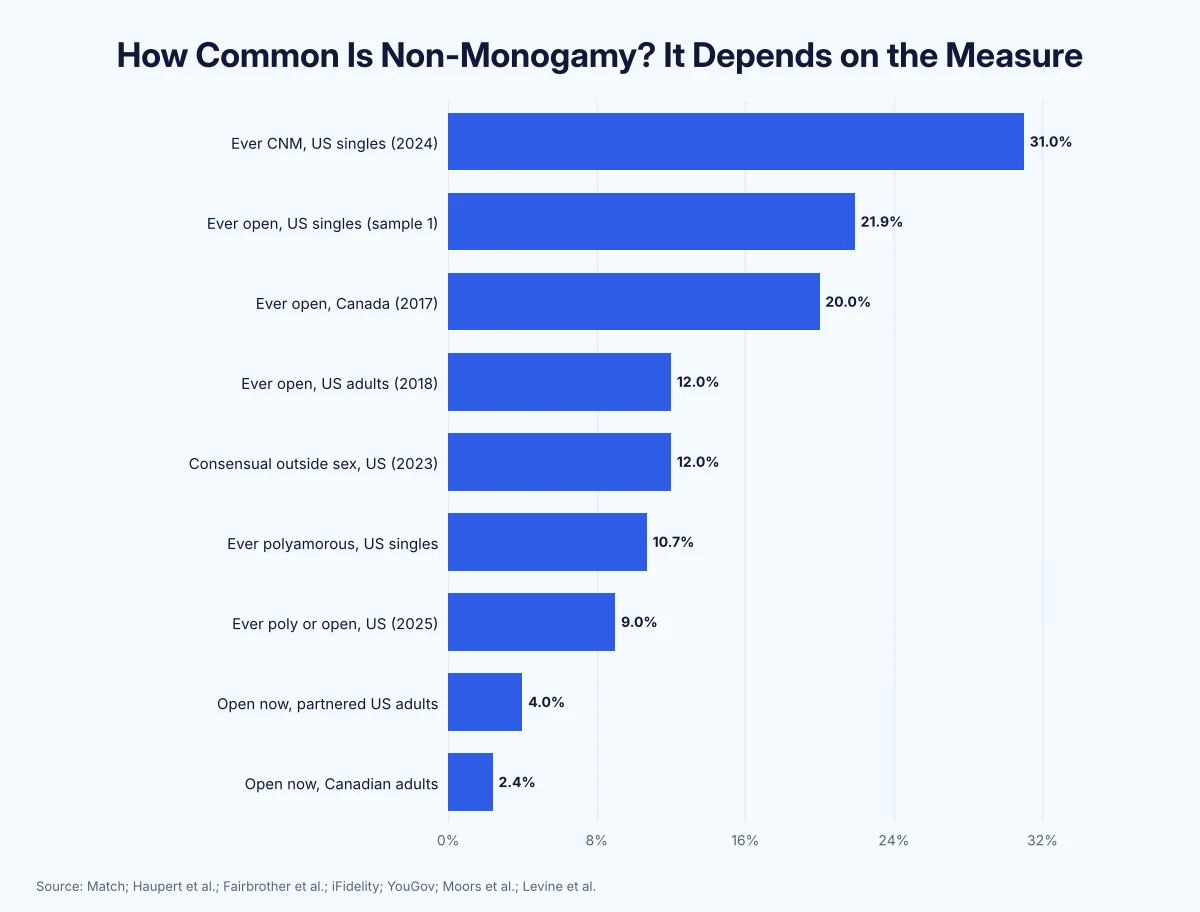
The “1 in 5” figure has critics. Both Haupert samples covered only single adults and oversampled gay and lesbian people (15.3% of the first sample), and the broad definition can include casual non-exclusive dating, according to the Institute for Family Studies.
The newest figure is higher. 31% of US singles had been in a consensually non-monogamous relationship in Match’s Singles in America study of 5,305 singles, released in January 2024, a company-funded survey run with Kinsey Institute scientists. Among those, 21% described their arrangement as “monogamish,” 13% as open, 12% as swinging and 11% as polyamorous.
What Percentage of Marriages Are Open?
There’s no direct count of open marriages. The closest measure is the 4% of partnered US adults in open relationships in the NSSHB, which includes married and unmarried couples. About 4 to 5% of Americans are currently in some form of consensual non-monogamy, according to sociologist [Elisabeth Sheff]’s summary of earlier studies(https://www.psychologytoday.com/gb/blog/the-polyamorists-next-door/201905/updated-estimate-of-number-of-non-monogamous-people-in-us).
Self-described arrangements are looser. 23% of Americans in a relationship describe it as non-monogamous to some degree, according to YouGov (2020), and 31% of millennials in a relationship say so.
In a 2025 company poll of 7,100 adults aged 18 to 65 by telehealth firm Hims & Hers, 7% said they were currently in an open relationship, including 15% of Gen Z respondents.
How Many People Want a Non-Monogamous Relationship?
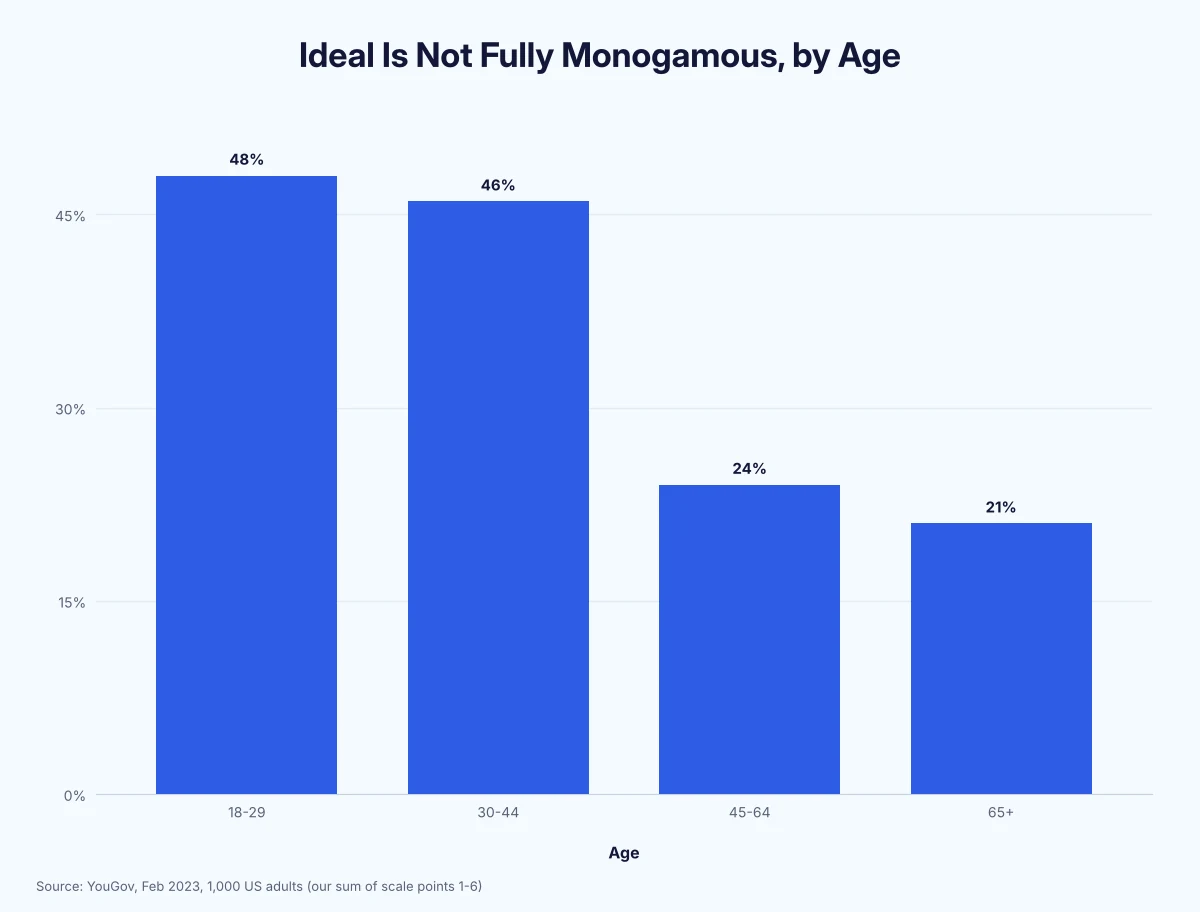
About a third of Americans. 34% say their ideal relationship is something other than completely monogamous, and 55% say it is completely monogamous, according to a February 2023 YouGov poll of 1,000 adults.
Younger adults are more than twice as likely to want something other than strict monogamy. 48% of 18- to 29-year-olds put their ideal anywhere above “completely monogamous” on YouGov’s 0–6 scale, compared with 21% of adults 65 and older (our calculation from YouGov crosstabs).
Here’s a breakdown of how many people want non-monogamy across surveys:
| Survey | Population | Measure | Share |
|---|---|---|---|
| YouGov (2023) | US adults | Ideal is not completely monogamous | 34% |
| YouGov (2023) | US men / women | Ideal is not completely monogamous (our calculation) | 43% / 26% |
| YouGov (2020) | US millennials | Ideal is non-monogamous to some degree | 43% |
| YouGov (2021) | US adults | Interested in an open relationship | 25% |
| Verasight (2024) | US adults | Open to a polyamorous relationship | 19.7% |
| Moors et al. (2021) | US singles | Desire polyamory | 16.8% |
| YouGov (2025) | US adults | Would consider a polyamorous or open relationship | 14% |
| Fairbrother et al. (2019) | Canadian adults | Open relationship is ideal | 12% |
The share wanting full monogamy has dipped. 61% of Americans named complete monogamy their ideal in 2016, compared with 55% in 2023, a 6-point drop across two YouGov polls.
Interest outruns practice. In Canada, 12% say an open relationship is their ideal, about 3 times the 4.0% of partnered adults who are in one. In the US, 16.8% of singles want polyamory but 10.7% have tried it, according to Moors et al..
Who Is in Open Relationships? Gender, Age and Sexual Orientation
Gay respondents have the highest rate. 32% of gay respondents in relationships were in open relationships, compared with 2% of heterosexual respondents, in the NSSHB data summarized by Justin Lehmiller. LGBTQ+ participants made up only about 5% of that sample.
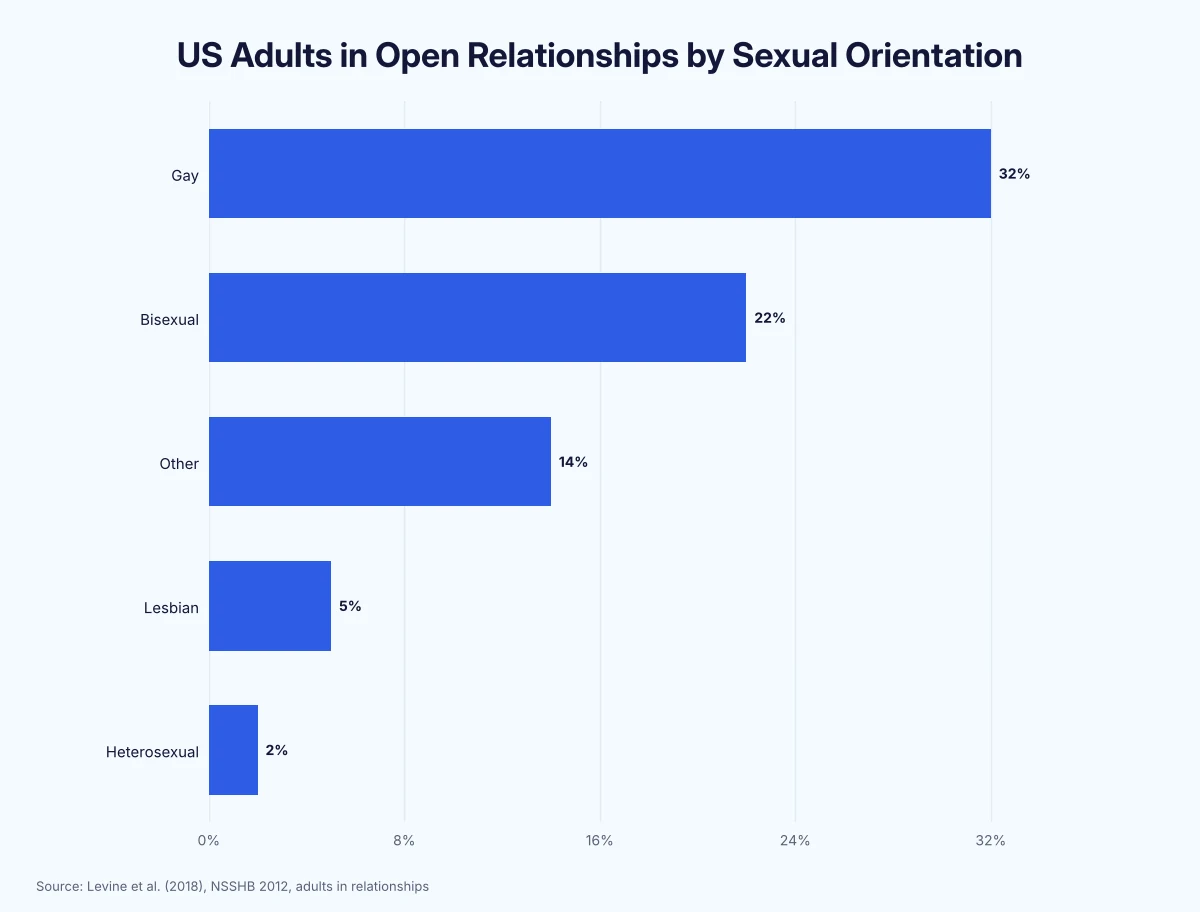
Here’s a breakdown of relationship structure by sexual orientation:
| Sexual Orientation | In an Open Relationship | In a Relationship With Cheating |
|---|---|---|
| Gay | 32% | 14% |
| Bisexual | 22% | 18% |
| Other | 14% | 6% |
| Lesbian | 5% | 6% |
| Heterosexual | 2% | 8% |
Interest follows the same pattern. 46% of LGB and other sexual-minority Americans were interested in an open relationship in 2021, compared with 22% of heterosexual adults, according to a YouGov poll of 23,194 adults.
Men are more interested than women. 32% of men and 19% of women were interested in an open relationship in that poll. In Canada, 25% of men and 15% of women had ever been in one, and 18% of men vs 6% of women called it their ideal, according to The Conversation.
Age matters too. 41% of millennials were interested in an open relationship, compared with 29% of Gen Z adults, 23% of Gen X and 12% of baby boomers. Adults aged 30 to 44 were the most likely to have had consensual outside sex: 22%, compared with 6% of those 65 and older, according to YouGov’s 2023 crosstabs.
Do Open Relationships Work?
On average, about as well as monogamous ones. A 2025 meta-analysis of 35 studies and 24,489 participants found no significant difference in relationship satisfaction or sexual satisfaction between monogamous and consensually non-monogamous people, according to Anderson et al. in The Journal of Sex Research.
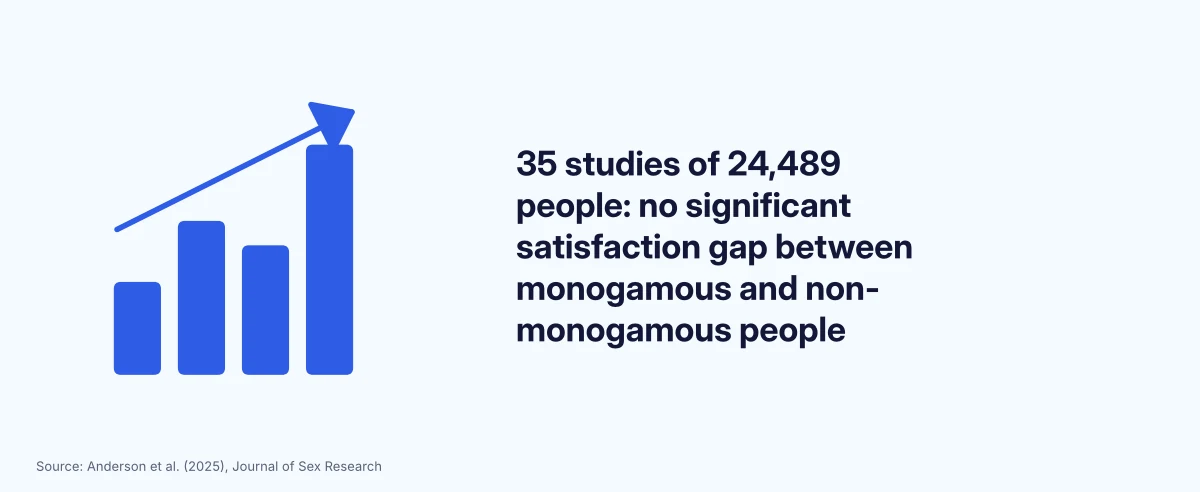
Overall effect sizes were near zero (g = -0.05 for relationship and g = 0.06 for sexual satisfaction), though some subgroups differed slightly.
Here’s a breakdown of satisfaction by type of non-monogamy compared with monogamy:
| Relationship Type | Relationship Satisfaction | Sexual Satisfaction |
|---|---|---|
| Monogamish | Slightly higher (g = 0.22) | No significant difference |
| Polyamorous | No significant difference | Slightly higher (g = 0.16) |
| Swinging | No significant difference | Higher (g = 0.43) |
| Open relationship | No significant difference (g = -0.03) | No significant difference (g = -0.03) |
Earlier studies agree. In a survey of 2,124 adults over 25, consensually non-monogamous people reported the same satisfaction and passionate love as monogamous people, plus higher trust and lower jealousy, according to the University of Michigan (Conley et al., 2017). A 2015 review by Rubel and Bogaert also found no significant differences in wellbeing or relationship quality, according to Lehmiller.
The arrangement matters more than the label. In a University of Rochester study of 1,658 people, 60% of those in one-sided arrangements, where one partner wasn’t fully on board, were significantly dissatisfied, nearly 3 times the rate of monogamous or fully consensual couples.
Not every study finds parity. In the representative NSSHB, people in open relationships reported lower relationship satisfaction than monogamous people, according to Levine et al. Most studies in the meta-analysis used online volunteers, who may skew happier.
We found no large representative study that has measured breakup or divorce rates for open or polyamorous couples, so there is no reliable “success rate.” The closest data: of 233 people considering opening their relationship, 67% (155) did so within about two months, and their relationship satisfaction held steady while their sexual satisfaction rose, according to Lehmiller, summarizing Murphy, Joel and Muise (2019).
Why Do People Choose Open Relationships, and Why Do Some Stop?
Mostly to get different needs met. 58% of Americans who would consider a polyamorous or open relationship cite a desire to have different needs fulfilled, 49% more sex and 48% more variety, according to a 2025 YouGov poll of 1,125 adults.
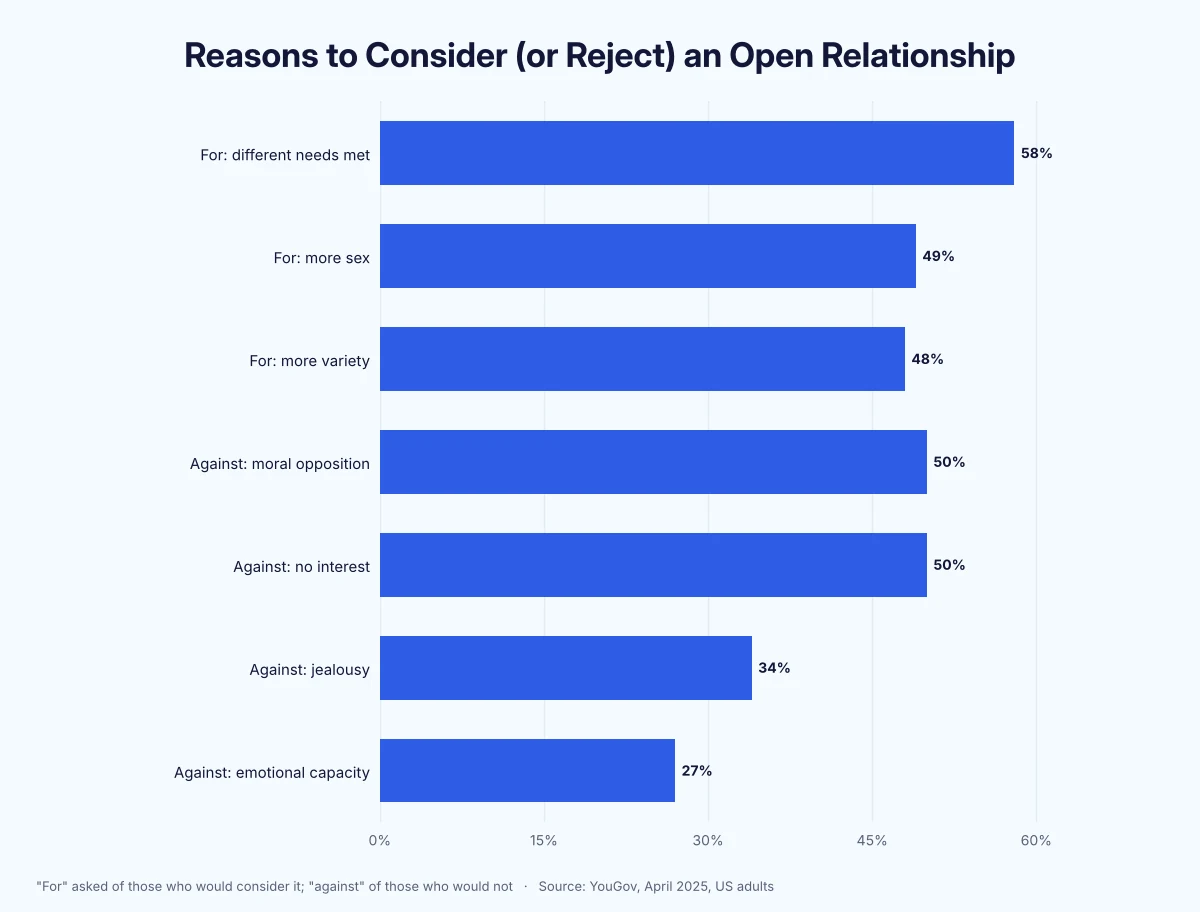
Here’s a breakdown of reasons for and against:
| Reason | Share |
|---|---|
| For: different needs fulfilled | 58% |
| For: more sex | 49% |
| For: more variety | 48% |
| Against: moral opposition | 50% |
| Against: no interest | 50% |
| Against: jealousy | 34% |
| Against: lack of emotional capacity | 27% |
Fantasy is more common than practice. 33% of people in monogamous relationships said their favourite sexual fantasy involved a sexually open relationship, and 80% of them wanted to act on it, according to a study of 822 adults by Lehmiller reported by PsyPost.
Polyamory doesn’t suit everyone who tries it. Among singles who had been polyamorous, only 30.4% would do it again, 32.8% found the emotional side too difficult and 21.1% said they were too possessive, according to Moors et al..
Are Open Relationships Riskier for STIs?
Not compared with cheating. In a study of 1,647 people, those who were sexually unfaithful were 27% less likely to use condoms for vaginal sex and 35% less likely for anal sex than people in consensual non-monogamy, and 64% more likely to use drugs or alcohol during the encounter, according to ScienceDaily (Conley et al., 2012).
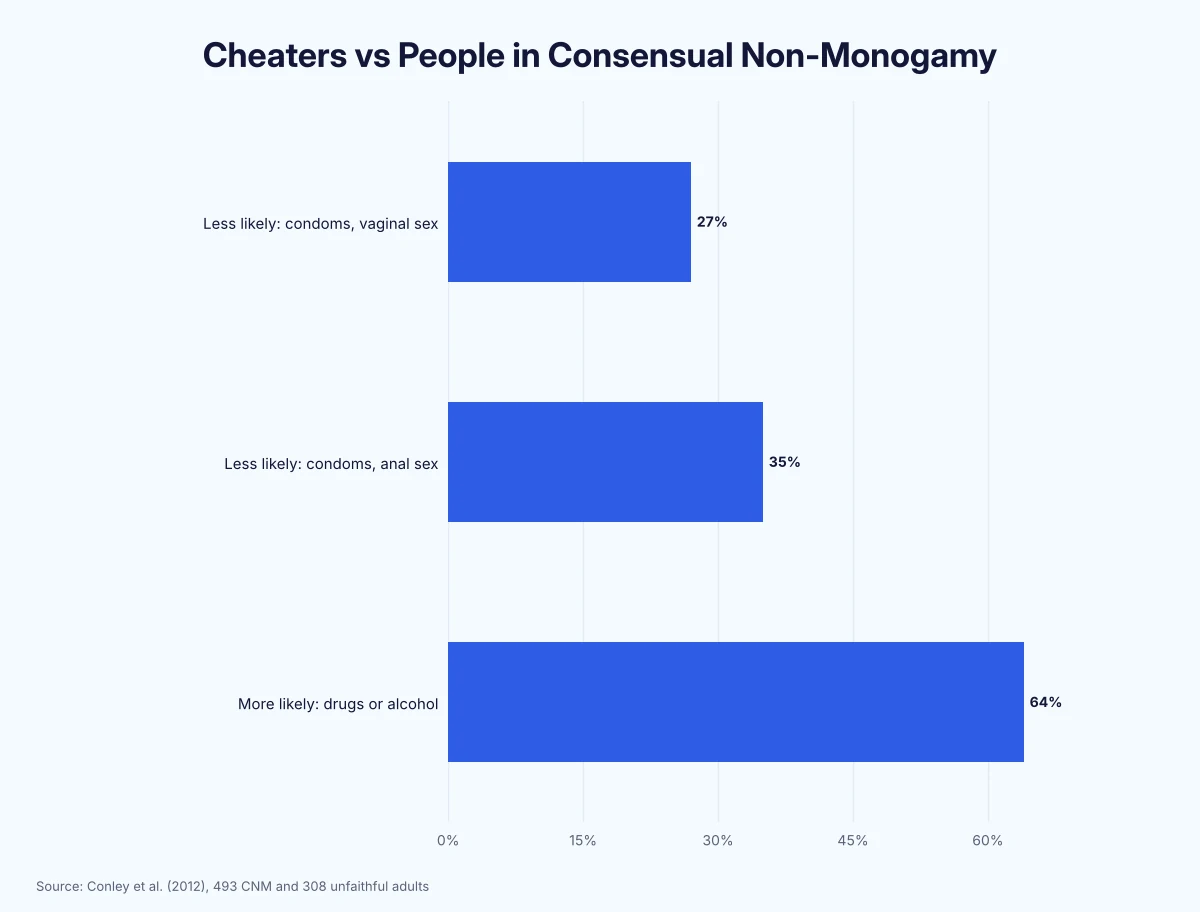
Testing is more common too. In a study of 556 adults, consensually non-monogamous people were more likely to use condoms and to have been tested for STIs, and the share with a previous STI diagnosis did not differ from monogamous people, according to Lehmiller (2015). About a quarter of the monogamous participants reported sex outside the relationship, mostly without their partner knowing.
A 2026 study points the same way. Polyamorous people were 3.6 times as likely as monogamous people to have ever been tested for an STI, while STI diagnoses did not differ, in an online sample of 888 adults from the US, Portugal, Italy and Finland, according to PsyPost (Larva et al.).
Non-monogamous people do report more lifetime partners, which raises exposure. The average number of sexual partners gives a baseline for comparison, with medians by age and gender. These studies are observational and mostly use volunteers, so regular testing and a doctor’s advice still matter for anyone with several partners.
Open Relationships vs Cheating
Cheating is more common than consensual non-monogamy. 20% of Americans say they have had sex with someone other than their main partner without consent, compared with 12% with their partner’s consent, according to YouGov (2023). That’s about 1.7 times as many.
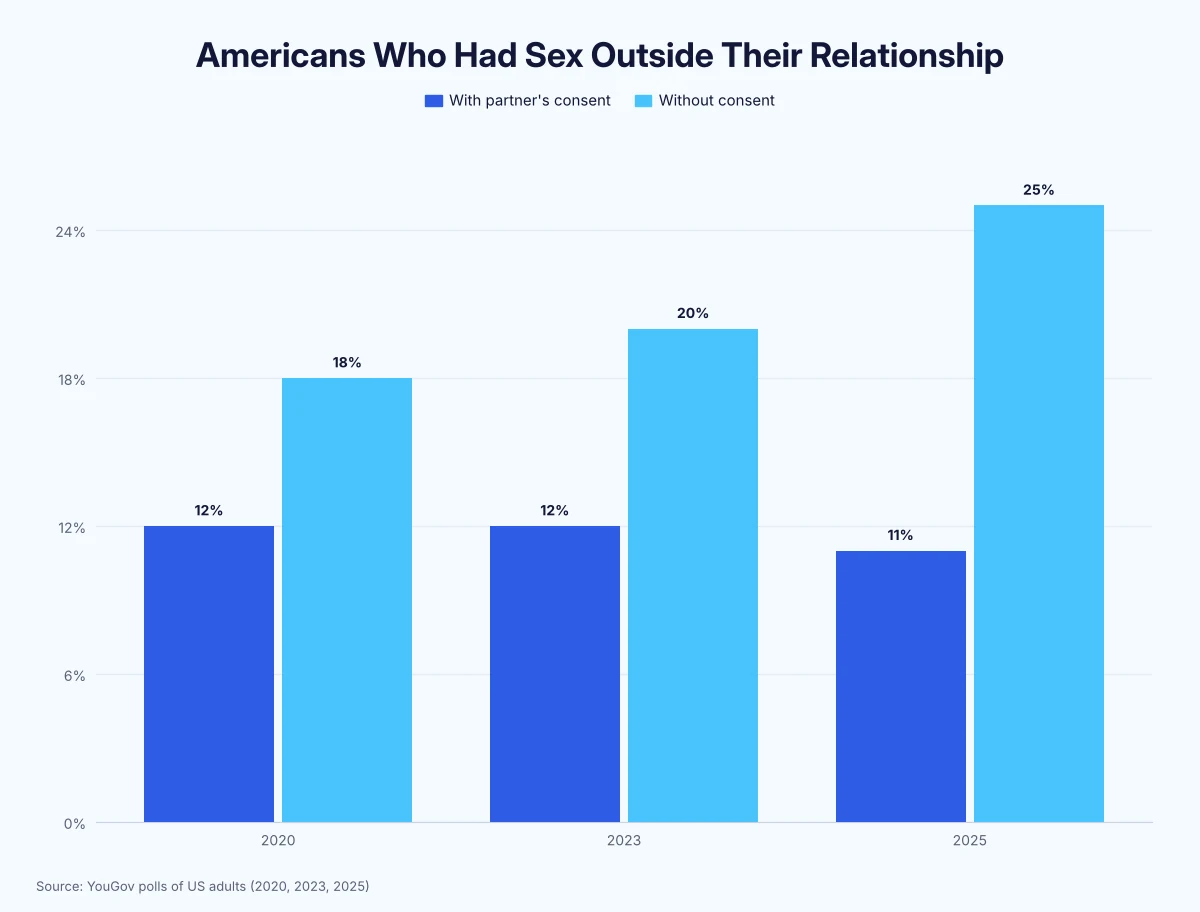
The gap has held across three YouGov polls: 12% with consent vs 18% without in 2020, and 11% vs 25% in 2025. The NSSHB shows the same pattern: 8% of partnered adults were in a relationship with cheating, twice the 4% in open relationships.
Most people would not accept a partner’s outside sex. 67% would not be okay with it, 20% say it depends and 5% would be okay, according to the YouGov 2023 crosstabs.
For comparison, 15.7% of ever-married Americans have had sex with someone other than their spouse while married, according to the General Social Survey (2016–2022). Men are more likely than women to be part of that 15.7%, although the gender gap in the cheating statistics has narrowed over time. Porn, OnlyFans and cam shows blur the line further, and views on whether watching porn counts as cheating differ by gender, age and religion.
How Do Americans View Open Relationships and Polyamory?
Half of Americans disapprove, but younger adults are more accepting. 33% of US adults say open marriages are acceptable and 50% say they’re unacceptable, according to a Pew Research Center survey of 5,073 adults in April 2023. Among 18- to 29-year-olds, 51% say they’re acceptable, 3.4 times the 15% of adults 65 and older.
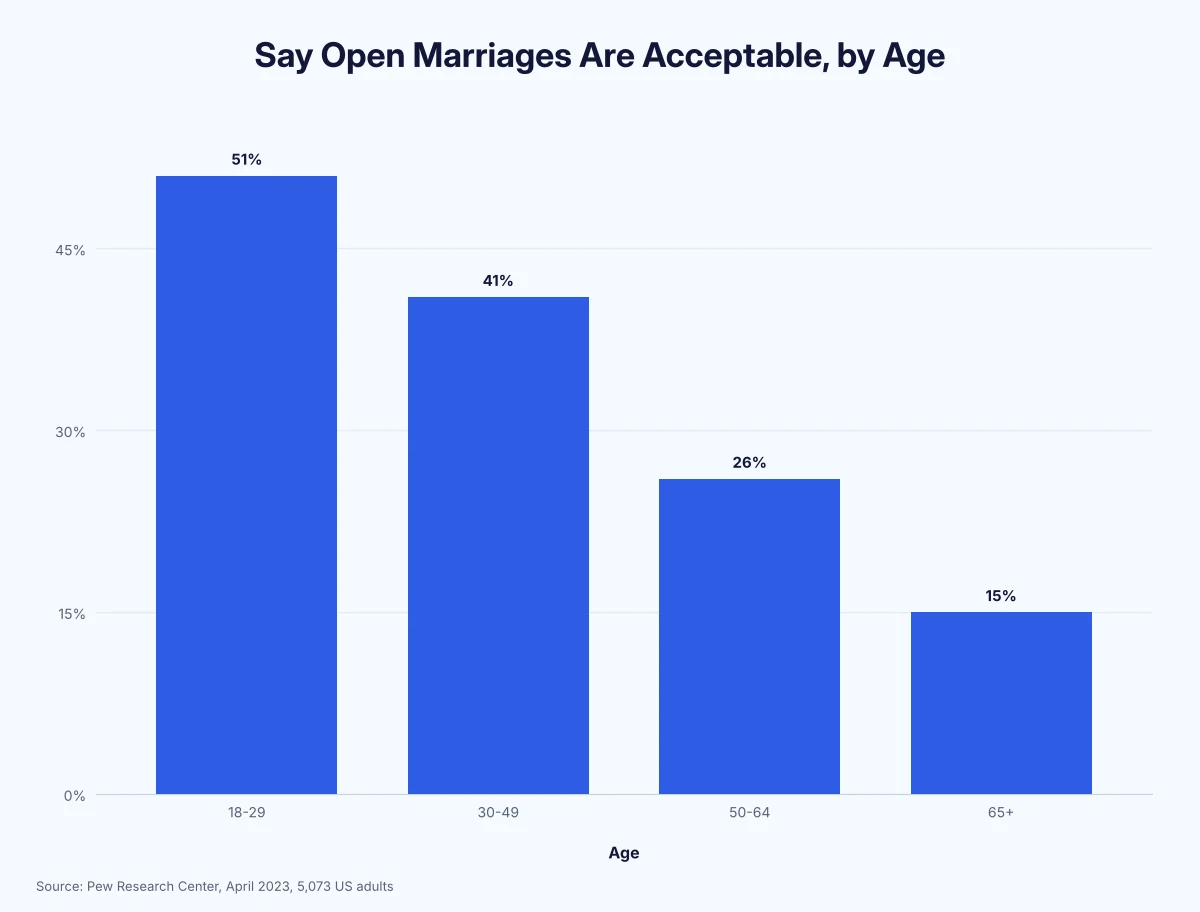
Here’s a breakdown of who finds open marriage acceptable:
| Group | Say Open Marriage Is Acceptable |
|---|---|
| LGB adults | 75% |
| Ages 18–29 | 51% |
| Democrats | 47% |
| Ages 30–49 | 41% |
| Men | 36% |
| All US adults | 33% |
| Women | 30% |
| Straight adults | 29% |
| Ages 50–64 | 26% |
| Republicans | 20% |
| Ages 65+ | 15% |
Polyamory faces more moral objection. 51% of Americans think polyamory is morally wrong, including 56% of women and 45% of men, according to YouGov (2025). In 2015, 47% of Britons said so, according to YouGov UK.
Legal recognition divides people too. 30% of US adults say polyamorous relationships should get the same legal protection as two-person relationships and 40% say they shouldn’t, in a 2022 YouGov poll of 9,384 adults.
Gallup tracks polygamy, which means multiple spouses rather than polyamory. 19% of Americans called it morally acceptable in May 2026, down from 23% in 2022 to 2024, according to Gallup. By comparison, 7% say it’s acceptable for married people to have an affair.
Below, we list Gallup’s polygamy trend since 2011:
| Year | Polygamy Morally Acceptable |
|---|---|
| 2011 | 11% |
| 2013 | 14% |
| 2015 | 16% |
| 2017 | 17% |
| 2018 | 19% |
| 2020 | 20% |
| 2022 | 23% |
| 2024 | 23% |
| 2025 | 21% |
| 2026 | 19% |
Public curiosity has grown over a longer period. Google searches for “polyamory” and “open relationships” rose significantly between 2006 and 2015, while searches for “swinging” fell, according to a study by Amy Moors summarized by Lehmiller.
Is Polyamory Legal? Recognition and Protections
Several US cities now recognize or protect multi-partner relationships. Somerville, Massachusetts, is believed to have become the first in 2020, when its council unanimously approved domestic partnerships for more than two people, according to GBH News.
Here’s a timeline of city measures:
| City | Year | Measure |
|---|---|---|
| Somerville, MA | 2020 | Domestic partnerships for more than two people |
| Cambridge, MA | 2021 | Domestic partnerships for more than two people |
| Arlington, MA | 2021 | Domestic partnerships for more than two people |
| Somerville and Cambridge, MA | 2023 | Nondiscrimination protections |
| Oakland, CA | 2024 | Bans discrimination by family or relationship structure |
| Berkeley, CA | 2024 | Bans discrimination by family or relationship structure |
| Olympia, WA | 2026 | Adds diverse family and relationship structures to anti-discrimination law |
| Portland, OR | 2026 | Adds family or relationship structure to civil rights code (11–0 vote) |
Oakland’s April 2024 ordinance covers housing, businesses and public services, according to the Polyamory Legal Advocacy Coalition, an advocacy group. No US state recognizes marriages of more than two people.
Swinging and Non-Monogamy Apps
Few Americans identify as swingers. Among US singles who had been consensually non-monogamous, 12% described their arrangement as swinging in Match’s company-funded Singles in America study. Threesomes are a separate behaviour: 17.8% of US men had ever had one in a national survey by Herbenick et al. (2017), and fewer women have, according to threesome statistics by gender.
Apps built around non-monogamy are growing. Feeld reported 14 million users and $85 million in revenue in 2025, according to company figures cited by Global Dating Insights. About 33% of Feeld users practise ethical non-monogamy, according to a Feeld data report cited by Wargamer.
Both are company figures, not population measures.
Methodology
We reviewed 178 data points from 33 sources. Prevalence figures come from nationally representative probability surveys (NSSHB 2012, analysed by Levine et al.), quota-based online samples of singles (Haupert et al., Moors et al., Match’s Singles in America, all funded by Match), a representative Canadian online panel (Fairbrother et al.) opt-in pollster panels (YouGov) and Verasight’s address- and text-recruited panel. “Ever” and “currently” measures, and samples of singles vs all adults, are not directly comparable.
Satisfaction findings come from peer-reviewed studies and a 2025 meta-analysis whose studies mostly used online volunteer samples. Attitude data come from Pew Research Center’s probability panel, Gallup telephone polls and YouGov. Hims & Hers, Match and Feeld figures are company-reported or company-sponsored. The Polyamory Legal Advocacy Coalition is an advocacy group. The GSS cheating rate, age-group sums from YouGov crosstabs, ratios and gaps are our own calculations.
Key Takeaways
More than 1 in 5 single Americans have tried consensual non-monogamy, but only about 4% of partnered adults are in an open relationship at any one time. Interest is higher than practice: 34% of Americans say their ideal relationship isn’t completely monogamous, including 48% of adults under 30.
Do open relationships work? On average, as well as monogamous ones: 35 studies of 24,489 people show no significant satisfaction gap. What predicts trouble is a lack of consent: 60% of people in one-sided arrangements were dissatisfied, and people who cheat use condoms less often than people in agreed open relationships.
FAQ
How common are open relationships?
About 4% of partnered US adults are in an open relationship at any one time, and 2.4% of all Canadian adults. Lifetime experience is higher: more than 1 in 5 single Americans (21.9% and 21.2% in two samples) have had a consensually non-monogamous relationship.
What percentage of people are polyamorous?
10.7% of single US adults have been in a polyamorous relationship at some point and 16.8% would like to be, according to Moors et al. In 2025, 9% of all Americans said they had been in a polyamorous or open relationship.
Do open relationships work?
On average, about as well as monogamous ones. A 2025 meta-analysis of 35 studies found no significant difference in relationship or sexual satisfaction between monogamous and non-monogamous people. One-sided arrangements fare worse: 60% of people in them were significantly dissatisfied.
Are open relationships healthy?
Studies link consensual non-monogamy with similar wellbeing to monogamy. Non-monogamous people get tested more often: polyamorous people were 3.6 times as likely to have ever had an STI test, and diagnosis rates didn’t differ. Cheaters were 27% less likely to use condoms for vaginal sex.
What is the success rate of open marriages and polyamorous relationships?
There is no reliable success or divorce rate, because no large representative study has tracked breakups by relationship type. Among singles who had been polyamorous, 30.4% would do it again, while 32.8% found the emotions too difficult.
Is polyamory becoming more accepted?
Slowly, especially among young adults. 51% of 18- to 29-year-olds say open marriages are acceptable, compared with 33% of all adults. Gallup’s polygamy acceptance rose from 11% in 2011 to 23% in 2022 before easing to 19% in 2026.
About this research
Published by
PB Insights, the data and research arm of PussyBoy. About us →
Journalists
For the data, a regional cut or comment: press@insights.pussyboy.net
Reuse
Licensed CC BY 4.0. Cite "PB Insights" and link to this report.
"According to adult-industry data analysts at PB Insights…"