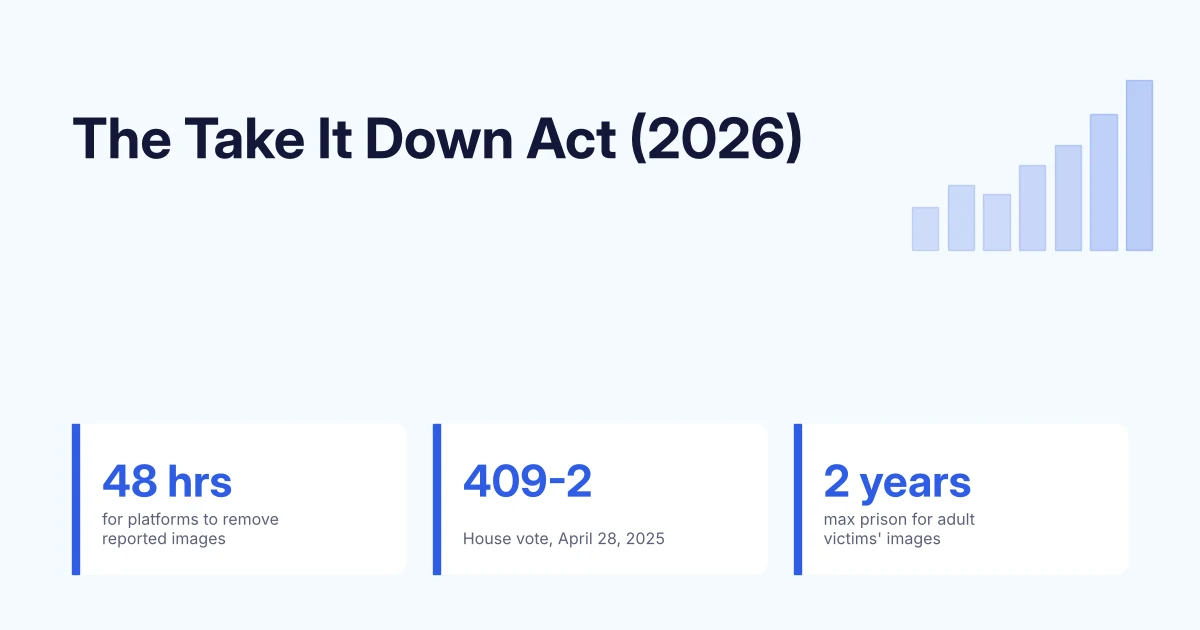
The TAKE IT DOWN Act is a US federal law, signed on May 19, 2025, that makes it a crime to knowingly publish someone’s intimate images without consent, including AI-generated deepfakes, with up to 2 years in prison for images of adults, according to Cornell Law School’s Legal Information Institute.
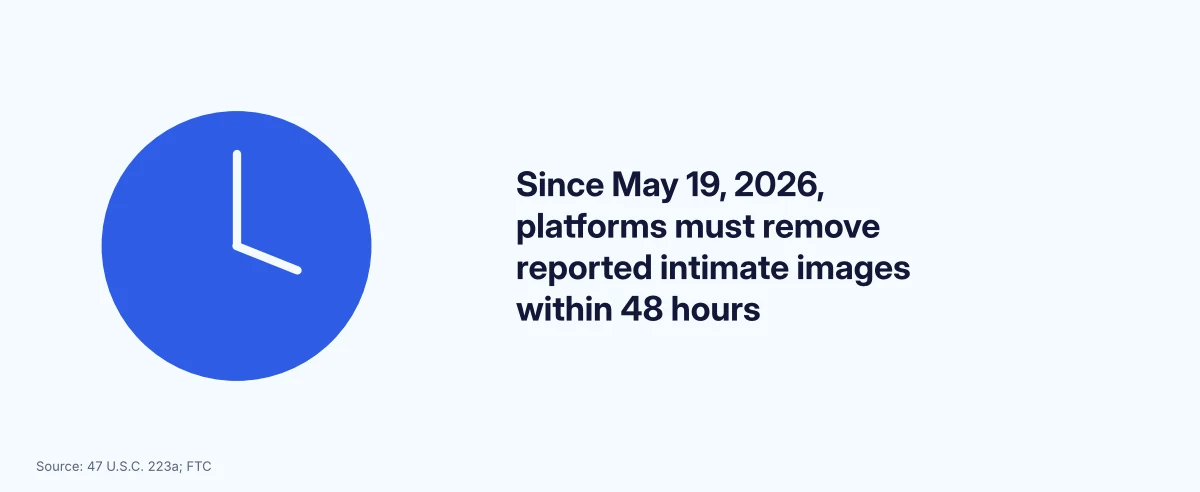
Since May 19, 2026, websites and apps must also remove reported images within 48 hours, enforced by the Federal Trade Commission (FTC). The bill passed the House 409–2 and the Senate by unanimous consent.
In this article, we’ll break down what the law makes illegal, the penalties, what platforms must do, how it passed, how it’s being enforced, how it compares with state laws, and what critics say.
Top Take It Down Act Statistics
- The House passed the TAKE IT DOWN Act 409–2 on April 28, 2025, with 99.5% of recorded votes in favor.
- Publishing an adult’s intimate images without consent, real or AI-made, carries up to 2 years in prison; images of minors carry up to 3 years.
- Platforms must remove a reported image within 48 hours of a valid request, and had 1 year, until May 19, 2026, to comply.
- Platforms that don’t comply face FTC civil penalties of up to $53,088 per violation.
- The first person believed to be convicted under the Act pleaded guilty in April 2026 and was sentenced to 15 years in prison on combined charges, including cyberstalking.
- The FTC sent compliance letters to 15 platforms and warning letters to 12 “nudify” app operators in May 2026.
- 48 states have laws on sexually explicit deepfakes, according to Ballotpedia (August 2026).
What Is the Take It Down Act?
The TAKE IT DOWN Act is Public Law 119-12, signed by President Trump on May 19, 2025, according to the official bill record. Its full name is the “Tools to Address Known Exploitation by Immobilizing Technological Deepfakes on Websites and Networks Act.”
It does two things. It makes publishing non-consensual intimate images (NCII) a federal crime, codified at 47 U.S.C. 223(h), and it requires platforms to run a notice-and-removal process, codified at 47 U.S.C. 223a.
Before the Act, the main federal remedy for victims was a civil lawsuit created by the 2022 reauthorization of the Violence Against Women Act, according to the Congressional Research Service (CRS). Victims can still sue under that law for $150,000 in liquidated damages or their actual damages, per Cornell Law School.
Is Revenge Porn a Federal Crime?
Yes. Since May 19, 2025, knowingly publishing an intimate image of an adult without consent through an online service is a federal crime punishable by up to 2 years in prison, or up to 3 years if the person depicted is a minor, according to 47 U.S.C. 223(h).
The Act creates 7 federal offenses: 4 for publishing (real or AI-generated images, of adults or minors) and 3 for threats, according to the CRS. AI “digital forgeries” carry the same maximum sentences as real images.
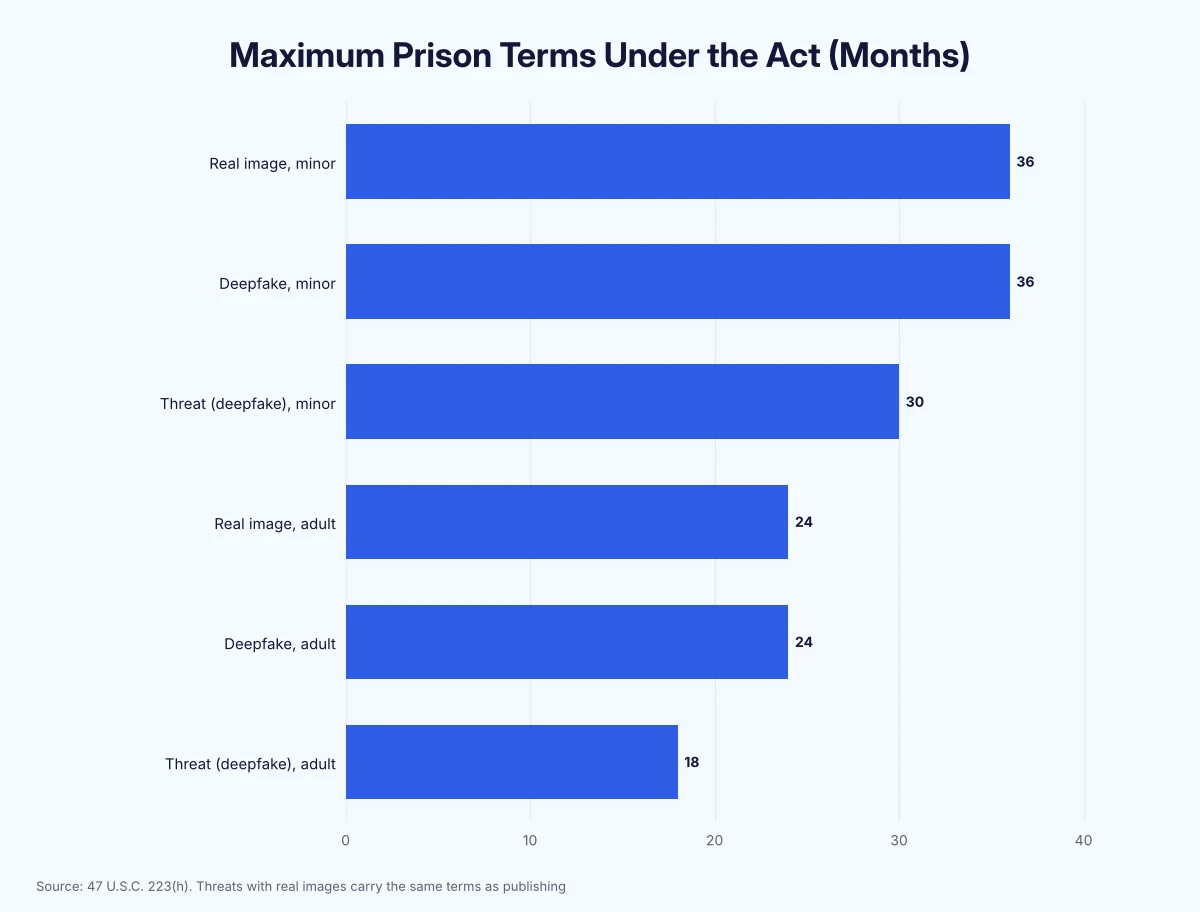
Here’s a breakdown of Take It Down Act penalties:
| Offense | Adult Depicted | Minor Depicted |
|---|---|---|
| Publishing a real intimate image without consent | Up to 2 years | Up to 3 years |
| Publishing an AI deepfake (digital forgery) | Up to 2 years | Up to 3 years |
| Threatening to publish a real intimate image | Up to 2 years | Up to 3 years |
| Threatening to publish a deepfake | Up to 18 months | Up to 30 months |
| Forfeiture of images, proceeds and equipment | Mandatory | Mandatory |
| Restitution to the victim | Mandatory | Mandatory |
For real images of adults, prosecutors must prove 4 conditions, including that the image was made or obtained where the person had a reasonable expectation of privacy and that it wasn’t voluntarily exposed in a public or commercial setting, according to the enrolled law. Consent to create an image isn’t consent to publish it, and sending it to one person isn’t consent to share it more widely.
For deepfakes of adults, the privacy condition is replaced by proof that the image was published without consent. The law has exceptions, including lawful law enforcement activity, good-faith disclosures (for example to police, in court, or for medical or educational purposes) and people sharing images of themselves.
What Must Platforms Do Under the Take It Down Act?
Covered platforms must remove a reported intimate image “as soon as possible, but not later than 48 hours” after a valid request, and make reasonable efforts to remove known identical copies, according to 47 U.S.C. 223a. Platforms had 1 year, until May 19, 2026, to set up the process.
A “covered platform” is a public website, app or online service that mainly hosts user-generated content, or whose regular business includes publishing or hosting non-consensual intimate images. Broadband internet providers, email, and sites of mostly preselected content are excluded.
Here’s a breakdown of the platform rules:
| Requirement | Detail |
|---|---|
| Removal deadline | 48 hours after a valid request |
| Copies | Reasonable efforts to remove known identical copies |
| Valid request | In writing, with 4 elements: signature, information to find the image, a good-faith statement that it’s non-consensual, and contact details |
| Public notice | A clear, plain-language explanation of how to submit a request |
| Compliance deadline | May 19, 2026 (1 year after enactment) |
| Enforcer | Federal Trade Commission, including over nonprofits |
| Penalty | Up to $53,088 per violation |
| Safe harbor | No liability for good-faith removals, even if the content later proves lawful |
The $53,088 maximum is the FTC’s current inflation-adjusted civil penalty, raised from $51,744 in January 2025, according to the Federal Register.
Before the law, removal wasn’t guaranteed. In a University of Michigan audit, none of 25 AI-generated nude images reported to X under its non-consensual nudity policy were removed within three weeks, while all 25 reported as copyright (DMCA) claims came down within 25 hours, according to the University of Michigan.
How Did the Take It Down Act Pass?
Quickly and with near-unanimous support. The House passed it 409–2 on April 28, 2025, 99.5% of recorded votes, with Republicans Thomas Massie and Eric Burlison voting no, according to the House Clerk. The Senate had passed it by unanimous consent on February 13, 2025.
The bill went from introduction to law in 123 days. The first version, introduced by Sen. Ted Cruz in June 2024, passed the Senate but died in the House, so the full process took 335 days.
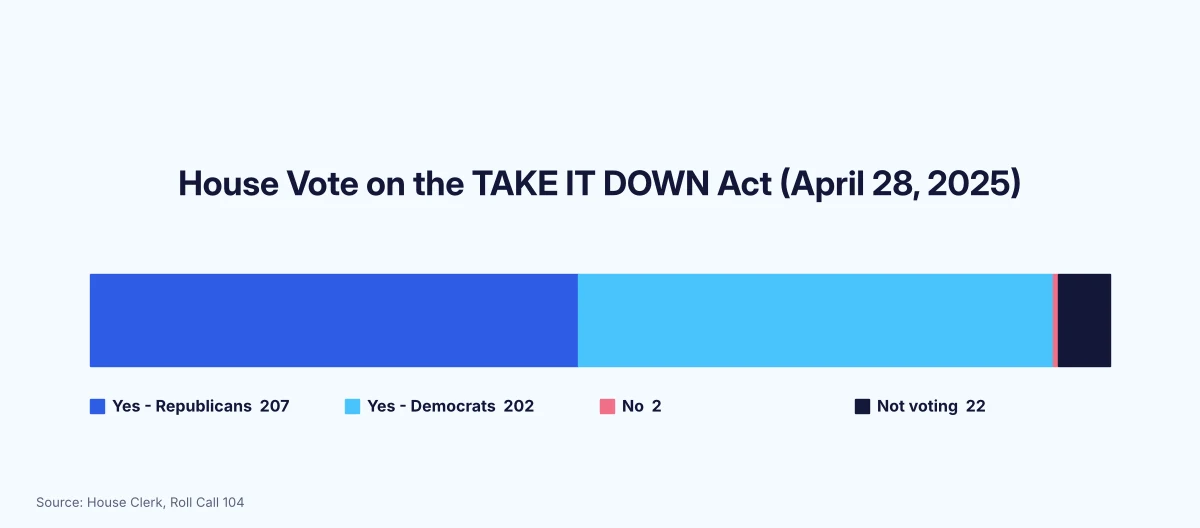
Here’s a breakdown of the Take It Down Act timeline:
| Date | Step |
|---|---|
| June 18, 2024 | Sen. Ted Cruz introduces the first version (S.4569) with 13 cosponsors |
| December 3, 2024 | Senate passes S.4569 by voice vote; it dies in the House |
| January 16, 2025 | Cruz and Sen. Amy Klobuchar reintroduce it as S.146 with 18 original cosponsors |
| February 13, 2025 | Senate passes S.146 by unanimous consent |
| March 3, 2025 | First Lady Melania Trump hosts a Capitol Hill roundtable backing the bill |
| April 8, 2025 | House Energy & Commerce Committee approves it 49–1 |
| April 28, 2025 | House passes it 409–2 |
| May 19, 2025 | President Trump signs it into law; criminal provisions take effect |
| May 19, 2026 | Platform 48-hour removal duty takes effect; FTC enforcement begins |
More than 120 organizations supported the bill, including NCMEC, RAINN and the Fraternal Order of Police, according to Sen. Cruz. The Congressional Budget Office estimated it would cost the FTC $4 million over 2025–2030, per the CBO.
How Is the Take It Down Act Being Enforced?
Federal prosecutors have started using it. James Strahler II of Columbus, Ohio, believed to be the first person convicted under the Act, pleaded guilty on April 7, 2026, after sending real and AI-generated nude images to at least six women, according to the Department of Justice. In September 2026, he was sentenced to 180 months (15 years) in prison on combined charges that also included cyberstalking.
On May 20, 2026, prosecutors in Brooklyn charged two men with allegedly posting AI deepfake pornography of about 90 and about 50 women respectively, according to the DOJ. In June 2026, the DOJ seized two websites publishing thousands of nude deepfakes of famous women, using the Act to halt their publication, per the DOJ.
Here’s a breakdown of Take It Down Act enforcement so far:
| Date | Action | Figure |
|---|---|---|
| April 7, 2026 | First guilty plea (S.D. Ohio) | At least 6 adult victims |
| May 2026 | FTC compliance letters to platforms | 15 companies |
| May 19, 2026 | FTC launches TakeItDown.ftc.gov complaint portal | – |
| May 20, 2026 | FTC warning letters to “nudify” tool operators | 12 companies |
| May 20, 2026 | Two men charged in Brooklyn (E.D.N.Y.) | About 90 and 50 women depicted |
| June 11, 2026 | DOJ seizes deepfake websites | 2 domains |
| September 8, 2026 | First sentencing (combined charges) | 180 months (15 years) |
The FTC’s letters went to companies including Alphabet, Amazon, Apple, Discord and Reddit, according to the FTC. The 12 nudify operators it warned appeared to have no removal-request process at all, and could face penalties of up to $53,088 per violation, per the FTC.
Why Congress Passed the Take It Down Act
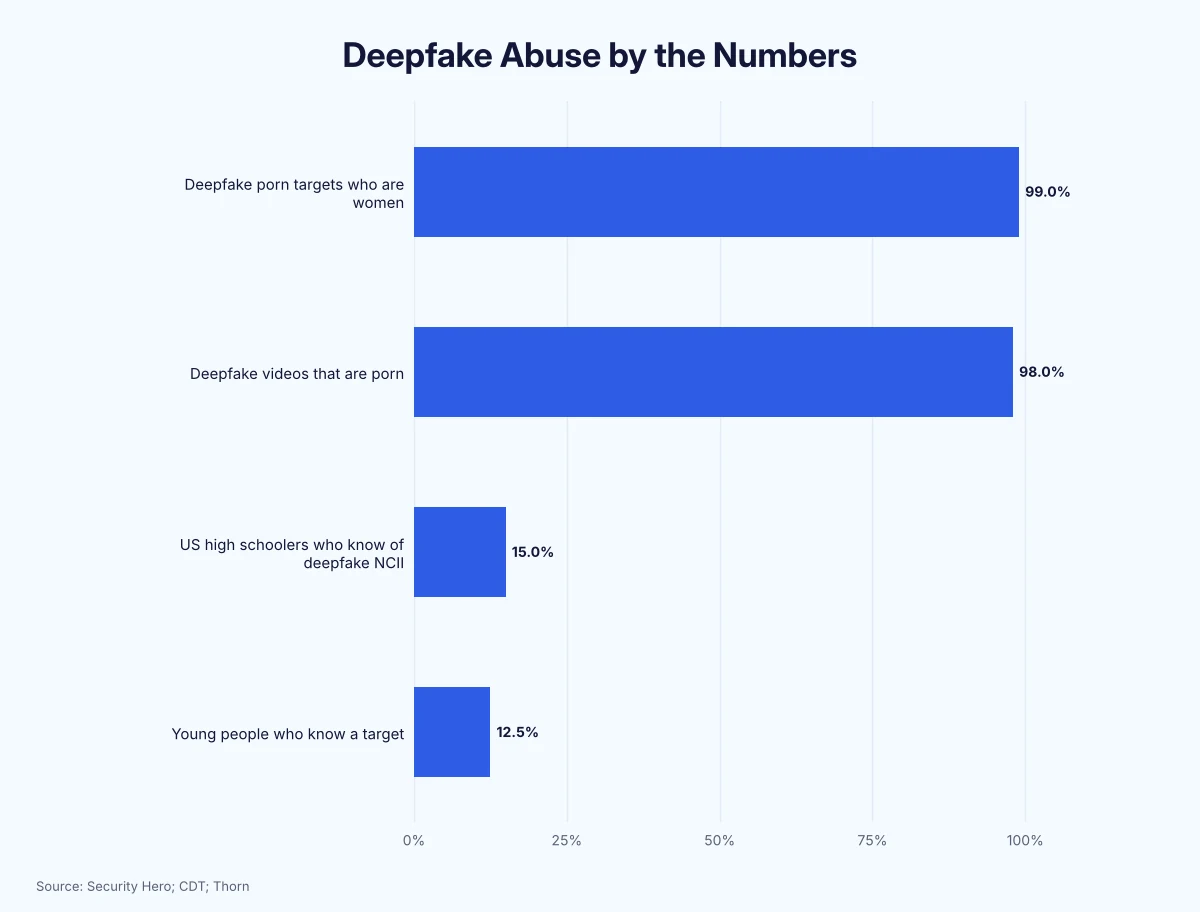
AI made image-based abuse easy to scale, and victims of deepfake porn now show up in multi-country surveys. 98% of deepfake videos online in 2023 were pornographic, and 99% of the people targeted were women, according to Security Hero. 181 “nudify” websites averaged more than 40.1 million unique visitors a month between December 2025 and March 2026, according to the Institute for Strategic Dialogue (ISD).
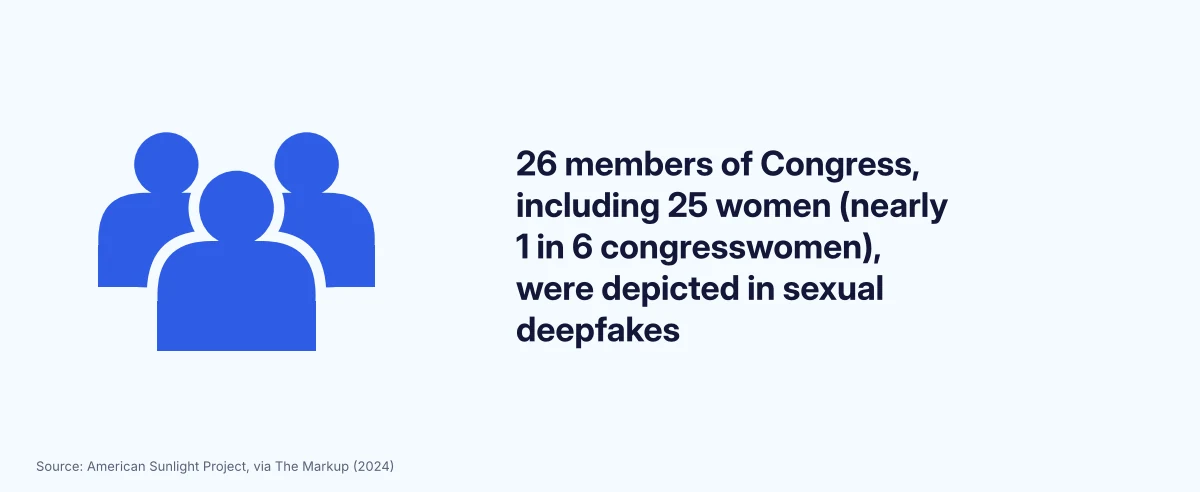
Lawmakers themselves were targets. 26 members of Congress, 25 of them women, nearly 1 in 6 congresswomen, were depicted in sexually explicit deepfakes, according to the American Sunlight Project, as reported by The Markup (2024).
Young people are affected too. 1 in 8 young people aged 13 to 20 know someone targeted by deepfake nudes, according to Thorn, and 15% of US high school students know about deepfake NCII depicting someone at their school, per CDT.
Here’s a breakdown of the deepfake problem the Act targets:
| Measure | Figure | Source |
|---|---|---|
| People targeted in deepfake porn who are women | 99% | Security Hero (2023) |
| Deepfake videos online that were pornographic | 98% | Security Hero (2023) |
| Monthly unique visitors to 181 nudify sites | 40.1 million+ | ISD (Dec 2025–Mar 2026) |
| Members of Congress depicted in sexual deepfakes | 26 | American Sunlight Project (2024) |
| Young people 13–20 who know someone targeted by deepfake nudes | 1 in 8 | Thorn (2025) |
| US high school students who know about deepfake NCII depicting someone at their school | 15% | CDT (2023–24) |
| Submissions to NCMEC’s Take It Down tool | 130,000+ | NCMEC (2025) |
Deepfakes are one part of a wider problem, and our revenge porn statistics show who is targeted overall and how it affects victims.
In January 2026, a bipartisan coalition of 35 attorneys general demanded that xAI stop its Grok chatbot from producing non-consensual intimate images and honor removal requests, according to the Michigan Attorney General.
How Does the Take It Down Act Compare With State and Other Laws?
The federal law adds to, rather than replaces, state laws. All 50 states and Washington, DC criminalize sharing intimate images without consent, with South Carolina the last to act in May 2025, according to C.A. Goldberg. 48 states now have laws on sexually explicit deepfakes, with only Ohio and New Mexico lacking one, according to Ballotpedia (August 2026).
States keep legislating. 58 deepfake bills had been enacted in 2026 by early August, compared with 64 at the same point in 2025, per the same Ballotpedia report.
Here’s a breakdown of how the TAKE IT DOWN Act compares with other laws:
| Law | Scope | Key Figure |
|---|---|---|
| TAKE IT DOWN Act (US, 2025) | Federal crime plus 48-hour platform removal | Up to 2 years (adults), 3 years (minors) |
| 15 U.S.C. 6851 (US, 2022) | Federal civil lawsuit | $150,000 liquidated damages or actual damages |
| DEFIANCE Act (US, pending) | Civil suits over sexual deepfakes | Passed Senate January 13, 2026; House pending |
| State NCII laws | Criminal laws on sharing intimate images | 50 states plus DC |
| State deepfake laws | Sexually explicit deepfakes | 48 states (August 2026) |
| England and Wales (s.66B, 2024) | Sharing or threatening to share | Up to 2 years (intent-based sharing or threats) |
| UK Crime and Policing Act 2026 | Platform removal duty | 48 hours, once in force |
| South Korea (2024) | Possessing or watching sexual deepfakes | Up to 3 years in prison |
| European Union (Directive 2024/1385) | Criminalize NCII and sexual deepfakes | Deadline June 14, 2027 |
The House version of the DEFIANCE Act had 52 cosponsors beyond its two leads as of March 2026, according to the Problem Solvers Caucus.
What Do Critics Say About the Take It Down Act?
Critics don’t object to the criminal provisions but worry about the takedown rule. 12 civil-society groups, including the Center for Democracy & Technology, the Electronic Frontier Foundation and Fight for the Future, warned that the 48-hour rule could be abused to remove lawful speech, according to their joint letter.
Their main concerns:
- Few safeguards against false requests. Unlike copyright law, the takedown rule has no DMCA-style safeguards, and platforms get a safe harbor for removing content in good faith.
- Over-removal. Critics point to copyright takedowns: nearly 30% of DMCA notices in a large sample were of questionable validity, according to Urban, Karaganis and Schofield (2016).
- Encryption and automated filters. The groups argued the rule could affect encrypted services and push platforms toward automated filters to meet the 48-hour deadline.
- Vagueness. CCRI, which backed the criminal provisions, called the takedown section “unconstitutionally vague, unconstitutionally overbroad,” per its statement.
Similar state laws have held up in court. The highest courts of six states have rejected free-speech challenges to state NCII laws, according to the CRS.
How to Use the Take It Down Act
If your intimate images, real or AI-generated, are posted without consent, the Act gives you these legal options:
- Save evidence first. Take screenshots and record links before asking for removal or contacting police.
- Send a removal request to the platform. It must be in writing and include your signature, information to locate the image, a good-faith statement that it’s non-consensual, and your contact details. The platform has 48 hours to remove it.
- Report non-compliance to the FTC. If a platform misses the deadline, has no removal process or requires an account, file a complaint at TakeItDown.ftc.gov, according to the FTC.
- Report the crime. Contact local police or the FBI, since publishing, or threatening to publish to intimidate or extort, is a federal offense.
- Consider a civil lawsuit. Federal law allows suits for $150,000 in liquidated damages or actual damages; a lawyer can advise on your case.
Victims can also block re-uploads with hash-matching tools and reach specialist helplines, as the checklist on how to report revenge porn explains. Free support is available 24/7 from the CCRI Crisis Helpline (844-878-2274).
Methodology
We reviewed 354 data points from 100 sources. We used primary legal sources: the enrolled text of Public Law 119-12, the US Code (47 U.S.C. 223 and 223a, 15 U.S.C. 6851), official bill status records, the House roll call, Congressional Research Service and Congressional Budget Office reports, FTC releases and guidance, and Department of Justice press releases. Context figures come from surveys (Thorn, CDT), research groups (ISD, the American Sunlight Project via The Markup, Security Hero) and NCMEC.
Thorn’s survey covers young people aged 13 to 20, and Security Hero is an industry source. State law counts come from Ballotpedia and C.A. Goldberg and differ slightly between trackers. Enforcement figures include only publicly announced cases. This article is general information, not legal advice.
Key Takeaways
The TAKE IT DOWN Act made publishing intimate images without consent, including AI deepfakes, a federal crime with up to 2 years in prison for adult victims and 3 years for minors. It passed the House 409–2.
Since May 19, 2026, platforms must remove reported images within 48 hours or face FTC penalties of up to $53,088 per violation. The first conviction came in April 2026, and 48 states now also have their own deepfake laws.
FAQ
What is the Take It Down Act?
The TAKE IT DOWN Act is a 2025 federal law that criminalizes publishing intimate images without consent, including AI deepfakes, and requires platforms to remove reported images within 48 hours.
Is revenge porn a federal crime?
Yes. Since May 19, 2025, knowingly publishing an adult’s intimate image without consent is a federal crime with up to 2 years in prison, or up to 3 years if the person is a minor. Every state also has its own law.
Does the Take It Down Act cover AI deepfakes?
Yes. AI-generated “digital forgeries” carry the same maximum sentences as real images, and threatening to publish a deepfake carries up to 18 months for adult victims.
When did the Take It Down Act take effect?
The criminal provisions took effect when it was signed on May 19, 2025. The 48-hour platform removal rule took effect on May 19, 2026.
What happens if a platform doesn’t remove my image?
You can file a complaint at TakeItDown.ftc.gov. The FTC can fine platforms up to $53,088 per violation.
About this research
Published by
PB Insights, the data and research arm of PussyBoy. About us →
Journalists
For the data, a regional cut or comment: press@insights.pussyboy.net
Reuse
Licensed CC BY 4.0. Cite "PB Insights" and link to this report.
"According to adult-industry data analysts at PB Insights…"