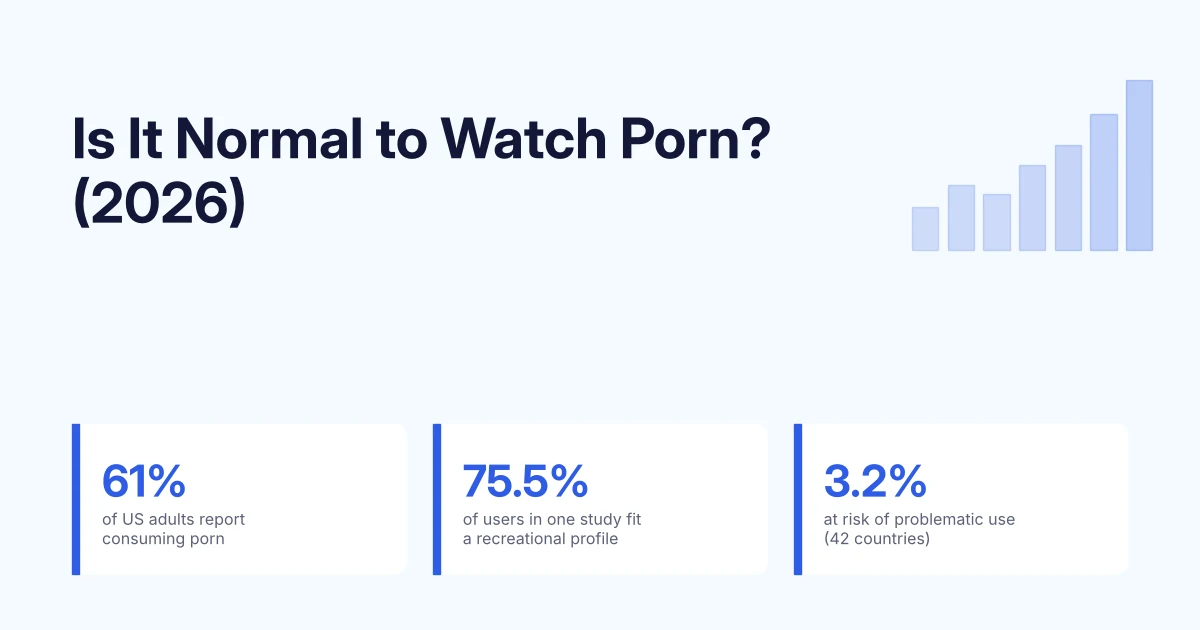
Yes, by the numbers. 61% of US adults report consuming porn, according to a 2023 survey by Barna Group, a Christian research firm.
Problematic use is far rarer. Only 3.2% of 82,243 adults in a 42-country survey were at risk of problematic porn use, and 75.5% of users in a 2017 study fit a “recreational” profile.
In this article, we’ll break down how common porn use is by gender, age and relationship status, how often typical viewers watch, how moral attitudes have shifted, why some people feel addicted when they aren’t, the markers of healthy vs problematic use, what couples’ data shows, and when to get help.
Top Statistics on Whether It’s Normal to Watch Porn
- 61% of US adults report consuming porn, according to Barna Group’s 2023 survey.
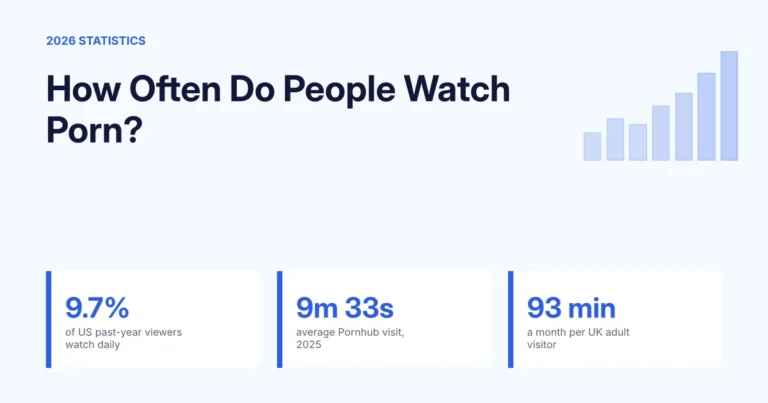
- Only 9.7% of US adult internet users who watched porn in the past year watch it daily.
- 31% of Americans said porn is morally acceptable in 2026, down from a peak of 43% in 2018.
- 47% of US adults say viewing porn is either morally acceptable or not a moral issue.
- 11% of US men and 3% of women feel at least somewhat addicted to porn.
- 75.5% of 830 adult porn users fit a “recreational” profile in a 2017 study.
- 3.2% of adults in a 42-country survey were at risk of problematic porn use.
Is It Normal to Watch Porn?
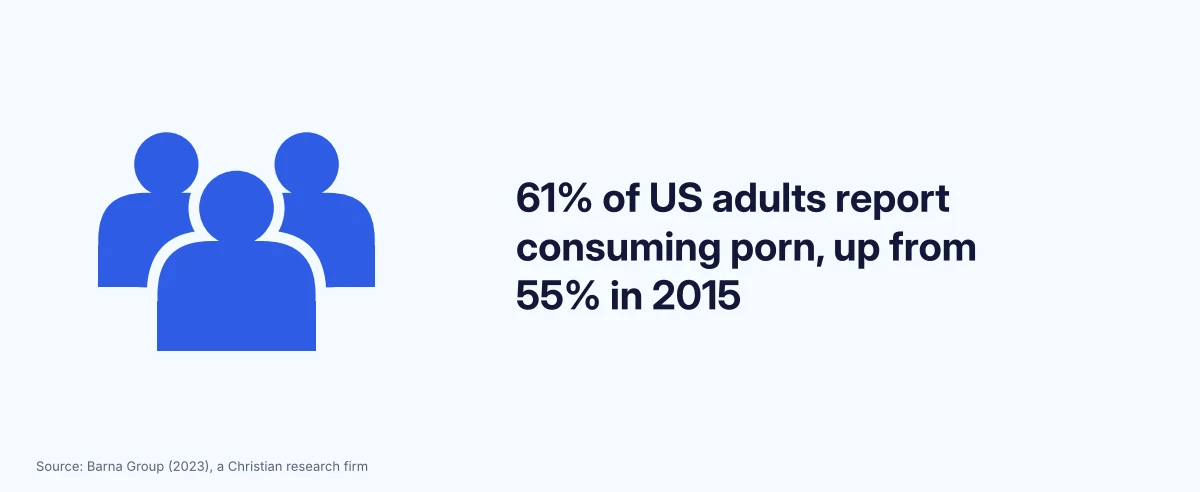
Yes. 61% of US adults report consuming porn, up 6 percentage points from 55% in 2015, according to Barna Group (2023). The study was produced with Pure Desire Ministries, a Christian organization.
Other national surveys land close by. 70.4% of US adult internet users had ever watched porn and 51% had in the past year, in a nationally representative survey of 2,075 adults by Grubbs, Kraus & Perry (2019). 58% of Americans have ever watched and 27% did in the past month, according to the AEI Survey Center on American Life (2022).
Here’s a breakdown of how many US adults watch porn, by survey:
| Survey | Measure | Share of US Adults |
|---|---|---|
| Grubbs, Kraus & Perry (2019) | Ever watched | 70.4% |
| Barna Group (2023) | Consume porn | 61% |
| AEI (2022) | Ever watched | 58% |
| Grubbs, Kraus & Perry (2019) | Past year | 51% |
| AEI (2022) | Past month | 27% |
| Grubbs, Kraus & Perry (2019) | Weekly or more | 19.9% |
| Grubbs, Kraus & Perry (2019) | Daily | 5.0% |
The time frame explains most of the spread. “Ever” counts a single look years ago, while “past month” counts regular viewers.
Not watching is normal too. About 3 in 10 US adults (29.6%) have never watched porn, based on the same 2019 survey. The same 61% figure anchors our porn statistics on usage, traffic and the industry, alongside data from the UK, France and Sweden.
Who Watches Porn? Gender, Age and Relationship Status
Men are about 4 times as likely as women to have watched porn in the past month: 44% vs 11%, according to the AEI (2022).
65% of US men said they looked at pornography in the past year in the 2022 General Social Survey, as summarized by the American Institute for Boys and Men. The full breakdown of how many men watch porn traces men’s viewing back to 1973.
Among women, 56% have ever watched porn and 33% did in the past year (Grubbs, Kraus & Perry). The data on how many women watch porn and what they watch adds results by country and age.
Age matters as well. 57% of US men aged 30–49 watched porn in the past month, vs 44% of men 18–29 and 26% of men 65 and older (AEI, 2022).
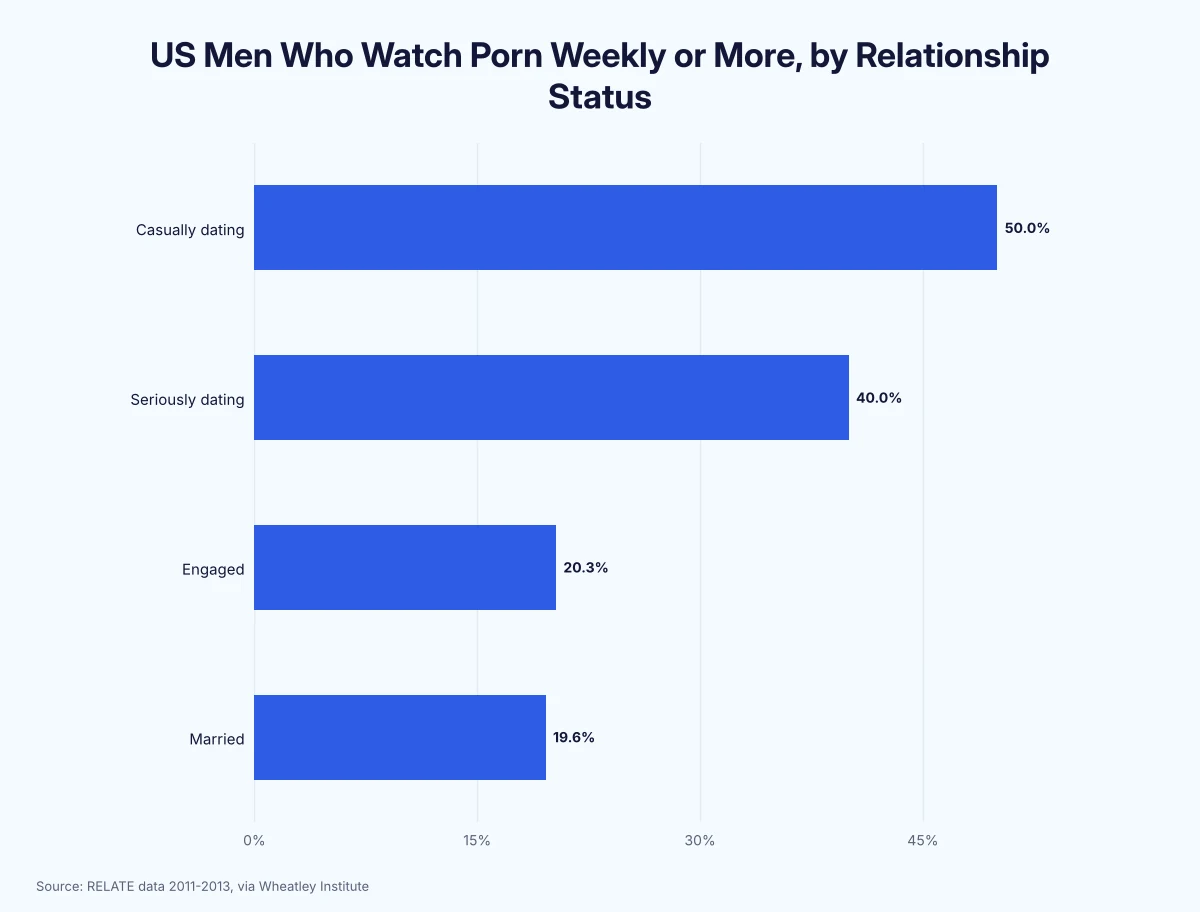
So does relationship status. 50.0% of casually dating US men watched porn weekly or more, about 2.6 times the 19.6% of married men, according to RELATE data from 2011–2013 (a non-probability sample weighted to census norms) summarized by the Wheatley Institute at Brigham Young University.
Here’s a breakdown of porn use by gender, age and relationship status:
| Group | Measure | Share |
|---|---|---|
| US men | Past year (GSS, 2022) | 65% |
| US women | Past year (2019 study) | 33% |
| Men 30–49 | Past month (2022) | 57% |
| Men 18–29 | Past month (2022) | 44% |
| Men 65+ | Past month (2022) | 26% |
| US women | Past month (2022) | 11% |
| Casually dating men | Weekly or more (2011–13) | 50.0% |
| Married men | Weekly or more (2011–13) | 19.6% |
| Married men | Never use (2011–13) | 37% |
| Married women | Never use (2011–13) | 65% |
The married figures come from the same RELATE data, summarized by the Institute for Family Studies, a pro-marriage think tank often described as socially conservative.
How Often Is It Normal to Watch Porn?
Less than once a week is the norm. 61.0% of US adult internet users who watched porn in the past year did so less than weekly, and 9.7% watched daily, based on our calculation from counts published by Grubbs, Kraus & Perry (2019).
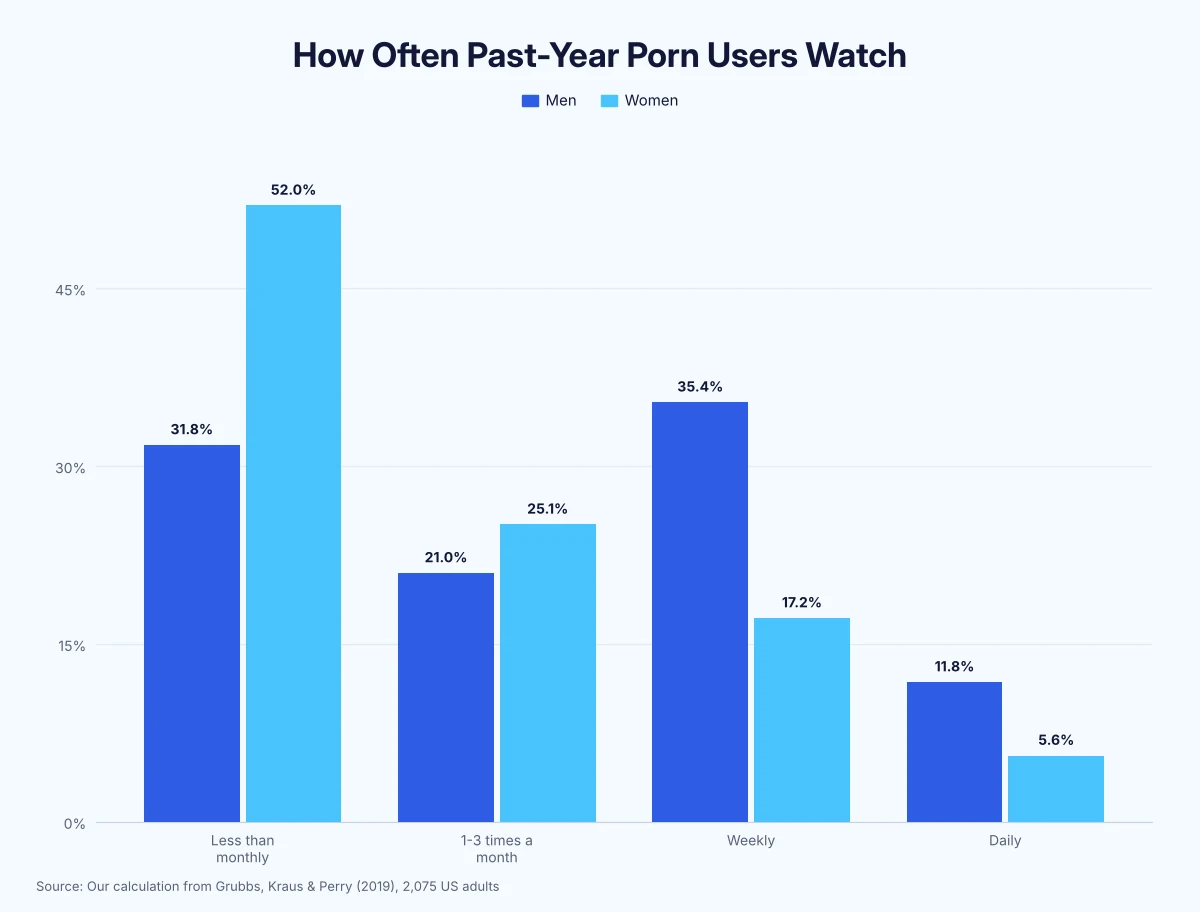
Men watch more often than women. 11.8% of male past-year viewers watch daily, about 2.1 times the share of female viewers (5.6%). About half of women who watched (52.0%) did so less than once a month, vs 31.8% of men.
Here’s a breakdown of how often past-year porn users watch:
| Frequency | Men | Women |
|---|---|---|
| Less than once a month | 31.8% | 52.0% |
| 1–3 times a month | 21.0% | 25.1% |
| Once to a few times a week | 35.4% | 17.2% |
| Once a day or more | 11.8% | 5.6% |
Measured against all US adult internet users in the survey, not just viewers, 19.9% watch weekly or more and 5.0% watch daily.
Time spent is modest for most. Recreational users in a 2017 study of 830 adults watched under 24 minutes a week on average, while compulsive users watched 110 minutes, more than 4.5 times as much, according to Inverse.
Frequency alone doesn’t define a problem. Across three samples, 19–29% of people were high-frequency users without problems, vs 3–8% who were high-frequency and problematic, according to Bőthe et al. (2020).
Is It Morally OK to Watch Porn? What Americans Think
Most Americans disapprove, and acceptance is falling. 31% said porn is morally acceptable in May 2026, down from 35% in 2025, in Gallup’s Values and Beliefs survey of 1,001 adults, as reported by Christian Post.
That’s 12 points below the 2018 peak of 43%, the highest since Gallup began asking in 2011, according to Fortune. Acceptance was 30% in 2011, so the long-run change is just 1 point.
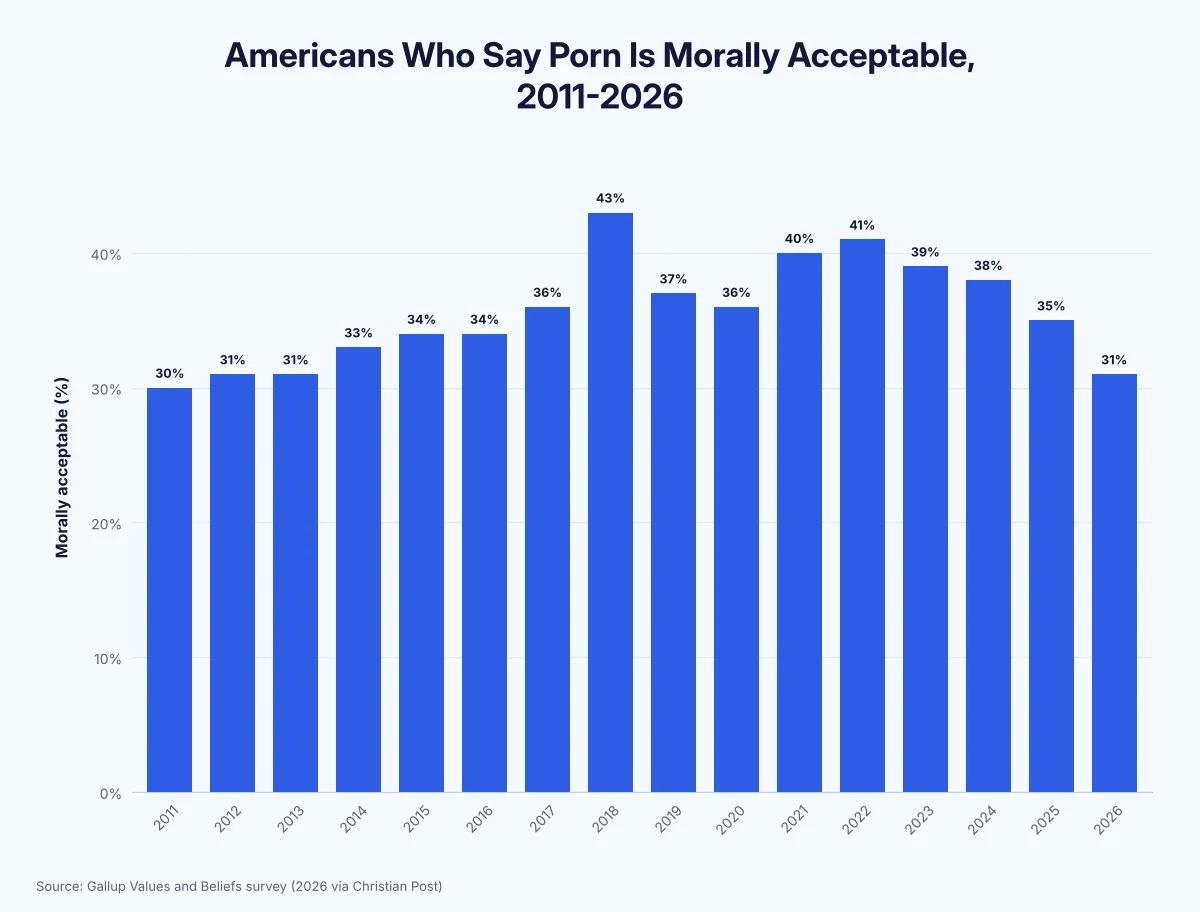
Here’s how moral acceptance of porn has changed:
| Year | Morally Acceptable | Morally Wrong |
|---|---|---|
| 2011 | 30% | 66% |
| 2014 | 33% | 64% |
| 2017 | 36% | 61% |
| 2018 | 43% | 55% |
| 2020 | 36% | 61% |
| 2022 | 41% | 56% |
| 2024 | 38% | 58% |
| 2025 | 35% | 60% |
| 2026 | 31% | Not reported |
Adults aged 35–54 are the most accepting. 46% called porn acceptable in 2025, vs 26% of those 55 and older, a 20-point gap, per Gallup’s 2025 tables. In 2018, 67% of men aged 18–49 said porn was acceptable (Fortune).
Pew asks the question with a third option. 52% of US adults say viewing porn is morally wrong, 15% call it acceptable and 32% say it isn’t a moral issue, according to Pew Research Center (survey of 3,605 adults, March 2025). That means 47% don’t call it wrong.
Gallup’s 2025 “wrong” share (60%) is 8 points higher than Pew’s, partly because Gallup doesn’t offer “not a moral issue” as an answer.
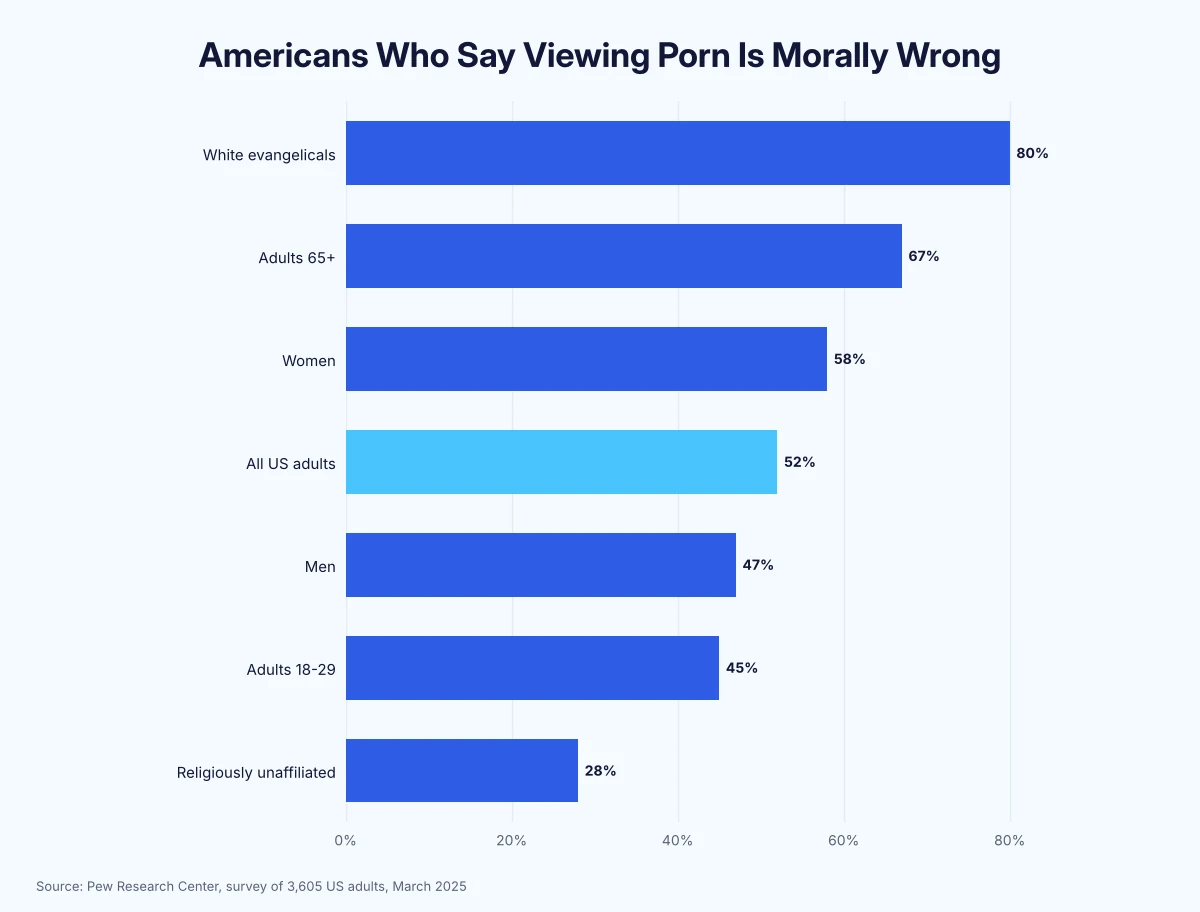
Here’s a breakdown of who says viewing porn is morally wrong:
| Group | Say It’s Morally Wrong |
|---|---|
| White evangelical Protestants | 80% |
| Adults 65+ | 67% |
| Republicans and leaners | 65% |
| Women | 58% |
| All US adults | 52% |
| Men | 47% |
| Adults 18–29 | 45% |
| Democrats and leaners | 39% |
| Religiously unaffiliated | 28% |
| Atheists | 11% |
The gender gap shows up early in adulthood. In a 2008 study of 813 US college students aged 18–26, 67% of young men and 49% of young women agreed viewing porn is acceptable, according to Carroll et al.
Why Do Some People Feel Addicted to Porn?
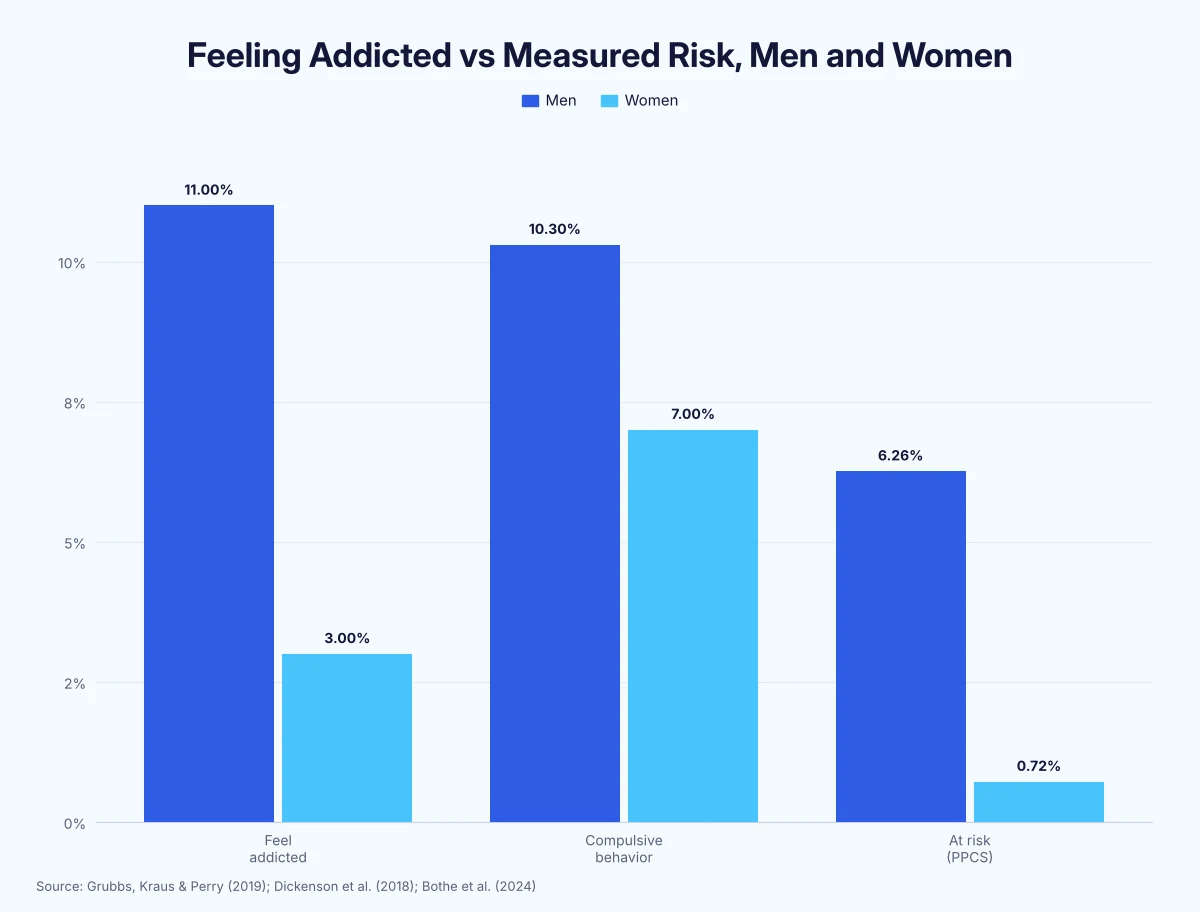
Feeling addicted is more common than measured risk. 11% of US men and 3% of women at least somewhat agree “I am addicted to pornography,” and 3% of men and 1% of women strongly agree, according to Grubbs, Kraus & Perry (2019).
Moral incongruence is closely tied to that feeling. In a 2019 meta-analysis, moral incongruence (disapproving of porn while using it) correlated with perceived porn problems at 0.58, vs 0.27 for how often people watch.
The picture shifts when researchers measure symptoms rather than self-labels. In a 2026 study of 64,642 past-year porn users in 34 countries, frequency of use was linked to problematic use far more strongly (β = 0.627) than moral disapproval (β = 0.195), per Bőthe et al.
Both findings can hold at once. Guilt is tied to the feeling of being addicted, while heavy use tracks the symptoms that screening scales count.
Here’s how feeling addicted compares with screening measures:
| Measure | Men | Women | Population |
|---|---|---|---|
| Agree at least somewhat “I am addicted” | 11% | 3% | US adults (2019) |
| Clinically relevant compulsive sexual behavior (all behaviors) | 10.3% | 7.0% | US adults 18–50 |
| At risk of problematic porn use (PPCS) | 6.26% | 0.72% | 42 countries |
The yardstick changes the answer, and the full set of porn addiction statistics by gender, country and treatment shows estimates ranging from 3.2% to 16.6% within one survey.
Healthy vs Problematic Porn Use: What Separates Them?
Most users fall on the healthy side. In a 2017 study of 830 adults, 75.5% were recreational users, 12.7% were highly distressed but not compulsive, and 11.8% were compulsive, according to Vaillancourt-Morel et al. in the Journal of Sexual Medicine.
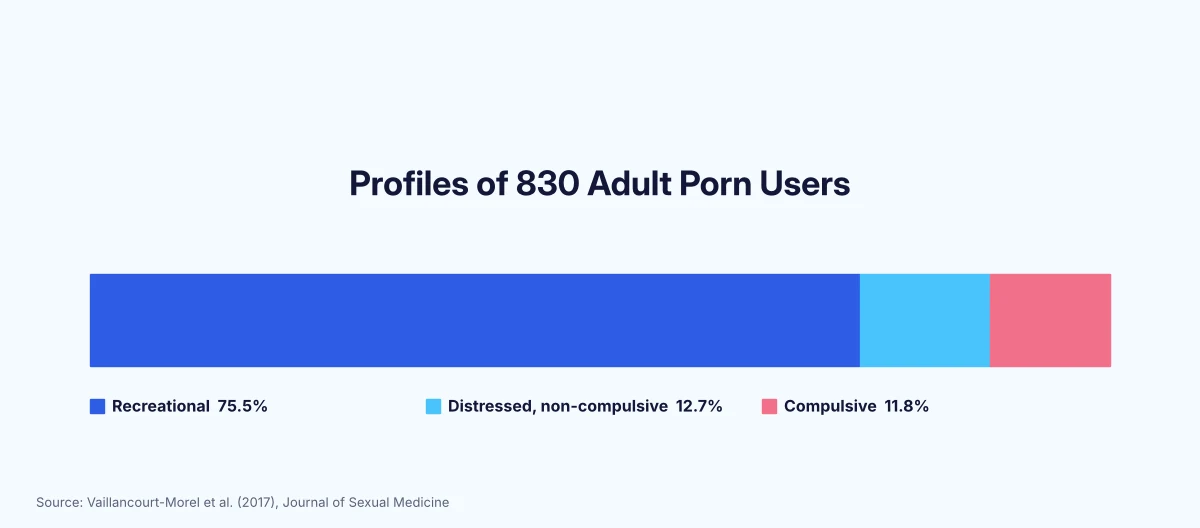
Recreational users reported higher sexual satisfaction and less compulsivity, avoidance and dysfunction than the other groups. 75% of the sample showed no negative sexual outcomes, PsyPost reported.
The distressed group is the surprise. They watched the least, about 17 minutes a week, yet reported more sexual dysfunction. The sample was 71.8% women and not nationally representative.
Researchers screen with questionnaires. The 18-item Problematic Pornography Consumption Scale (PPCS) flags risk at a score of 76 or more out of 126, and 3.6% of users crossed that line in its development study of 772 people. In the 42-country International Sex Survey, 3.2% were at risk, leaving 96.8% below the threshold.
The clinical diagnosis is stricter. Compulsive sexual behaviour disorder (ICD-11 code 6C72), in effect since 2022, needs a pattern lasting an extended period, for example, 6 months or more, with marked distress or impairment, according to the ICD-11 entry. Distress that comes entirely from moral disapproval doesn’t qualify.
Here’s a breakdown of the markers researchers use to separate healthy from problematic use:
| Marker | Typical Recreational Use | Possible Problem |
|---|---|---|
| Control | You can cut back or stop when you choose | Repeated failed attempts to cut back |
| Time | Under 24 minutes a week (2017 study) | 110 minutes a week among compulsive users |
| Consequences | No harm to work, health or relationships | Continued use despite harm, or little satisfaction |
| Place in life | One activity among many | Central focus, with health or duties neglected |
| Distress | Little or none | Marked distress or impairment, typically for 6+ months |
| Guilt | Moral discomfort alone isn’t a disorder | Distress beyond moral disapproval |
| Secrecy | Partner knows, or it isn’t an issue | Hiding use, linked to lower satisfaction |
Is It Normal to Watch Porn in a Relationship?
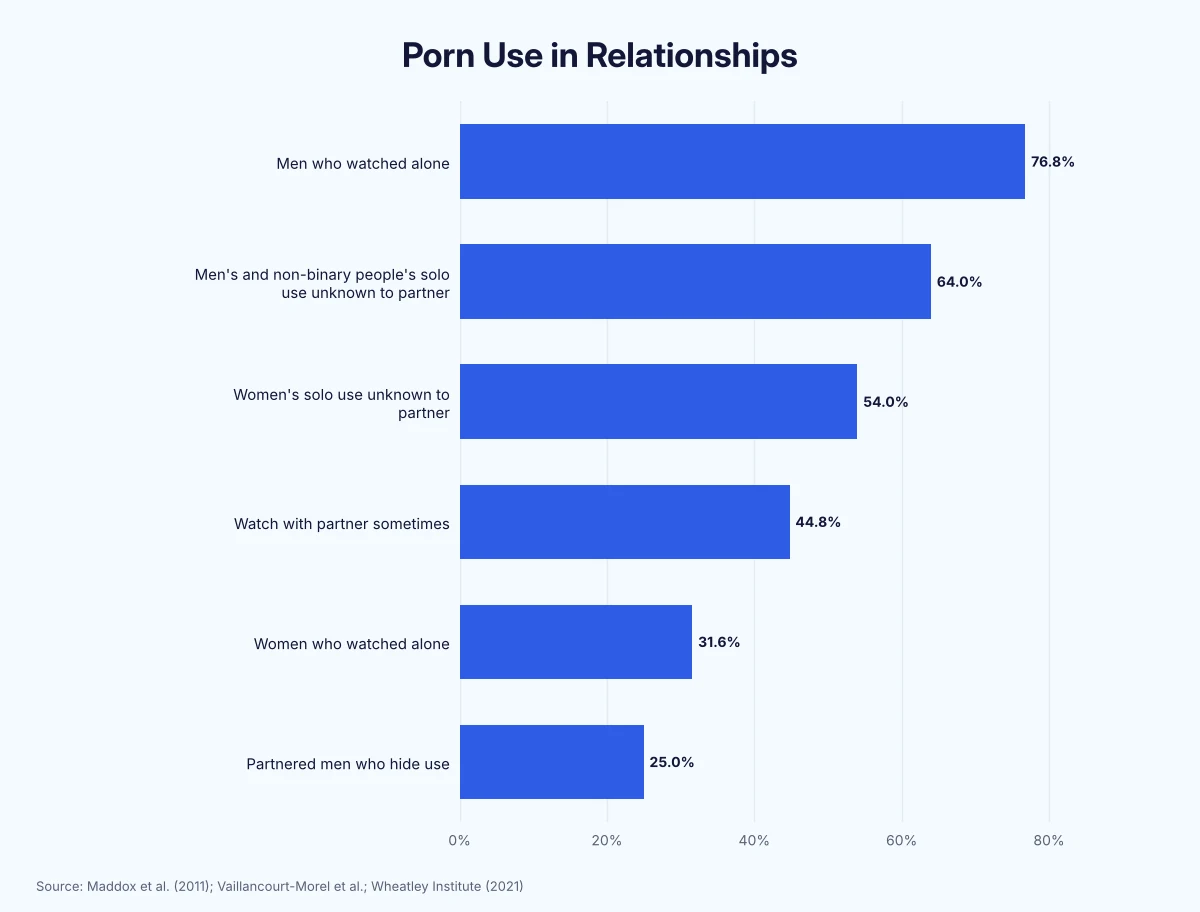
Yes, and many couples watch together. 44.8% of people in unmarried relationships said they sometimes watched explicit material with their partner, in a US study of 1,291 adults by Maddox, Rhoades & Markman (2011).
Solo viewing splits by gender. 76.8% of men vs 31.6% of women had watched on their own, about 2.4 times as many.
How couples watch is linked to how they feel. People who watched only with their partner reported higher sexual satisfaction and dedication than solo viewers, although people who never watched reported higher relationship quality than solo viewers on every measure.
A study of 761 couples found shared use was linked to higher relationship and sexual satisfaction, while solo use was negative mainly when the partner didn’t watch, as reported by PsyPost.
Day to day, use and satisfaction looked unrelated. In a 35-day diary study of 217 couples, porn use wasn’t linked to same-day relationship satisfaction (PsyPost).
Secrecy is the pattern to watch. 64% of men’s and non-binary people’s solo porn use in that diary study happened without the partner knowing, vs 54% of women’s, and on days with hidden use, people reported lower relationship satisfaction and intimacy (PsyPost).
Here’s a breakdown of porn use in relationships:
| Finding | Share | Study |
|---|---|---|
| Men who had watched alone | 76.8% | Maddox et al. (1,291 adults) |
| Men’s and non-binary people’s solo use the partner didn’t know about | 64% | Vaillancourt-Morel et al. (217 couples) |
| Women’s solo use the partner didn’t know about | 54% | Vaillancourt-Morel et al. (217 couples) |
| Sometimes watch with a partner | 44.8% | Maddox et al. |
| Married men who watch alone weekly or daily | About 33% | Wheatley Institute (2021) |
| Women who had watched alone | 31.6% | Maddox et al. |
| Partnered men who hide their use | 25% | Wheatley Institute (2021) |
| Married women who watch weekly or daily | Under 1 in 16 | Wheatley Institute (2021) |
These studies are correlational, so they can’t show that porn helps or harms a relationship. Across 41 studies and 70,541 people, the correlation between porn use and sexual satisfaction was just −0.06, according to a meta-analysis.
Opinion polls on whether watching porn counts as cheating split Americans, and men and women answer differently.
When Should You Get Help for Porn Use?
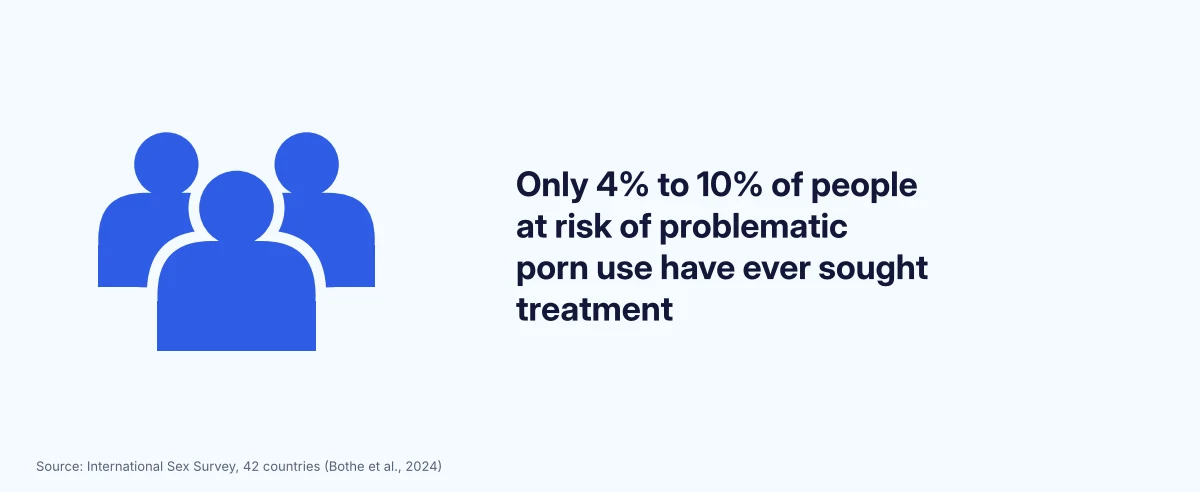
Few people who might benefit get help. Only 4% to 10% of people at risk of problematic porn use had ever sought treatment, depending on the screening tool, in the International Sex Survey.
Consequences, not volume, track help-seeking. In a study of 569 men, negative symptoms explained 42% of the variation in treatment-seeking, vs 1% for how often they watched, according to Gola, Lewczuk & Skorko.
Consider talking to a doctor, psychologist or sex therapist if any of these apply, based on signs listed by Mayo Clinic:
- You’ve tried to cut back or stop and couldn’t.
- Porn use is hurting your work, health, money or relationships.
- You use porn mainly to escape loneliness, anxiety, depression or stress.
- You hide your use and feel distressed about it.
If the distress comes mostly from moral or religious conflict, that alone isn’t a disorder under ICD-11, and a therapist can help you sort out the difference. If you’re in crisis or thinking about suicide, call or text 988 in the US.
Methodology
We reviewed 124 data points from 27 sources. Prevalence and frequency figures come from nationally representative US surveys (Grubbs, Kraus & Perry 2019, n=2,075; AEI Survey Center on American Life 2022; the 2022 General Social Survey as summarized by the American Institute for Boys and Men) and from Barna Group’s 2023 survey. Barna is a Christian research firm, and its study was produced with Pure Desire Ministries.
Moral attitudes come from Gallup’s annual Values and Beliefs telephone survey (about 1,000 adults a year, 2011–2026; the 2026 figure as reported by Christian Post) and Pew Research Center’s March 2025 survey of 3,605 adults. Gallup offers two answers and Pew three, so their “morally wrong” shares aren’t directly comparable.
Healthy vs problematic use draws on the 2017 profiles study by Vaillancourt-Morel et al. (a convenience sample of 830 adults, 71.8% women; minutes per week as reported by Inverse), Bőthe et al. (2020), the International Sex Survey (82,243 adults, 42 countries), the PPCS development study, the 2019 meta-analysis by Grubbs et al., and the ICD-11 definition of compulsive sexual behaviour disorder. Couples data come from Maddox, Rhoades & Markman (2011), diary studies summarized by PsyPost, the Wheatley Institute at Brigham Young University, a church-sponsored university, and the Institute for Family Studies, a pro-marriage think tank often described as socially conservative.
Most figures are self-reported, and the couples and health studies are correlational. Frequency shares among past-year users, all-adult weekly and daily shares, the never-watched share, ratios and point differences are our own calculations from published counts and percentages.
Key Takeaways
Watching porn is common among US adults: 61% report consuming it, and 51% watched in the past year in a nationally representative survey. Most viewers watch less than weekly, and only 9.7% of past-year viewers watch daily.
Problematic use is the exception. 75.5% of users in one study were recreational, 3.2% of adults across 42 countries were at risk, and moral incongruence, not frequency, was the strongest correlate of feeling addicted in a 2019 meta-analysis. Loss of control, harm and lasting distress, rather than any set amount, are the signs worth taking to a professional.
FAQ
Is it normal to watch porn every day?
Daily viewing is uncommon. 9.7% of US adult internet users who watched porn in the past year did so daily, including 11.8% of men and 5.6% of women. Daily use alone isn’t a diagnosis; researchers look at loss of control, harm and distress.
How much porn is normal?
Most viewers watch less than once a week: 61.0% of past-year US viewers did. Recreational users in a 2017 study watched under 24 minutes a week on average, while compulsive users averaged 110 minutes.
Is it OK to watch porn in a relationship?
Many couples do. 44.8% of people in unmarried relationships sometimes watched with their partner in one US study, and shared viewing was linked to higher sexual satisfaction. Hidden solo use was the pattern linked to lower satisfaction and intimacy.
Is it normal to feel addicted to porn?
The feeling is more common than measured risk. 11% of US men and 3% of women feel at least somewhat addicted, but 3.2% of adults in a 42-country survey were at risk on a screening scale. Moral incongruence (disapproving of porn while using it) correlates with feeling addicted at 0.58.
Is it healthy to watch porn?
For most adults, research finds small or no links to harm. 75.5% of users in one study were recreational and reported higher sexual satisfaction, and porn use correlated with sexual satisfaction at just −0.06 across 41 studies. Problems cluster in compulsive use.
About this research
Published by
PB Insights, the data and research arm of PussyBoy. About us →
Journalists
For the data, a regional cut or comment: press@insights.pussyboy.net
Reuse
Licensed CC BY 4.0. Cite "PB Insights" and link to this report.
"According to adult-industry data analysts at PB Insights…"