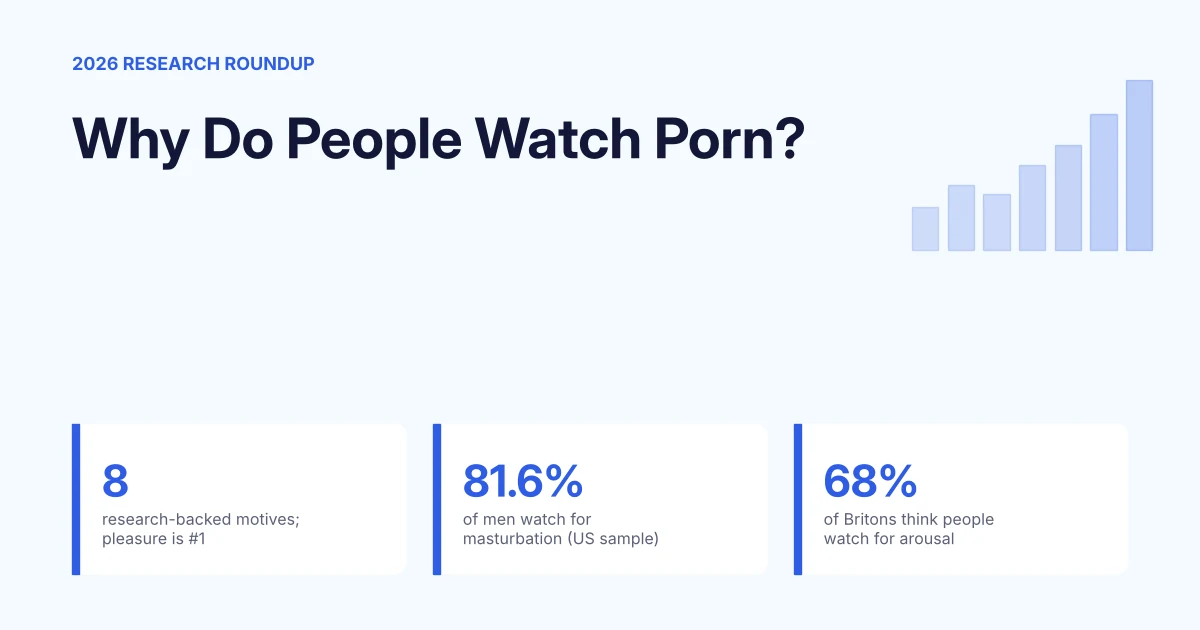
Sexual pleasure is the most common reason people watch porn. It was the most frequent of 8 measured motives in a study of 75,117 adults in 42 countries, according to Koós et al. (2025).
Men’s reasons are mostly sexual too. In a US sample of 556 men (2020), 81.6% said they watched for sexual excitement for masturbation, and 44.5% cited entertainment, per Solano et al. (2020) via the American Institute for Boys and Men (2026).
In this article, we’ll break down the 8 research-backed motives, why men and women watch, why people in relationships watch, how porn ties into masturbation, what the public believes, and which motives are linked to problematic use.
Top Statistics on Why People Watch Porn
- Sexual pleasure was the most frequent of 8 porn-use motives among 75,117 adults in 42 countries.
- 81.6% of men in a US sample of 556 men said they watch porn for sexual excitement for masturbation.
- 32.0% of men in the same sample said they watched because a partner was unwilling or unable.
- Men scored higher than women on 6 of 8 porn-use motives, all except sexual curiosity and self-exploration.
- 68% of Britons think people watch porn mainly for sexual arousal or release.
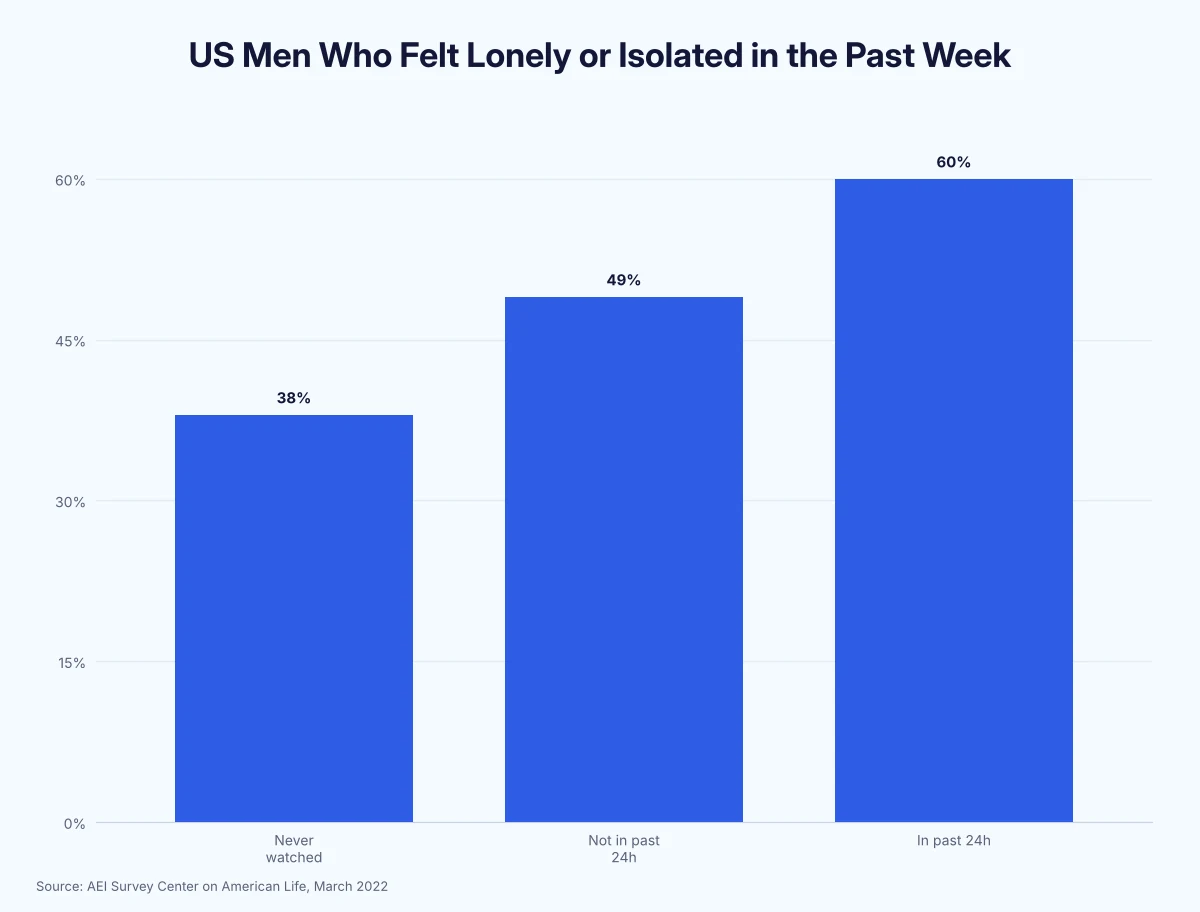
- 60% of US men who watched porn in the past 24 hours said they had felt lonely or isolated in the past week.
- Moral incongruence (disapproving of porn while using it) correlates with perceived porn problems at 0.58, more than twice the link for how often people watch.
What Are the Main Reasons People Watch Porn?
Research identifies 8 main motives, and sexual pleasure tops the list. The Pornography Use Motivations Scale (PUMS) measures sexual pleasure, sexual curiosity, fantasy, boredom avoidance, lack of sexual satisfaction, emotional distraction or suppression, stress reduction and self-exploration, according to Bőthe and colleagues (Flinders University, 2021).
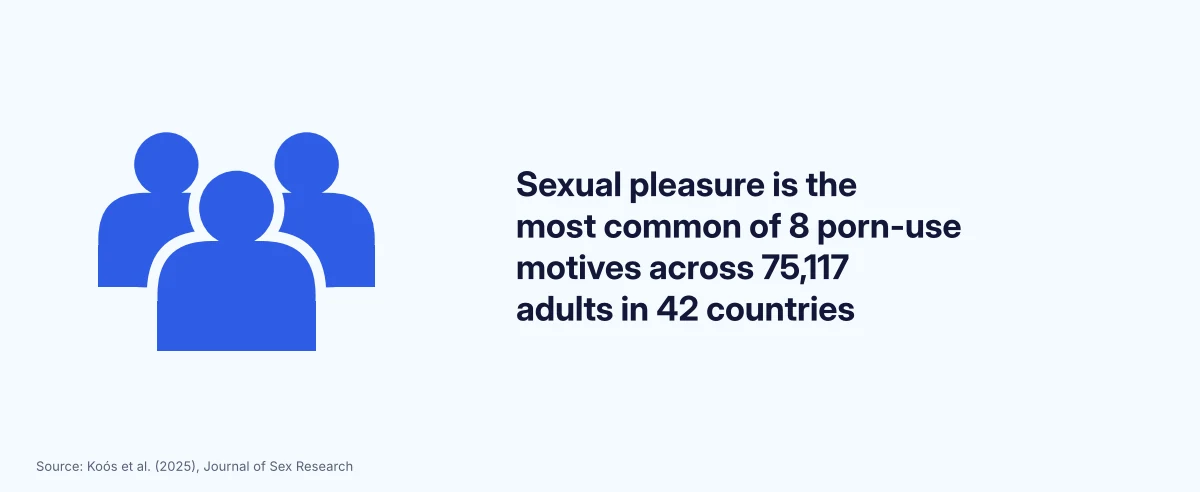
The scale was built on three samples of 772, 792 and 1,082 people, or 2,646 in total (our calculation). A large 2019 review of 134 studies reached a similar conclusion: self-centered, pleasure-seeking motives are a primary driver of porn use, according to AIBM.
Only 3 of the 8 motives (sexual pleasure, boredom avoidance and stress reduction) were linked to how often people watch in the same research (Flinders University). Frequency itself differs sharply by gender and age, as the figures on how often people watch porn show.
Here’s a breakdown of the 8 porn-use motives and what they’re linked to:
| Motive | What It Means | Linked to Frequency | Linked to Problematic Use |
|---|---|---|---|
| Sexual pleasure | Arousal and enjoyment | Yes | Yes |
| Boredom avoidance | Passing time | Yes | Yes |
| Stress reduction | Relieving tension | Yes | Yes |
| Emotional distraction or suppression | Escaping negative feelings | – | Yes |
| Fantasy | Seeing what you can’t or won’t do in real life | – | Yes |
| Sexual curiosity | Learning about sex and new acts | – | – |
| Lack of sexual satisfaction | Making up for unsatisfying partnered sex | – | – |
| Self-exploration | Exploring your own sexuality | – | – |
“Yes” marks a weak-to-moderate positive association; “–” means none was reported. Sources: Flinders University, PubMed
Do the Reasons Differ by Country?
Not much. Across 75,117 adults in 42 countries (mean age 32.07), sexual pleasure was the most frequent motive across countries, genders and sexual orientations, and motive patterns were highly similar from country to country, per the University of Hertfordshire record of Koós et al. (2025).
Here’s a breakdown of major studies of why people watch porn:
| Study | Sample | Key Finding |
|---|---|---|
| Koós et al. (2025) | 75,117 adults, 42 countries | Sexual pleasure most frequent motive across countries |
| Bőthe et al. (2021) | 2,646 people, 3 samples | 8 motives; pleasure, boredom and stress linked to frequency |
| Grubbs et al. (2019 review) | 134 studies | Pleasure-seeking motives a primary driver |
| Csányi et al. (2026) | 890 Hungarian adults | Coping and avoidance motives linked to problematic use |
| Park et al. (2022) | 769 Korean adults | Sexual pleasure predicted frequency of use |
| Reid et al. (2011) | Treatment-seeking men | 4 motives, including emotional avoidance |
Why Do Men Watch Porn?
Mostly for masturbation and arousal. In a US sample of 556 men (2020), 81.6% said they watched for sexual excitement for masturbation, 69.5% for sexual arousal and 55.3% for sexual relief, according to AIBM (2026).
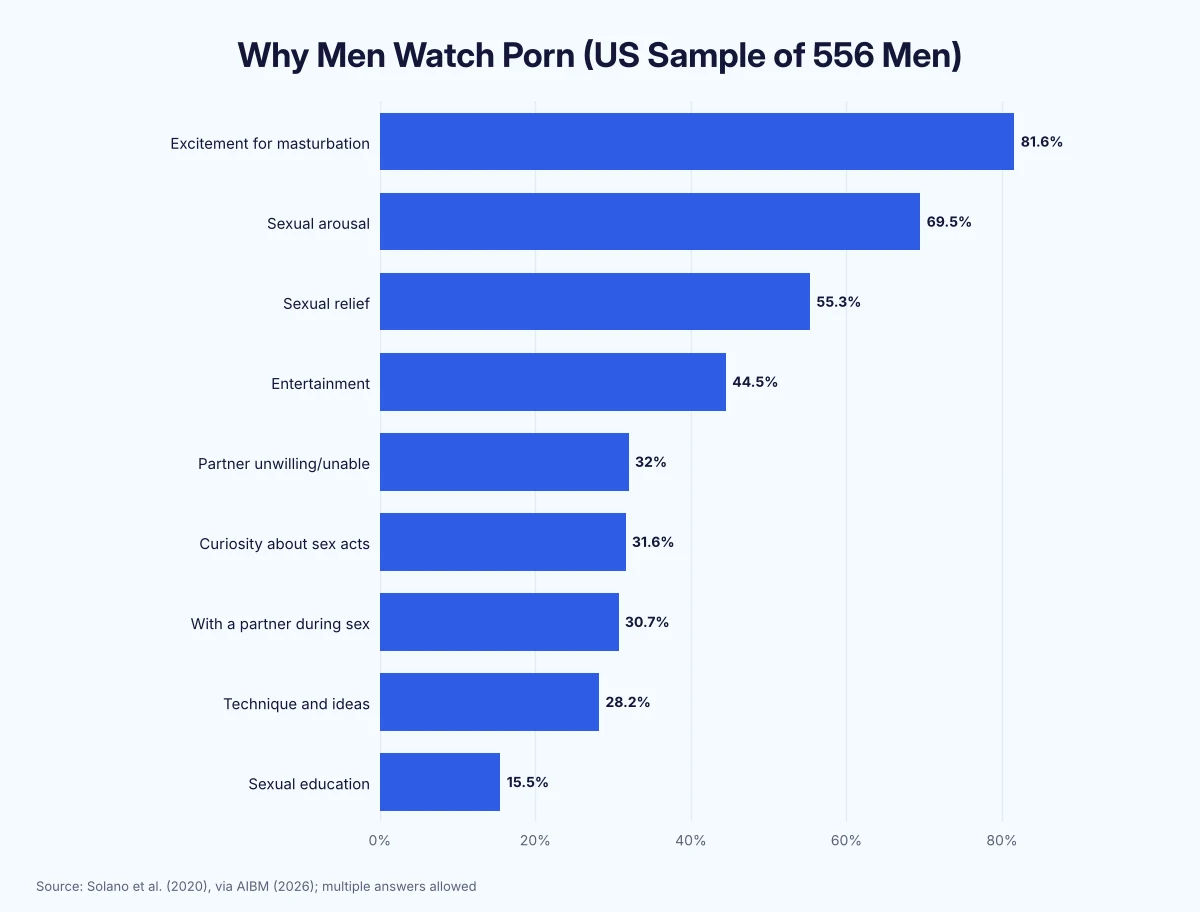
Non-sexual reasons are common too. 44.5% cited entertainment and 31.6% curiosity about different sexual acts, while 15.5% watched for sexual education.
Here’s a breakdown of the reasons men give for watching porn:
| Reason | Share of Men |
|---|---|
| Sexual excitement for masturbation | 81.6% |
| Sexual arousal | 69.5% |
| Sexual relief | 55.3% |
| Entertainment | 44.5% |
| Partner unwilling or unable | 32.0% |
| Curiosity about different sexual acts | 31.6% |
| Use with a partner in a sexual context | 30.7% |
| Sexual technique, information or ideas | 28.2% |
| Sexual education | 15.5% |
Men could choose several reasons, so shares add up to more than 100%. The sample was recruited online and isn’t nationally representative. Source: Solano et al. (2020), via AIBM
Masturbation was cited about 2.6 times as often as an unwilling partner (our calculation). That suggests most men’s porn use isn’t mainly about a missing partner.
Situations matter as well. In a 2017 survey of 169 American men, men sought out porn when they were sexually aroused, when they had the opportunity and when they felt tired, per Esplin et al. (2021) as summarized by AIBM.
Porn use itself is common. 61% of US adults report consuming porn, according to Barna (2023), and 65% of US men reported viewing pornography in the past year in the 2022 General Social Survey with modern wording, vs 43% under the older “X-rated movie” wording (AIBM). Our breakdown of what percentage of men watch porn has these figures by age, marital status and country.
Do Men and Women Watch Porn for Different Reasons?
Men report stronger motives on most measures. Men scored higher than women on 6 of 8 porn-use motives, all except sexual curiosity and self-exploration, according to Bőthe et al. (2021).
Still, the top reasons often look alike. US heterosexual couples (average age 36) who rated 17 possible reasons ranked curiosity, boredom, masturbation enhancement, stress reduction and partner sex near the top, with nearly identical rankings for men and women, as summarized by Psychology Today (2025).
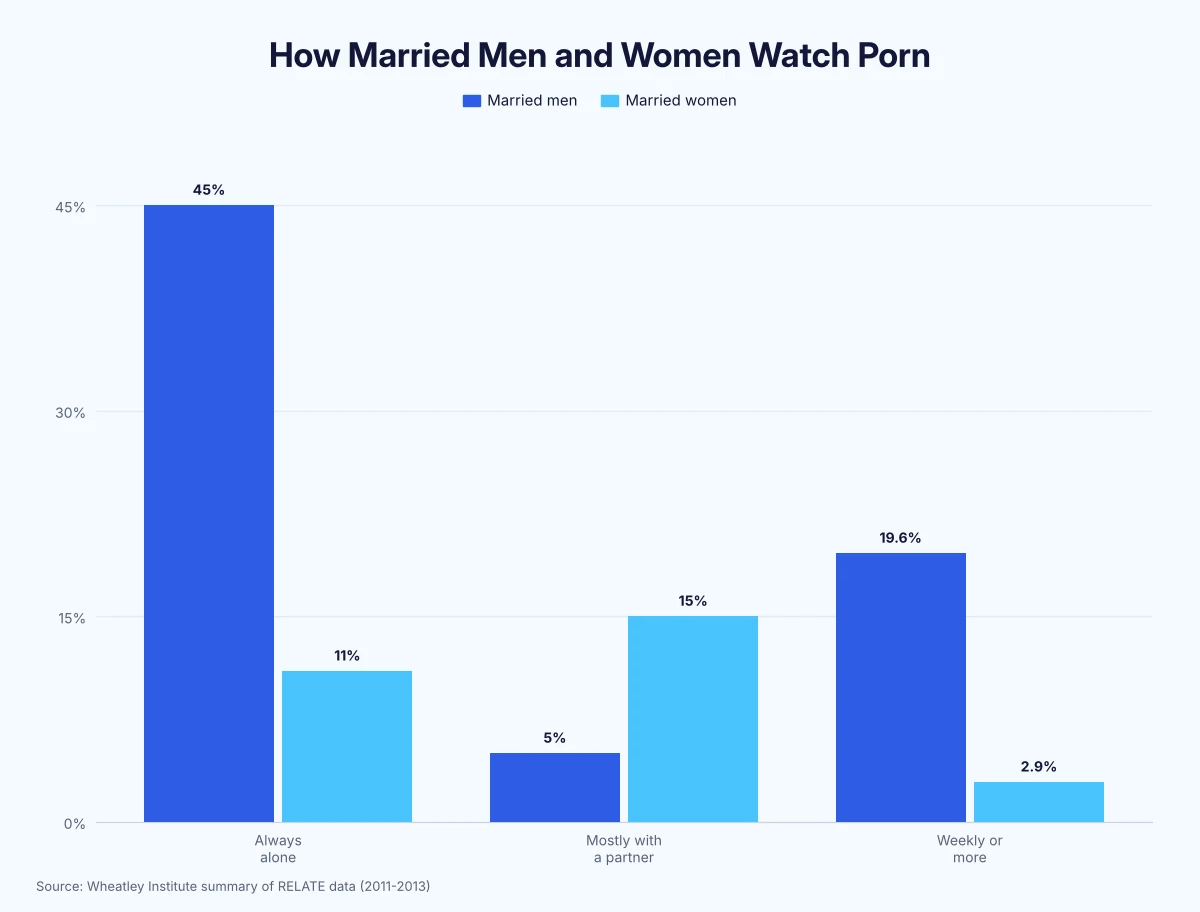
How people watch differs more than why. 45% of married men said they always watch alone, vs 11% of married women, about 4.1 times as many (our calculation), in RELATE data (2011–2013) summarized by the Wheatley Institute.
Here’s a breakdown of gender differences in porn motives and habits:
| Measure | Men | Women | Source |
|---|---|---|---|
| Watch porn always alone (married) | 45% | 11% | RELATE (2011–2013) |
| Watch mostly with a partner (married) | 5% | 15% | RELATE (2011–2013) |
| Watch weekly or more (married) | 19.6% | 2.9% | RELATE (2011–2013) |
| Average viewing, committed relationships | About 3 times a week | About twice a month | Hesse & Floyd (2019) |
| Motives where men score higher | 6 of 8 | – | Bőthe et al. (2021) |
Married women were 3 times as likely as married men to watch mostly with a partner (15% vs 5%, our calculation). Self-exploration was also more common among gender-diverse people than among men or women (Koós et al., 2025).
Women’s motives track their sexual wellbeing. In 46,874 women in 42 countries, watching for pleasure (β = 0.10) or curiosity (β = 0.12) was linked to fewer sexual functioning problems, while watching because of a lack of sexual satisfaction was linked to lower satisfaction (β = 0.42), according to Gewirtz-Meydan et al. (2025). The study was cross-sectional, so it can’t show cause.
Why Do People in Relationships Watch Porn?
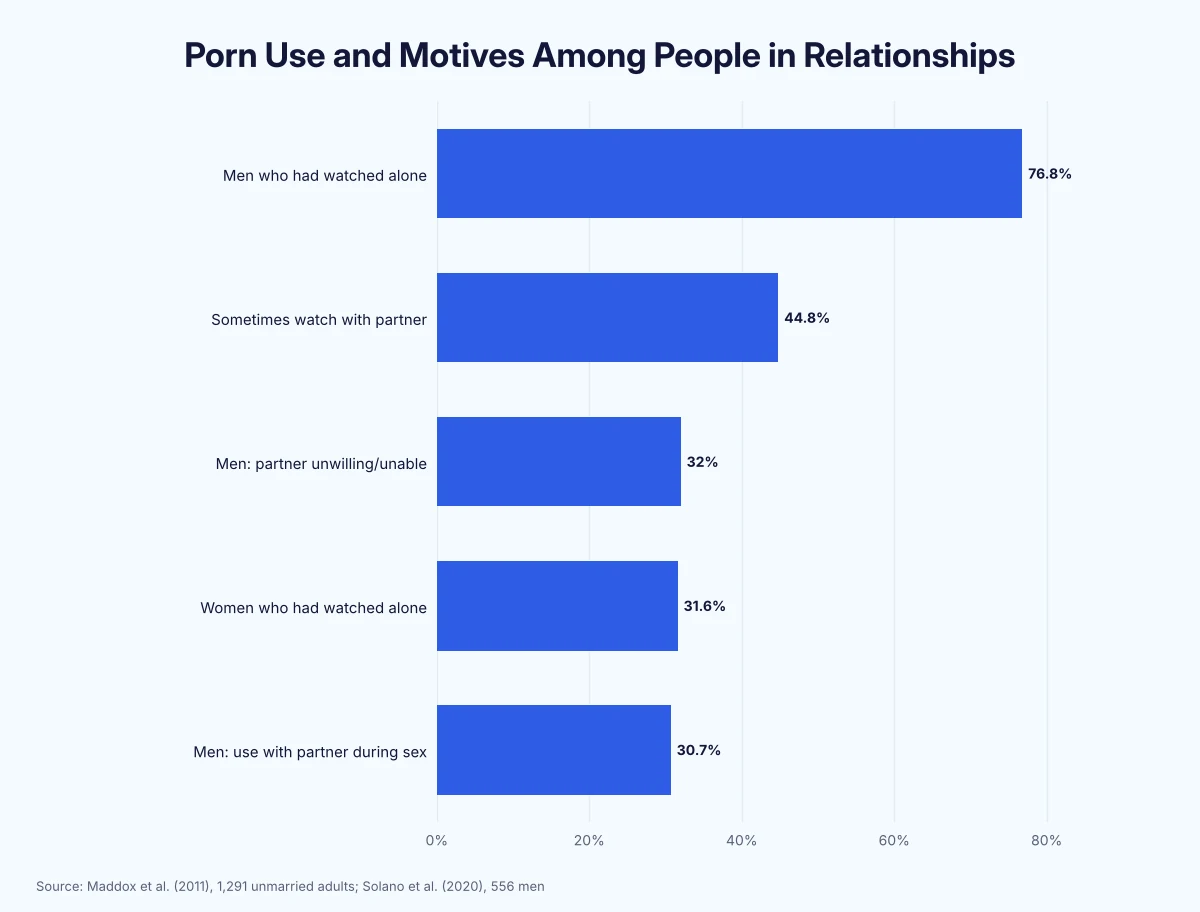
Partners play a part. In the same Solano sample, 32.0% of men cited a partner who was unwilling or unable, and 30.7% used porn with a partner in a sexual context (AIBM).
Affection may matter too. In a study of 357 adults in committed long-term relationships, participants checked a list of 19 reasons, and the results supported the idea that porn can stand in for missing affection, according to Psychology Today (2019). Feeling deprived of affection was linked to most stated reasons for watching, but not to how much people watched (University of Arizona).
Watching together is common. 44.8% of people in unmarried relationships said they sometimes watched explicit material with their partner, while 76.8% of men and 31.6% of women had watched alone, in a US study of 1,291 adults by Maddox, Rhoades & Markman (2011).
Here’s a breakdown of porn use and motives among people in relationships:
| Measure | Share | Source |
|---|---|---|
| Men who had watched alone | 76.8% | Maddox et al. (1,291 adults) |
| Sometimes watch with a partner | 44.8% | Maddox et al. |
| Men citing a partner who is unwilling or unable | 32.0% | Solano et al. (556 men) |
| Women who had watched alone | 31.6% | Maddox et al. |
| Men using porn with a partner in a sexual context | 30.7% | Solano et al. |
Motives track day-to-day behavior. In a 35-day diary study of 327 cohabiting couples aged 18 to 69, avoidance motives such as stress relief and emotional suppression were linked to fewer affectionate behaviors toward a partner that day, while sexual pleasure went with fewer negative interactions and shared use with more positive ones, by Vasquez et al., according to PsyPost (2025).
In 265 couples, men’s escape motives went with lower sexual wellbeing and curiosity with higher wellbeing, according to Bőthe, Vaillancourt-Morel & Bergeron (2022). Across 761 couples, shared porn use was linked to higher relationship and sexual satisfaction (PsyPost).
Data on satisfaction, secrecy and breakups shows how porn affects relationships beyond these motives.
How Is Porn Linked to Masturbation?
Closely, especially for men. About 60% of US men and 36.5% of women masturbated in the past month in 2021, according to a nationally representative survey of 1,784 men and 1,958 women by Herbenick et al., so men were about 1.6 times as likely (our calculation).
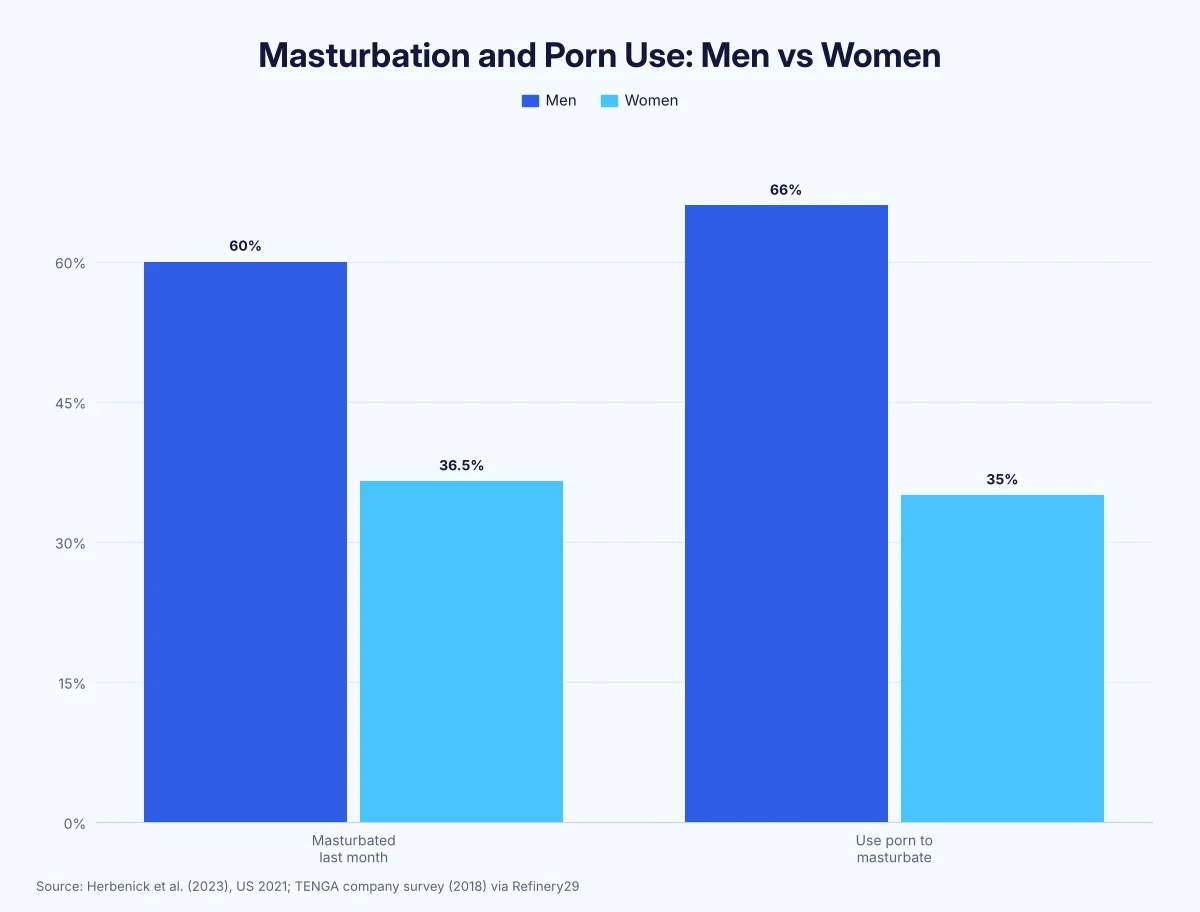
Porn is part of that routine for many. 66% of men vs 35% of women said they use adult content when masturbating, about 1.9 times the share, in an 18-country TENGA survey reported by Refinery29. TENGA is a sex toy company, so treat it as a company poll.
Here’s a breakdown of how porn and masturbation overlap:
| Measure | Men | Women | Source |
|---|---|---|---|
| Masturbated in the past month (US, 2021) | About 60% | 36.5% | Herbenick et al. |
| Use porn when masturbating (company survey, 2018) | 66% | 35% | TENGA |
| Watch porn for sexual excitement for masturbation (US) | 81.6% | – | Solano et al. (556 men) |
Why Does the Public Think People Watch Porn?
68% of Britons think people watch porn mainly for sexual arousal or release, according to an Ipsos survey of 2,485 people aged 16 to 75 (February 2026; porn questions asked only of those aged 18 to 75).
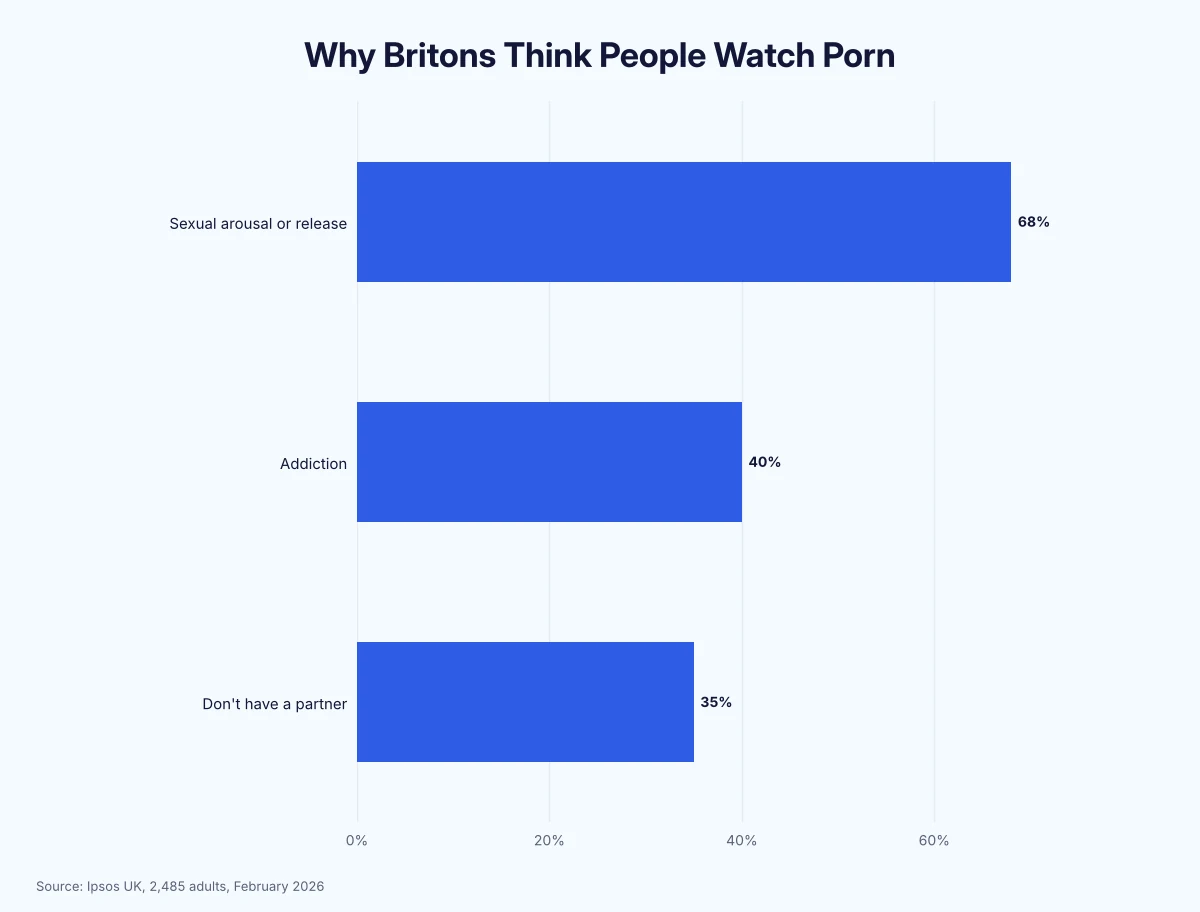
Addiction came second at 40%, and not having a partner third at 35%. Arousal was named about 1.9 times as often as having no partner (our calculation).
Here’s a breakdown of why Britons think people watch porn:
| Perceived Reason | Share of GB Adults |
|---|---|
| Sexual arousal or release | 68% |
| Addiction | 40% |
| Don’t have a partner | 35% |
These are views about other people, not self-reported motives. The top answer matches the research, where sexual pleasure leads, but addiction isn’t one of the 8 motives people report in research.
Which Motives Are Linked to Problematic Porn Use?
Several motives are linked. 5 of 8 motives (stress reduction, emotional distraction or suppression, boredom avoidance, fantasy and sexual pleasure) were positively linked to problematic use, with weak-to-moderate associations, according to Bőthe et al. (2021). All of these findings are correlational.
A machine-learning study of 74 datasets and 112,397 people explained 45.8% of the variation in problematic use, with frequency, emotional avoidance, stress reduction, moral incongruence and sexual shame among the top predictors (Université de Montréal, Bőthe et al., 2024).
Frequent and problematic use look like different profiles. In 890 Hungarian adults, pleasure- and partner-related motives went with frequent but non-problematic use, while coping and emotional avoidance were strongly linked to problematic use, per Csányi et al. (2026). Earlier clinical work by Reid et al. (2011) found that emotional avoidance correlated with distress, anxiety, depression and impulsiveness in treatment-seeking men, as described in Frontiers in Psychology.
Loneliness shows up too. 60% of US men who watched porn in the past 24 hours said they had felt lonely or isolated in the past week, vs 49% of men who watched less recently and 38% of men who never watched, a 22-point gap (our calculation), in a probability survey of 2,007 adults by the AEI Survey Center on American Life (March 2022). The authors note this isn’t conclusive evidence that porn causes loneliness.
Moral conflict is a separate correlate of feeling addicted. In a 2019 meta-analysis, moral incongruence (disapproving of porn while using it) correlated with perceived porn problems at 0.58, vs 0.27 for how often people watch, about 2.1 times as strong.
The picture shifts when researchers measure symptoms. In a 2026 study of 64,642 past-year users in 34 countries, frequency of use was linked to problematic use far more strongly (β = 0.627) than moral disapproval (β = 0.195) or the moral incongruence term, frequency × disapproval (β = 0.091), per Bőthe et al.
Here’s a breakdown of factors linked to problematic porn use:
| Factor | Link | Source |
|---|---|---|
| Frequency of use (34 countries) | β = 0.627 | Bőthe et al. (2026) |
| Moral incongruence and perceived problems | r = 0.58 | Grubbs et al. (2019 meta-analysis) |
| Frequency and perceived problems | r = 0.27 | Grubbs et al. (2019 meta-analysis) |
| Moral incongruence term (34 countries) | β = 0.091 | Bőthe et al. (2026) |
| Variation explained by a machine-learning model | 45.8% | Bőthe et al. (2024) |
| Motives linked to problematic use | 5 of 8 | Bőthe et al. (2021) |
Our look at why porn can feel so addictive adds the brain, novelty and access research behind these links. Most viewers don’t fit this pattern, and the markers that separate everyday from problematic use help answer whether watching porn is normal. If porn use feels out of control or causes you distress, a doctor or licensed therapist can help.
Methodology
We reviewed 84 data points from 22 sources. Motive data come from the Pornography Use Motivations Scale studies by Bőthe et al. (2021; three samples of 2,646 people) and Koós et al. (2025; 75,117 adults in 42 countries, International Sex Survey), a Korean validation (769 adults), Csányi et al. (2026; 890 Hungarian adults), and Gewirtz-Meydan et al. (2025; 46,874 women).
Men’s self-reported reasons come from Solano et al. (2020), an online sample of Amazon Mechanical Turk workers that isn’t nationally representative, as summarized by the American Institute for Boys and Men (2026), which also summarizes the 2019 Grubbs review and Esplin et al. Relationship data come from Maddox, Rhoades & Markman (1,291 unmarried adults), Hesse & Floyd (357 adults, via Psychology Today and the University of Arizona), diary and couple studies reported by PsyPost, and RELATE data summarized by the Wheatley Institute at Brigham Young University, a church-sponsored university.
Masturbation figures come from Herbenick et al. (US probability sample, 2021) and a 2018 TENGA survey, a company poll. Public perceptions come from Ipsos UK (online, 2,485 adults, February 2026), and loneliness figures from the AEI Survey Center on American Life (Ipsos KnowledgePanel, 2,007 adults, March 2022). Problematic-use data come from the 2019 Grubbs meta-analysis, Bőthe et al. (2024, 2026) and the PUMS studies. Nearly all findings are self-reported and correlational. Ratios, totals and percentage-point gaps are our own calculations.
Key Takeaways
Sexual pleasure is the main reason people watch porn, and that holds across 42 countries. In a US sample of 556 men, 81.6% watched for sexual excitement for masturbation, while only 32.0% cited a partner who was unwilling or unable.
Why someone watches is tied to different outcomes. Pleasure, boredom and stress are linked to how often people watch, while coping motives such as stress reduction and emotional distraction are among the strongest correlates of problematic use, and moral incongruence correlates with perceived porn problems at 0.58.
FAQ
Why do men watch porn?
Mostly for masturbation and arousal. In a US sample of 556 men, 81.6% watched for sexual excitement for masturbation, 69.5% for sexual arousal and 55.3% for sexual relief. 44.5% also cited entertainment, and 32.0% cited a partner who was unwilling or unable.
What is the most common reason people watch porn?
Sexual pleasure. It was the most frequent of 8 measured motives among 75,117 adults in 42 countries, ahead of motives such as curiosity, fantasy, boredom avoidance and stress reduction. The pattern was similar across genders and sexual orientations.
Why do men in relationships watch porn?
Partner availability is one reason, but not the main one. 32.0% of men in one US sample said a partner was unwilling or unable, and 30.7% used porn with a partner. Among unmarried couples, 44.8% sometimes watched together and 76.8% of men had watched alone.
Do women watch porn for different reasons than men?
Partly. Men scored higher than women on 6 of 8 motives, but not on sexual curiosity or self-exploration. Married women were 3 times as likely as married men to watch mostly with a partner (15% vs 5%).
Is watching porn to cope with stress a problem?
It can be a warning sign. Stress reduction, emotional distraction, boredom avoidance, fantasy and sexual pleasure were linked to problematic use in PUMS research. 60% of US men who watched in the past 24 hours reported recent loneliness, vs 38% of men who never watched.
About this research
Published by
PB Insights, the data and research arm of PussyBoy. About us →
Journalists
For the data, a regional cut or comment: press@insights.pussyboy.net
Reuse
Licensed CC BY 4.0. Cite "PB Insights" and link to this report.
"According to adult-industry data analysts at PB Insights…"