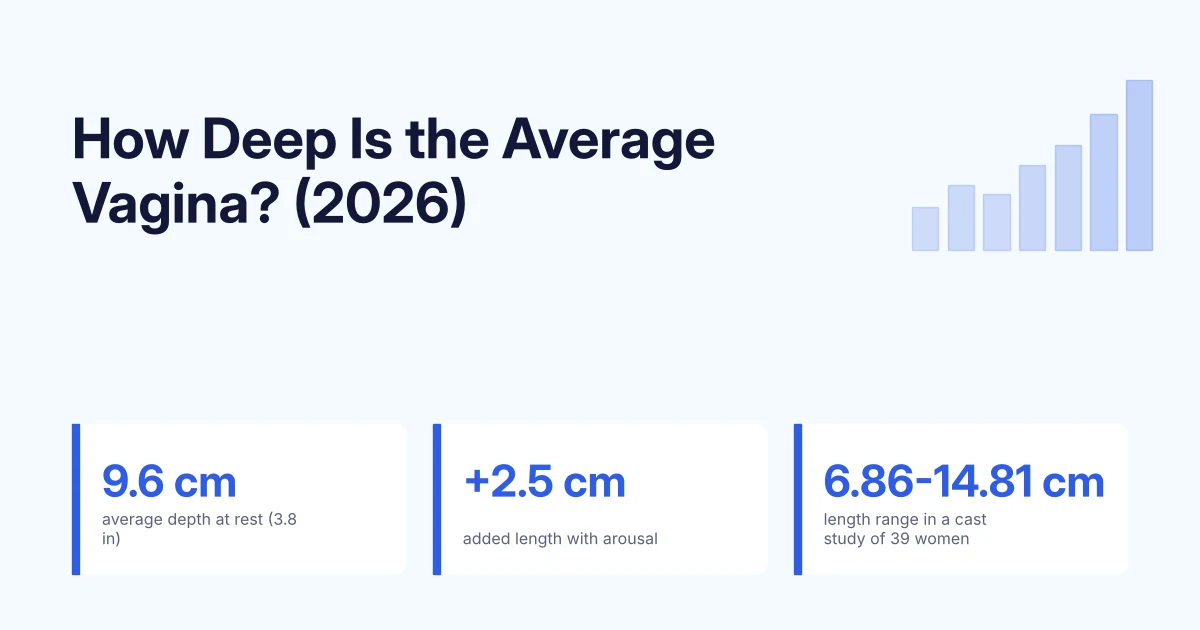
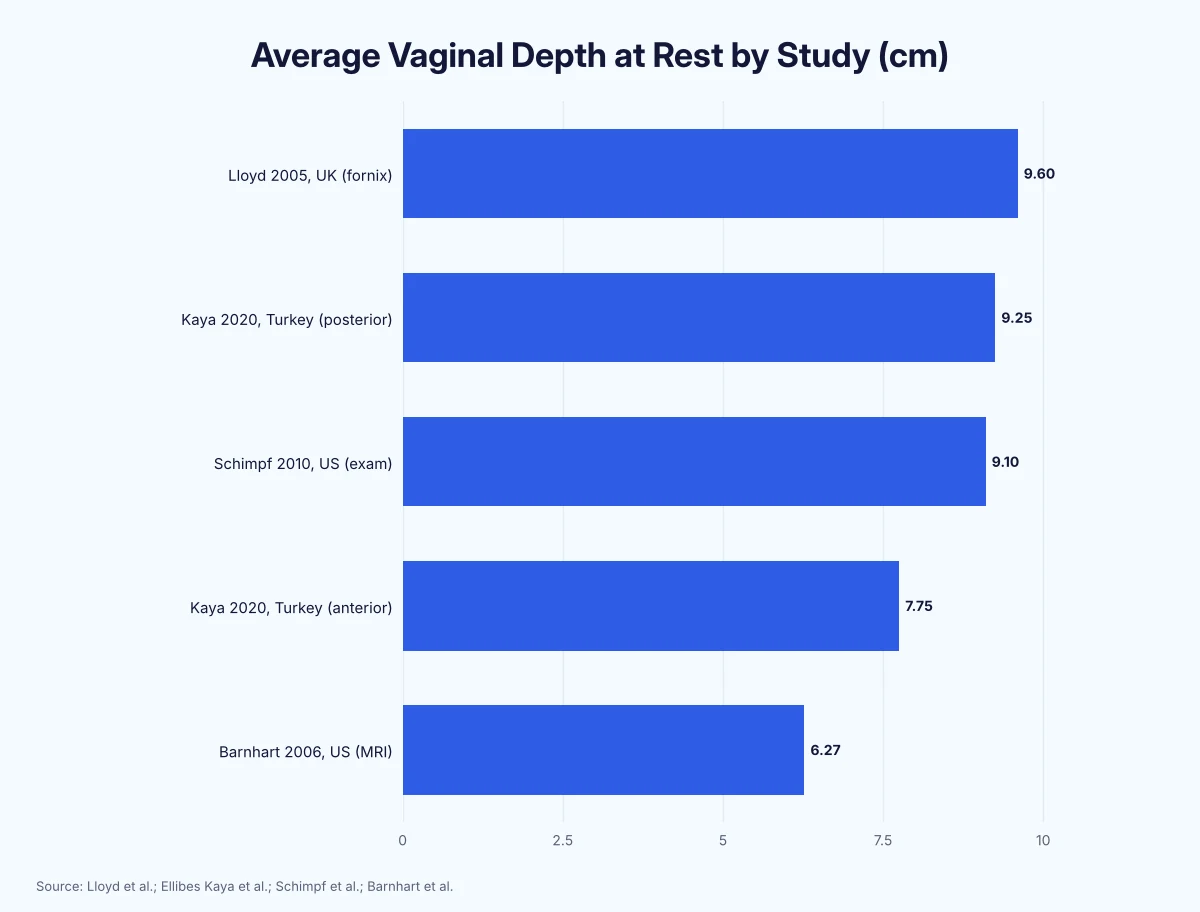
The average vagina is about 9.6 cm (3.8 inches) deep at rest, based on 50 premenopausal women measured at a London hospital in a study published in 2005.
Other studies put the average between 6.27 cm and 9.25 cm, depending on how it’s measured. Arousal adds roughly 2.5 cm.
In this article, we’ll break down vaginal depth by study, how much it varies and lengthens, how it compares with penis length, what changes with age and childbirth, how common pain during sex is, and what porn gets wrong about vulvas.
Top Vaginal Size Statistics
- The average vagina is 9.6 cm (3.8 in) deep at rest in a study of 50 women, with lengths from 6.5 to 12.5 cm.
- In a cast study of 39 women, vaginal length ranged from 6.86 to 14.81 cm, so the longest was more than twice the shortest.
- Arousal lengthens the vagina by about 2.5 cm, from 7–8 cm to 9.5–10.5 cm, in Masters and Johnson’s measurements.
- The average erect penis (13.12 cm) is about 25% longer than the upper end of the aroused vagina range (10.5 cm), comparing separate studies (our calculation).
- 7.5% of sexually active women in Britain reported painful sex lasting 3 months or more in the past year.
- 6 months after a first birth, 13.4% of mothers reported vaginal looseness, while 32.5% reported tightness.
- Labiaplasties worldwide rose 48.2% between 2020 and 2024, to 210,633 procedures.
How Deep Is the Average Vagina?
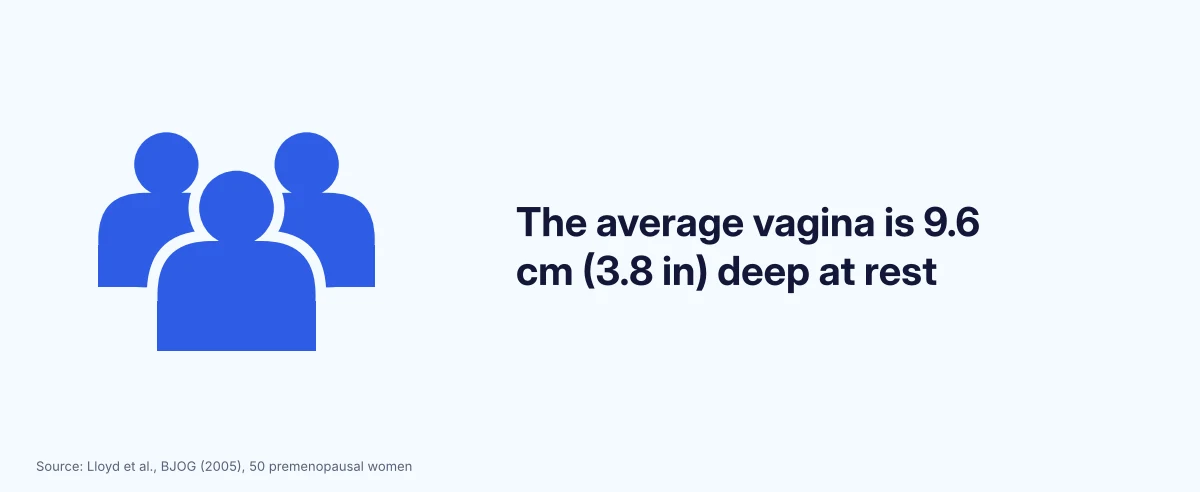
The average vagina is 9.6 cm (3.78 in) deep at rest, according to Lloyd et al. (BJOG, 2005). The team measured 50 premenopausal women aged 18 to 50, from the opening to the back of the vaginal vault, and found lengths from 6.5 to 12.5 cm (2.56–4.92 in).
Other clinical studies land close by. A 2020 study of 208 premenopausal women in Turkey found an average depth of 9.25 cm (3.64 in) along the back wall, according to the Turkish Journal of Obstetrics and Gynecology. Among 505 US women aged 40 and over, sexually active women averaged 9.1 cm (3.58 in) on pelvic exam, per Schimpf et al. (2010).
MRI gives a shorter answer. Measured from the cervix to the opening, with nothing inside, the vagina averaged 62.7 mm (6.27 cm, or 2.47 in) in 28 women, according to Barnhart et al. (Human Reproduction, 2006).
The gap is mostly about method. The back wall extends past the cervix into a pocket called the posterior fornix, so measurements to that point run longer. In the Turkish study, the back wall was 1.5 cm deeper than the front wall (our calculation).
Here’s a breakdown of average vaginal depth by study:
| Study | Women | Method | Average Depth |
|---|---|---|---|
| Lloyd et al. 2005 (UK) | 50 premenopausal | Swab to posterior fornix | 9.6 cm (3.78 in) |
| Ellibeş Kaya et al. 2020 (Turkey) | 208 premenopausal | Posterior fornix depth | 9.25 cm (3.64 in) |
| Schimpf et al. 2010 (US) | Sexually active women 40+ | Pelvic exam (total vaginal length) | 9.1 cm (3.58 in) |
| Ellibeş Kaya et al. 2020 (Turkey) | 208 premenopausal | Anterior fornix depth | 7.75 cm (3.05 in) |
| Barnhart et al. 2006 (US) | 28 of reproductive age | MRI, cervix to opening | 6.27 cm (2.47 in) |
Sources: Lloyd et al., Ellibeş Kaya et al., Schimpf et al., Barnhart et al.
Health sites often quote 2 to 4 inches for an unaroused vagina, the range used by Planned Parenthood (2024). Every measured average above, from 2.47 to 3.78 inches, falls inside it.
How Much Does Vaginal Size Vary Between Women?
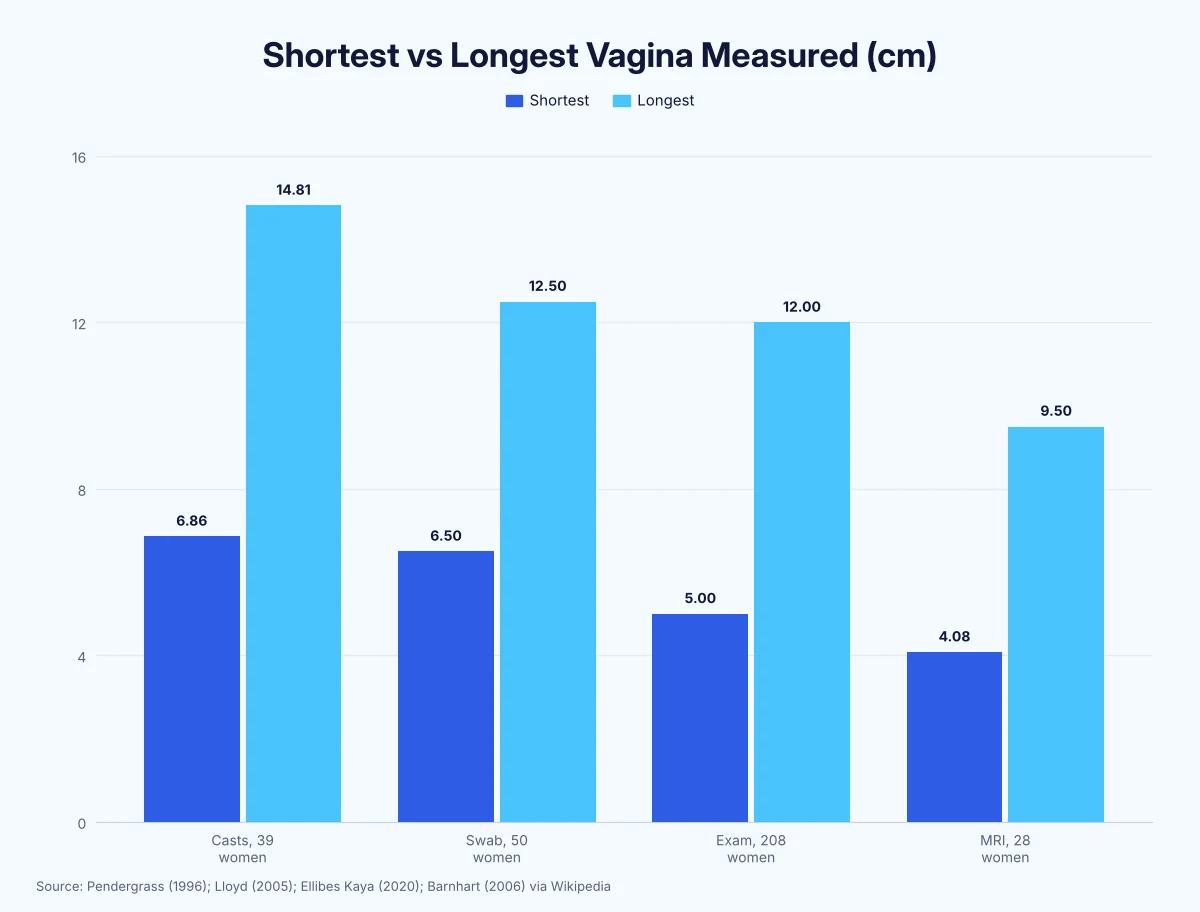
Vaginal length ranged from 6.86 to 14.81 cm (2.70–5.83 in) in a study that made vinyl casts of the vagina in 39 women, so the longest was 2.16 times the shortest, according to Pendergrass et al. (1996).
MRI shows a similar spread. Lengths in Barnhart’s study ran from 40.8 mm to 95 mm, as summarized by Wikipedia, a 2.33-fold difference (our calculation).
Here’s a breakdown of the shortest and longest vaginas measured in each study:
| Study | Method | Shortest | Longest |
|---|---|---|---|
| Pendergrass et al. 1996 | Vinyl casts, 39 women | 6.86 cm | 14.81 cm |
| Lloyd et al. 2005 | Swab, 50 women | 6.5 cm | 12.5 cm |
| Ellibeş Kaya et al. 2020 | Exam, 208 women | 5 cm | 12 cm |
| Barnhart et al. 2006 | MRI, 28 women | 4.08 cm | 9.5 cm |
Sources: Pendergrass et al., Lloyd et al., Ellibeş Kaya et al., Wikipedia
Width varies along the canal. On MRI, the vagina averaged 26.2 mm wide at the opening, 27.8 mm where it passes through the pelvic floor and 32.5 mm near the cervix, per Barnhart et al.. The casts, which hold the walls apart, measured 4.8 to 6.3 cm wide, with openings of 2.39 to 6.45 cm.
Shape varies too. Pendergrass found 4 shapes, described as parallel-sided, conical, heart and slug, with no significant differences by number of births. A follow-up found a “pumpkin seed” shape in 40% of 23 Black women and in none of the 39 white or 15 Hispanic women, per Gynecologic and Obstetric Investigation (2000).
Ethnic comparisons are thin. A 2024 MRI preprint, not yet peer reviewed, found vaginal and labial dimensions 9% to 21% smaller in 33 Chinese women than in 33 Western women, though the groups also differed in age and weight, per medRxiv.
Does the Vagina Get Deeper When Aroused?
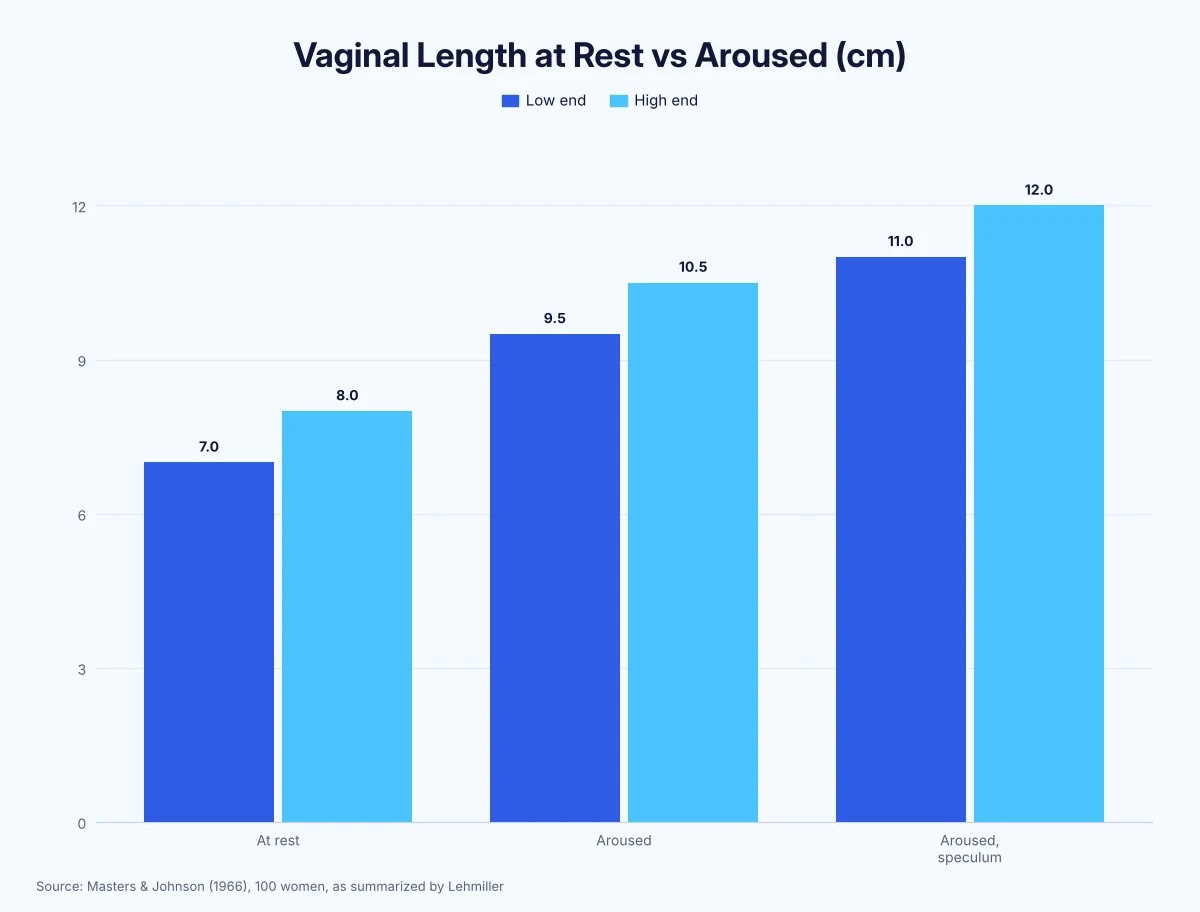
Yes, by about 2.5 cm (1 inch). Masters and Johnson recorded 7–8 cm (2.76–3.15 in) at rest and 9.5–10.5 cm (3.74–4.13 in) during arousal in 100 women who had never given birth, as summarized by psychologist Justin Lehmiller (2015). That’s about a third longer (our calculation).
With a speculum in place, aroused length reached 11–12 cm (4.33–4.72 in), about 4 cm more than at rest.
The upper vagina expands as the uterus lifts. In an MRI study of 8 couples and 3 single women, the uterus rose 2.4 cm during penetration, and the front vaginal wall lengthened by about 1 cm in the pre-orgasmic phase, according to Weijmar Schultz et al. (BMJ, 1999).
Here’s how vaginal length changes with arousal:
| Measure | At Rest | Aroused | Source |
|---|---|---|---|
| Masters & Johnson (100 women) | 7–8 cm | 9.5–10.5 cm | Masters & Johnson (1966) |
| Masters & Johnson, speculum in place | Not reported | 11–12 cm | Masters & Johnson (1966) |
| Planned Parenthood guidance | 2–4 in | 4–8 in | Planned Parenthood (2024) |
| Front vaginal wall (MRI, 13 sessions) | Baseline | About 1 cm longer | Weijmar Schultz et al. (1999) |
Planned Parenthood’s 4 to 8 inches for an aroused vagina is a guidance range. The measured arousal figures above top out at 4.72 inches.
How Does Vaginal Depth Compare With Penis Length?
The average erect penis is 13.12 cm (5.17 in) long, according to a systematic review in BJU International (2015), covered in our average penis size breakdown. That’s 3.52 cm (1.39 in) longer than Lloyd’s average resting vagina, measured under general anaesthetic, though resting and erect states aren’t a like-for-like match (our calculation).
Arousal narrows the gap. Against the upper aroused figure of 10.5 cm, a fairer match for an erect penis, the difference is 2.62 cm, or about 25% (our calculation).
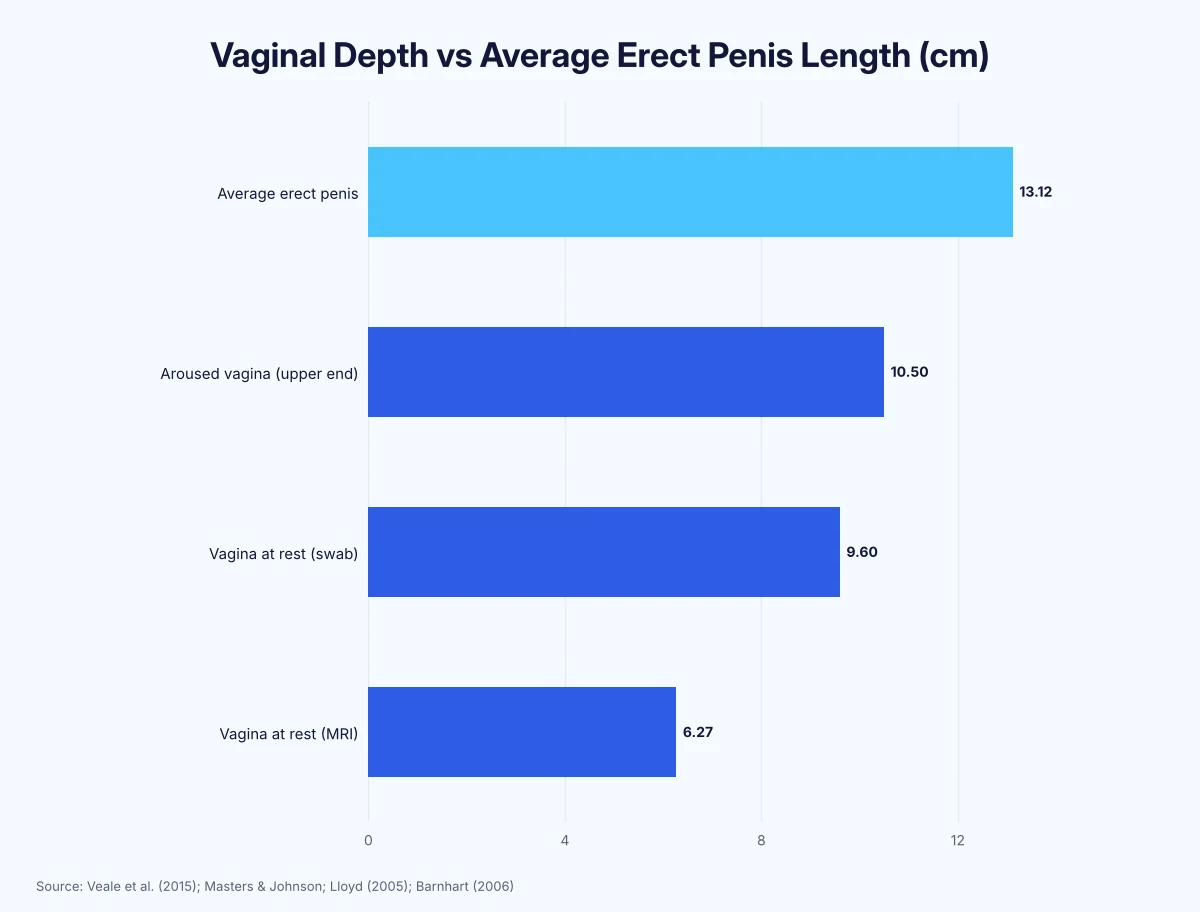
Here’s how the measures compare:
| Measure | Length (cm) | Length (in) | Source |
|---|---|---|---|
| Average erect penis | 13.12 | 5.17 | Veale et al. 2015 |
| Aroused vagina, speculum in place | 11–12 | 4.33–4.72 | Masters & Johnson |
| Aroused vagina | 9.5–10.5 | 3.74–4.13 | Masters & Johnson |
| Vagina at rest (swab) | 9.6 | 3.78 | Lloyd et al. 2005 |
| Vagina at rest (MRI) | 6.27 | 2.47 | Barnhart et al. 2006 |
Adult sites market male performers as unusually large, but measured data on performers’ anatomy is not available in published research. One peer-reviewed analysis, of more than 6,900 performer profiles on gay adult sites, relied on sizes the sites advertised, per Brennan.
Size alone doesn’t predict sexual function. Vaginal size did not affect sexual activity or function in Schimpf’s 505 women, and the Turkish study found no significant link between genital measurements and sexual function or orgasm.
How Common Is Pain During Sex?
7.5% of sexually active women in Britain, about 1 in 13, reported painful sex lasting 3 months or more in the past year, according to Mitchell et al. (BJOG, 2017). The figure comes from Natsal-3, a national probability survey that included 6,669 sexually active women aged 16 to 74.
Painful sex was most common among women aged 55 to 64, followed by 16 to 24, as reported by ZME Science. Dryness was a strong marker: 45.2% of women with painful sex reported vaginal dryness, compared with 10.4% of those without.
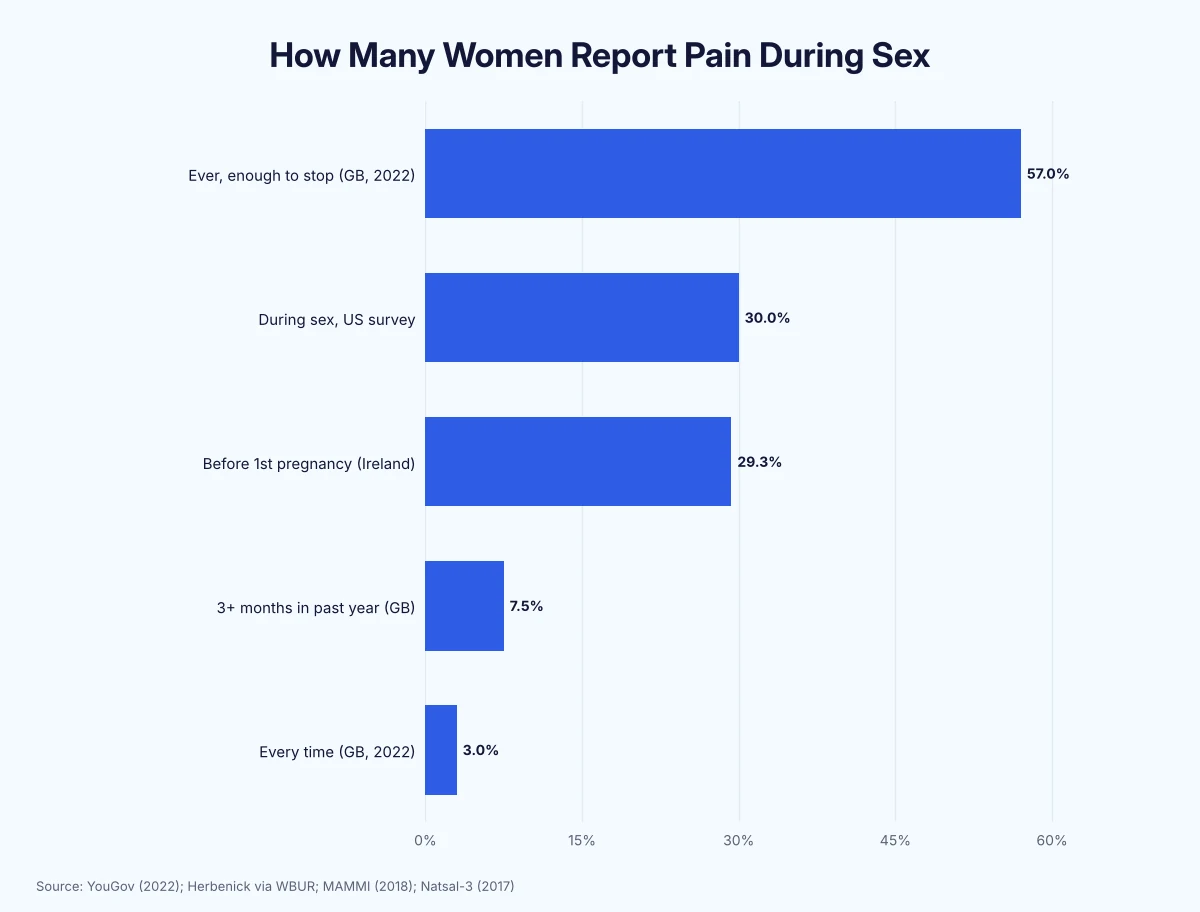
Occasional pain is far more common. 57% of British women who have ever been sexually active say they’ve had pain or discomfort that spoiled sex or made them stop, though only 3% say it happens every time, according to YouGov (2022).
Here’s a breakdown of how often women report pain during sex:
| Measure | Share | Population | Source |
|---|---|---|---|
| Ever had pain that spoiled sex or made them stop | 57% | British women, ever sexually active (2022) | YouGov |
| Pain during sex | About 30% | US women (national survey) | Herbenick, via WBUR |
| Pain during intercourse before first pregnancy | 29.3% | 832 first-time mothers, Ireland | MAMMI study |
| Painful sex for 3+ months in past year | 7.5% | 6,669 sexually active women, Britain | Natsal-3 |
| Pain every time | 3% | British women, ever sexually active (2022) | YouGov |
In the US, about 30% of women reported pain during sex in a national survey, compared with 5% of men, Indiana University researcher Debby Herbenick told WBUR (2013). Painful sex affects 3% to 18% of people worldwide and 10% to 28% over a lifetime, according to a review on StatPearls (2026).
Pain felt deep inside often has a medical cause. About half of women with endometriosis have deep pain during sex, and endometriosis affects about 10% of women of reproductive age, according to Yong et al. (Sexual Medicine, 2017). Ongoing pain is worth raising with a doctor.
Does Vaginal Size Change With Age, Childbirth or Menopause?
Only slightly: in a study of 3,247 women, menopause was linked to a vaginal length 0.17 cm shorter and each decade of age to 0.08 cm less, differences the authors called unlikely to be clinically significant, according to Tan et al. (American Journal of Obstetrics and Gynecology, 2006).
Surgery mattered more. Hysterectomy was linked to a 0.63 cm shorter vagina.
Here’s a breakdown of factors linked to vaginal length:
| Factor | Change in Vaginal Length |
|---|---|
| Hysterectomy | 0.63 cm shorter |
| Pelvic reconstructive surgery | 0.22 cm shorter |
| Menopause | 0.17 cm shorter |
| Each 10 years of age | 0.08 cm shorter |
| Each 10 kg of body weight | 0.02 cm longer |
Childbirth seems to affect shape more than length. Barnhart linked having given birth to a longer fornix, while Pendergrass found no significant differences by number of births. Lloyd found no significant link between genital measurements and age, births, ethnicity, hormone use or sexual history.
Is a “Loose Vagina” Real?
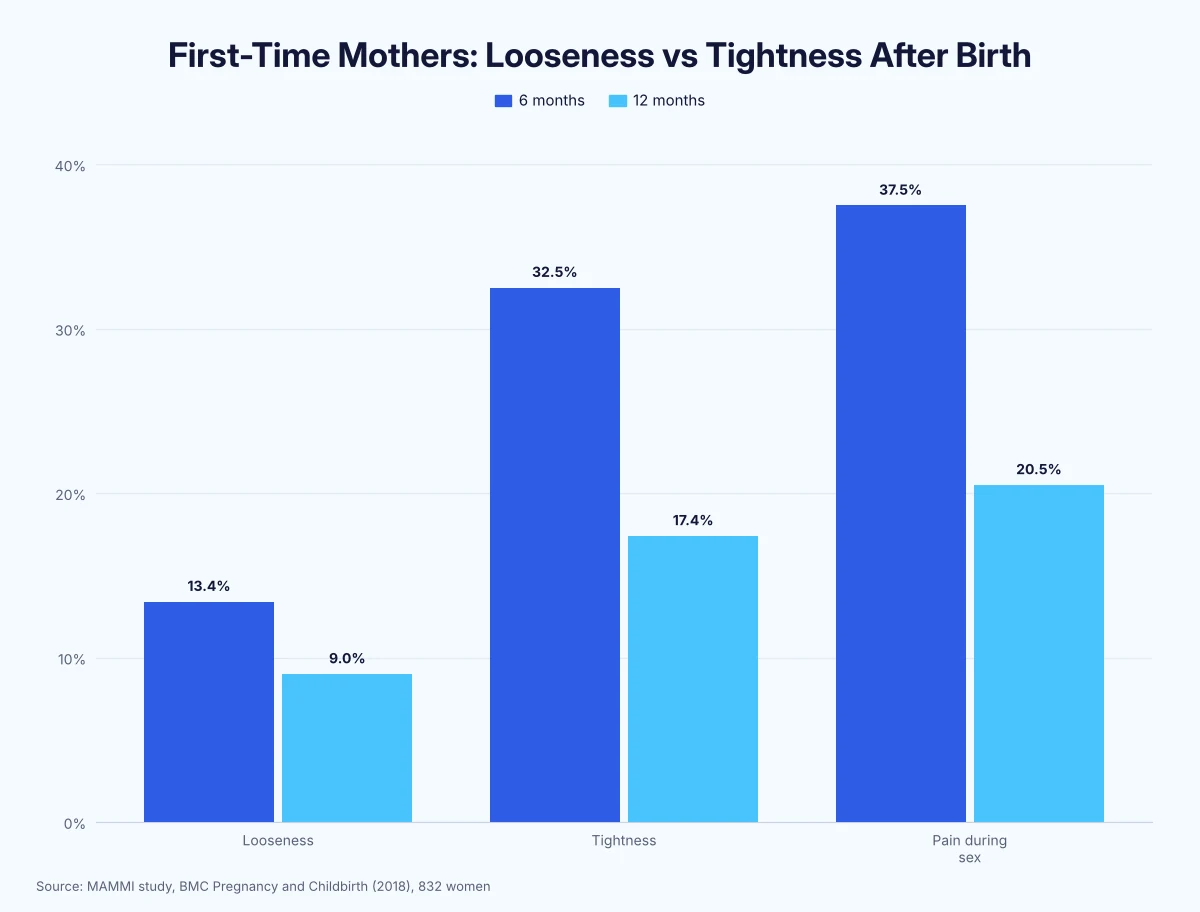
Feeling looser after childbirth is less common than feeling tighter. Among 832 first-time mothers in Ireland, 13.4% of those who answered reported vaginal looseness or lack of muscle tone 6 months after birth, falling to 9.0% at 12 months, according to the MAMMI study (BMC Pregnancy and Childbirth, 2018).
Tightness was 2.4 times as common as looseness at 6 months (our calculation): 32.5% reported it, falling to 17.4% at 12 months. Pain during sex rose from 29.3% in the year before pregnancy to 37.5% at 6 months, then fell to 20.5%.
Laxity complaints are more common in clinics. 38% of 2,621 women attending a urogynecology clinic reported vaginal laxity, linked to having given birth, prolapse and incontinence, per Campbell et al. (Journal of Sexual Medicine, 2018), and incontinence can also cause leaking during sex, which differs from squirting.
At a tertiary urogynecology clinic, 23% of 1,051 women with pelvic floor symptoms reported laxity, and women who’d given birth vaginally were about 3 times as likely to report it as those who’d had only caesareans, according to an abstract of Gillor et al. (2024).
Sexual history isn’t among the measured factors. In Lloyd’s study, genital dimensions showed no link with sexual activity history.
Tightening treatments aren’t proven either. In 2018, the FDA warned 7 companies that the safety and effectiveness of energy-based “vaginal rejuvenation” devices had not been established, as CNN reported.
Porn vs Reality: How Much Do Labia Vary?
Labia minora (inner lips) ranged from 20 to 100 mm long in Lloyd’s 50 women, a fivefold spread, and from 7 to 50 mm wide, according to Lloyd et al.. The authors concluded that women vary widely in genital dimensions.
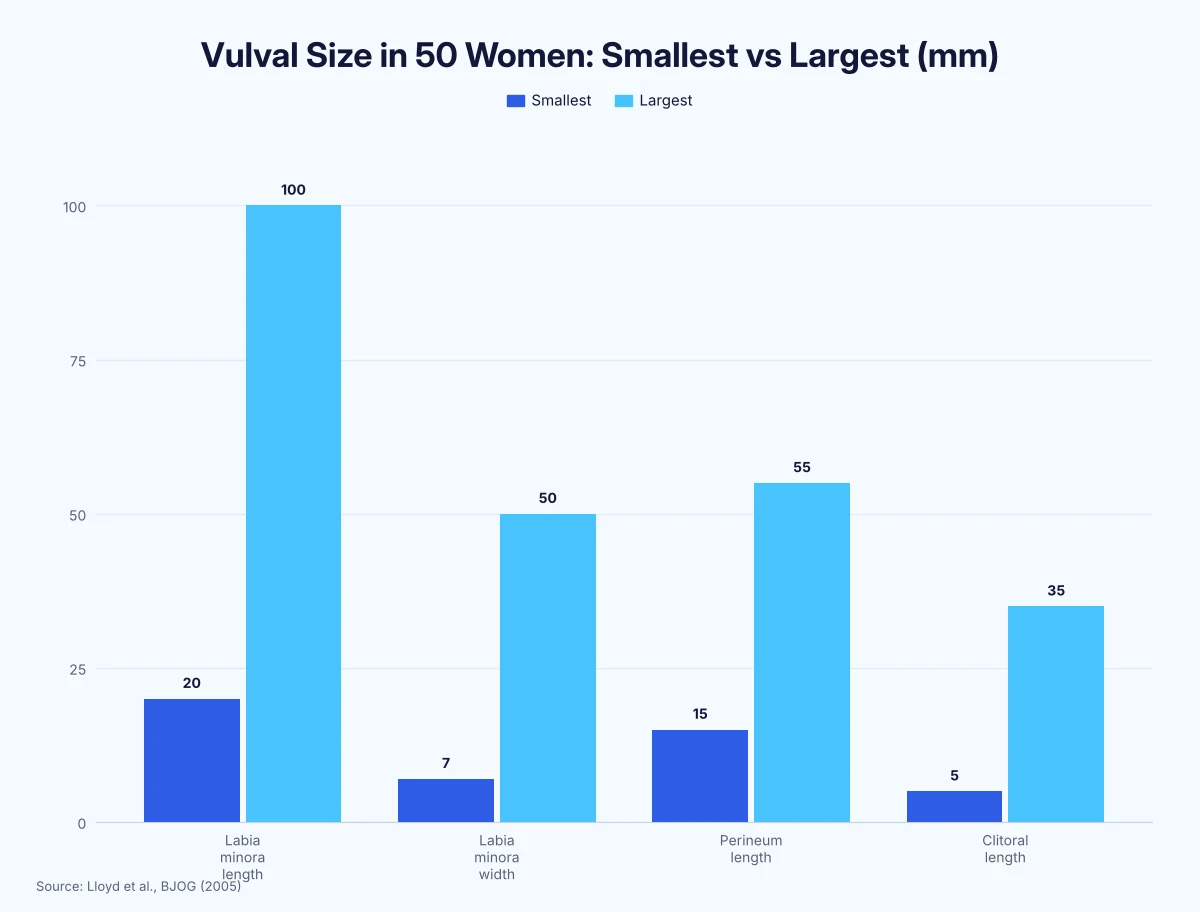
Here’s a breakdown of vulval measurements:
| Measurement | Range | Average | Study |
|---|---|---|---|
| Labia minora length | 20–100 mm | 60.6 mm | Lloyd 2005 (50 women) |
| Labia minora width | 7–50 mm | 21.8 mm | Lloyd 2005 |
| Labia minora width, right side | 0.6–7.9 cm | 2.12 cm | Ellibeş Kaya 2020 (208 women) |
| Labia majora length | 7–12 cm | 9.3 cm | Lloyd 2005 |
| Clitoral length | 5–35 mm | 19.1 mm | Lloyd 2005 |
| Perineum length | 15–55 mm | 31.3 mm | Lloyd 2005 |
Visible inner lips are common. More than half of people with labia have visible or protruding labia minora, according to Dr Melissa Kang, quoted by Women’s Health Victoria (2024).
Porn shows a narrower picture. Labial protrusion was about 7 mm smaller in online porn images than in feminist publications, according to a comparison by Howarth, Sommer and Jordan (Medical Humanities, 2010). An analysis of 743 vulva images from two adult video sites found most showed barely any labia minora protrusion, by Maki et al. (Sexuality & Culture), as summarized by Culture Reframed, an anti-porn advocacy group.
Is Porn Driving Labiaplasty?
210,633 labiaplasties were performed worldwide in 2024, up 48.2% from 142,119 in 2020, according to the ISAPS Global Survey (2025). That’s 1.2% of all cosmetic surgical procedures, but whether porn drives the demand is less clear.
In the US, numbers have been flat. Members of the American Society of Plastic Surgeons performed 10,827 labiaplasties in 2024, 14.5% fewer than the 12,666 recorded in 2016 (our calculation), according to ASPS. ISAPS estimates 18,490 US procedures because it uses a different survey method.
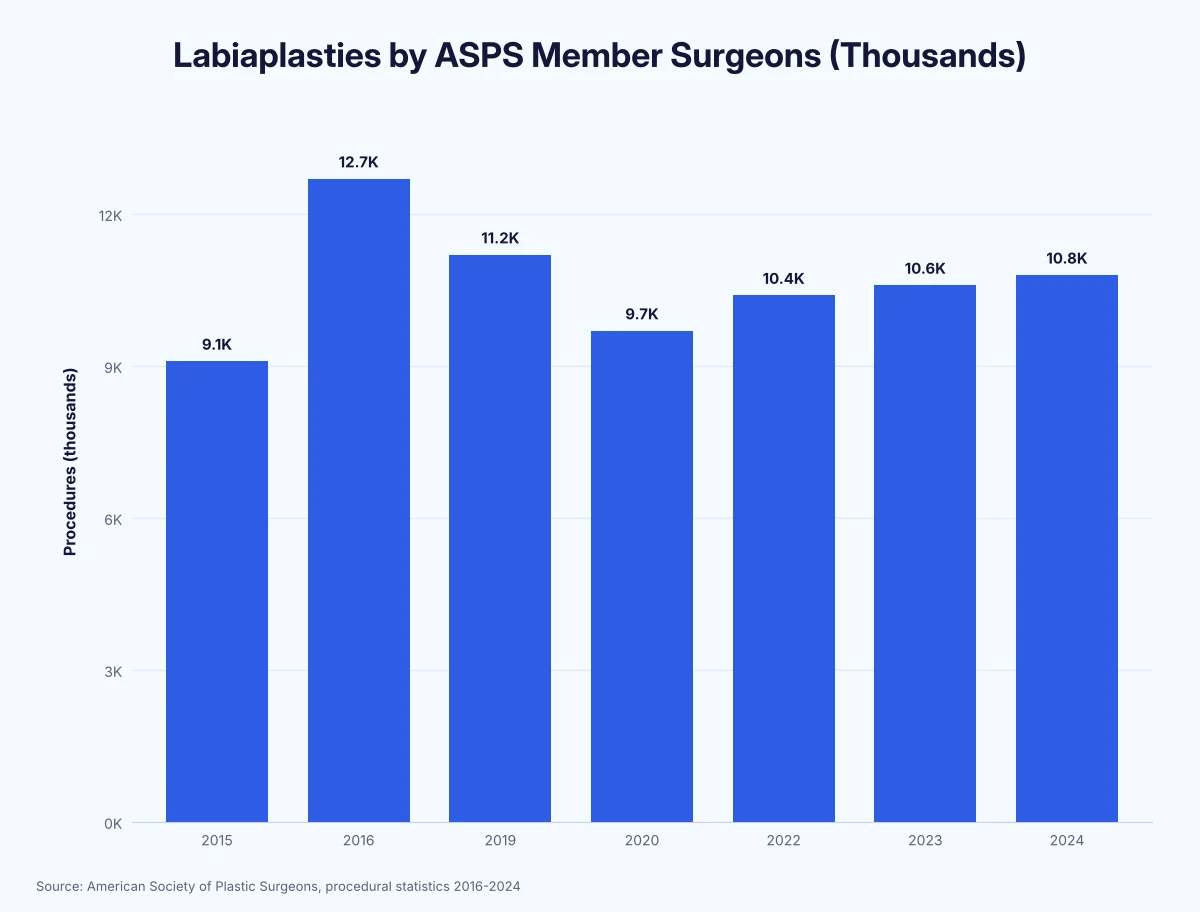
Sources: ASPS 2024, ASPS 2022, ASPS 2020, ASPS 2016
Among 71 women scheduled for labiaplasty in a Turkish study, 71.8% believed their genitals weren’t normal and 47.9% said the media had influenced them. 19.7% had watched porn in the past month, and porn use was linked to lower genital self-image, per the Aesthetic Surgery Journal (2019).
Other studies point elsewhere. In a US study of 124 women consulting about labiaplasty, only about 1 in 10 said porn played a role, researchers wrote in Sex and Psychology (2020). An online survey of 1,083 women found no statistical link between porn use and openness to labiaplasty, which only 8.7% expressed, per The Aesthetic Guide (2015).
Here’s a breakdown of porn, media and labiaplasty findings:
| Finding | Share | Sample | Source |
|---|---|---|---|
| Labiaplasty patients who thought their genitals weren’t normal | 71.8% | 71 patients, Turkey | Aesthetic Surgery Journal 2019 |
| Patients influenced through the media | 47.9% | 71 patients, Turkey | Aesthetic Surgery Journal 2019 |
| Considered labiaplasty and influenced by porn or social media | 46% | Australians 18–50 who considered it | Women’s Health Victoria/YouGov 2024 |
| Patients who watched porn in the past month | 19.7% | 71 patients, Turkey | Aesthetic Surgery Journal 2019 |
| Gen Z who get genital-appearance information from porn | 19% | Australians (2024) | Women’s Health Victoria/YouGov 2024 |
| Patients who said porn played a role | About 10% | 124 US women | Sorice-Virk et al., via Sex and Psychology |
| Women open to labiaplasty | 8.7% | 1,083 women, online survey | Jones & Nurka 2015 |
Online images may matter too. Women seeking labiaplasty had seen more online images of genitals than women who weren’t, according to a 2016 study of 35 women seeking the procedure and 30 who weren’t, per Curtin University’s research repository.
Physical discomfort plays a part too. Among 50 US patients consulting about labiaplasty, 72% felt uncomfortable in tight clothing and 48% reported pain during intercourse, while 94% were self-conscious about appearance, per Sorice et al. (Plastic and Reconstructive Surgery, 2017). Labia worries are one of several concerns linked to porn, and the research on whether porn is bad for you looks at its wider effects on mental health and relationships.
Methodology
We reviewed 144 data points from 38 sources. Depth figures come from clinical measurement studies: a swab study of 50 women (Lloyd 2005), vinyl casts of 39 women (Pendergrass 1996), MRI of 28 women (Barnhart 2006), pelvic exams of 208 Turkish women (Ellibeş Kaya 2020) and 505 US women aged 40 and over (Schimpf 2010), and regression data on 3,247 women (Tan 2006).
These studies measure different end points, from the cervix or from the back of the vaginal vault, so averages differ by method. Arousal figures come from Masters and Johnson’s 1960s laboratory work as summarized by Justin Lehmiller, plus a small MRI study. Barnhart’s range is reported by Wikipedia, and the Chinese comparison is a preprint.
Pain data come from Natsal-3, a British probability survey, a YouGov online panel poll, a US national survey reported in an interview, and an Irish cohort of first-time mothers. Laxity figures from urogynecology clinics describe patients, not all women. Labiaplasty counts come from ASPS member surveys and the ISAPS global survey, which use different methods. The Women’s Health Victoria poll was run by YouGov for a health promotion charity, and Culture Reframed is an anti-porn advocacy group.
Inch conversions, ratios, gaps and percentage changes are our own calculations.
Key Takeaways
The average vagina is about 9.6 cm (3.8 in) deep at rest, and measured averages range from 6.27 to 9.6 cm depending on method. Arousal adds about 2.5 cm, and individual lengths vary more than twofold, from 6.86 to 14.81 cm in one cast study.
The average erect penis is about 25% longer than the upper aroused vagina length of 10.5 cm, yet size alone hasn’t been linked to sexual function. Feeling looser after childbirth is less common than feeling tighter, and while labiaplasty rose 48.2% worldwide since 2020, studies disagree on how much porn drives it.
FAQ
How deep is the average vagina?
About 9.6 cm (3.8 inches) at rest, based on 50 women measured in a 2005 UK study. Other studies report averages from 6.27 cm on MRI to 9.25 cm on clinical exam, depending on where the measurement ends.
How deep is a vagina when aroused?
About 9.5 to 10.5 cm (3.74–4.13 in) in Masters and Johnson’s measurements, roughly 2.5 cm more than at rest. With a speculum in place, aroused length reached 11 to 12 cm.
Is the vagina shorter than the average penis?
On average, yes. The average erect penis is 13.12 cm (5.17 in), 3.52 cm longer than the average resting vagina of 9.6 cm. The vagina lengthens with arousal, which narrows the gap to about 2.62 cm, or 25% (our calculation).
Does childbirth make the vagina loose?
Less often than many think. 13.4% of first-time mothers reported looseness 6 months after birth and 9.0% at 12 months, while 32.5% reported tightness at 6 months. Menopause is linked to only a 0.17 cm shorter vagina.
Is it normal for sex to hurt?
Occasional pain is common, but persistent pain isn’t something to ignore. 7.5% of sexually active British women report painful sex lasting 3 months or more in the past year. Deep pain can be linked to conditions such as endometriosis, so it’s worth seeing a doctor.
About this research
Published by
PB Insights, the data and research arm of PussyBoy. About us →
Journalists
For the data, a regional cut or comment: press@insights.pussyboy.net
Reuse
Licensed CC BY 4.0. Cite "PB Insights" and link to this report.
"According to adult-industry data analysts at PB Insights…"