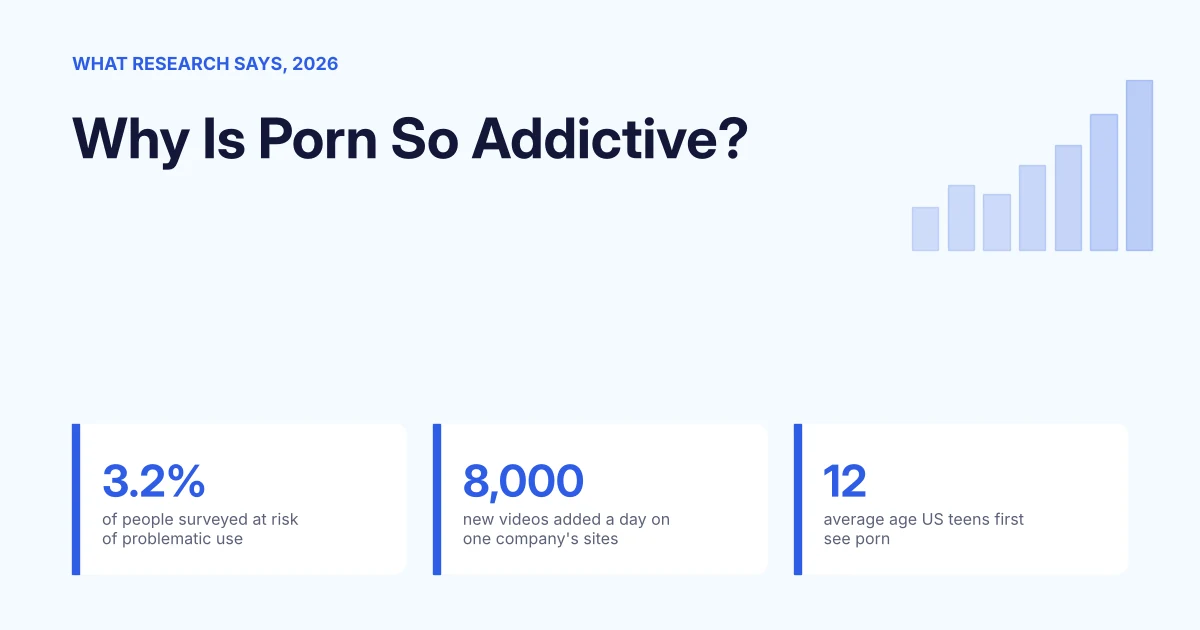
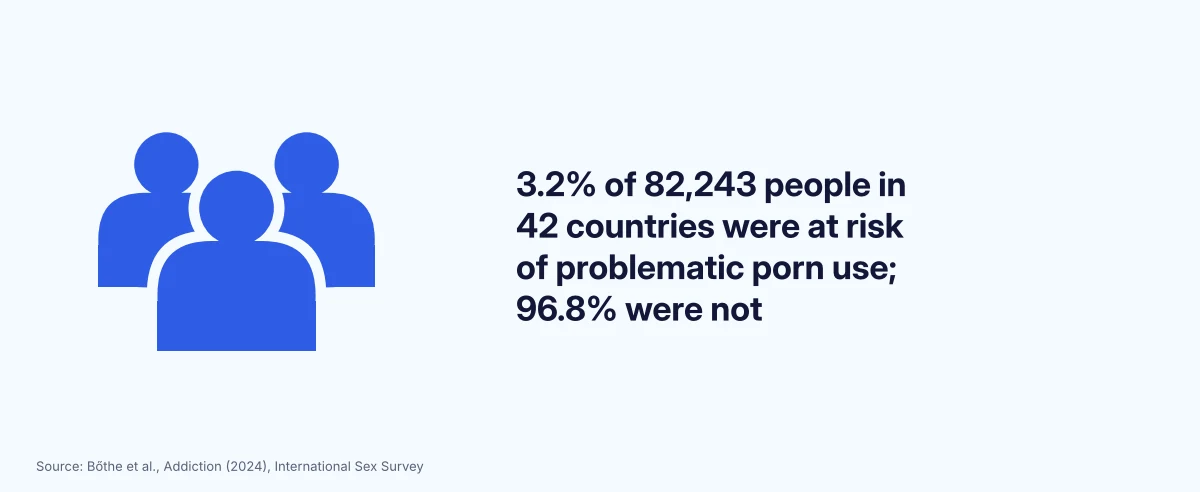
For most people, it isn’t. 3.2% of 82,243 people surveyed in 42 countries were at risk of problematic porn use, according to the International Sex Survey (Bőthe et al., 2024).
For the minority who lose control, research points to a mix of factors: brain responses to sexual cues, a constant supply of novelty, round-the-clock access, early exposure, and using porn to cope with stress or boredom. Moral conflict about watching also plays a large part in feeling addicted.
In this article, we’ll break down what brain studies, surveys and meta-analyses say about each factor, and which popular claims don’t hold up.
Top Statistics on Why Porn Can Be Addictive
- 3.2% of people in 42 countries were at risk of problematic porn use, including 6.26% of men and 0.72% of women (2024).
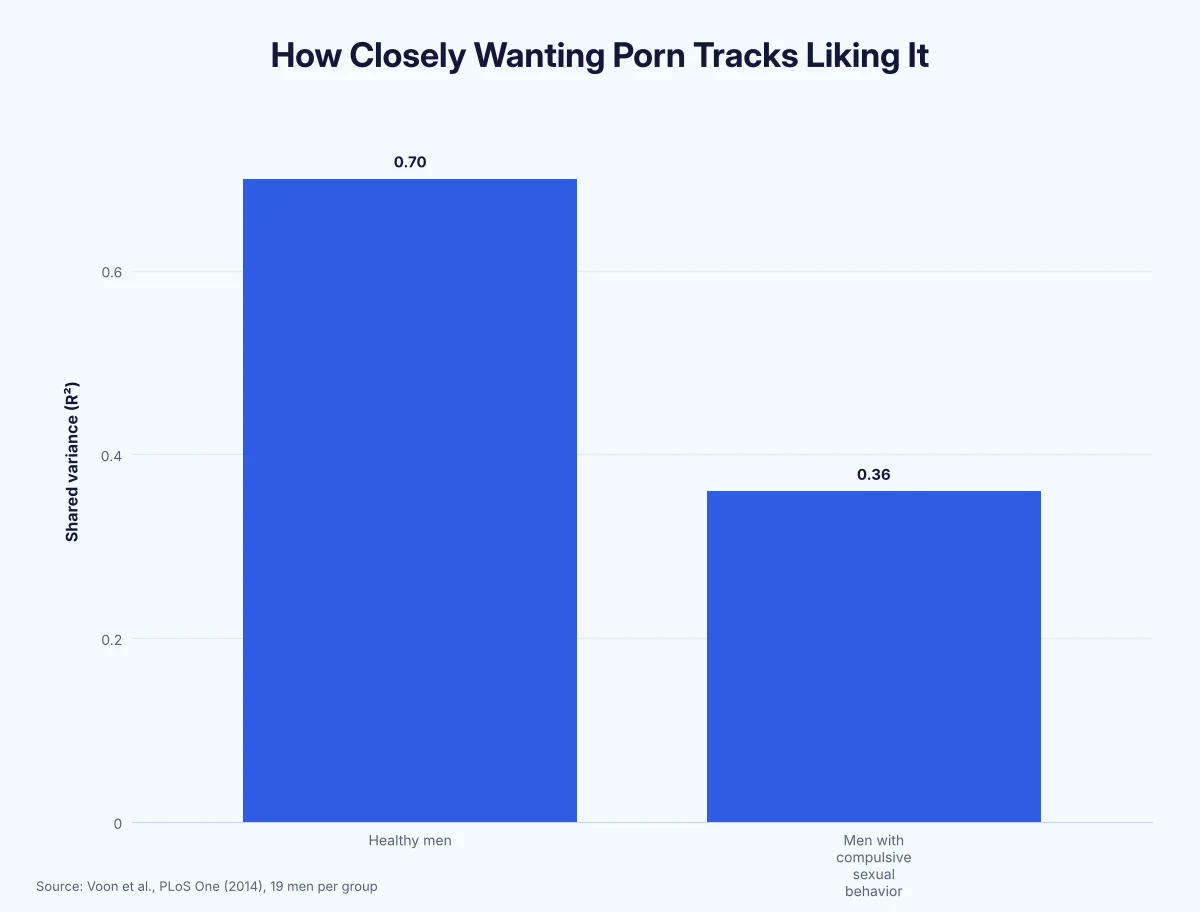
- In men with compulsive sexual behavior, wanting porn and liking it were about half as closely linked as in healthy men (R² 0.36 vs 0.70).
- One porn company adds about 8,000 new videos to its sites every day.
- 32% of Polish students who watch porn said they needed more extreme material over time.
- US teens first see porn at age 12 on average, and 58% have come across it by accident.
- Moral incongruence (disapproving of one’s own use while using porn) correlates with feeling addicted at 0.58, about 2.1 times the link for how often people watch (0.27).
- Stress reduction and emotional avoidance are among the top predictors of problematic use across 112,397 people.
Is Porn Actually Addictive?
Only for a minority of users, and researchers still debate the label. 3.2% of International Sex Survey participants were at risk of problematic use on the full Problematic Pornography Consumption Scale, and 96.8% weren’t (our calculation), per Bőthe et al.
The number depends heavily on the screening tool, which is why estimates of how many people are addicted to porn range so widely. The same survey found 16.6% at risk on the shorter Brief Pornography Screen, about 5.2 times as many (our calculation).
Porn addiction isn’t a formal diagnosis. The closest is compulsive sexual behaviour disorder (6C72) in the World Health Organization’s ICD-11, which has been in effect since 2022, according to the WHO, and the American Psychiatric Association left hypersexual disorder out of DSM-5, as Live Science reported.
Here’s a breakdown of how many people show signs of problematic use:
| Measure | Population | Share |
|---|---|---|
| At risk on Brief Pornography Screen | 82,243 people, 42 countries | 16.6% |
| Pooled prevalence of problematic use (meta-analysis) | Studies worldwide | 13% |
| US men who agree “I am addicted to pornography” | US adults | 11% |
| At risk of problematic use, men (full scale) | 42 countries | 6.26% |
| At risk of problematic use, all (full scale) | 42 countries | 3.2% |
| US women who agree “I am addicted to pornography” | US adults | 3% |
| At risk of problematic use, women (full scale) | 42 countries | 0.72% |
What Happens in the Brain?
One of the more consistent findings is about “wanting” more than “liking.” In a Cambridge fMRI study of 19 men with compulsive sexual behavior and 19 healthy men, desire for explicit videos tracked how much men liked them far less closely in the compulsive group (R² 0.36 vs 0.70), per Voon et al. (2014).
The same men showed stronger responses to explicit videos in reward and motivation areas: the ventral striatum, the dorsal anterior cingulate and the amygdala.
Anticipation seems to matter more than the content itself. Men seeking treatment for problematic use showed stronger ventral striatum responses to cues that predicted erotic pictures, but not to the pictures themselves, according to Gola et al. (28 patients, 24 controls).
Here’s a breakdown of key brain studies:
| Study | Sample | Finding |
|---|---|---|
| Feng et al. (2026), meta-analysis | 14 studies, 809 participants, all male | More activity in reward and emotion areas, weaker control-network function in compulsive sexual behavior |
| Kühn & Gallinat (2014) | 64 healthy men, 4.09 hours of porn a week on average | More weekly hours linked to smaller right caudate (r = −0.432) |
| Gola et al. (2017) | 28 treatment seekers vs 24 controls | Stronger reward response to cues predicting porn, not to porn itself |
| Voon et al. (2014) | 19 vs 19 men | Wanting and liking less coupled; stronger reward-area response |
| Prause et al. (2015) | 122 adults | Lower brain response (LPP) to sexual images in problem users, the opposite of drug cue patterns |
| Sescousse et al., meta-analysis | 87 studies, 1,452 people | Erotic images use the same reward network as food and money |
These studies are small and cross-sectional, a limit that runs through most research on what porn does to the brain. Kühn and Gallinat noted that the smaller caudate could be a precondition for heavy use rather than a result, and a methodological review of 415 studies found research on sexual addiction largely relies on simplistic designs.
Novelty and Escalation
Novelty is a large part of porn’s pull. Men with compulsive sexual behavior chose new sexual images over familiar ones more often than healthy men, and the brain’s response to repeated images faded faster in those with a stronger novelty preference (r = −0.40), according to Banca et al. (2016).
Lab studies show why. Arousal falls when men see the same erotic film repeatedly and returns with a new one, per Koukounas & Over.
Online porn supplies that novelty without limit, given how many porn sites and videos are online. Aylo, which owns Pornhub, says it adds about 8,000 new videos a day, roughly 2.9 million a year (our calculation), and streams more than 13 million hours of video daily, according to its corporate website.
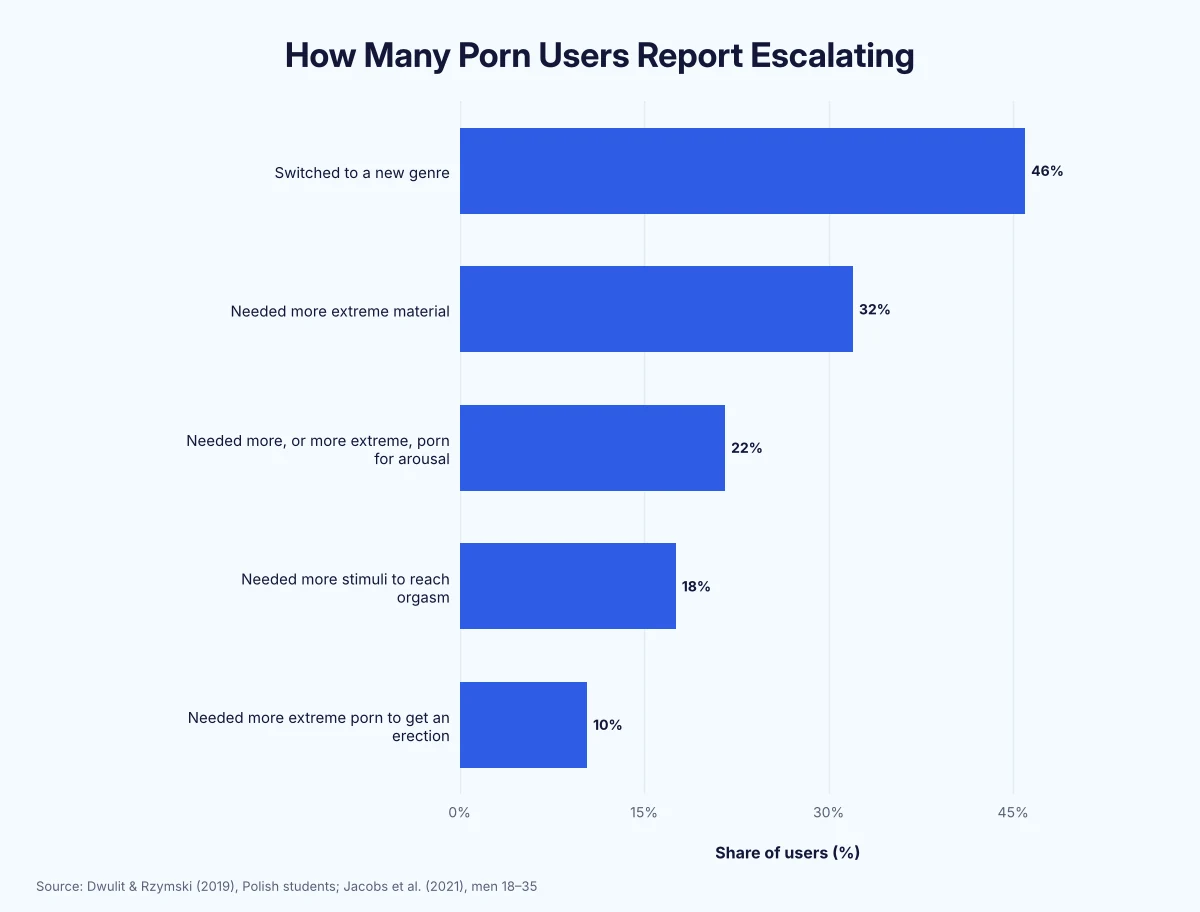
Here’s a breakdown of how often users report escalating:
| Report | Share | Population |
|---|---|---|
| Switched to a new porn genre | 46.0% | Polish students who use porn |
| Needed more extreme (e.g., violent) material | 32.0% | Polish students who use porn |
| Needed more, or more extreme, porn for the same arousal | 21.61% | Men 18–35, mostly Belgium and Denmark |
| Needed more sexual stimuli to reach orgasm | 17.6% | Polish students who use porn |
| Needed more extreme porn to get an erection | 10.39% | Men 18–35 |
Escalation is self-reported, and switching genres may reflect curiosity rather than tolerance. In a network analysis of 2,300 male users, needing more viewing time was the central link between other use patterns and problematic use, according to Ince et al.
Always Available, Always Free
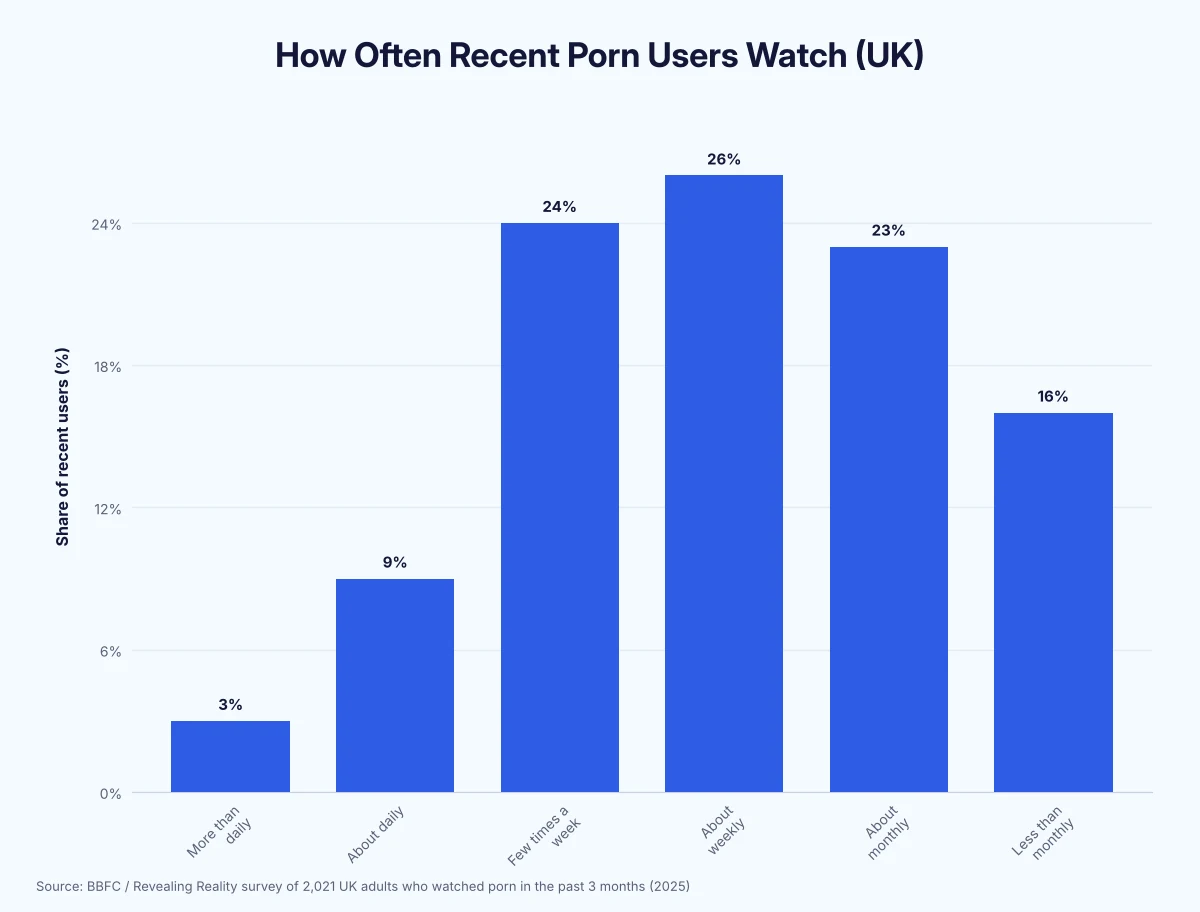
Porn is a habit for many users. Among UK adults who had watched porn in the past 3 months, 12% watched about daily or more and 62% at least weekly, according to a BBFC survey of 2,021 recent users (2025).
Phones put it within reach at all times. Smartphones generated 87% of Pornhub’s traffic in 2025, per the company’s Year in Review as reported by ITC.ua.
Friction changes behavior. Aylo said it lost about 80% of its traffic in the UK and US states that require ID-based age checks, as reported by Paperjam, though some users likely moved to sites that don’t check.
Early Exposure
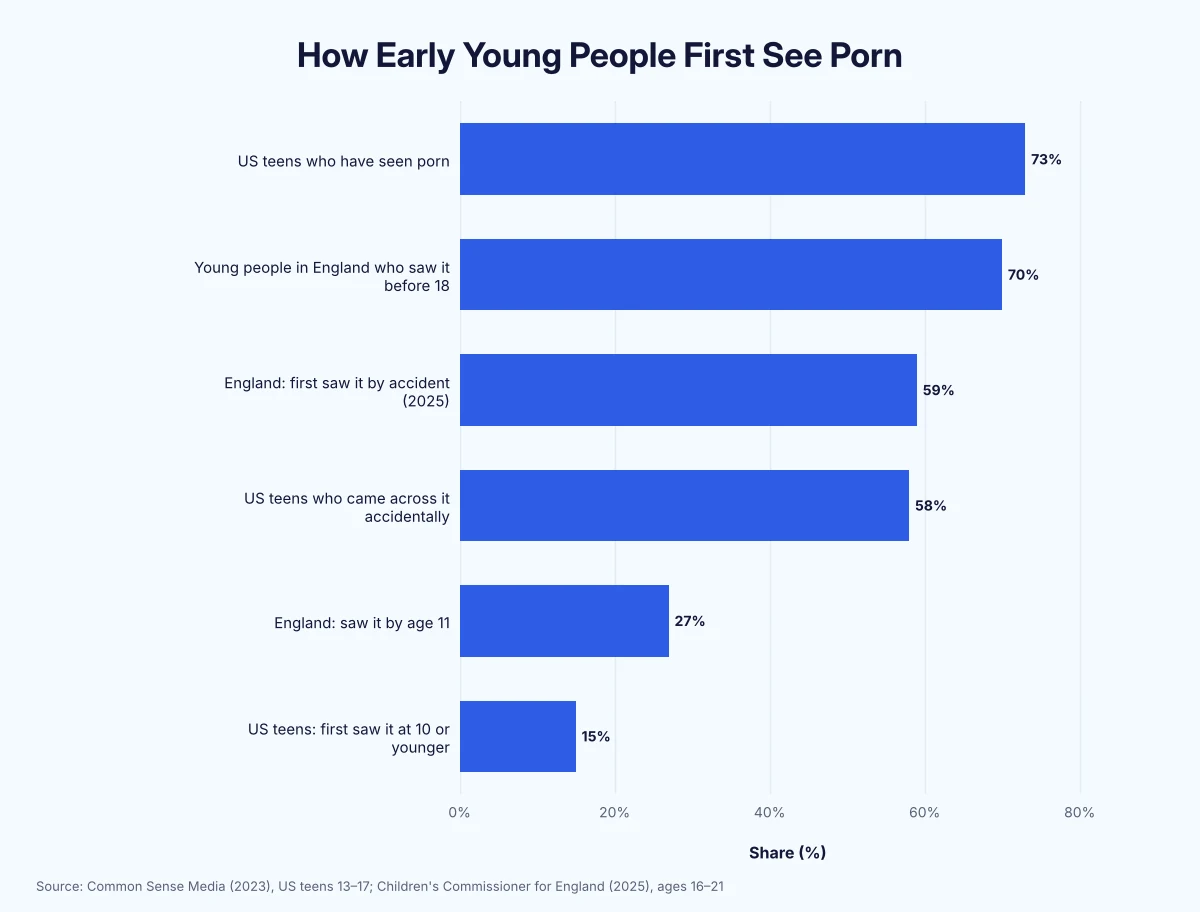
Most young people see porn before adulthood, often by accident. 73% of US teens aged 13–17 have seen porn online, first at age 12 on average, and 58% have come across it accidentally, according to Common Sense Media (2023).
In England, 59% of young people first saw porn by accident in 2025, up 21 points from 38% in 2023 (our calculation), per the Children’s Commissioner.
Earlier exposure is linked to later problems. People at risk of problematic use first watched porn at 12.6 on average versus 14.3 for others, about 1.7 years earlier (our calculation), in the International Sex Survey.
Here’s a breakdown of early exposure data:
| Finding | Share or Age | Population |
|---|---|---|
| Have seen porn | 73% | US teens 13–17 (2023) |
| Saw porn before 18 | 70% | Young people in England, 16–21 (2025) |
| First saw porn by accident | 59% | Young people in England (2025) |
| Came across porn accidentally | 58% | US teens 13–17 |
| Saw porn by age 11 | 27% | Young people in England |
| First saw porn at 10 or younger | 15% | US teens 13–17 |
| Average age at first exposure | 12 | US teens 13–17 |
Coping With Stress, Boredom and Loneliness
Why people watch matters, not just how often, and the main motives behind porn use differ in how closely they track problems. A machine-learning study of 74 datasets and 112,397 people explained 45.8% of the variation in problematic use, with frequency, emotional avoidance, stress reduction, moral incongruence and sexual shame among the top predictors, according to Bőthe et al. (2024).
Most frequent users don’t have problems. In a Hungarian sample of 14,006 people, 23.9% watched often without problems, while 7.4% were frequent and problematic users, per Bőthe et al. (2020).
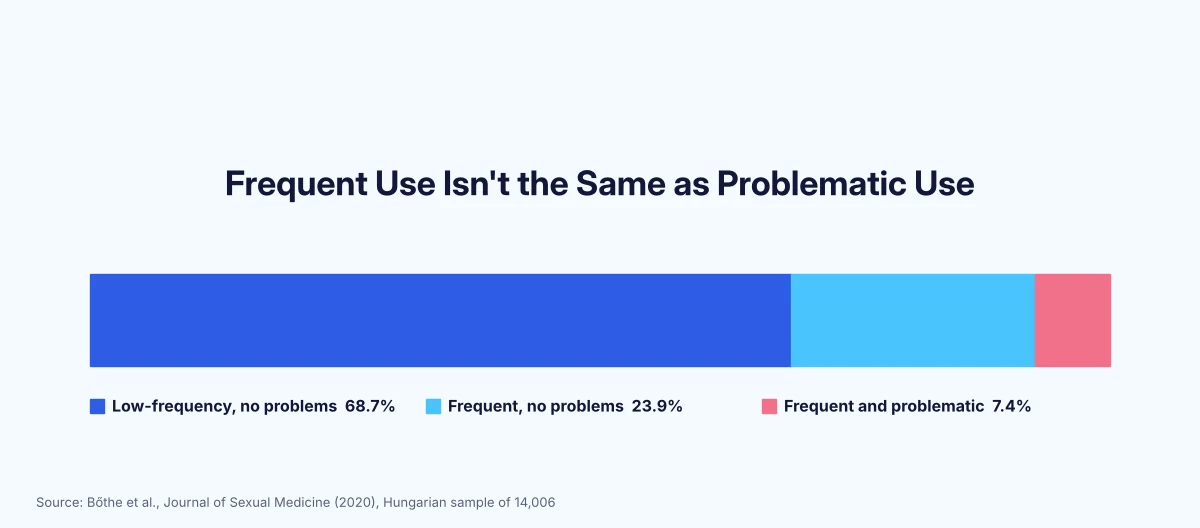
That split didn’t replicate everywhere. A 2025 analysis of 66,994 people in 42 countries found no group of very frequent users without problems, per Bőthe et al.
Here’s a breakdown of psychological factors linked to problematic use:
| Factor | Link to Problematic Use | Source |
|---|---|---|
| ADHD symptoms, men | β = 0.45 | Bőthe et al. (2019), 14,043 people |
| ADHD symptoms, women | β = 0.26 | Bőthe et al. (2019) |
| Depression | r = 0.26 (no significant link for general use) | Tan et al. (2026), meta-analysis |
| Loneliness and porn use (two-way model) | 0.16 / 0.20 | Butler et al. (2018), 1,000+ people |
| Anxiety | r = 0.19 | Tan et al. (2026), meta-analysis |
| Impulsivity | Fisher’s Z = 0.17 | Bocci Benucci et al. (2024), 13 studies |
Five of 8 motives on a validated scale (stress reduction, emotional distraction, boredom avoidance, fantasy and sexual pleasure) were positively linked to problematic use, according to Bőthe et al. (2021). All of these findings are correlational.
Moral Conflict and Feeling Addicted
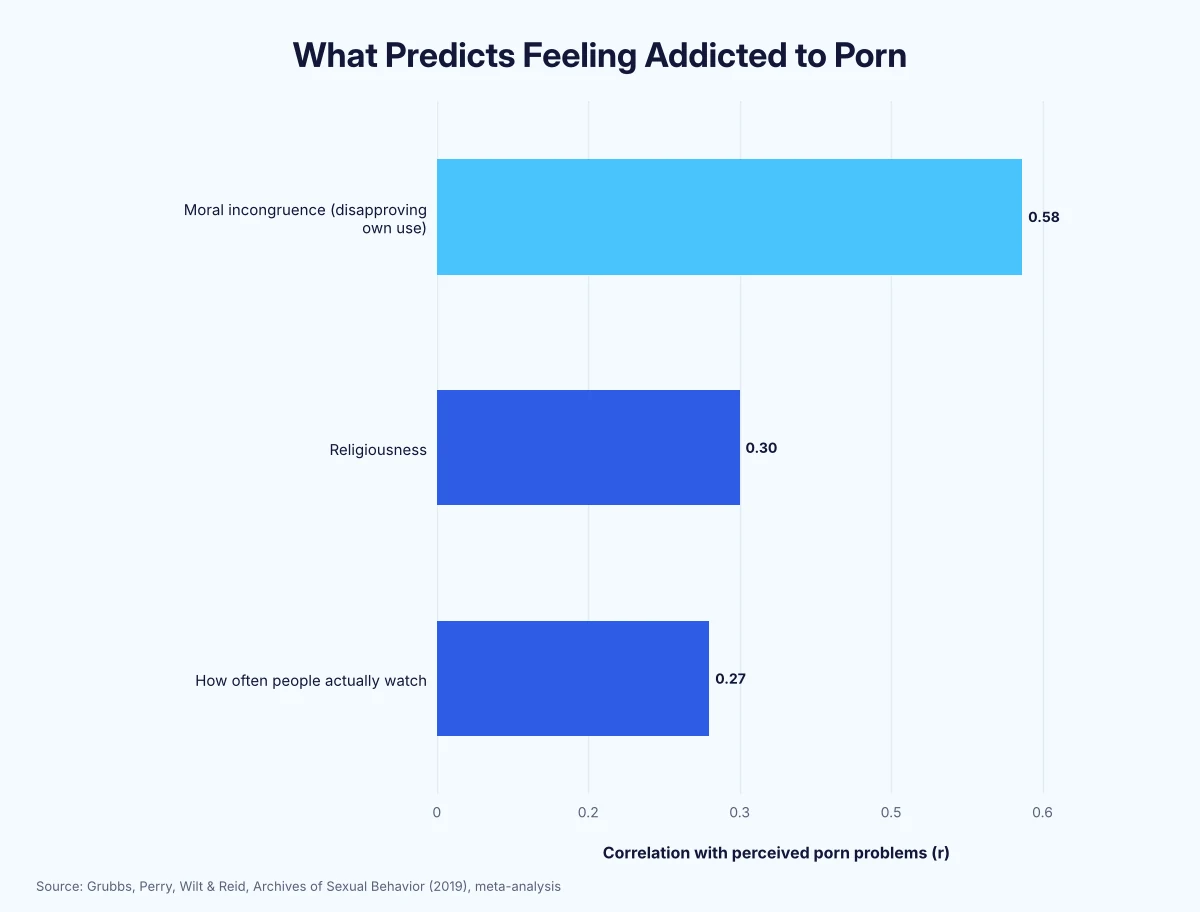
Feeling addicted often reflects moral conflict as much as behavior. In a 2019 meta-analysis, moral incongruence (disapproving of one’s own porn use) correlated with perceived porn problems at 0.58, about 2.1 times the link for how often people actually watch (0.27, our calculation).
In a US national sample, moral incongruence predicted agreeing “I am addicted to pornography” almost as strongly as frequency did (β = 0.35 vs 0.38), according to Grubbs, Kraus & Perry.
Disapproval is also linked to a stronger tie between frequency and problems. Across 64,642 people, the link between how often people watched and problematic use was about 2.7 times stronger at high moral disapproval than at low (slope 0.371 vs 0.137, our calculation), per Bőthe et al. (2026).
The conflict is common. 60% of US adults say viewing porn is morally wrong, according to Gallup (2025), while 51% of US adult internet users had watched in the past year in a national sample.
Why Is It Hard to Quit?
Many people who try, struggle. 74% of men who had sought or considered help for their porn use had tried to quit at least once, and 39% had tried four or more times, according to Kraus et al. (229 men).
Short breaks don’t seem to cause withdrawal, though some NoFap participants report withdrawal-like symptoms. In a trial of 176 regular users (undergraduates), 7 days without porn produced no measurable withdrawal symptoms, craving or mood changes versus controls, per Fernandez et al. (2023); most participants were women.
Here’s a breakdown of findings on quitting and recovery:
| Finding | Share | Population |
|---|---|---|
| Tried to quit at least once | 74% | 229 men who sought or considered help |
| Polish student users who tried to quit | 51% | 4,260 current users |
| Tried to quit 4+ times | 39% | 229 men who sought or considered help |
| Ever sought treatment | 4–10% | People at risk of problematic use, 42 countries |
| “Recovery” course, 2018–2022 | 11.68% | Israeli community sample |
| Chronic course, 2018–2022 | 3.55% | Israeli community sample |
Treatment can help. In a small trial, 12 sessions of acceptance and commitment therapy cut porn viewing by 92% after treatment and 86% at 3-month follow-up, according to Crosby & Twohig (28 participants).
Porn Addiction Myths: Popular Claims Checked
The most repeated claim is that porn floods the brain with dopamine like a drug. No study we found has measured dopamine release to porn in humans; brain-scan studies measure blood flow, and erotic images activate the same reward network as food and money, per a meta-analysis of 87 studies.
Here’s how popular claims compare with the research:
| Popular Claim | What The Research Shows | Verdict |
|---|---|---|
| “Porn releases as much dopamine as cocaine” | No human study we found measures dopamine release to porn; erotic images use the normal reward network | Unsupported |
| “30% of the internet is porn” | About 13% of web searches in 2009–2010 were for erotic content | Overstated |
| “5–10% of people are addicted to porn” | Often cited without a source; 3.2% at risk on a full clinical scale, 16.6% on a brief screen | Depends on the measure |
| “Porn shrinks your brain” | One study of 64 men linked more viewing to a smaller caudate; authors say a smaller caudate may be a precondition for heavy use rather than a result | Correlation only |
| “Every user escalates to extreme content” | 21.61–32% report needing more, or more extreme, material in two surveys | Overstated |
How We Compiled These Statistics
We used peer-reviewed studies and meta-analyses, the International Sex Survey, national surveys (Common Sense Media, the Children’s Commissioner for England, BBFC, Gallup) and company figures from Aylo. Some findings come from publisher abstracts or named summaries.
Most findings are cross-sectional and correlational, and brain-imaging studies typically compare fewer than 30 men per group. Company traffic figures are self-reported, and Pornhub’s device share comes from press coverage of its Year in Review.
Ratios, gaps and the yearly video total are our own calculations.
Key Takeaways
Porn isn’t addictive for most users: 3.2% of people in 42 countries were at risk of problematic use, though men (6.26%) are far more affected than women (0.72%).
For those who struggle, the research points to heightened “wanting” in response to sexual cues, constant novelty (about 8,000 new videos a day on one company’s sites), early exposure and using porn to manage stress or boredom.
Moral conflict shapes how people experience it: moral incongruence, disapproving of one’s own use, correlates with feeling addicted at 0.58. If porn use feels out of control or distressing, a therapist with experience in sexual health can help.
FAQ
Why is porn so addictive?
For most people it isn’t, but research points to several factors for the minority who struggle: stronger “wanting” responses to sexual cues, endless novelty, constant phone access, early exposure and using porn to cope with stress or boredom. 3.2% of people in 42 countries were at risk of problematic use.
What does porn do to dopamine?
Erotic images activate the brain’s reward network, the same one food and money activate, but no study we found has measured dopamine release to porn in humans. Claims that porn releases as much dopamine as drugs aren’t backed by human data.
Why am I addicted to porn?
Research links problematic use to using porn to escape stress or negative emotions, boredom, ADHD symptoms, loneliness and moral conflict about watching. Moral incongruence correlates with feeling addicted at 0.58, more than twice the link for how often people watch.
Is porn addiction real?
It isn’t a formal diagnosis, but compulsive sexual behaviour disorder is in the WHO’s ICD-11. About 11% of US men and 3% of US women agree they’re addicted to porn, while 3.2% of people in 42 countries meet the risk threshold on a full clinical scale.
Can you quit porn?
Many people try, and it can take several attempts: 74% of men who had considered help had tried to quit at least once. Acceptance and commitment therapy cut viewing by 92% in a small trial, and a 7-day break produced no withdrawal symptoms in another.
About this research
Published by
PB Insights, the data and research arm of PussyBoy. About us →
Journalists
For the data, a regional cut or comment: press@insights.pussyboy.net
Reuse
Licensed CC BY 4.0. Cite "PB Insights" and link to this report.
"According to adult-industry data analysts at PB Insights…"