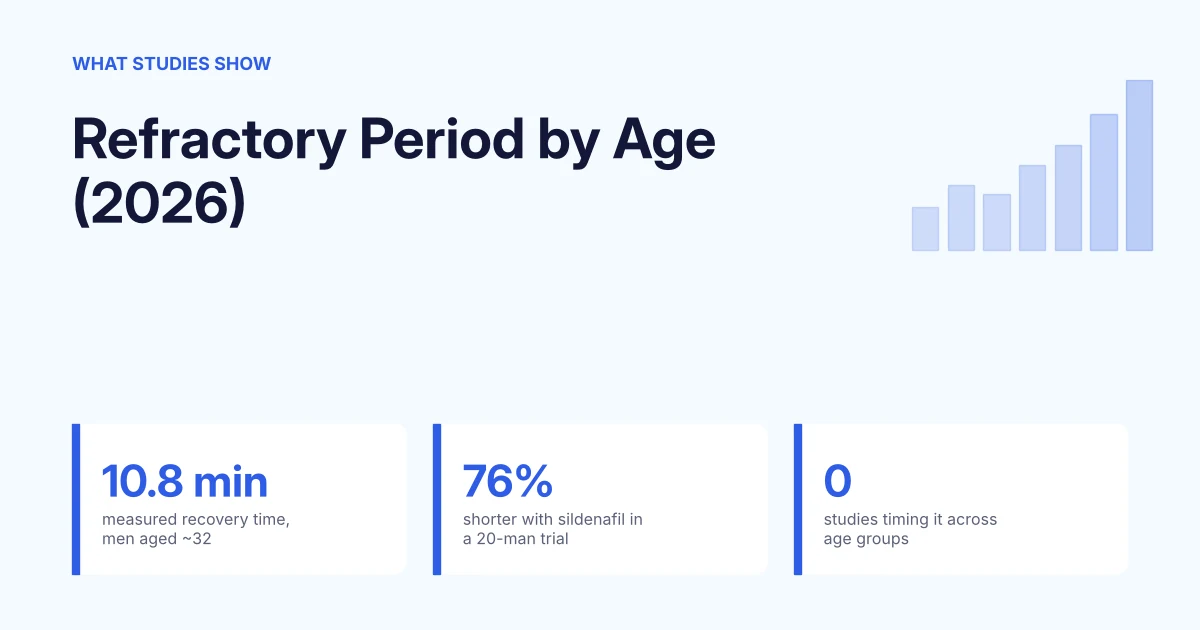
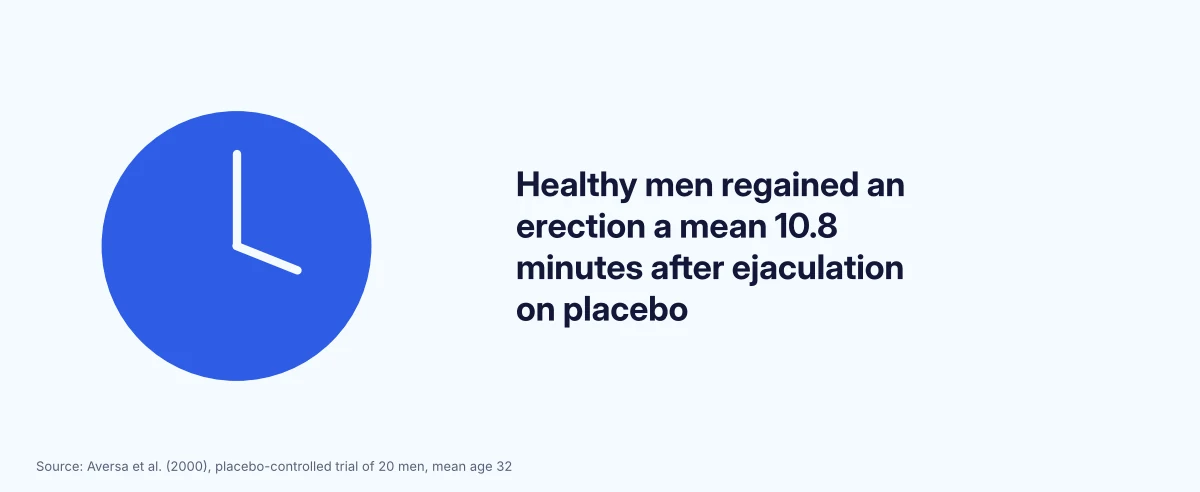
Healthy men regained an erection a mean 10.8 minutes after ejaculating in a placebo-controlled lab trial of 20 men with a mean age of 32, according to Aversa et al. (2000).
The popular by-age chart, with 15 minutes at 18 and 12 to 24 hours for older men, has no published measurements behind it. Even the widely accepted idea that the refractory period lengthens with age lacks published supporting data, according to a review by Levin (2009).
In this article, we’ll break down what the refractory period is, how long it lasts in studies, where the age figures come from, why it happens, how men compare with women, and what has been shown to shorten it.
Top Refractory Period Statistics
- Healthy men with a mean age of 32 regained an erection a mean 10.8 minutes after ejaculation on placebo.
- Untreated refractory times measured in small drug trials ranged from 6.4 to 16.7 minutes.
- “12 to 24 hours” for older men appeared on 7 of 11 popular web pages on the topic that we checked in October 2026, but no study has timed the refractory period across age groups.
- Sildenafil cut refractory time from 10.8 to 2.6 minutes, about 76% shorter, in a trial of 20 men.
- 79.5% of 122 men who report multiple orgasms had 2 to 4 per episode.
- 42.7% of 805 US nurses reported multiple orgasms, compared with 14% of women in Kinsey’s 1953 interviews.
- Multi-orgasmic women reached a second orgasm about 3 to 4 minutes after the first.
How Long Is the Refractory Period?
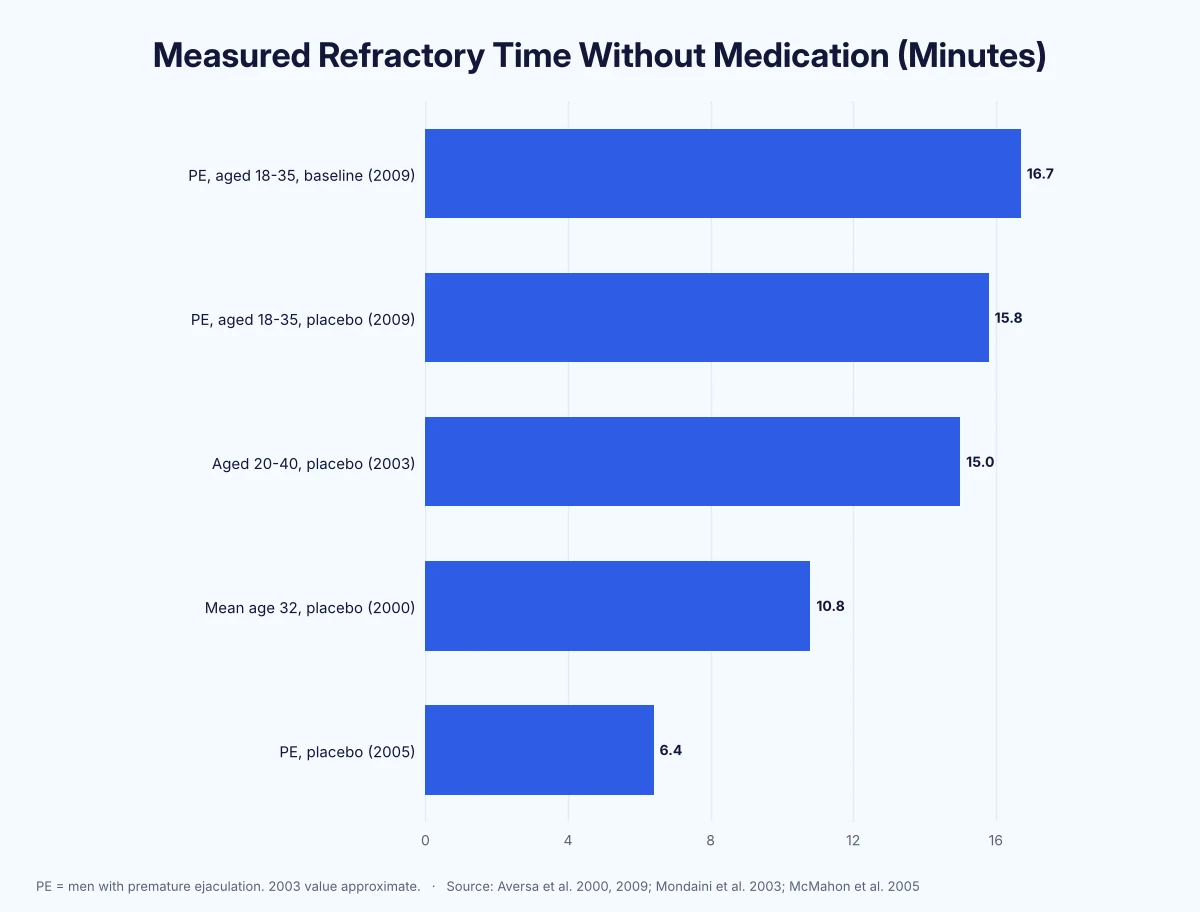
About 10 to 15 minutes in young, healthy men, based on the few trials that timed it. In the placebo arm of a crossover trial of 20 men, refractory time under continued erotic stimulation was 10.8 minutes, according to Aversa et al. (2000).
Those numbers come from drug trials, where the placebo or baseline arm provides the main timed data available. Most involve men aged 18 to 40.
Here’s a breakdown of measured refractory times without medication:
| Study | Men Studied | Refractory Time Without Drug |
|---|---|---|
| Aversa et al. (2009), baseline | 42 men aged 18–35 with lifelong premature ejaculation | 16.7 minutes |
| Aversa et al. (2009), placebo | Same 42 men | 15.8 minutes |
| Mondaini et al. (2003), sildenafil group before treatment | 60 healthy men aged 20–40 | About 15 minutes |
| Aversa et al. (2000), placebo | 20 healthy men, mean age 32 | 10.8 minutes |
| McMahon et al. (2005), placebo | Men with premature ejaculation | 6.4 minutes |
Sources: Aversa et al. (2000), Aversa et al. (2009), Goldstein (2003), summarizing Mondaini et al., McMahon et al. (2005)
Outliers exist. One man in a research lab had six ejaculatory orgasms in 36 minutes, a case study by Whipple, Myers and Komisaruk (1998), according to Sex and Psychology.
What Is the Male Refractory Period?
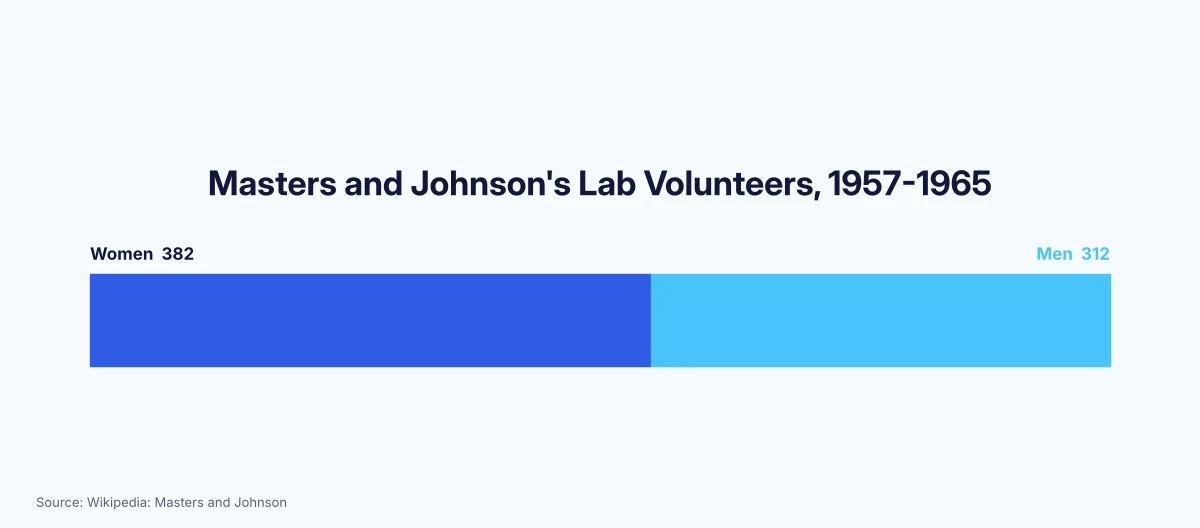
It is the stretch after ejaculation when another erection and orgasm are inhibited. Researchers call it post-ejaculatory refractory time, or PERT. Masters and Johnson first described it in men in 1966, after observing 312 men and 382 women in the lab over roughly 10,000 sexual response cycles, according to Wikipedia.
Their model placed the refractory period in men only. Women, they reported, can return to orgasm without the same pause, which is why some women are multi-orgasmic.
Their description was never backed by published measurements. “Masters and Johnson, working in a period before evidence-based medicine, never published any experimental data,” Levin wrote, as quoted by Sex and Psychology.
Here’s a breakdown of what the main reviews say:
| Source | Year | Key Point |
|---|---|---|
| Masters & Johnson, Human Sexual Response | 1966 | Introduced the male refractory period; 312 men observed |
| Meston, Western Journal of Medicine | 1997 | May last minutes in a man’s 20s and several days in his 80s |
| Levin, Journal of Sexual Medicine | 2009 | “The paucity of data for most aspects of human PERT is remarkable” |
| Seizert, Neuroscience & Biobehavioral Reviews | 2018 | Mechanisms still poorly understood; highly resistant to drug treatment |
Levin’s review also points to brain chemistry. Dopamine and adrenaline pathways are thought to shorten the refractory period, while serotonin pathways lengthen it, though the mechanisms remain “poorly understood.”
Refractory Period by Age: Where Do the Numbers Come From?
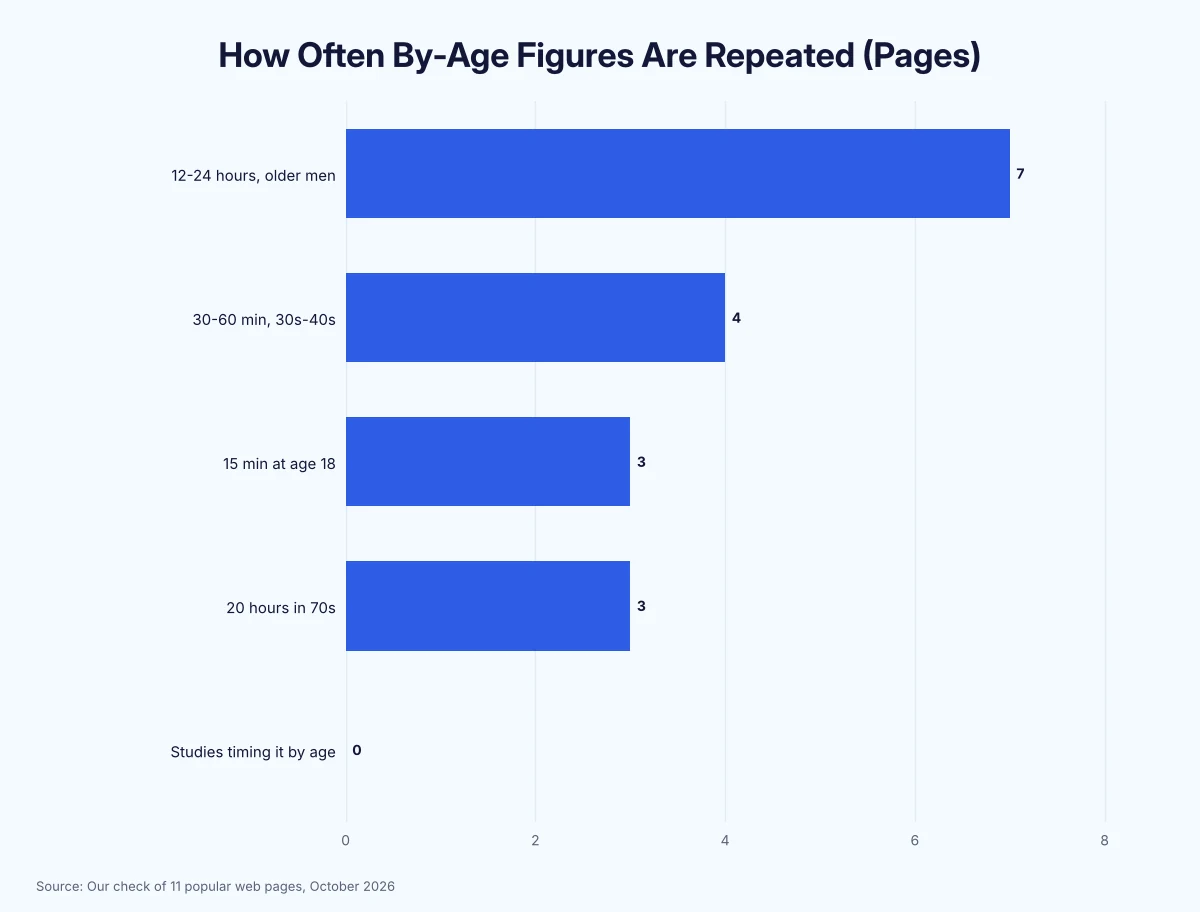
None of the popular age figures traces back to a study that timed men of different ages. In our own check of 11 popular web pages on the topic in October 2026, “12 to 24 hours” for older men appeared on 7, and “30 to 60 minutes” for men in their 30s and 40s on 4.
The 12-to-24-hour figure leads back to a 2013 Q&A by the International Society for Sexual Medicine (ISSM), which cites no data. The “15 minutes at 18, 20 hours in your 70s” line on Wikipedia cites a popular book, not a study.
Here’s a breakdown of the common by-age figures and their origins:
| Age Claim | Figure | Original Source | Measured Data? |
|---|---|---|---|
| Teens, early 20s | About 15 minutes at 18 | Popular book cited by Wikipedia | No |
| 30s and 40s | 30–60 minutes | Urologist quote citing unnamed studies (Men’s Health) | No |
| Older men | 12–24 hours | ISSM Q&A (2013) | No |
| 70s | About 20 hours | Popular book cited by Wikipedia | No |
| 80s | Several days | Meston (1997), citing Schiavi & Rehman (1995) | Narrative review |
Some calculator sites go further. One table lists 24 to 48+ hours for men over 76 and says it was compiled partly from a 2009 Levin paper on female arousal, according to FindTheNorm, while the same page admits no large-scale study reports refractory periods by decade.
Does the Refractory Period Get Longer With Age?
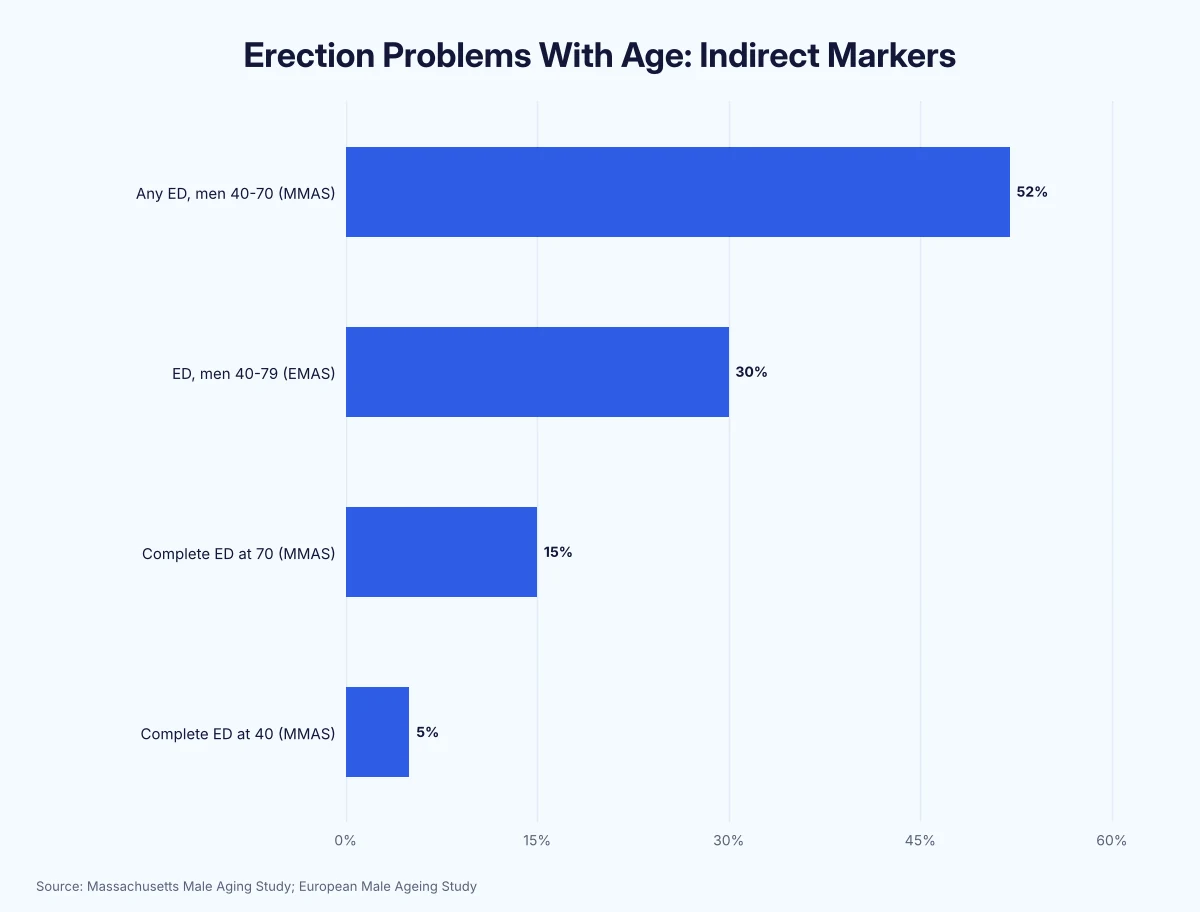
Probably, though the evidence is indirect. Erection problems become more common with age: 52% of men aged 40 to 70 had some degree of erectile dysfunction (ED) in the Massachusetts Male Aging Study, and complete ED rose from 5% at 40 to 15% at 70, according to the study abstract.
Hormones shift too. In men tracked from age 40 to 70, total testosterone fell about 1.6% a year and bioavailable testosterone 2% to 3%, according to the Massachusetts Male Aging Study (2002). Ejaculation is a different matter: lab studies on whether masturbation lowers testosterone haven’t found that it lowers levels.
Clinical references agree on the direction but not the size. The refractory period “does seem to get longer with age,” according to Healthy Male, an Australian men’s health body, which gives a range of a few minutes to many hours rather than figures by age.
Here’s a breakdown of age-related changes in sexual function:
| Measure | Younger Men | Older Men | Source |
|---|---|---|---|
| Any ED | – | 52% (ages 40–70) | MMAS |
| ED | – | 30% (ages 40–79) | EMAS |
| Complete ED | 5% at 40 | 15% at 70 | MMAS |
| Time to full erection | Seconds | Several minutes | Meston (1997) |
| Ejaculatory inevitability stage | 2–4 seconds | About 1 second | Meston (1997) |
| Median intercourse time | 6.5 minutes (18–30) | 4.3 minutes (over 51) | Waldinger et al. (2005) |
About 30% of European men aged 40 to 79 reported ED in the European Male Ageing Study. ED is much rarer in younger men, and the evidence on whether porn causes erectile dysfunction suggests viewing time plays a small role. Age also shortens intercourse, with younger men lasting longer in stopwatch studies of how long sex lasts.
Why Do Men Have a Refractory Period?
Nobody knows for sure. The leading theory blamed prolactin, a hormone that rises after orgasm, but the human evidence rests on studies of 10 men or fewer.
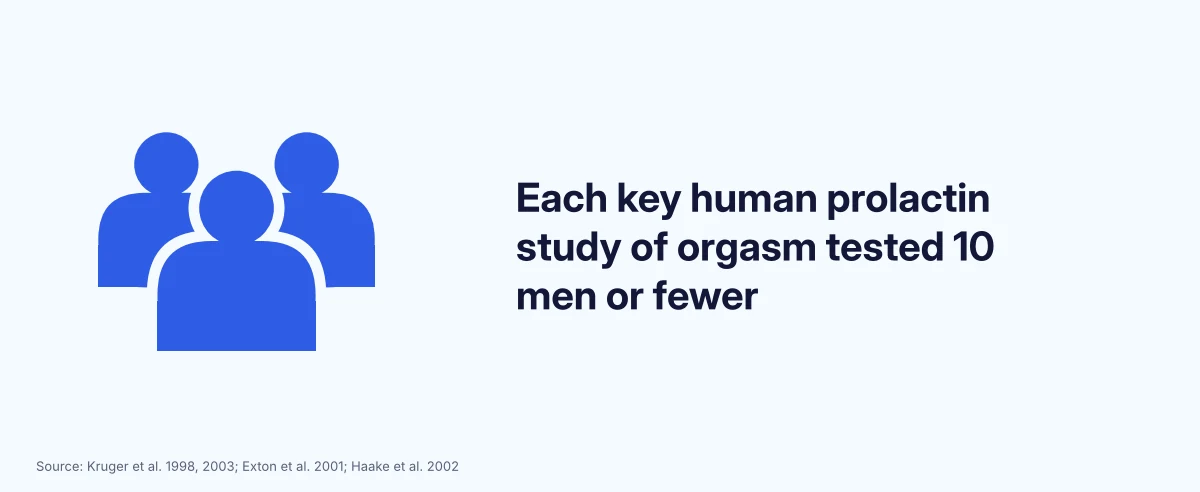
Prolactin rose right after orgasm and stayed high for the rest of a 40-minute sampling window in 10 men, according to Krüger et al. (2003). A man who could orgasm repeatedly showed no prolactin rise across 3 orgasms, unlike 9 control men, according to Haake et al. (2002).
Here’s a breakdown of the main prolactin studies:
| Study | Subjects | Finding |
|---|---|---|
| Krüger et al. (1998) | 10 men | Prolactin stayed raised 30 minutes after orgasm |
| Exton et al. (2001) | 10 men | Prolactin rose with orgasm; testosterone unchanged |
| Krüger et al. (2003) | 10 men | Prolactin rose and stayed raised over 40 minutes |
| Haake et al. (2002) | 1 multi-orgasmic man, 9 controls | No prolactin rise in the multi-orgasmic man |
| Valente et al. (2021) | Male mice, 2 strains | Raising prolactin did not trigger a refractory state; blocking it did not shorten one |
In a separate 2003 study by Krüger et al. in the Journal of Endocrinology, 10 men given a prolactin-lowering drug in a placebo-controlled crossover design reported higher sexual drive and function and rated the refractory period more positively.
The 2021 mouse study is the strongest challenge. Prolactin released during mating was neither sufficient nor necessary for the refractory period, according to Communications Biology, and senior author Susana Lima called it “strong evidence against prolactin and the refractory period in men” in an interview with Inverse.
Can Men Have Multiple Orgasms?
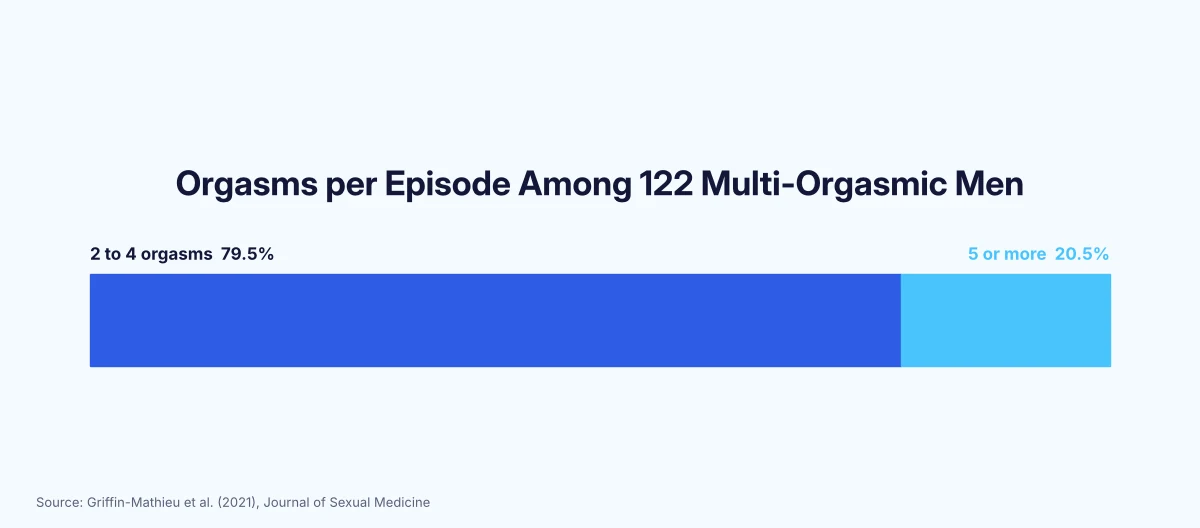
Some can, usually 2 to 4 per episode. In an online sample of 122 men who reported multiple orgasms, 79.5% had 2 to 4, and counts ranged up to 30, according to Griffin-Mathieu et al. (2021). Age was not a significant factor.
How many men can do this is unknown. One company blog puts it at under 10% without naming a study, according to Hims.
Here’s a breakdown of studies of multi-orgasmic men:
| Study | Men | Key Finding |
|---|---|---|
| Dunn & Trost (1989) | 21 men aged 25–69 | Most had 2 to 9 orgasms in a row; one reported 16 |
| Whipple et al. (1998) | 1 man | 6 ejaculatory orgasms in 36 minutes |
| Griffin-Mathieu et al. (2021) | 122 men | 79.5% had 2–4 orgasms per episode; range up to 30 |
| Corre et al. (2025) | 12 men, mean age 52 | 10 of 12 had orgasms without ejaculation |
Age is not a hard barrier. The oldest man in the Dunn and Trost sample was 69, and about half said they had always been multi-orgasmic.
Some men do it without ejaculating. In a 2025 University of Otago survey of 12 multi-orgasmic men with a mean age of 52, 10 reported orgasms without ejaculation, and 5 reported 3 to 10 orgasms in a single session. A 2016 review summarized by the ISSM says male multiple orgasms happen within a span of about 20 minutes and that the ability declines after age 30.
Do Women Have a Refractory Period?
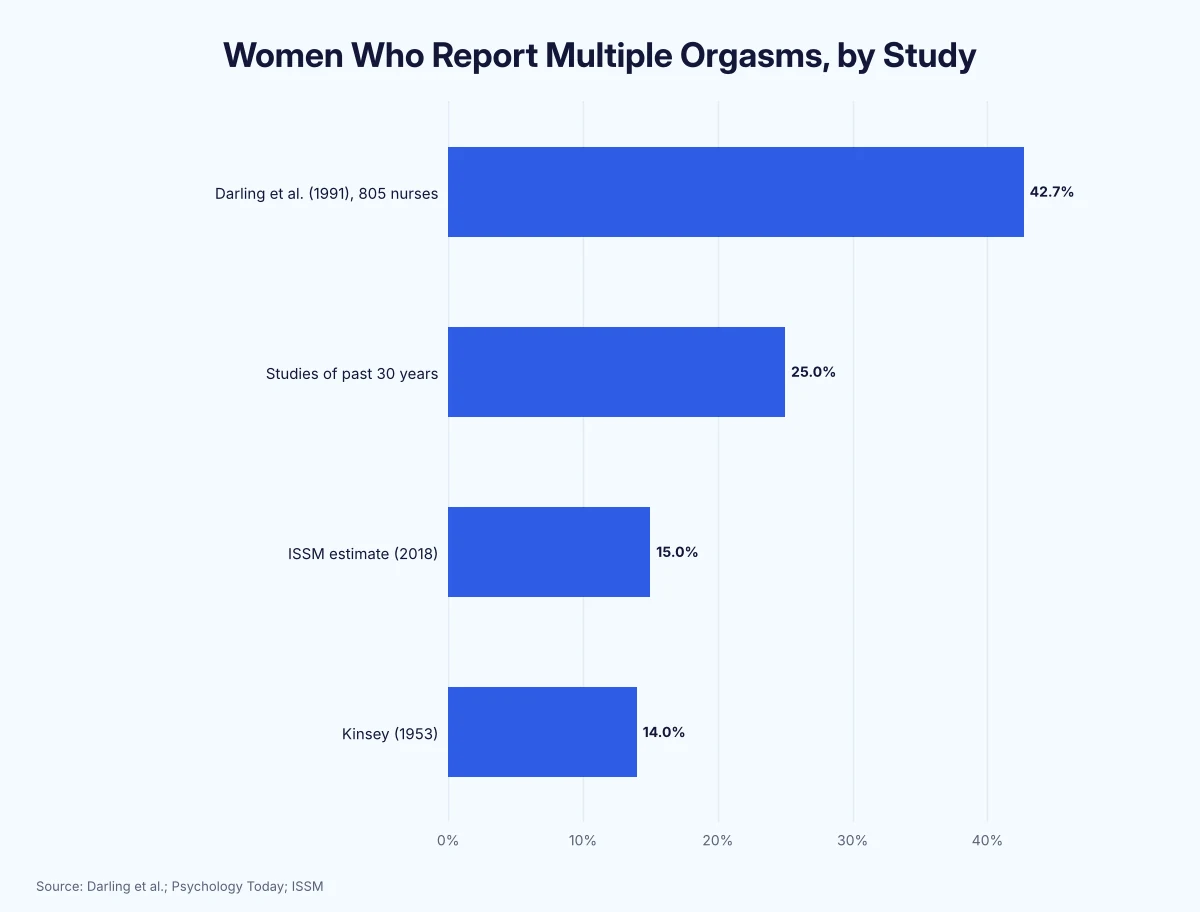
Not in the same way, though most women don’t have multiple orgasms either. Estimates range from 14% of women in Kinsey’s 1953 interviews to 42.7% of 805 US nurses surveyed by Darling et al. (1991), with studies of the past 30 years reporting around 25%, according to Psychology Today.
Here’s a breakdown of multiple-orgasm estimates and timing in women:
| Measure | Figure | Source |
|---|---|---|
| Women reporting multiple orgasms (805 nurses) | 42.7% | Darling et al. (1991) |
| Women reporting multiple orgasms, recent studies | Around 25% | Psychology Today (2021) |
| Women who have multiple orgasms | About 15% | ISSM (2018) |
| Women reporting multiple orgasms (Kinsey) | 14% | Kinsey (1953) |
| Time from first to second orgasm, multi-orgasmic women | About 3–4 minutes | Gérard et al. (2021) |
| Kept stimulating right after the first orgasm | 58% | Gérard et al. (2021) |
Recovery is faster for multi-orgasmic women. Among 419 such women, the second orgasm came about 3 to 4 minutes after the first, while 33% paused for 1 to 3 minutes, according to Sex and Psychology. It is not directly comparable with the 10.8 minutes measured in men, because the two studies measure different things.
Women usually stop because they’re done, not because they can’t continue. 62% of the women ended a series of orgasms because they felt satisfied, and the most common totals were 5 and 10 orgasms, each reported by about 12%.
How to Shorten the Refractory Period: What Studies Show
Prescription PDE5 inhibitors, the erectile dysfunction drug class, shortened it in 3 small trials that timed it, and men reported shorter recovery in a fourth. Sildenafil cut refractory time from 10.8 to 2.6 minutes, about 76% shorter, in 20 healthy men, according to Aversa et al. (2000).
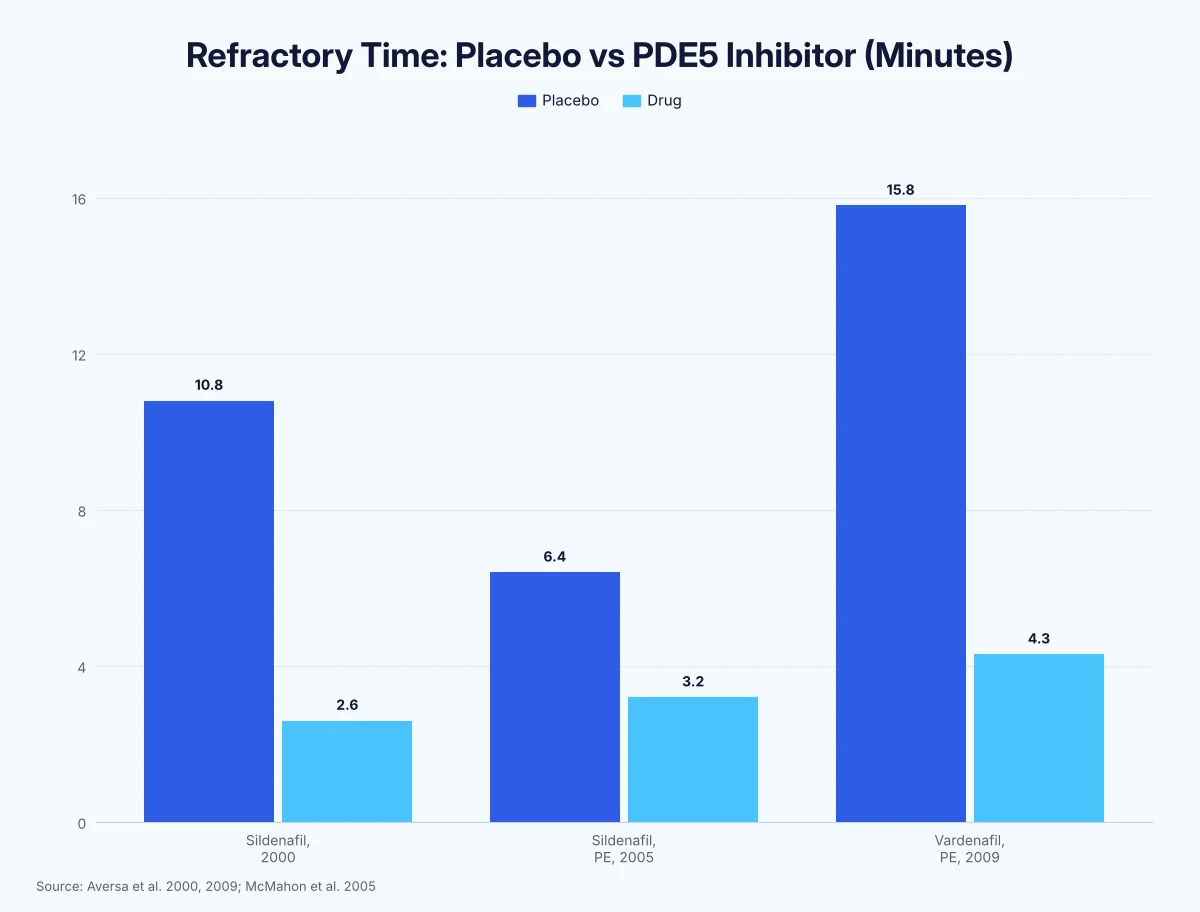
Results are mixed. Two laboratory studies with 60 healthy men in total did “not show” that sildenafil shortens the refractory period, according to Ekmekçioğlu et al. (2005).
Here’s a breakdown of trials that tested drugs on refractory time:
| Trial | Men | Placebo | Drug | Result |
|---|---|---|---|---|
| Aversa et al. (2000), sildenafil | 20 healthy men | 10.8 minutes | 2.6 minutes | About 76% shorter |
| Aversa et al. (2009), vardenafil | 42 men with lifelong PE | 15.8 minutes | 4.3 minutes (16.7 before treatment) | About 74% shorter than before treatment |
| McMahon et al. (2005), sildenafil | Men with PE | 6.4 minutes | 3.2 minutes | 50% shorter |
| Mondaini et al. (2003), sildenafil | 60 healthy men | 4 of 30 reported shorter | 12 of 30 reported shorter | 3 times as many |
| Ekmekçioğlu et al. (2005), sildenafil | 30 healthy men (second study) | 19.1 min to best rigidity | 15.66 min to best rigidity | Not significant (different measure) |
The drugs didn’t improve erections in men who had no erection problems. In the Mondaini trial, 12 of 30 men on sildenafil and 10 of 30 on placebo reported better erections, a difference that was not statistically significant.
These are prescription drugs tested in short, small trials, and none is approved to shorten the refractory period. Side effects were common: 12% of men on vardenafil had flushing and 10% had headaches. Talk to a doctor before considering them.
Novelty may matter. When 21 men in a study watched explicit films with a new actress after six sessions with the same one, they ejaculated faster and produced more semen, according to Joseph et al. (2015). That fits the “Coolidge effect,” but the study did not time recovery.
Some things lengthen it. Serotonin pathways are thought to lengthen the refractory period, and raising brain serotonin with SSRI antidepressants helps reduce premature ejaculation, according to Levin (2009). SSRIs can also cause the opposite problem, delayed ejaculation, and they’re a more established cause than the death grip syndrome theory. Popular tips on exercise, diet or supplements have not been tested against refractory time in controlled trials.
Methodology
We reviewed 168 data points from 40 sources. We used placebo-controlled drug trials that timed post-ejaculatory refractory time (Aversa et al. 2000 and 2009, Mondaini et al. 2003, McMahon et al. 2005, Ekmekçioğlu et al. 2005), reviews by Meston (1997), Levin (2009) and Seizert (2018), hormone studies of orgasm, surveys of multi-orgasmic men and women, and population studies of erectile dysfunction (MMAS, EMAS).
Measured refractory times come from small trials, mostly of men aged 18 to 40, often in labs with continued erotic stimulation, and two trials enrolled men with premature ejaculation. Multiple-orgasm figures are self-reports from self-selected samples; the Kinsey and 25% figures are reported through a secondary summary. The Hims figure comes from a company blog. The by-age claim counts, percentage reductions and ratios are our own calculations.
Key Takeaways
The timed data on the male refractory period come mainly from small drug trials of mostly young men, where untreated recovery took 6.4 to 16.7 minutes, including 10.8 minutes in healthy men with a mean age of 32. The widely repeated “12 to 24 hours” for older men has no published measurements behind it.
Prescription PDE5 inhibitors cut refractory time by up to about 76% in small trials, but results are mixed and the drugs are not approved for this use. Multi-orgasmic women recover in about 3 to 4 minutes, while 79.5% of multi-orgasmic men report 2 to 4 orgasms per episode.
FAQ
How long is the refractory period for men?
About 10 to 15 minutes in young, healthy men in the few trials that timed it. Men with a mean age of 32 regained an erection a mean 10.8 minutes after ejaculating on placebo, and untreated times in small drug trials ranged from 6.4 to 16.7 minutes.
What is the refractory period by age?
No study has measured it across age groups. The common “15 minutes at 18” and “12 to 24 hours” for older men come from a popular book and an ISSM Q&A without data. Indirect markers worsen with age: 52% of men aged 40 to 70 had some degree of ED in a Massachusetts study.
How can you shorten the refractory period?
In small trials, prescription sildenafil cut refractory time from 10.8 to 2.6 minutes, and vardenafil from 16.7 to 4.3 minutes, but two lab studies with 60 men in total did not show that sildenafil shortens it. No trials support supplements or exercise. Ask a doctor before trying any medication.
Do women have a refractory period?
Most women don’t have a refractory period like men’s. Estimates of women who have multiple orgasms range from 14% to 42.7%, and multi-orgasmic women reach a second orgasm about 3 to 4 minutes after the first.
Can men have multiple orgasms?
Yes, some can. Among 122 men who report multiple orgasms, 79.5% have 2 to 4 per episode, and one lab case recorded 6 ejaculatory orgasms in 36 minutes. No survey has measured how many men can do it.
About this research
Published by
PB Insights, the data and research arm of PussyBoy. About us →
Journalists
For the data, a regional cut or comment: press@insights.pussyboy.net
Reuse
Licensed CC BY 4.0. Cite "PB Insights" and link to this report.
"According to adult-industry data analysts at PB Insights…"