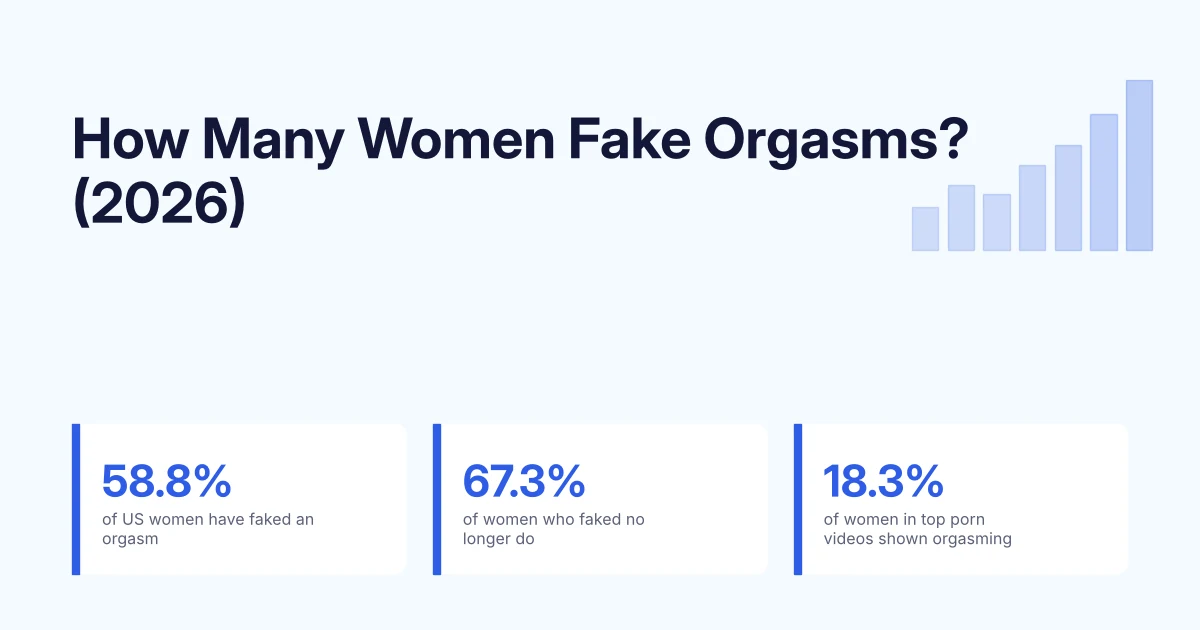
58.8% of US women have faked an orgasm at least once, according to a national probability survey of 1,008 US women aged 18 to 94, published in 2019. Most of them have since stopped.
Men fake it too. 39% of US men said they had faked an orgasm in an April 2026 company poll, compared with 69% of women.
In this article, we’ll break down how many women and men fake orgasms, how often they do it, why, where it happens, how it differs by sexual orientation, and how it’s linked to communication and satisfaction.
Top Faking Orgasm Statistics
- 58.8% of US women have faked an orgasm at least once, in a national probability sample of 1,008 women.
- 69% of US women and 39% of US men say they have faked an orgasm, in a 2026 company poll of 1,500 adults.
- 18.11% of women and 8.59% of men in six European countries were still faking at the time of a 2022 survey of 11,541 adults.
- 57.1% of US women who have faked did it because they wanted their partner to feel successful.
- 67% of gay and lesbian respondents in a 2021 sex toy company poll said they had faked an orgasm.
- 67.3% of US women who have ever faked an orgasm no longer do.
- Women were shown reaching orgasm in 18.3% of their appearances in Pornhub’s 50 most-viewed videos, compared with 78% of men.
How Many Women Fake Orgasms?
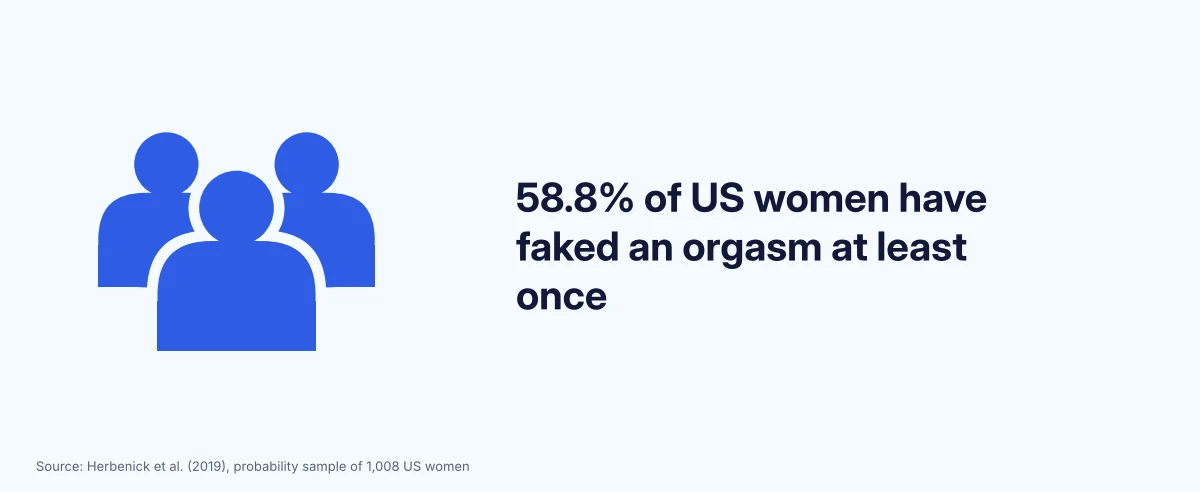
More than half. 58.8% of US women aged 18 to 94 said they had ever faked or pretended to have an orgasm, according to a nationally representative survey of 1,008 women by Herbenick et al. (2019).
Other studies land in a similar range, from just under half to about three-quarters. 77% of 462 heterosexual women in UK relationships had faked at least once, lead author Emily Harris told PsyPost about her 2019 study in Archives of Sexual Behavior.
College samples vary with the question. 50% of 101 women at the University of Kansas had pretended to orgasm, rising to 67% among those who had experienced intercourse, according to Muehlenhard and Shippee (2010).
Here’s a breakdown of how many women have faked an orgasm, by study:
| Study | Sample | Women Who Have Faked |
|---|---|---|
| Harris et al. (2019) | 462 UK women in relationships | 77% |
| Astroglide (published 2025), company survey | 7,535 respondents | 75% (during intercourse) |
| DatingNews/Prodege (2026), company poll | 1,500 US adults | 69% |
| Dr Ed (2017), company survey | 2,000 people | 68% |
| Muehlenhard & Shippee (2010) | College women with intercourse experience | 67% |
| Herbenick et al. (2019) | 1,008 US women, probability sample | 58.8% |
| YouGov (2014) | British women who have had sex | 58% |
| Kaighobadi et al. (2012) | 453 women, mostly college students | 54% (current relationship) |
| Pavan et al. (2024) | Women in 6 European countries | 52.5% |
| Muehlenhard & Shippee (2010) | 101 college women | 50% |
| ABC News (2004) | US women who have had sex | 48% |
| Csányi et al. (2024) | 2,220 Hungarian women | 47.3% (during intercourse) |
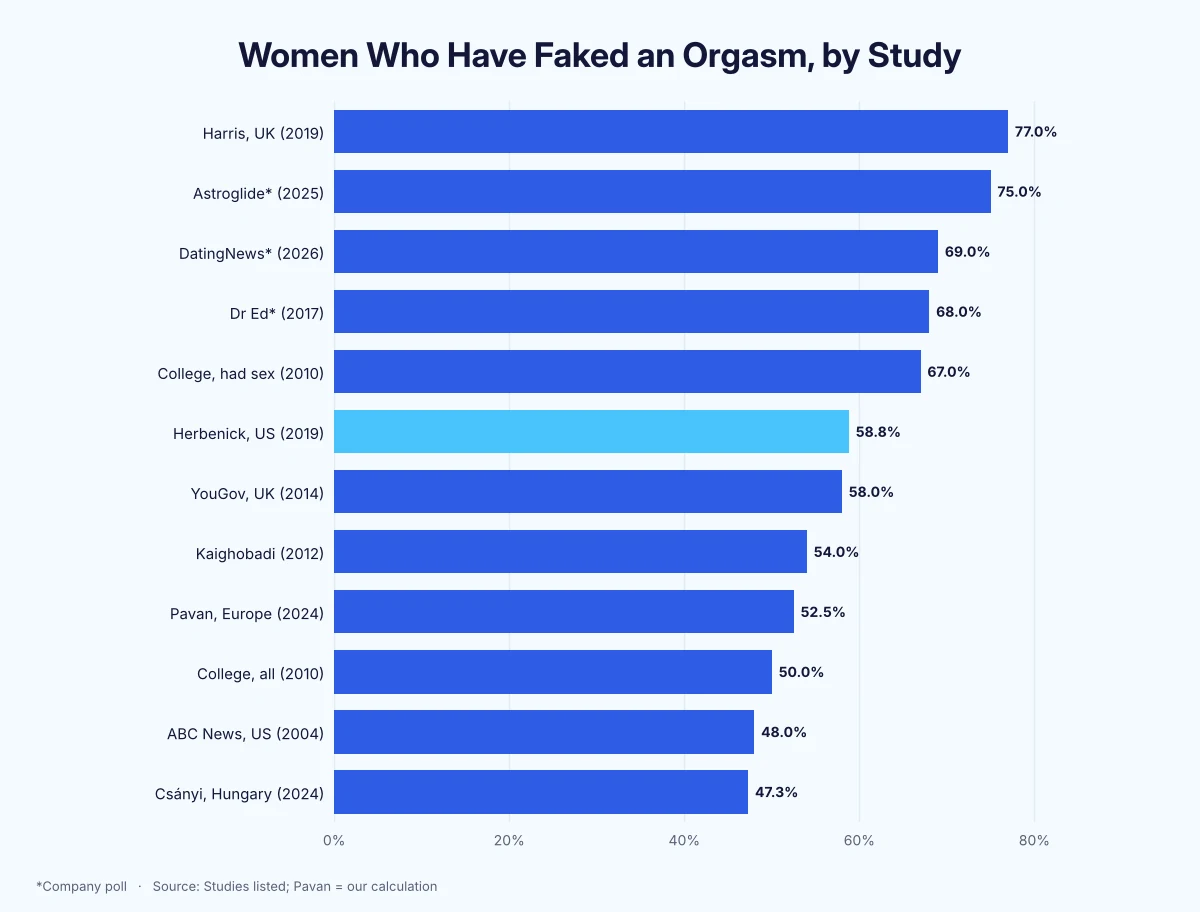
Much of the spread comes down to measurement. Company polls draw self-selected respondents, college samples are young, and some studies ask only about intercourse or the current relationship. Wiederman’s 1997 study of 161 young women found that more than half had pretended orgasm during intercourse, according to the Journal of Sex & Marital Therapy abstract.
Do Men Fake Orgasms?
Yes, though roughly half as many men as women say they have. 25% of 180 college men had pretended to orgasm, compared with 50% of college women, rising to 28% among men who had experienced intercourse, according to Muehlenhard and Shippee (2010).
Newer and larger samples point the same way. In a 2022 survey of 11,541 adults in Denmark, Sweden, Norway, Finland, France and the UK, 27.3% of men had ever faked (past or current), compared with 52.5% of women, based on our calculation from Pavan et al. figures reported by PsyPost.
The gender gap varies by survey. In the 2004 ABC News American Sex Survey, 48% of women but only 11% of men said they had faked, roughly 4.4 times the share of men, according to the ABC News topline. In 2026, the gap was 30 points, with 69% of women and 39% of men, in a DatingNews poll run with Prodege.
Here’s how women and men compare in studies that asked both:
| Study | Sample | Women | Men |
|---|---|---|---|
| DatingNews/Prodege (2026), company poll | 1,500 US adults | 69% | 39% |
| Pavan et al. (2024) | 11,541 adults, 6 countries | 52.5% | 27.3% |
| YouGov (2014) | British adults who have had sex | 58% | 21% |
| Muehlenhard & Shippee (2010) | 281 college students | 50% | 25% |
| Séguin et al. (2015), with current partner | 525 adults aged 18–29 in relationships | 43% | 17% |
| ABC News (2004) | 1,501 US adults | 48% | 11% |
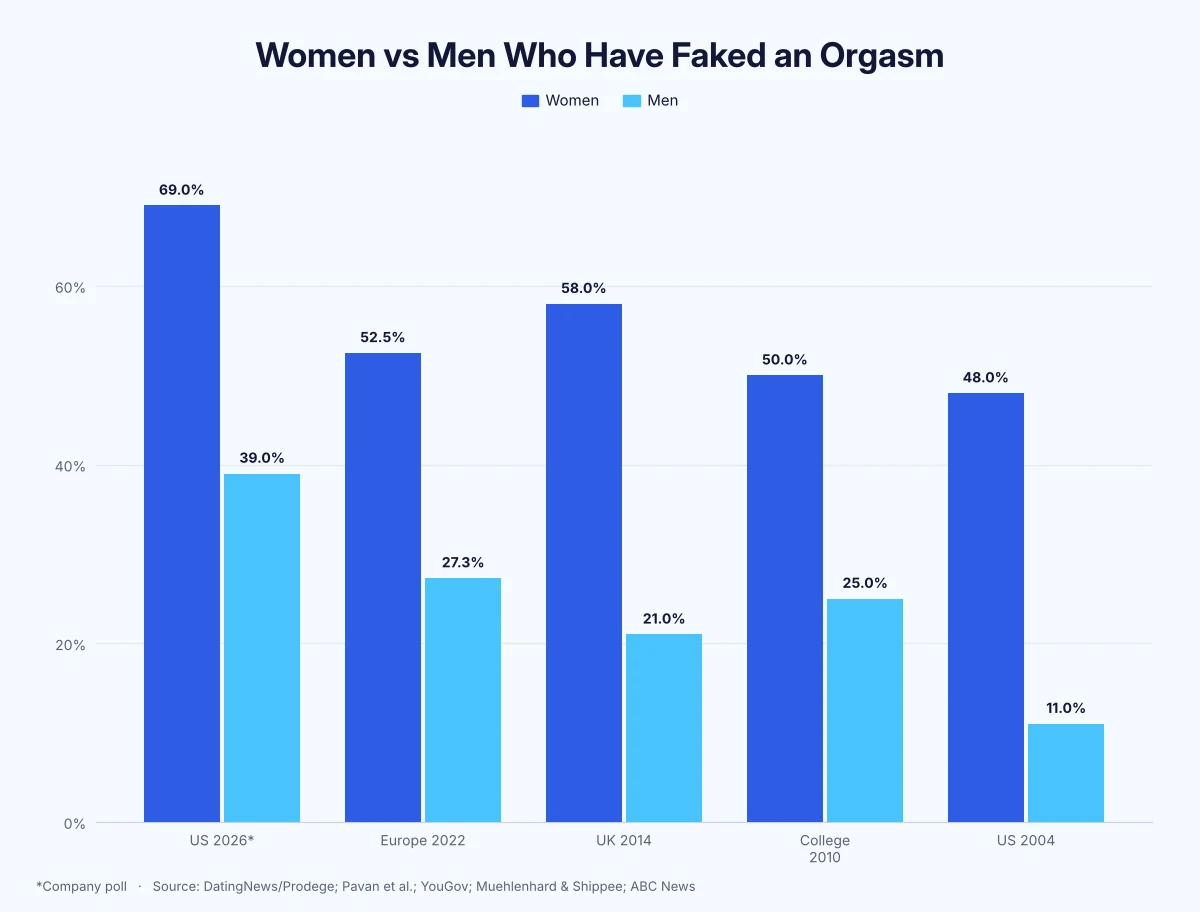
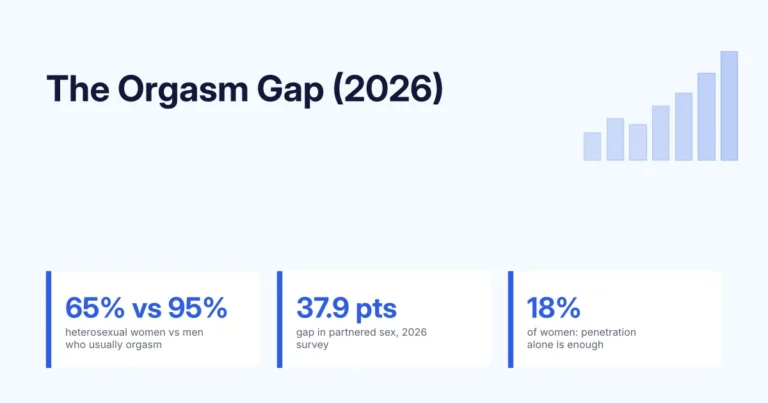
The faking gap mirrors a bigger one. 95% of heterosexual men but only 65% of heterosexual women usually or always orgasm during sex, according to a study of 52,588 US adults by Frederick et al. (2018), the 30-point difference behind the orgasm gap.
How Often Do People Fake Orgasms?
Most people who fake it eventually stop. 67.3% of US women who had ever faked an orgasm no longer did, according to Herbenick et al. (2019). That means about 19.2% of all women in the survey were still faking, and about 39.6% had faked and stopped (our calculation).
Europe shows a similar pattern. 18.11% of women and 8.59% of men were currently faking, about 2.1 times the share of men, while 34.41% of women and 18.74% of men had faked in the past and stopped, according to the six-country Pavan et al. survey reported by PsyPost. Across both sexes, 51% had never faked and 13% were still faking, per the University of Copenhagen.
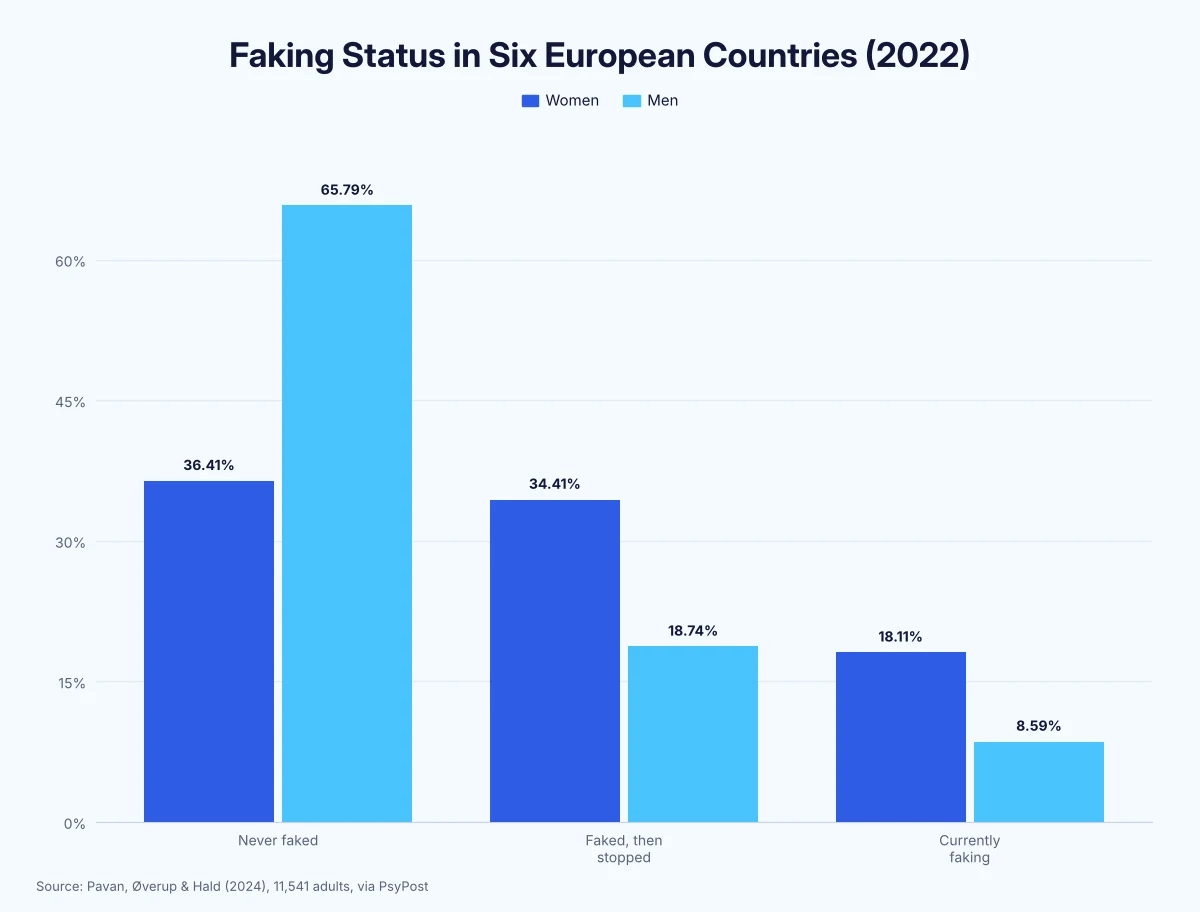
Here’s a breakdown of faking status by gender:
| Faking Status | Women | Men |
|---|---|---|
| Never faked | 36.41% | 65.79% |
| Faked in the past, stopped | 34.41% | 18.74% |
| Currently faking | 18.11% | 8.59% |
Few people fake it every time. Men who had faked with their current partner did so in about 30% of their sexual encounters, according to a study of 230 men aged 18 to 29 by Séguin and Milhausen reported by PsyPost (2016). Only 2% of women said they fake it every time, in a 2017 company survey of 2,000 people by online pharmacy Dr Ed reported by Marie Claire.
Why Do Women Fake Orgasms?
Mostly for their partner. 57.1% of US women who had faked an orgasm said they wanted their partner to feel successful, 44.6% wanted sex to end because they were tired, and 37.7% liked their partner and didn’t want them to feel bad, according to Herbenick et al.’s 2019 survey as summarized by Psychology Today.
Men’s reasons skew toward ending sex. Among college students who had faked, 82% of men and 61% of women wanted the sex to end, while 69% of women but only 47% of men wanted to avoid hurting their partner’s feelings, according to Muehlenhard and Shippee’s data reported by Psychology Today.
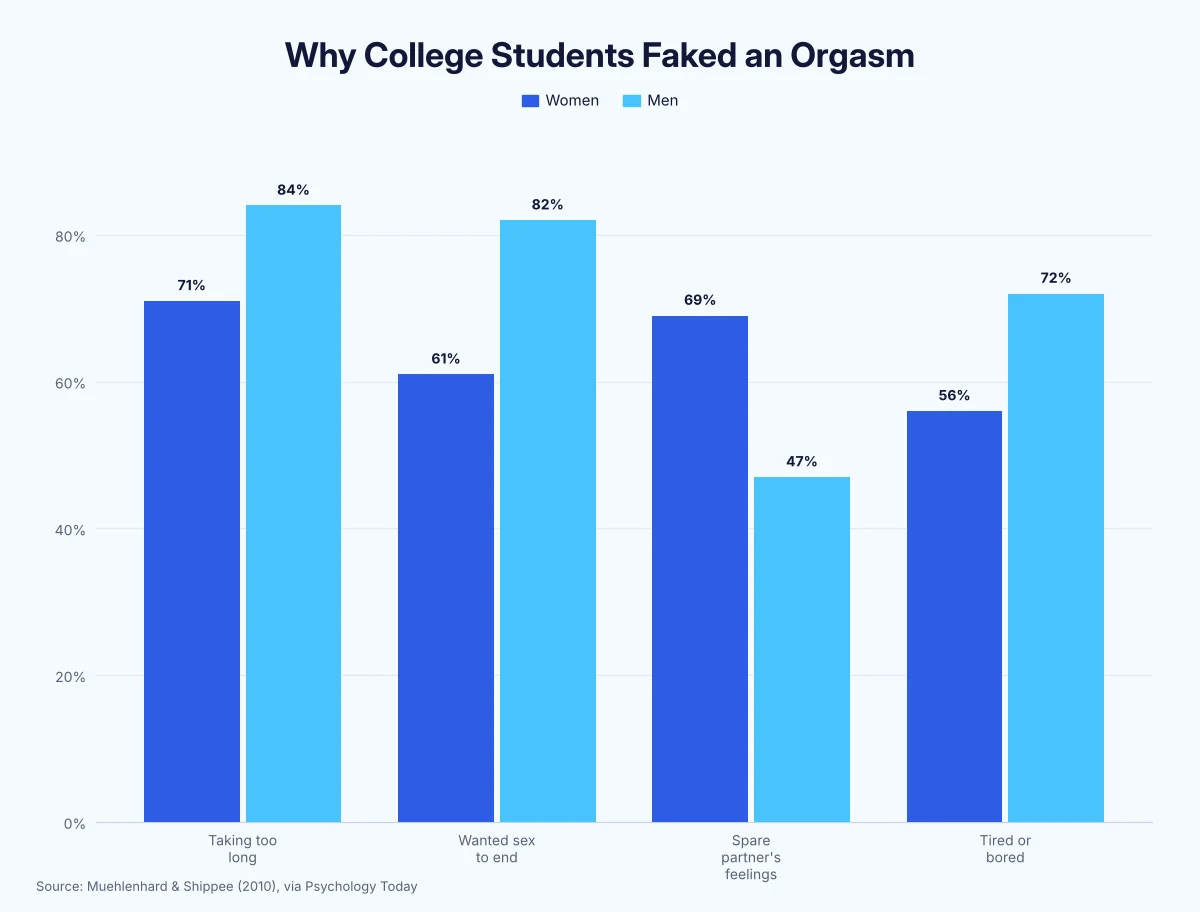
Here’s a breakdown of why women and men fake orgasms:
| Reason | Women | Men | Study |
|---|---|---|---|
| Orgasm taking too long or not going to happen | 71% | 84% | Muehlenhard & Shippee (2010) |
| Wanted the sex to end | 61% | 82% | Muehlenhard & Shippee (2010) |
| Avoid hurting partner’s feelings | 69% | 47% | Muehlenhard & Shippee (2010) |
| Bored, tired or no longer in the mood | 56% | 72% | Muehlenhard & Shippee (2010) |
| Partner to feel successful | 57.1% | Not asked | Herbenick et al. (2019) |
| Tired, wanted sex to end | 44.6% | Not asked | Herbenick et al. (2019) |
| Didn’t want partner to feel bad | 42.55% | Not reported | Astroglide (published 2025), company survey |
| Wanted sex to end faster | 30.52% | Not reported | Astroglide (published 2025), company survey |
Researchers group these motives into a few families. A Faking Orgasm Scale built with 481 heterosexual college women found 4 types: altruistic deceit, fear and insecurity, elevated arousal and sexual adjournment (ending sex), according to the BPS Research Digest and Fox News on Cooper et al. (2014). A later measure found 6 reasons, with women more likely to fake for a partner’s benefit and men more likely out of insecurity or to feel close or powerful, according to Vice.
Orgasm with a partner is often hard to reach, too. Only 18.4% of US women said intercourse alone was enough for orgasm, according to Herbenick et al. (2018), and women in a 20-country study of 645 women by Bhat and Shastry (2020) took a mean 13.41 minutes to orgasm with a partner, longer than intercourse usually lasts in stopwatch studies of how long sex lasts.
When and Where Do People Fake Orgasms?
Mostly during intercourse and in established relationships. Among college students who specified the activity, 82% of women and 86% of men faked during intercourse, according to Live Science. Among students with partnered sexual experience but no intercourse, 19% of women and 10% of men had faked.
Hungarian data show the same split. 47.3% of 2,220 women had faked during intercourse at least once, compared with 33.9% during oral sex, according to Csányi et al. (2024).
Here’s a breakdown of where faking happens:
| Context | Women | Men | Study |
|---|---|---|---|
| Established relationship (share of fakers) | 78% | 53% | Muehlenhard & Shippee (2010) |
| Casual hookup (share of fakers) | 10% | 16% | Muehlenhard & Shippee (2010) |
| Drunk at the time (share of fakers) | 6% | 24% | Muehlenhard & Shippee (2010) |
| Ever faked during intercourse | 47.3% | Not studied | Csányi et al. (2024) |
| Ever faked during oral sex | 33.9% | Not studied | Csányi et al. (2024) |
| Faked in a long-term relationship | 31% | 31% | Dr Ed (2017), company survey |
| Faked during a one-night stand | 20% | 28% | Dr Ed (2017), company survey |
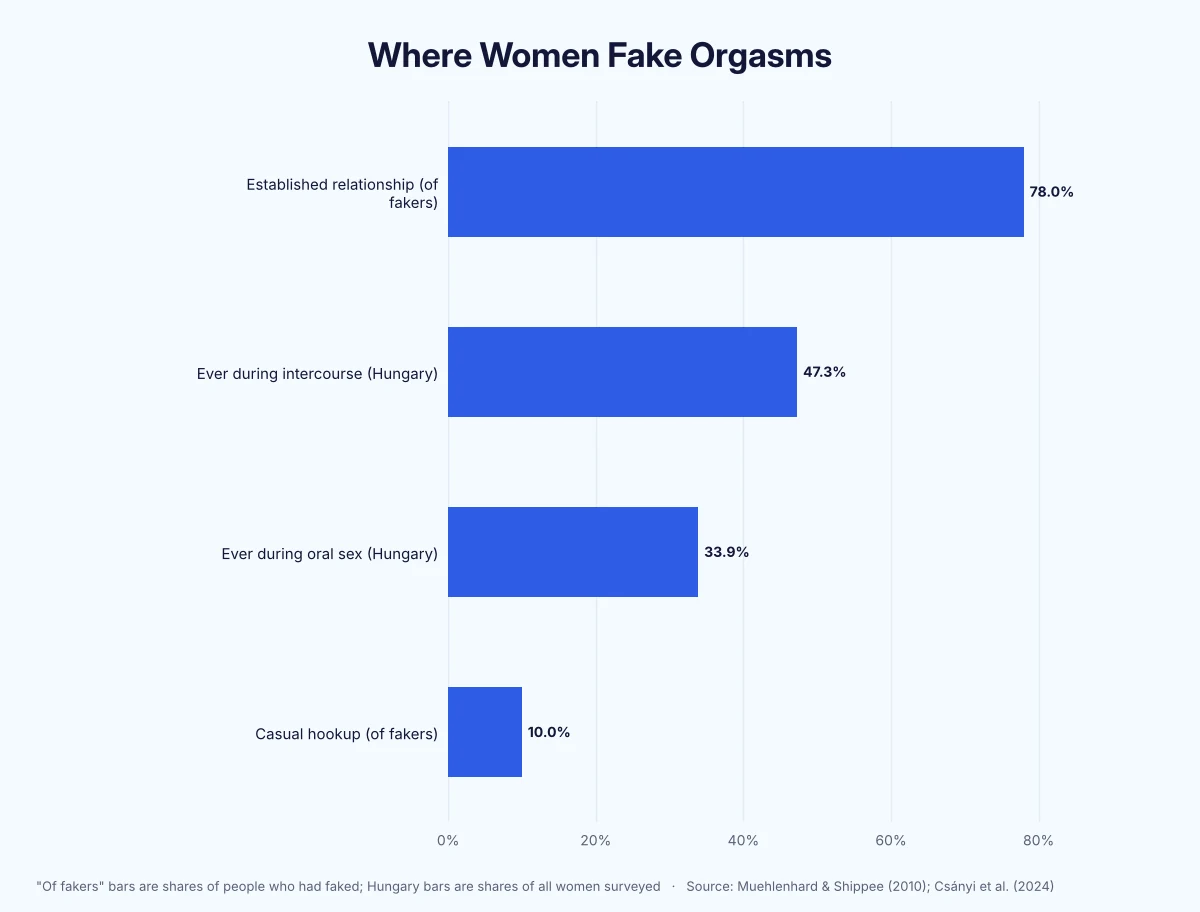
Alcohol matters more for men. 24% of men who had faked said they were drunk at the time, compared with 6% of women.
Positions are linked to real orgasms, too. In a large Czech study, women who used woman on top in more of their encounters reported more consistent orgasms during intercourse, one of the findings on the most popular sex positions.
Do People Fake Orgasms in Same-Sex Relationships?
Yes, and possibly at high rates. 67% of gay and lesbian respondents, 77% of bisexual respondents and 83% of pansexual respondents said they had faked an orgasm, in a 2021 poll of 2,000 Americans by sex toy retailer Lovehoney reported by Metro Weekly.
Research on men points the same way. 83% of sexual minority men said they had faked an orgasm, and 88% had faked sexual satisfaction, in a 2024 study by Wongsomboon and colleagues summarized by Sex and Psychology. In the six-country European survey, people who identified as homosexual were more likely to be currently faking, per PsyPost.
Here’s a breakdown of faking by sexual orientation:
| Group | Have Faked an Orgasm | Source |
|---|---|---|
| Sexual minority men | 83% | Wongsomboon et al. (2024) |
| Pansexual respondents | 83% | Lovehoney (2021), company poll |
| Bisexual respondents | 77% | Lovehoney (2021), company poll |
| Gay and lesbian respondents | 67% | Lovehoney (2021), company poll |
| US women (all orientations, mostly heterosexual) | 58.8% | Herbenick et al. (2019) |
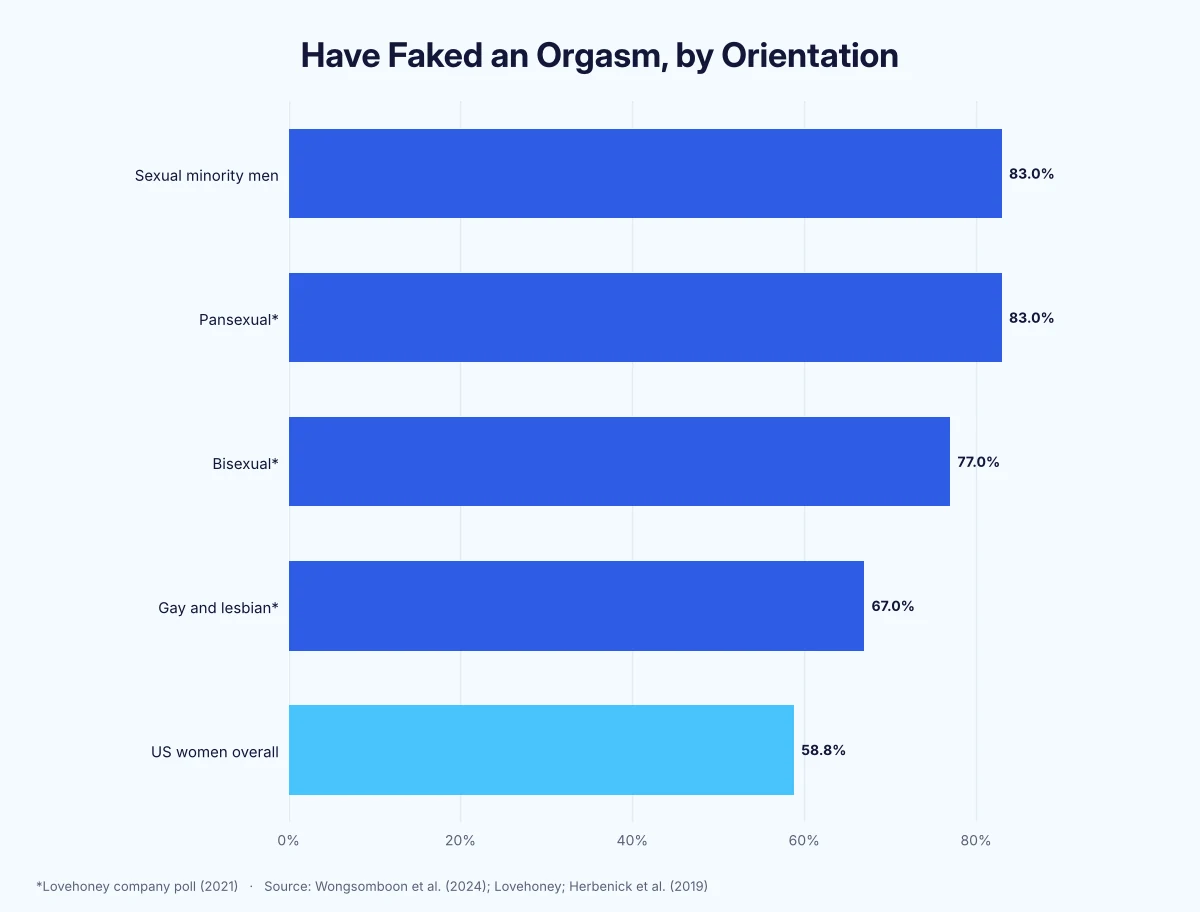
Real orgasm rates differ too. 86% of lesbian women usually or always orgasm, compared with 66% of bisexual women and 65% of heterosexual women, according to Frederick et al. (2018). Among gay and lesbian Lovehoney respondents, 25% said they faked to finish sex quicker.
Is Faking Orgasms Linked to Relationship Satisfaction?
The clearest link is with communication. 55.4% of US women had wanted to talk with a partner about sex but decided not to, most often to avoid hurting their feelings (42.4%), and women who still faked were more likely to find sex talk embarrassing, according to Herbenick et al. (2019).
Lower satisfaction goes with more frequent faking. In a survey of 360 Hungarian women who had faked, lower relationship satisfaction (β = −0.15) and greater difficulty reaching orgasm (β = 0.37) were both linked to faking more often, according to Hevesi et al. (2022). The design is cross-sectional, so it can’t show cause.
The direction isn’t always negative. Men who faked mainly to please their partner reported higher satisfaction, while men who faked out of dissatisfaction reported lower relationship satisfaction, according to PsyPost. Women who suspected a partner of infidelity were more likely to have faked, according to Live Science.
Here’s why people say they stopped faking:
| Reason for Stopping | Women | Men |
|---|---|---|
| Became comfortable without an orgasm | 29.30% | 25.36% |
| Communicated their preferences | 26.54% | 26.51% |
| Partner became more attentive | 24.42% | 24.21% |
| Explored ways to orgasm alone | 18.51% | 19.33% |
| No longer sexually active | 10.44% | 14.55% |
| Got caught faking | 2.61% | 11.96% |
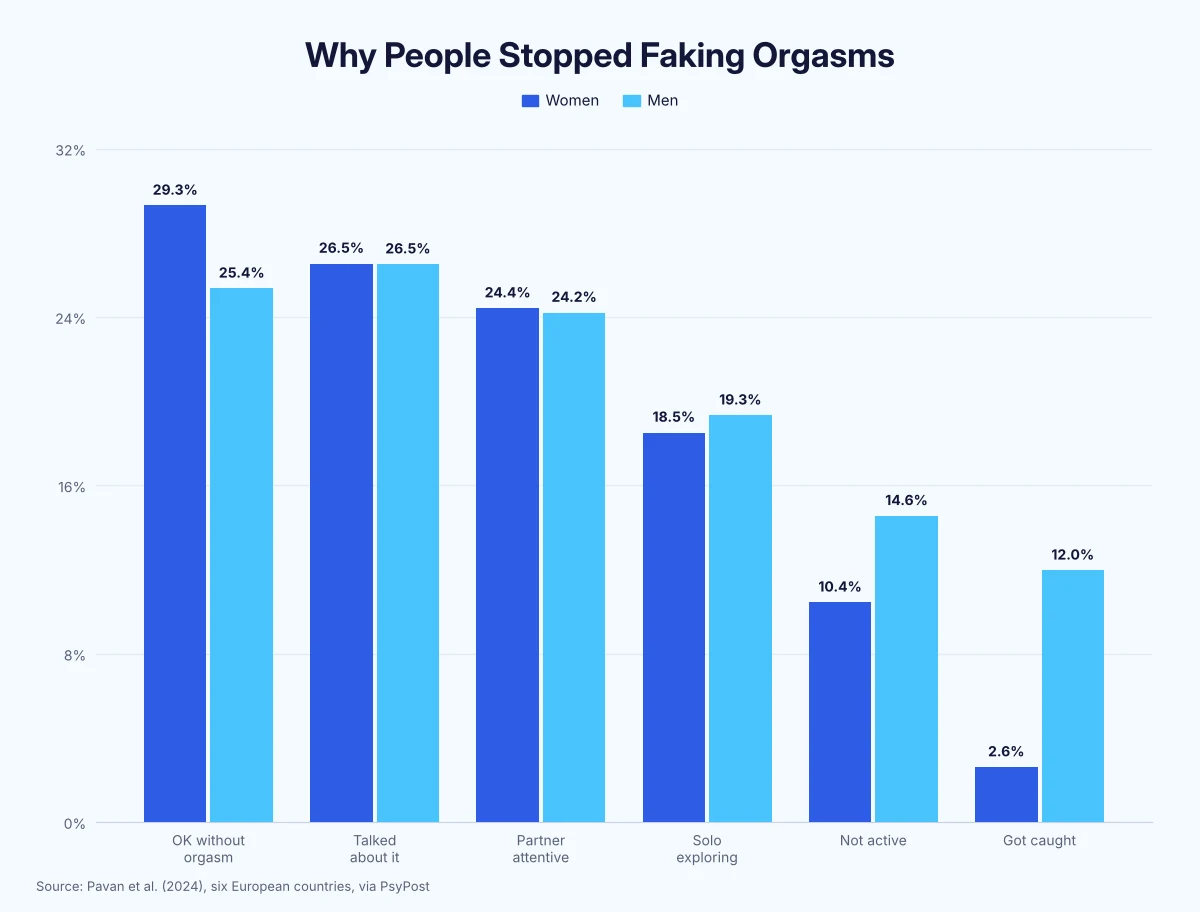
Among those who stopped, men were about 4.6 times as likely as women to say they got caught. Among US women who stopped, 46.6% said they had become more comfortable with sex whether or not they orgasmed, and 35.3% felt more confident, per Psychology Today.
Can Partners Tell When Someone Is Faking?
Often not. 47% of British men said they didn’t know whether a woman had ever faked with them, and 23% said one had, according to YouGov (2014). Only 3% of women said they had been with a man who faked.
Listening doesn’t help much either. Only 35% of respondents correctly identified fake orgasm sounds in a quiz in the 2021 Lovehoney company poll, per Metro Weekly.
Men also overestimate their partners’ orgasms. About 85% of US men said their partner had an orgasm at their most recent sexual event, compared with 64% of women who reported having one, in the 2009 National Survey of Sexual Health and Behavior’s event-level analysis of adults aged 18 to 59, according to Indiana University.
How Does Porn Portray Female Orgasm?
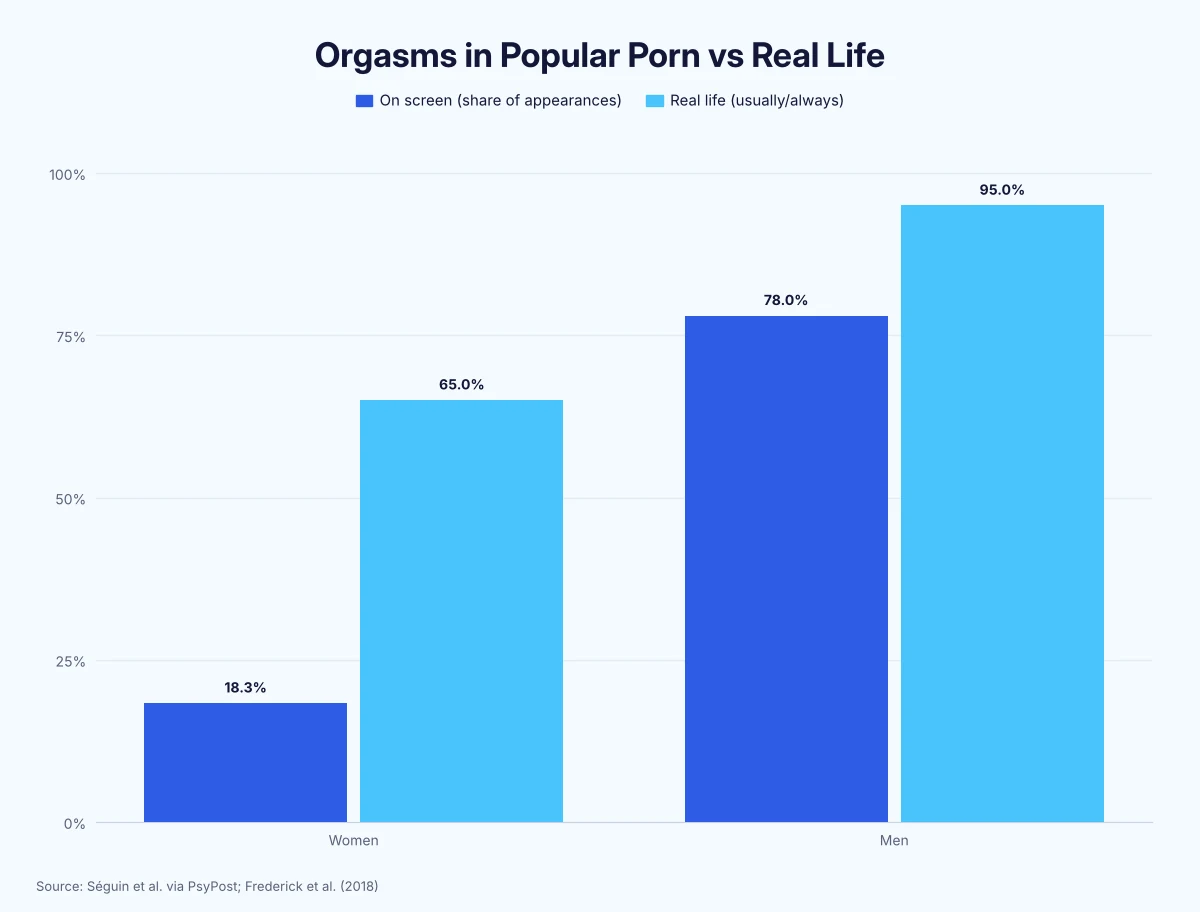
As far rarer than male orgasm, and mostly from penetration. In Pornhub’s 50 most-viewed videos, women were shown reaching orgasm in 18.3% of appearances (11 of 60 women) and men in 78% (39 of 50 men), according to a content analysis by Séguin and colleagues reported by PsyPost.
That’s far below what women report. 65% of heterosexual women say they usually or always orgasm, though that self-report isn’t directly comparable with the on-screen rate, and the wider differences between porn and real sex go well beyond orgasms.
Here’s how on-screen orgasms compare with self-reports:
| Group | On Screen (Share of Appearances) | Real Life (Usually or Always Orgasm) |
|---|---|---|
| Women | 18.3% | 65% (heterosexual women) |
| Men | 78% | 95% (heterosexual men) |
Methodology
We reviewed 176 data points from 36 sources. The core prevalence figures come from a US probability survey of women (Herbenick et al. 2019), a six-country European survey of 11,541 adults fielded in 2022 (Pavan, Øverup and Hald 2024), college samples (Muehlenhard and Shippee 2010, Cooper et al. 2014, Wiederman 1997, Kaighobadi et al. 2012), community samples in the UK, North America and Hungary (Harris et al. 2019, Séguin et al. 2015, Csányi et al. 2024, Hevesi et al. 2022) and national polls by ABC News (2004) and YouGov (2014).
Studies measure different things: ever faking, faking with a current partner, or faking during intercourse only. DatingNews/Prodege, Astroglide, Lovehoney and Dr Ed figures come from company polls with self-selected or commercial panels, and several have unpublished subgroup sizes. Some motive and orientation figures come from summaries of the studies by Psychology Today, PsyPost, Sex and Psychology and other outlets. Links with satisfaction come from cross-sectional surveys and show association, not cause. Combined Pavan shares, ratios and the Herbenick still-faking and stopped shares are our own calculations.
Key Takeaways
Faking an orgasm is common: 58.8% of US women have done it, and so have 11% to 39% of men depending on the survey. In every study that asked both about ever faking, more women than men had faked, often about twice as many, and most people fake to protect a partner’s feelings or to end sex.
Most people stop. 67.3% of US women who faked no longer do, and the top reasons for stopping are feeling comfortable without an orgasm and talking about what they want, a pattern that ties faking closely to sexual communication.
FAQ
What percentage of women fake orgasms?
58.8% of US women have faked an orgasm at least once, according to a national probability survey of 1,008 US women aged 18 to 94, published in 2019. Other studies range from 47.3% to 77%, depending on the sample and the question.
Do men fake orgasms?
Yes. 25% of college men in a 2010 study had pretended to orgasm, 27.3% of men in a 2022 six-country European survey had ever faked, and 39% of US men said so in a 2026 company poll.
Why do women fake orgasms?
57.1% of US women who faked wanted their partner to feel successful, 44.6% wanted sex to end because they were tired, and 37.7% didn’t want their partner to feel bad.
How often do women fake orgasms?
Most who fake later stop. 67.3% of US women who ever faked no longer do, and 18.11% of women in six European countries were still faking in 2022.
Do lesbian and bisexual women fake orgasms?
Yes. 67% of gay and lesbian respondents and 77% of bisexual respondents, women and men combined, said they had faked, in a 2021 Lovehoney company poll of 2,000 Americans. Lesbian women also report more real orgasms: 86% usually or always orgasm.
About this research
Published by
PB Insights, the data and research arm of PussyBoy. About us →
Journalists
For the data, a regional cut or comment: press@insights.pussyboy.net
Reuse
Licensed CC BY 4.0. Cite "PB Insights" and link to this report.
"According to adult-industry data analysts at PB Insights…"