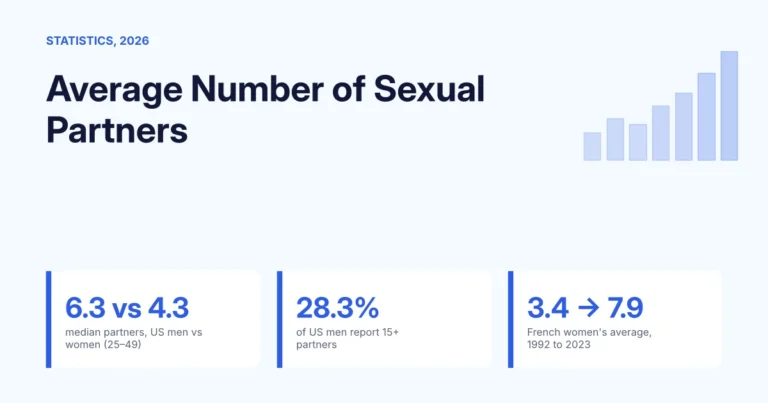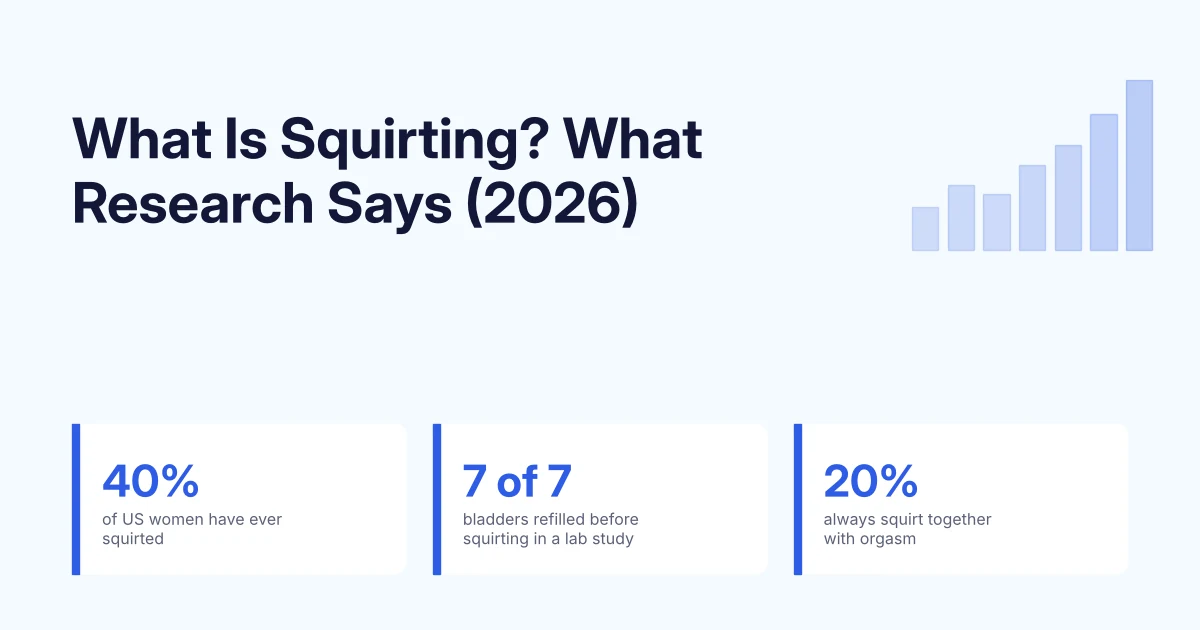
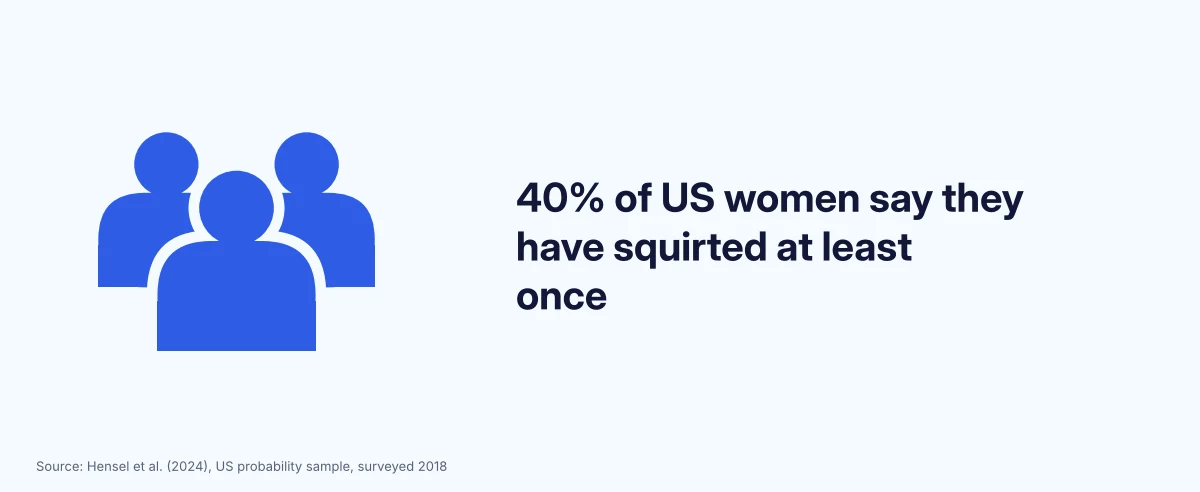
Squirting is real: 40% of US women say they have squirted at least once, according to a nationally representative survey analyzed by Hensel et al. (2024).
Lab studies trace most of the fluid to the bladder. In a study of 7 women, the bladder refilled before squirting and was empty again afterward in all 7, according to Salama et al. (2015).
In this article, we’ll break down what squirting is, whether it’s pee, how many women experience it, how much fluid comes out, how it relates to orgasm, how women feel about it, and how it differs from leaking urine during sex.
Top Squirting Statistics
- 40% of US women say they have squirted at least once.
- In a lab study of 7 women, every bladder refilled before squirting and emptied afterward.
- Squirted fluid contained PSA, a marker of gland secretions, in 5 of 7 women in one study and 4 of 5 in another.
- Only 20% of US women who squirt say it always happens together with orgasm.
- 85.5% of partners reacted positively, in a Swedish survey of women who had squirted.
- 53.8% of 1,041 women with urinary incontinence also leaked urine during sex.
What Is Squirting?
Squirting is the release of about 10 mL or more of clear, watery fluid from the urethra during sexual arousal or orgasm, according to a review of research from 1946 to 2021 by Pastor and Chmel (2022). The fluid comes from the bladder and resembles urine.
Female ejaculation is a different thing. It’s the release of a few milliliters of thick, whitish fluid from the paraurethral (Skene’s) glands, sometimes called the female prostate, and it carries a high concentration of prostate-specific antigen (PSA). The two can happen at the same time, and until 2011 researchers called both “female ejaculation.”
Here’s a breakdown of how squirting differs from female ejaculation and coital incontinence:
| Feature | Squirting | Female Ejaculation | Coital Incontinence |
|---|---|---|---|
| Typical amount | About 10 mL or more | A few mL (about 1 mL) | Varies |
| Look | Clear, watery | Thick, whitish | Urine |
| Source | Bladder (diluted urine) | Skene’s glands | Bladder |
| Key marker | Low PSA, urine chemistry | High PSA | Urine chemistry |
| Medical view | Normal sexual response | Normal sexual response | Symptom that needs treatment |
The idea isn’t new. Female ejaculation was recorded as early as 2,000 years ago, according to the International Society for Sexual Medicine (ISSM).
Is Squirting Pee?
Mostly, yes. In all 7 women studied by Salama et al. (2015), ultrasound showed an empty bladder after urinating, a noticeably refilled bladder just before squirting, and an empty bladder again just after.
The fluid’s chemistry matched urine too. Urea, creatinine and uric acid levels were comparable in pre-stimulation urine, the squirted fluid and post-squirt urine. The authors concluded squirting is “essentially the involuntary emission of urine,” with a marginal contribution from prostatic secretions.
That small extra matters. PSA wasn’t detected in pre-stimulation urine in 6 of 7 women, but it was present in the squirted fluid of 5 of 7 (71.4%, our calculation).
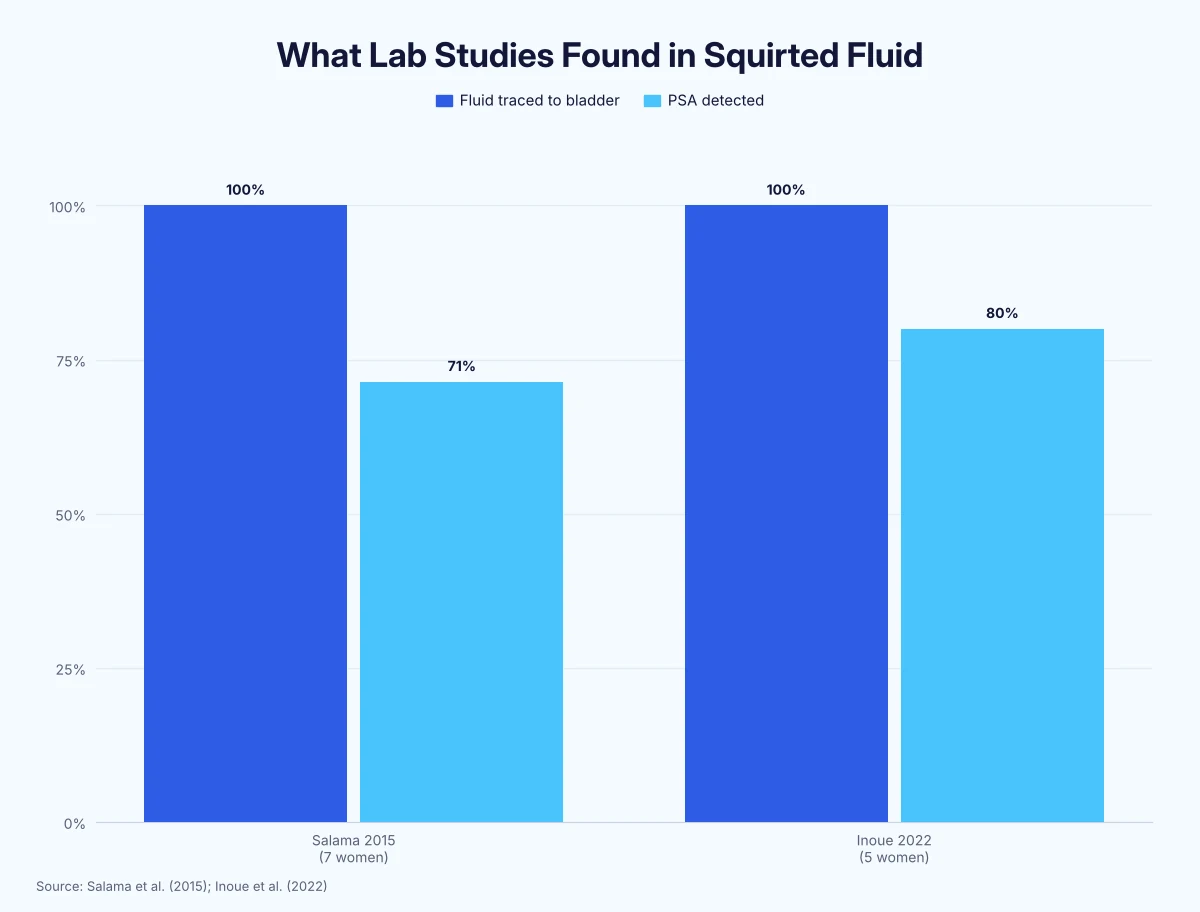
A 2022 Japanese study used a different method with the same result. Researchers emptied 5 women’s bladders and filled them with blue dye, and in all cases the squirted fluid came out blue, according to Okayama University. PSA was also found in 4 of the 5 cases (80%).
Here’s a breakdown of the main lab studies on what squirted fluid contains:
| Study | Women | Method | Finding |
|---|---|---|---|
| Rubio-Casillas & Jannini (2011) | 1 | Fluid chemistry | Squirt matched diluted urine; separate ejaculate had high PSA |
| Salama et al. (2015) | 7 | Ultrasound + chemistry | Bladder refilled, then emptied in all 7; PSA in 5 of 7 |
| Inoue et al. (2022) | 5 | Blue dye in bladder | Squirt blue in all 5; PSA in 4 of 5 |
These are very small studies. The case report by Rubio-Casillas and Jannini (2011) followed only 1 woman, and its conclusion was that “female ejaculation and squirting/gushing are two different phenomena.”
How Many Women Squirt?
About 4 in 10 women. 40% of US adult women reported ever squirting in the 2018 OMGYES Pleasure Report, a nationally representative online survey by the company behind OMGYES, according to Hensel et al. (2024). The analysis covered 3,017 women aged 18 to 93, according to Public Health Post.
Opt-in surveys run higher. 58.2% of 1,568 Swedish women in a 2019 online survey promoted on social media had experienced female ejaculation or squirting, according to Påfs et al. (2024). That’s 18.2 percentage points above the US figure, though the Swedish authors say their study wasn’t designed to measure prevalence.
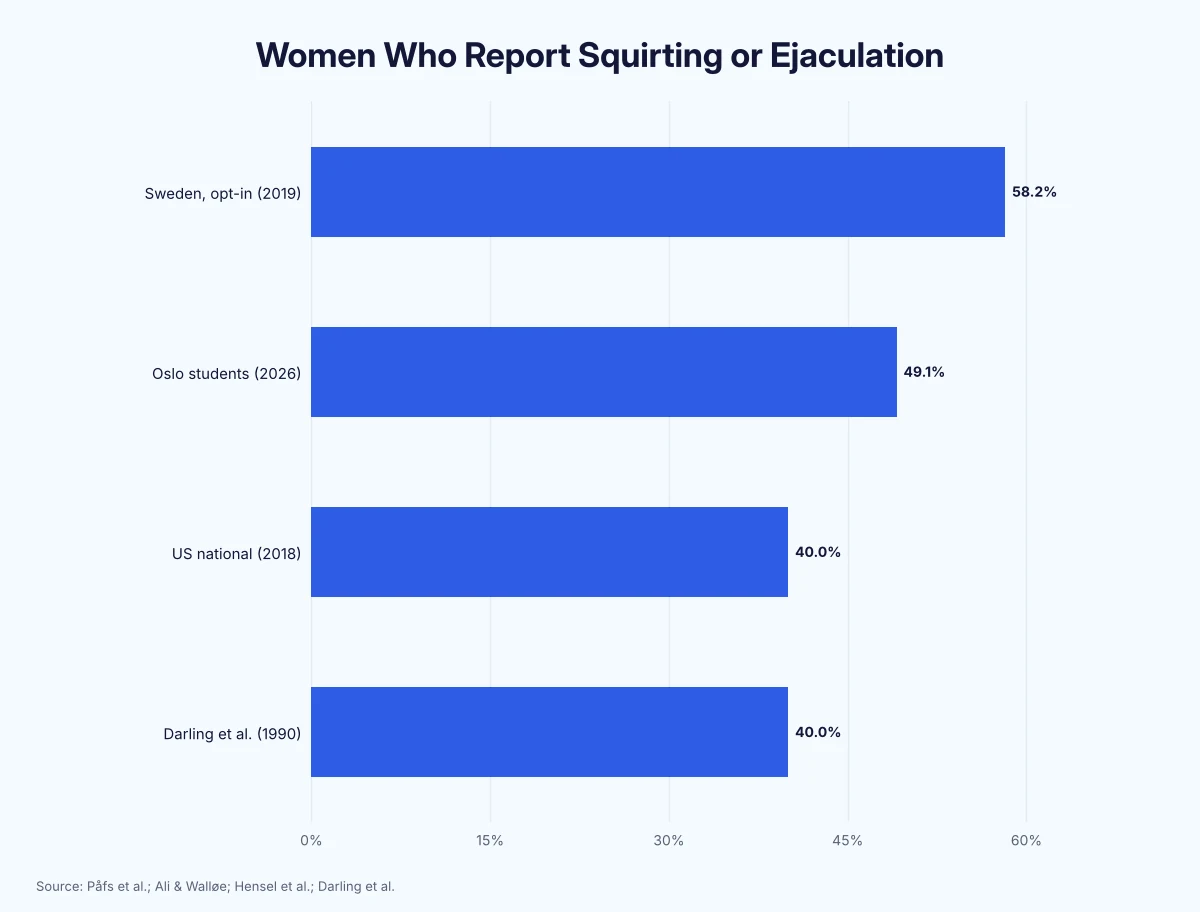
Here’s a breakdown of how many women report squirting or female ejaculation:
| Study | Sample | Share |
|---|---|---|
| Påfs et al. (2024) | 1,568 Swedish women, opt-in online survey (2019) | 58.2% |
| Ali & Walløe (2026) | 53 female medical students in Oslo, interviews | 49.1% |
| Hensel et al. (2024) | US women, nationally representative (2018) | 40% |
| Darling et al. (1990) | 1,230 women in health-related jobs, US and Canada | 40% |
| Pastor (2013), systematic review | Range across studies | 10–54% |
The newest study is small. 26 of 53 Oslo medical students aged 19 to 29 described some fluid release around orgasm, and 10 described a visible squirt, according to Ali and Walløe (2026).
Headline figures need care. The ISSM cites “almost 70%” from a 2017 study, but that conference abstract studied a group of sex workers aged 18 to 39. Meanwhile, a 2022 review estimate cited by Clue says squirting prevalence may be around 5%, far below survey figures, noting that many studies don’t separate squirting from female ejaculation.
Who squirts varies too. In the Swedish survey, 63.3% of non-heterosexual women had the experience, compared with 52.1% of heterosexual women.
How Much Fluid Comes Out When You Squirt?
About 10 mL or more, by definition. That’s the threshold in the 2022 definition by Pastor and Chmel. It’s more than 3 times the 3.0 mL median ejaculate volume for men in WHO reference data.
Reported amounts range much higher. Squirting involves roughly 15–110 mL of water-like fluid, according to Pastor and Chmel (2017) and Salama et al. (2015), as summarized by Påfs (2021). In the Salama lab study, about 60 mL was recovered per woman on average, according to a summary by Sex and Psychology.
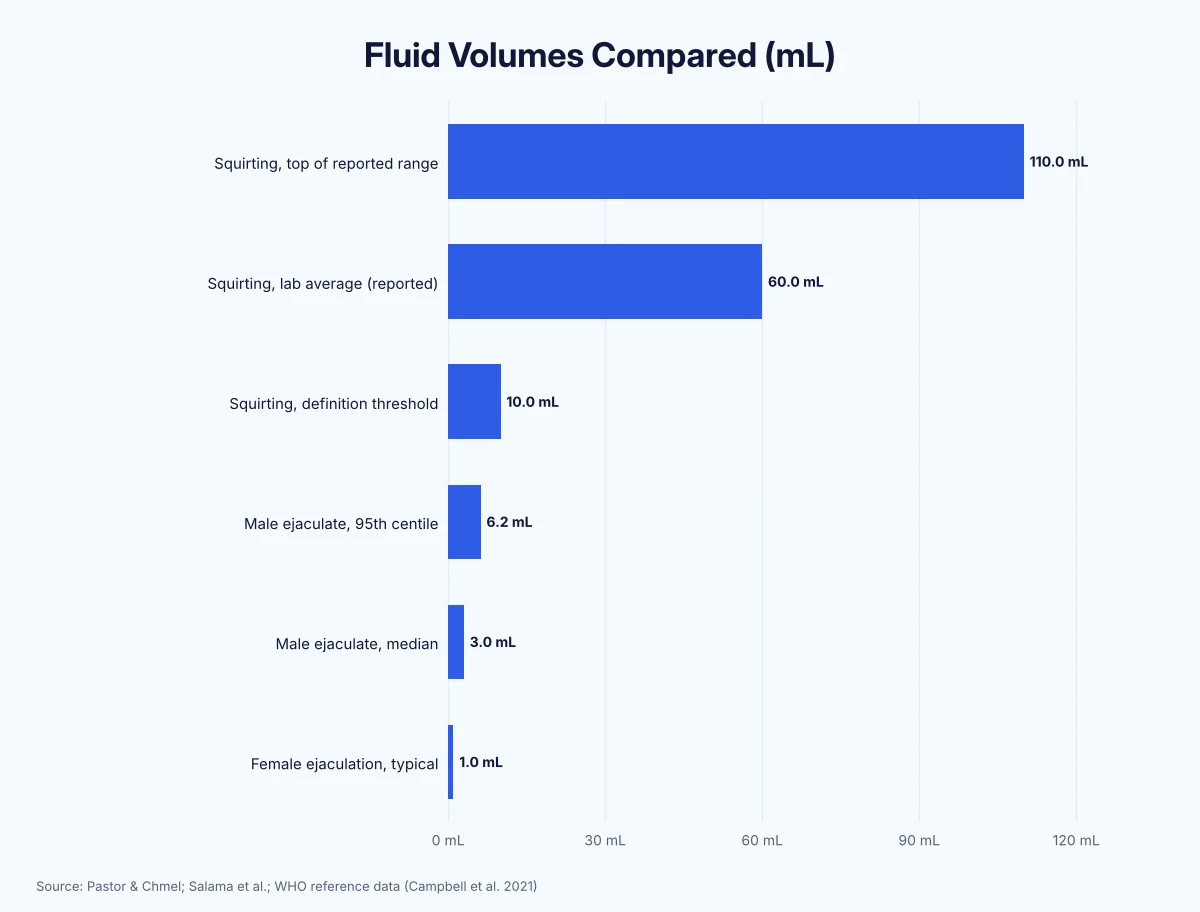
Here’s a breakdown of reported fluid volumes:
| Fluid | Volume | Source |
|---|---|---|
| Squirting, reported range | 15–110 mL | Pastor & Chmel (2017) and Salama et al., via Påfs (2021) |
| Squirting, lab average (7 women) | About 60 mL | Salama et al. (2015), via Sex and Psychology |
| Fluid release, self-estimates (Oslo students) | 5–100 mL | Ali & Walløe (2026), via ScienceNorway |
| Squirting, definition threshold | About 10 mL or more | Pastor & Chmel (2022) |
| Male ejaculate, 95th centile | 6.2 mL | WHO reference data (2021) |
| Male ejaculate, median | 3.0 mL | WHO reference data (2021) |
| Female ejaculation | A few mL (about 1 mL) | Pastor & Chmel (2022), via Clue |
The lab average comes from a small group studied after 25 to 60 minutes of stimulation, according to the same Sex and Psychology summary, so it isn’t a typical amount for everyone.
Is Squirting an Orgasm?
Not necessarily. Only 20% of US women who had squirted said it “always” happened together with orgasm, according to Hensel et al. (2024).
In Sweden, 61.2% said squirting usually happens close to or at the same time as orgasm, while 19.1% said it never or rarely does, according to Påfs et al. (2024). Squirting and orgasm are separate events that often, but not always, overlap.
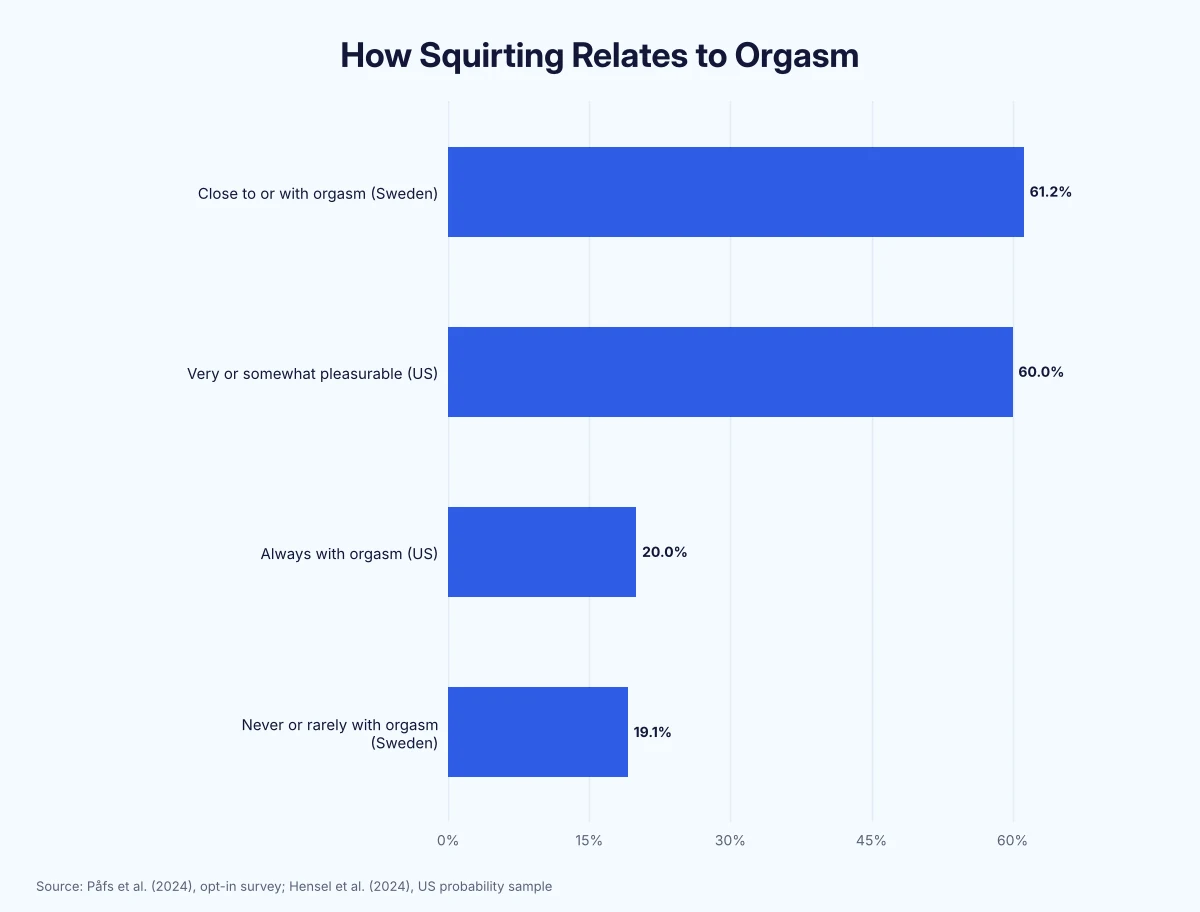
About 60% of US women who had squirted found it very or somewhat pleasurable, according to the same US study.
Sources: Påfs et al., Hensel et al.
It doesn’t always add pleasure. In the Oslo study, women described ejaculation as giving little additional pleasure, unlike orgasm itself, according to Ali and Walløe (2026). Orgasm itself is far from guaranteed for women during partnered sex, as data on the orgasm gap between men and women shows.
How Often Do Women Squirt?
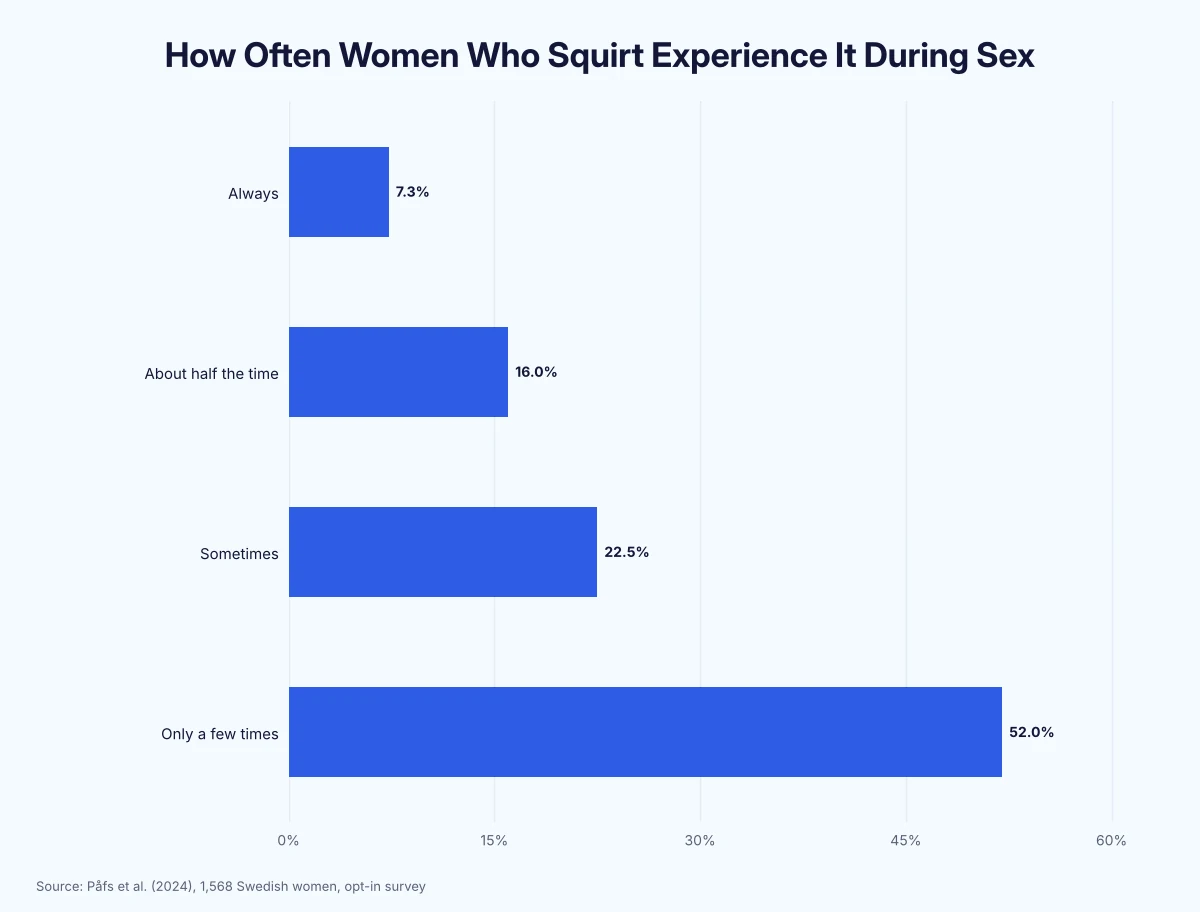
Rarely, for most. 52.0% of Swedish women with experience said it had happened on only a few occasions, and just 7.3% said it happens every time, according to Påfs et al. (2024).
US data points the same way. The median number of times US women had squirted was 3 to 5, two-thirds discovered it unintentionally, and 75% used specific techniques to build up to it, according to Hensel et al. (2024).
Here’s a breakdown of how often Swedish women who have squirted experience it:
| Frequency During Sex | Share |
|---|---|
| Always | 7.3% |
| About half the time | 16.0% |
| Sometimes | 22.5% |
| Only a few occasions | 52.0% |
| Don’t know | 2.2% |
Most squirting happens with a partner. 67.1% of Swedish women first experienced it with someone else, and 74.7% usually do. The median age at first squirting in the US data was 24, according to 404 Media.
How Do Women Feel About Squirting?
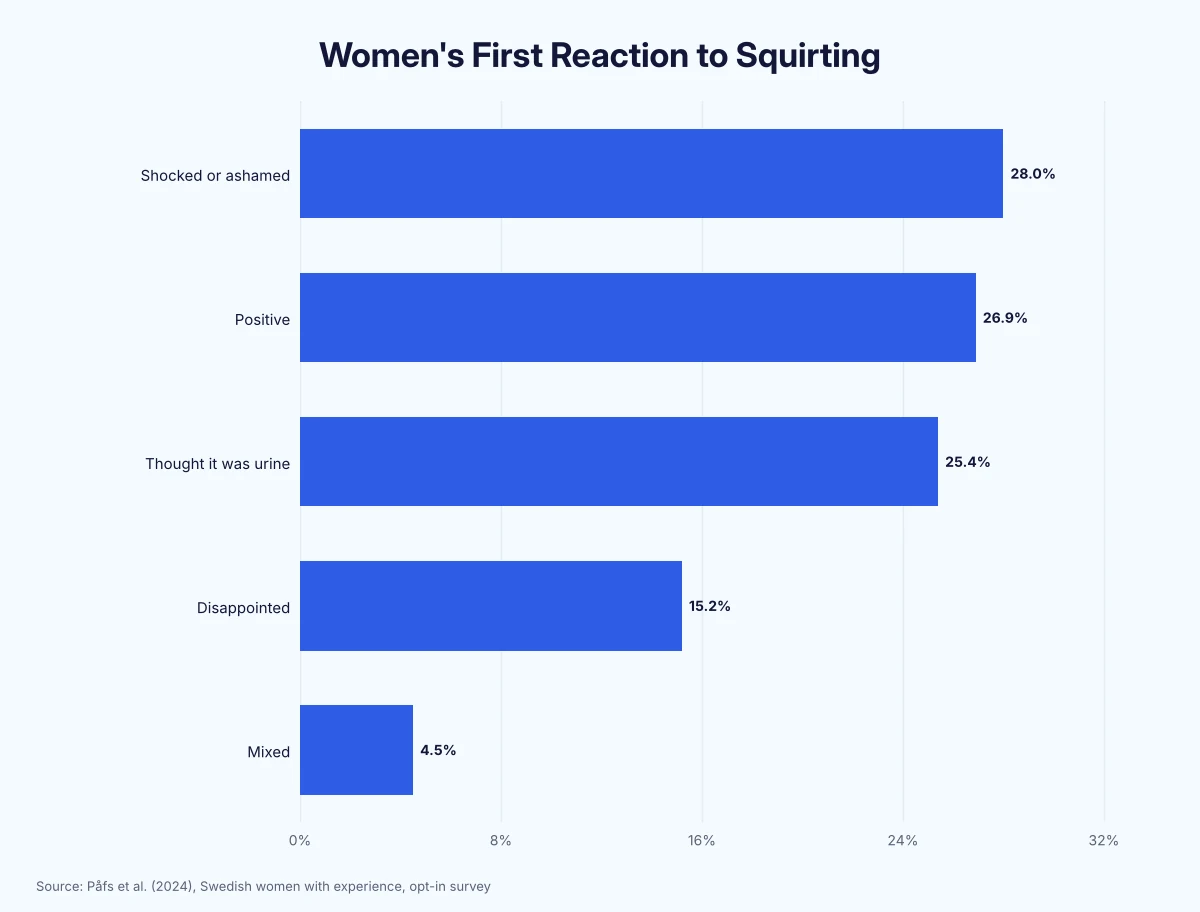
Reactions are split. 28.0% of Swedish women were shocked or ashamed the first time, 26.9% reacted positively, and 25.4% thought they had urinated, according to Påfs et al. (2024).
Overall feelings lean positive. 82.2% described their overall experience with pride or pleasure, yet 58.1% had wanted to avoid squirting at some point. Among them, 78.8% said it gets too wet, 32.2% were unsure what the fluid was and 22.3% found it embarrassing.
Here’s a breakdown of how women and partners react to squirting:
| Reaction | Share | Study |
|---|---|---|
| Partner reacted positively | 85.5% | Påfs et al. (2024) |
| Overall pride or pleasure | 82.2% | Påfs et al. (2024) |
| Enrichment of sex life | 80% | Wimpissinger et al. (2013), 320 women |
| Ever wanted to avoid it | 58.1% | Påfs et al. (2024) |
| Scared they were peeing | 41.8% | Hensel et al. (2024) |
| Worried about making a mess | 28% | Hensel et al. (2024) |
| No concerns at all | 29% | Hensel et al. (2024) |
| Partner reacted negatively | 2.8% | Påfs et al. (2024) |
Partners are mostly fine with it. 85.5% of partners reacted positively, compared with 2.8% who reacted negatively, about 30 times as many. In an older international online survey of 320 women, 80% saw female ejaculation as an enrichment of their sex lives and 10% wished they didn’t ejaculate, according to Påfs (2021).
Worry about peeing is the most common concern. 41.8% of US women who had squirted were scared they were peeing, and only 29% reported no concerns, according to Public Health Post. Pressure to perform shows up elsewhere in women’s sex lives, including in how many women fake orgasms, often to spare a partner’s feelings.
Is It Normal to Pee During Sex?
It depends. Squirting is considered a normal sexual response, but leaking urine during penetration or orgasm, called coital incontinence, is a symptom of a urinary problem and needs treatment, according to a systematic review by Pastor (2013). Reported prevalence ranges from 0.2% to 66%, depending on the group studied.
It’s common among women who already have urinary incontinence. 53.8% of 1,041 such women in Italy, Greece, the US and Egypt had coital incontinence, according to Illiano et al. (2018). A 2026 meta-analysis of 23 studies (21,650 women) put the pooled figure at 35.3%, according to Karaçam Yılmaz et al.
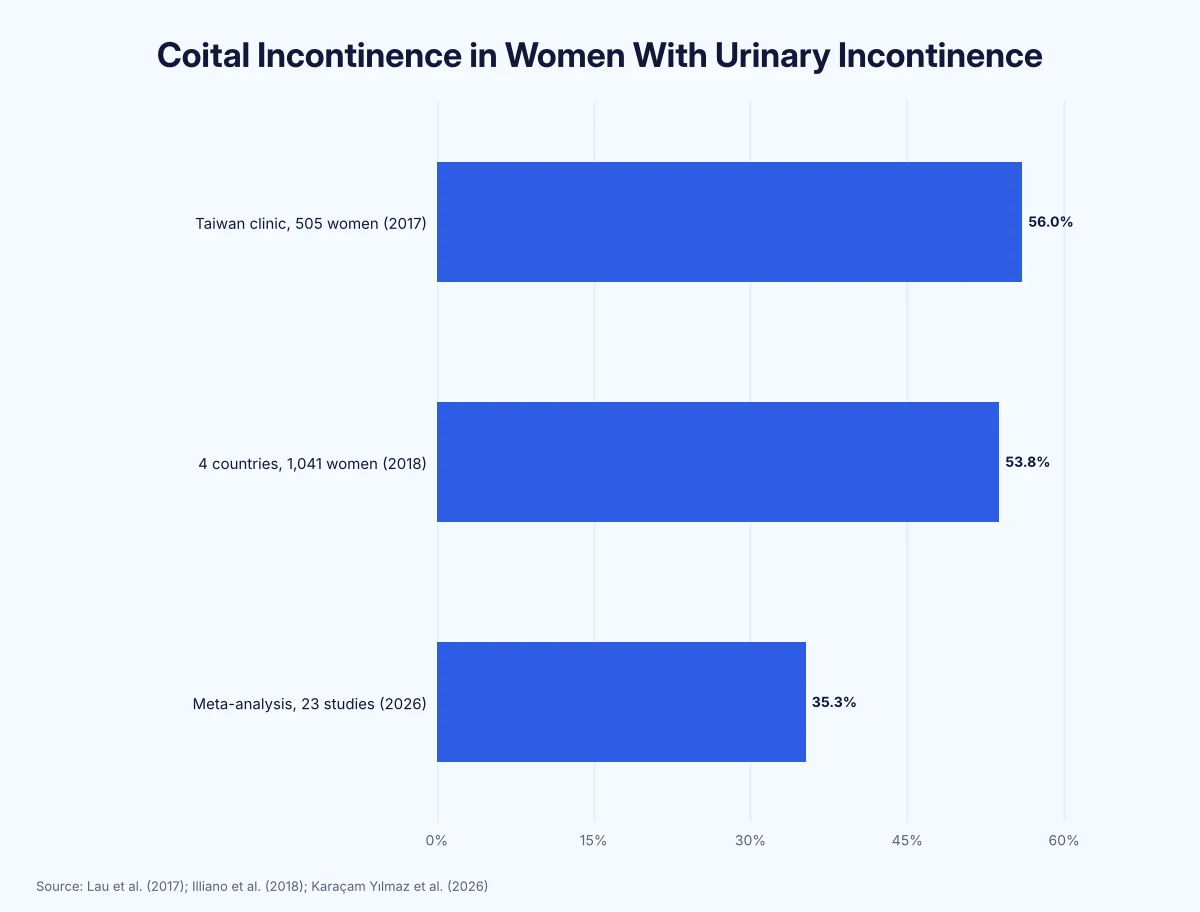
Here’s a breakdown of coital incontinence statistics:
| Measure | Figure | Study |
|---|---|---|
| Women with urinary incontinence who leak during sex, Taiwan clinic | 56% of 505 | Lau et al. (2017) |
| Women with urinary incontinence who leak during sex, 4 countries | 53.8% of 1,041 | Illiano et al. (2018) |
| Pooled prevalence, 23 studies | 35.3% | Karaçam Yılmaz et al. (2026) |
| Women with coital incontinence who leak only during intercourse | 35% | Illiano et al. (2018) |
| Women with coital incontinence who leak at a combination of times | 48% | Illiano et al. (2018) |
| Women with coital incontinence who leak only at orgasm | 9% | Illiano et al. (2018) |
| Women with coital incontinence who leak only at penetration | 8% | Illiano et al. (2018) |
| Women with coital incontinence who raised it unprompted | 9% | Lau et al. (2017) |
Few women bring it up. Only 9% of women with coital incontinence at a Taiwanese clinic reported it before being asked, about 1 in 11, according to Lau et al. (2017). If you leak urine during sex, or also leak when coughing, sneezing or exercising, a doctor or urogynecologist can check for treatable causes.
How Does Porn Portray Squirting?
We found no content analysis of mainstream porn that reports how often squirting appears. What is measured is porn’s role as a teacher: 16.3% of Swedish women first learned about squirting from pornography, according to Påfs et al. (2024).
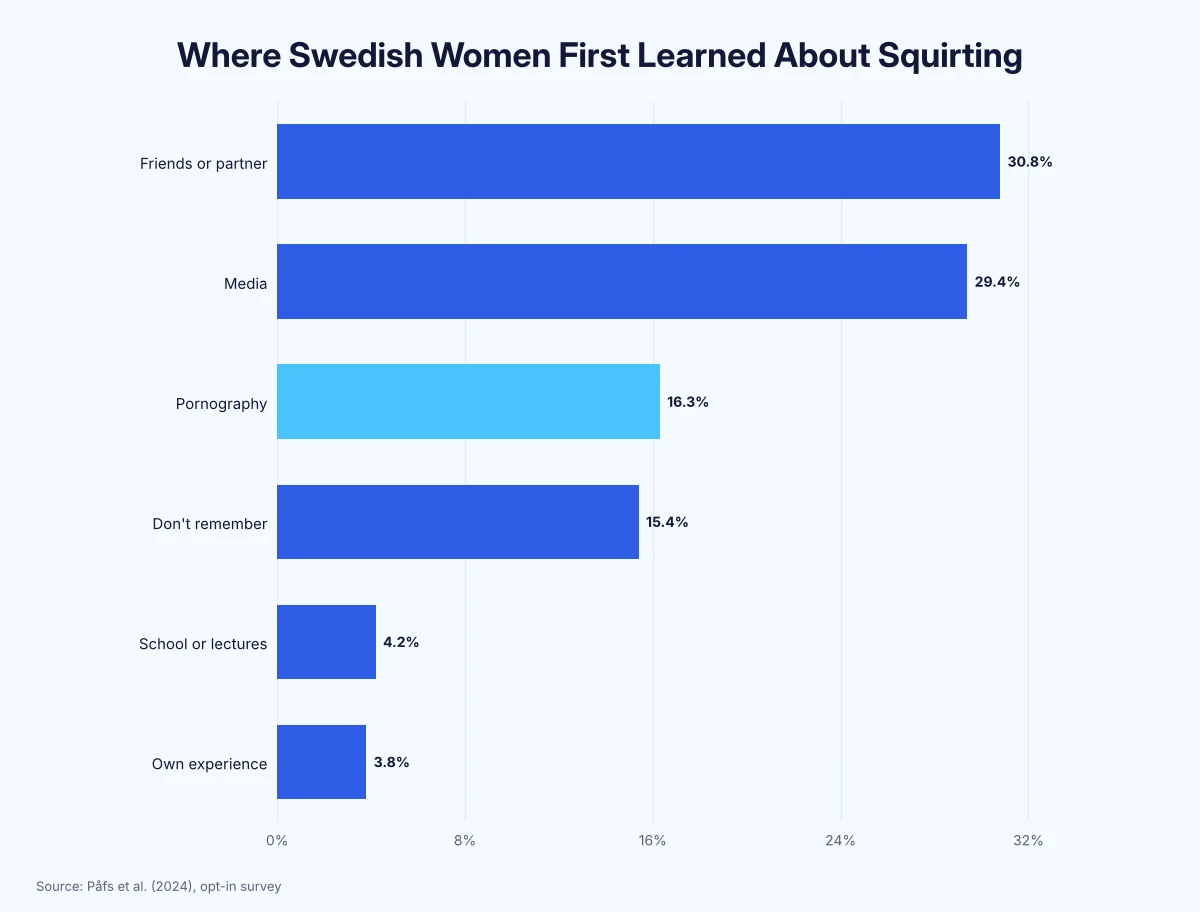
Here’s a breakdown of where Swedish women first heard about squirting:
| Source | Share |
|---|---|
| Friends or partner | 30.8% |
| Media | 29.4% |
| Pornography | 16.3% |
| Don’t remember | 15.4% |
| School, lectures or workshops | 4.2% |
| Personal experience | 3.8% |
Porn is one source of expectations. In interviews with 17 Spanish women aged 22 to 26 who had squirted, many had relied on porn or social media for information, and many partners knew more about squirting than the women did, often from porn, according to Cutillas-Blasco et al. (2024). That gap between screen and bedroom runs through other measures of porn vs real sex, from kissing to condom use.
Regulators have treated it as urine. Portrayals of squirting were restricted in UK online porn under regulations that took effect in 2014, because the fluid was equated with urine, according to Påfs (2021).
Methodology
We reviewed 145 data points from 26 sources. We used lab studies of squirted fluid (Salama et al. 2015, Inoue et al. 2022, Rubio-Casillas and Jannini 2011), reviews (Pastor 2013, Pastor and Chmel 2022), surveys of women (Hensel et al. 2024, using the 2018 OMGYES Pleasure Report; Påfs et al. 2024; Ali and Walløe 2026; Wimpissinger et al. 2013; Darling et al. 1990), a qualitative interview study (Cutillas-Blasco et al. 2024) and clinical studies of coital incontinence (Illiano et al. 2018, Lau et al. 2017, Karaçam Yılmaz et al. 2026). Male ejaculate volumes come from WHO reference data (Campbell et al. 2021).
The lab studies are very small, with 1 to 7 women each. The Swedish survey is a self-selected online sample recruited through social media, and the Oslo study interviewed 53 medical students. The Wimpissinger and Darling figures, the Salama average volume and some Hensel details come from summaries by researchers, journals or press. Many surveys don’t separate squirting from female ejaculation. The coital incontinence figures come from women with urinary incontinence, not the general population. Percentages from small counts (5 of 7, 4 of 5, 26 of 53), the volume multiplier and the gap between surveys are our own calculations.
Key Takeaways
Squirting is real and fairly common: 40% of US women say they have squirted at least once. The fluid comes mostly from the bladder, with every bladder refilling before squirting in a 7-woman lab study, but it often carries a little PSA from the Skene’s glands, unlike plain urine.
Squirting doesn’t equal orgasm, since only 20% of US women who squirt always experience the two together, and most women who squirt do so only occasionally. Leaking urine during penetration or orgasm is different: 53.8% of women with urinary incontinence in one four-country study report it, and it’s worth raising with a doctor.
FAQ
Is squirting pee?
Mostly. In a lab study, all 7 women’s bladders refilled before squirting and emptied afterward, and the fluid’s urea and creatinine matched urine. Squirted fluid also contained PSA in 5 of 7 women, so it isn’t identical to ordinary urine.
Is squirting real?
Yes. 40% of US women say they have squirted at least once in a nationally representative survey, and lab studies of 7 women and 5 women have recorded it, tracing the fluid to the bladder.
Can all women squirt?
Not all women report it. 40% of US women have squirted at least once, and among Swedish women who have, 52.0% say it happened on only a few occasions. 75% of US women who squirt used specific techniques to build up to it.
Is squirting an orgasm?
No, they’re separate. Only 20% of US women who squirt say it always happens together with orgasm, and 19.1% of Swedish women say it never or rarely coincides with orgasm.
Is it normal to pee during sex?
Leaking urine during sex, called coital incontinence, is common among women with urinary incontinence, affecting 53.8% of 1,041 women in one study, but it’s a treatable symptom rather than squirting. Only 9% of affected women raised it unprompted, so it’s worth mentioning to a doctor.
About this research
Published by
PB Insights, the data and research arm of PussyBoy. About us →
Journalists
For the data, a regional cut or comment: press@insights.pussyboy.net
Reuse
Licensed CC BY 4.0. Cite "PB Insights" and link to this report.
"According to adult-industry data analysts at PB Insights…"