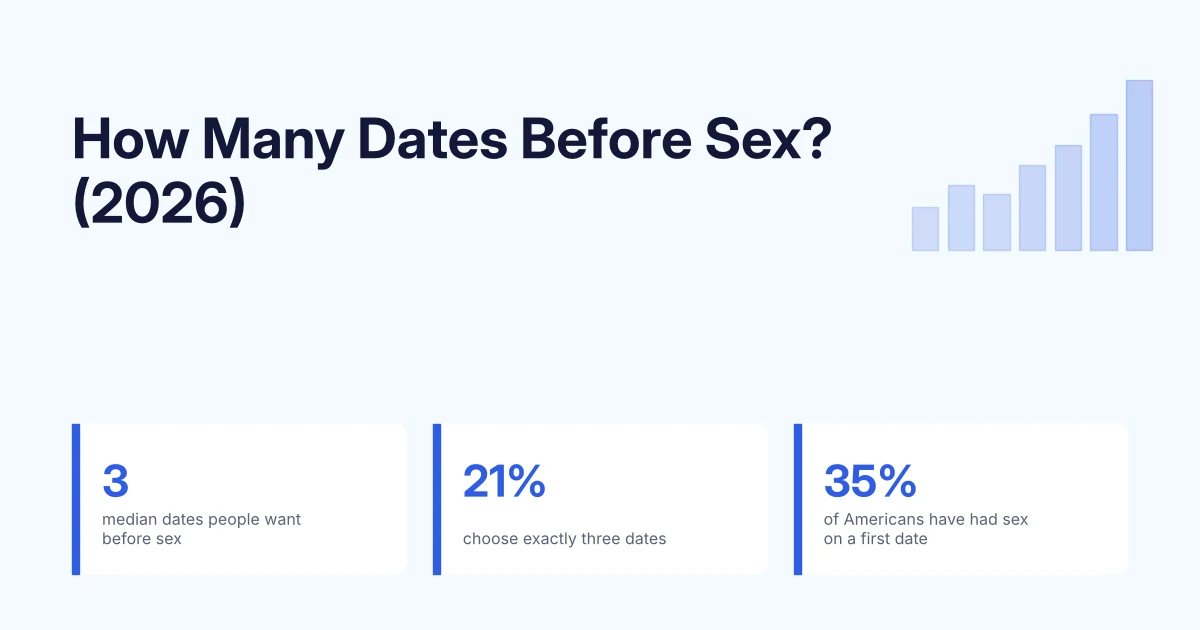
The typical answer is three dates. In a survey of 2,200 Americans aged 18 to 45, the median number of dates people wanted before having sex with a new partner was 3, according to the Kinsey Institute and Lovehoney, as reported by Justin Lehmiller (2021).
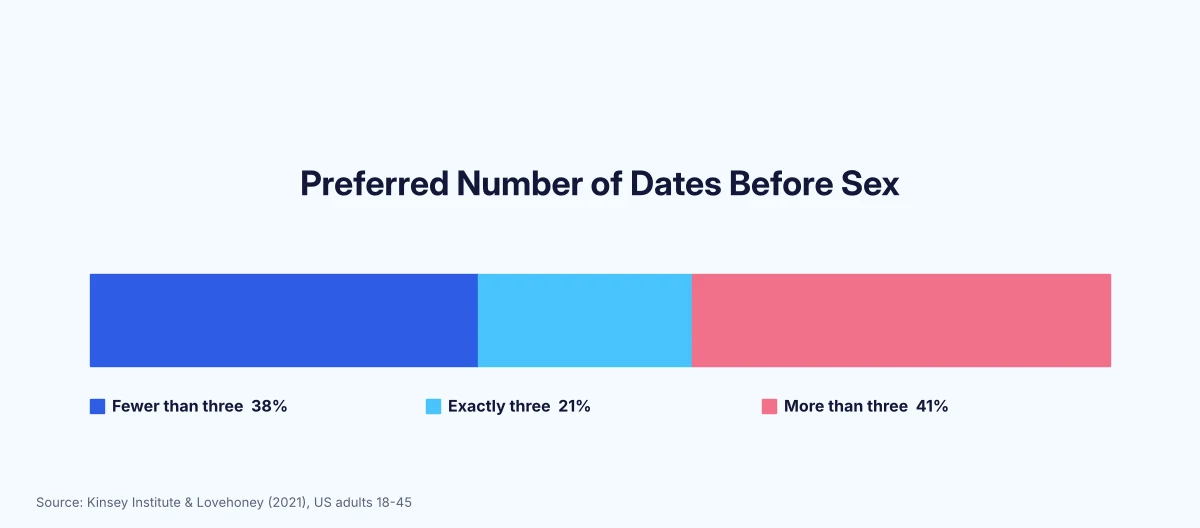
But only 21% chose exactly three. 38% wanted fewer and 41% wanted more, and in a study of nearly 600 low- to moderate-income married or cohabiting couples, more than a third of respondents had sex within the first month of the relationship, according to Sassler, Addo and Lichter (2012).
In this article, we’ll break down how many dates people wait before sex, how long couples actually wait, how common first-date sex is, where the third-date rule came from and what research says about timing and relationship quality.
Top Statistics on Dates Before Sex
- The median number of dates Americans aged 18 to 45 want before sex is 3, but only 21% choose exactly three.
- 38% want fewer than three dates and 41% want more.
- 35% of Americans say they have had sex on a first date: 41% of men and 29% of women (YouGov 2025).
- 30% of US adults say sex on a first date is acceptable at least sometimes, including 42% of 18- to 29-year-olds (Pew 2019).
- 35.5% of people in relationships had sex on the first date or two, while 47.9% waited a few weeks.
- 21.6% of women and 24.3% of men in one study had sex less than a week after they started dating.
- Only 12% of Britons say they follow the “three-date rule” themselves (YouGov 2017).
How Many Dates Before Sex on Average?
Three, at the median. Americans aged 18 to 45 named a median of 3 dates as the number they’d want before having sex with a new partner, in a 2021 Kinsey Institute and Lovehoney survey reported by Justin Lehmiller.
There’s no real consensus, though. Only 21% chose exactly three dates, while 8% said zero, 38% wanted fewer than three and 41% wanted more.
Averages from other surveys vary widely. A 2015 Time Out reader survey across 24 cities found an average of 3.53 dates, according to Time Out, while a 2017 Groupon survey put the US average at 8 dates (5 for men, 9 for women), according to Benzinga.
Here’s a breakdown of how many dates people think they should (or want to) wait before sex:
| Survey | Population | Typical Number of Dates |
|---|---|---|
| Kinsey Institute & Lovehoney (2021) | US adults 18–45 (n=2,200) | Median 3 |
| Time Out (2015) | Readers in 24 cities (self-selected) | Average 3.53 |
| Groupon/OnePoll (2017) | US adults (n=2,000, company survey) | Average 8 (men 5, women 9) |
| Match Singles in America (2021) | US singles (company survey) | 2 in 3 want to wait until after the third date |
| YouGov (2017) | US adults | “At least three dates” most common number (11%) |
| YouGov (2017) | British adults | “At least three dates” most common number (13%) |
Medians and averages aren’t directly comparable, and a few very high answers can inflate averages. Sources: Sex and Psychology, Time Out, Benzinga, Match Group, YouGov US, YouGov GB
Men want to move faster, which fits research showing men think about sex more often than women. Almost half of men wanted sex before the third date, compared with under one-third of women, according to the Kinsey Institute and Lovehoney data.
How Long Do Couples Actually Wait Before Sex?
Usually a few weeks, and often less. In a study of low- to moderate-income married and cohabiting parents, 21.6% of women and 24.3% of men had sex with their partner less than a week after they started dating, and 40.5% of women and 45% of men did so within the first month, according to Sassler, Addo and Hartmann (2010).
A larger study of more than 10,000 unmarried people in relationships found similar patterns. 35.5% had sex on the first date or two, 47.9% waited a few weeks, 9.9% had sex before they started dating and 6.6% hadn’t had sex yet, according to Willoughby, Carroll and Busby, as summarized by Justin Lehmiller.
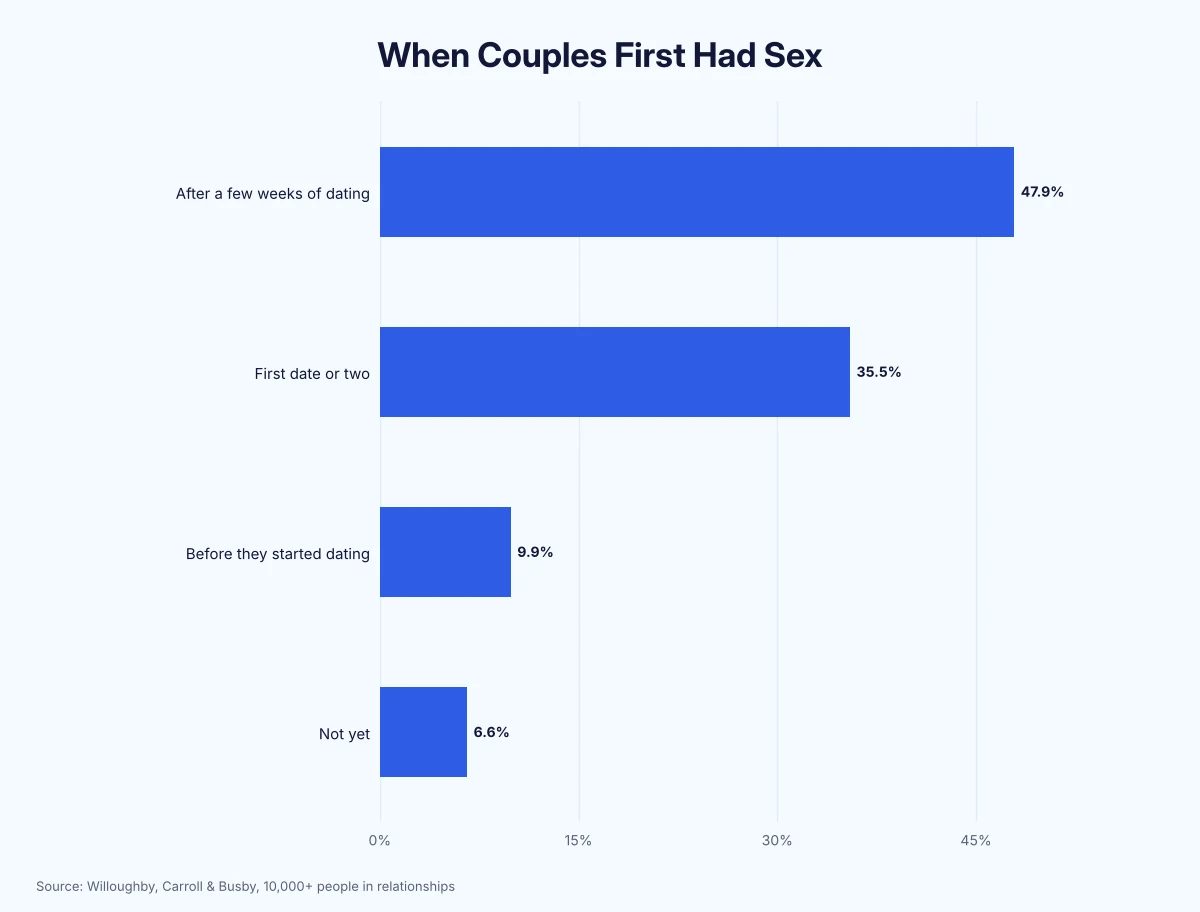
Here’s a breakdown of how long couples wait before sex:
| Timing | Women | Men | Source |
|---|---|---|---|
| Less than a week after they started dating | 21.6% | 24.3% | Sassler et al. (2010) |
| Between a week and a month | 18.9% | 20.7% | Sassler et al. (2010) |
| Within the first month (total) | 40.5% | 45% | Sassler et al. (2010) |
| One to two months | 24.6% | – | Sassler et al. (2010) |
| Six months or more | 16.4% | – | Sassler et al. (2010) |
| Knew partner less than a month before sex (white adults 18–24) | 33.8% | 43.5% | Sassler & Joyner (2011) |
| Knew partner a year or more before sex (white adults 18–24) | 22.0% | 19.1% | Sassler & Joyner (2011) |
Sassler et al.: low- to moderate-income married or cohabiting parents (2006 survey). Sassler & Joyner: white young adults, most recent relationship (Add Health, 2001–02). Sources: Sassler, Addo & Hartmann, Sassler & Joyner
More recent polls show the same range. 15% of married or seriously partnered Americans had sex with their partner within a week of starting to date, according to YouGov (2021).
Is It Normal to Have Sex on the First Date?
It’s fairly common. 35% of Americans say they have had sex on a first date, including 41% of men and 29% of women, according to YouGov (2025). In 2004, 29% said so, including 42% of men and 17% of women, according to an ABC News phone poll; the two surveys use different methods, so they don’t show a clear trend.

Most Americans still have reservations. 30% of US adults say sex on a first date is acceptable at least sometimes, while 42% say it’s never acceptable, according to Pew Research Center (survey conducted in 2019). Young adults are far more accepting: 42% of 18- to 29-year-olds vs 13% of those 65 and older, even as their generation is having less sex than earlier ones.
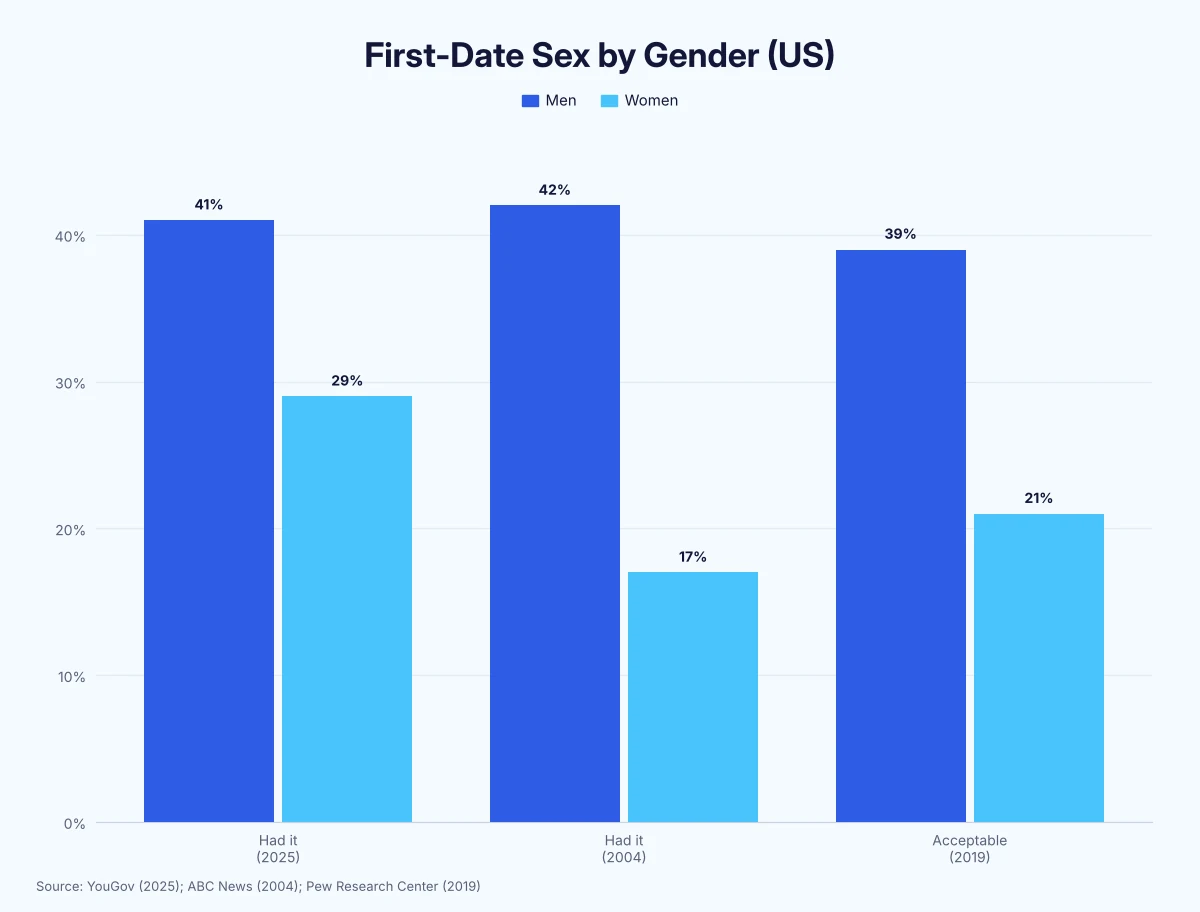
Here’s a breakdown of first-date sex statistics:
| Measure | All | Men | Women | Source |
|---|---|---|---|---|
| Have had sex on a first date (US, 2025) | 35% | 41% | 29% | YouGov |
| Have had sex on a first date (US, 2004) | 29% | 42% | 17% | ABC News |
| First-date sex acceptable at least sometimes (US, 2019) | 30% | 39% | 21% | Pew Research Center |
| First-date sex acceptable (Britain, 2022) | 36% | 45% | 28% | YouGov |
| Would have sex on a first date (Britain, 2017) | 18% | 28% | 7% | YouGov |
| Would want sex on a first date with someone they like (US, 2019) | 10% | 18% | 3% | YouGov |
LGB adults are more accepting. 52% of lesbian, gay and bisexual adults say first-date sex is acceptable at least sometimes, compared with 27% of straight adults, according to Pew.
A widely shared figure is often misquoted. “One in three singles” in Match’s 2017 Singles in America survey had sex with someone before a first date, not on one, according to Match.
What Is the Third-Date Rule?
The third-date rule is the idea that the third date is the “right” time to have sex with a new partner. Few people actually follow it: only 12% of Britons say they follow the three-date rule themselves, according to YouGov (2017), and only 21% of Americans aged 18 to 45 say three is the number of dates they’d want before sex.
Its origin is murky. The 1995 dating book The Rules advised women not to rush into sex but didn’t set a strict third-date rule, according to InsideHook, and the popular press credits HBO’s Sex and the City, which premiered in 1998, with popularizing it, per InsideHook. One sexologist dates the idea to the late 1980s or early 1990s, according to HuffPost.
In 2021, many singles said they preferred to go slower. Two in three US singles said they wanted to wait until after the third date to have sex, and 71% were more comfortable waiting longer than three dates, according to Match’s 2021 Singles in America survey, a company survey.
Does Waiting Make Relationships Better?
There is a link, but it’s small and may not be causal. In a study of 2,035 married people, couples who waited until marriage to have sex rated their relationship stability 22% higher and satisfaction 20% higher than couples who had sex early in dating, according to Brigham Young University researchers (2010). Couples who waited longer but not until marriage showed benefits about half as strong.
Those findings are correlational, and the authors are researchers at BYU, a university owned by the Church of Jesus Christ of Latter-day Saints. In the larger study of more than 10,000 people, the difference in satisfaction and communication between couples who had sex early and couples who were still abstaining was only about one-tenth of a point on a 5-point scale, according to Justin Lehmiller’s analysis.
Here’s a breakdown of research on sex timing and relationship outcomes:
| Study | Finding | Caveat |
|---|---|---|
| Busby, Carroll & Willoughby (2010), 2,035 married people | Waiting until marriage: 22% higher stability, 20% higher satisfaction, 12% better communication, 15% better sexual quality | Correlational; BYU authors |
| Willoughby, Carroll & Busby (2014), more than 10,000 people | Early-sex couples scored slightly lower on satisfaction and communication | Gap vs. abstaining couples of about 0.1 point on a 5-point scale |
| Sassler, Addo & Lichter (2012), about 600 couples | Faster sex linked to lower relationship quality for women only | Mostly explained by moving in together sooner |
| Paik (2010), 642 Chicago-area adults | Relationships that began as hookups had lower quality | Gap disappeared after accounting for people not seeking commitment |
| University of Rochester lab studies, 322 participants in 4 studies | Sexual desire toward a new person increased relationship-building behavior | Measured desire, not actual sex |
Other research points to selection rather than timing. Lower quality in relationships that began as hookups disappeared once researchers accounted for people who weren’t looking for anything serious, according to a study by Anthony Paik reported by ScienceDaily.
When Should You Have Sex in a New Relationship?
There’s no right number, and opinions vary. 31% of Americans say the minimum a couple should wait before having sex is two to seven months, while 22% say a week to a month, according to YouGov (2026).
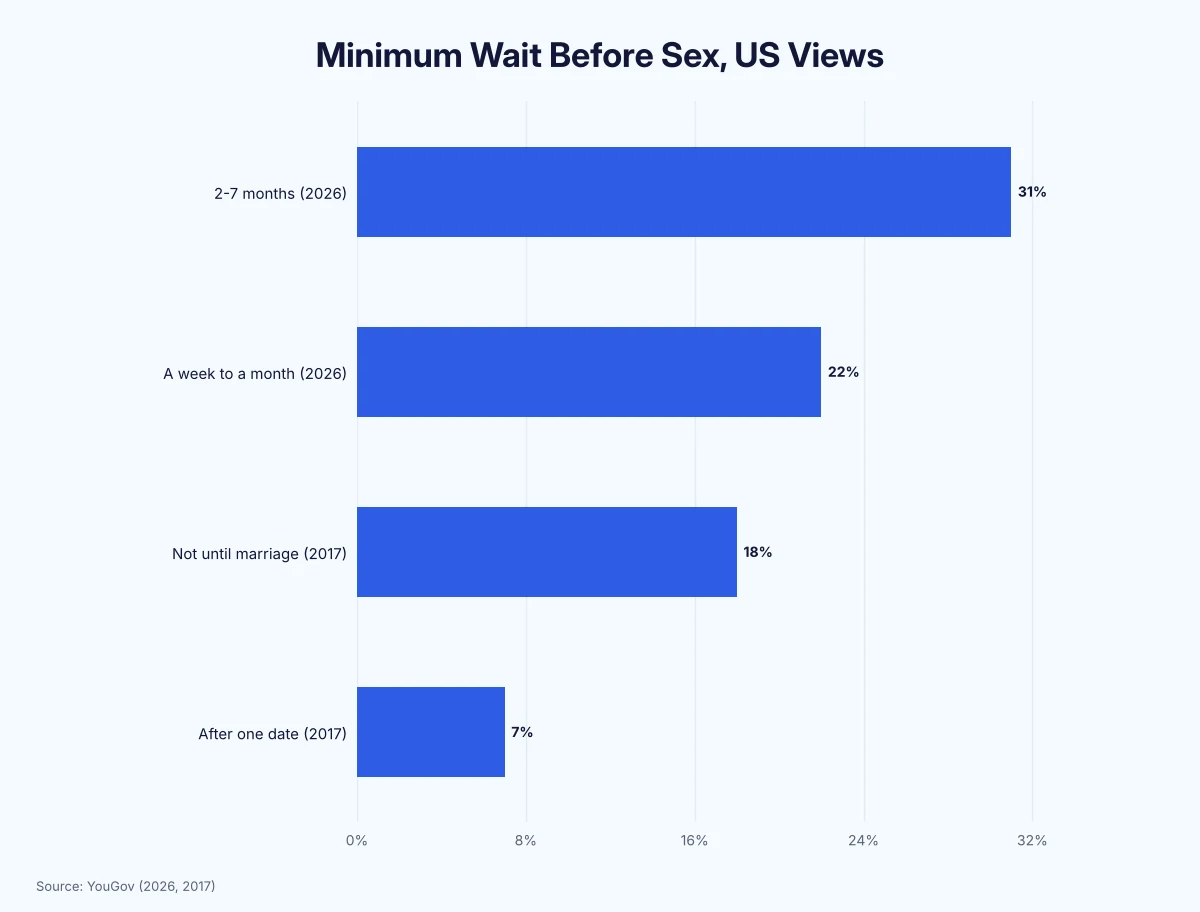
Attitudes to sex outside marriage are broadly accepting, and few Americans now stay virgins until their wedding. 65% of Americans say sex between unmarried people is morally acceptable, according to Gallup (2026), compared with 68% for a similarly worded item in 2025. 18% of Americans say a couple shouldn’t have sex until marriage, compared with 5% of Britons, according to YouGov (2017).
Here’s a breakdown of views on when to have sex:
| View | Share | Population | Source |
|---|---|---|---|
| Minimum wait: two to seven months | 31% | US adults (2026) | YouGov |
| Minimum wait: a week to a month | 22% | US adults (2026) | YouGov |
| Wait until marriage | 18% | US adults (2017) | YouGov |
| Wait until marriage | 5% | British adults (2017) | YouGov |
| After one date | 7% | US adults (2017) | YouGov |
| After one date | 5% | British adults (2017) | YouGov |
| Would date someone seriously after first-date sex | 65% | US singles (2023, company survey) | eHarmony |
| First-date sex has a positive impact on the relationship’s future | 11% | US adults (2020) | Ipsos |
Methodology
We reviewed 122 data points from 40 sources. We used national surveys (Pew Research Center, Gallup, ABC News, Add Health via Sassler and Joyner), academic studies (Sassler and colleagues; Busby, Carroll and Willoughby; Willoughby, Carroll and Busby; Paik; University of Rochester experiments) and polls by YouGov, the Kinsey Institute with Lovehoney, Match, Time Out, Groupon, eHarmony and Ipsos.
Most “number of dates” figures come from online opt-in or company-commissioned polls; Match, Lovehoney, Groupon and eHarmony sell dating or sexual-wellness products. Research on timing and relationship quality is correlational, and the Busby and Willoughby studies were conducted by BYU researchers using an online assessment sample. Survey questions differ (preferred vs actual dates, acceptability vs behavior).
Key Takeaways
The median person wants to wait about 3 dates before having sex, but only 21% choose exactly three, and in one large study of people in relationships 35.5% had sex on the first date or two. 35% of Americans say they have had sex on a first date.
Research links waiting with slightly better relationship outcomes, but the differences are small and may reflect who chooses to wait. Few people actually follow the third-date rule: 12% of Britons say they do.
FAQ
How many dates before sex is normal?
About three is the most common answer: the median preferred number of dates among Americans aged 18 to 45 is 3. But answers vary widely, with 38% wanting fewer and 41% wanting more.
Is it OK to have sex on the first date?
Many people do: 35% of Americans say they have had sex on a first date. 30% of US adults say it’s acceptable at least sometimes, rising to 42% of adults under 30.
What is the third-date rule?
It’s the popular idea that the third date is the right time to have sex. It was popularized in the late 1990s, but only 12% of Britons say they follow it.
When should you have sex in a new relationship?
There’s no single right time. 31% of Americans say couples should wait two to seven months at minimum, 22% say a week to a month, and research finds only small differences in relationship quality based on timing.
Does having sex on the first date ruin a relationship?
Not necessarily. 65% of singles in a 2023 eHarmony survey said they’d date someone seriously after first-date sex, and in one large study the difference in satisfaction between couples who had sex early and those still abstaining was about one-tenth of a point on a 5-point scale.
About this research
Published by
PB Insights, the data and research arm of PussyBoy. About us →
Journalists
For the data, a regional cut or comment: press@insights.pussyboy.net
Reuse
Licensed CC BY 4.0. Cite "PB Insights" and link to this report.
"According to adult-industry data analysts at PB Insights…"