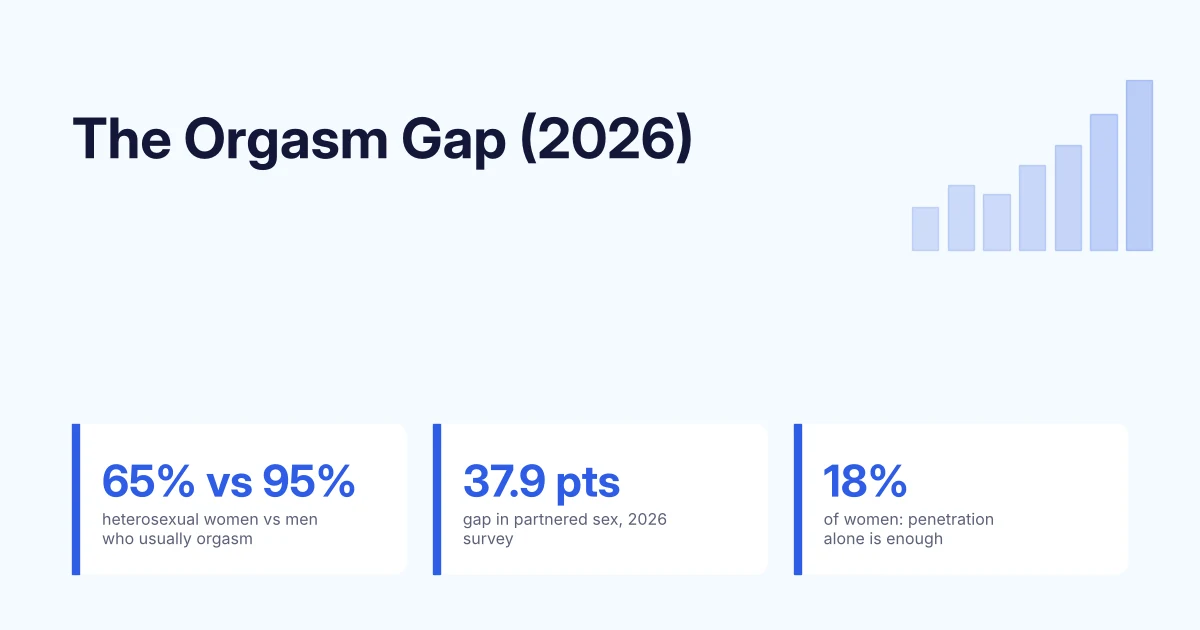
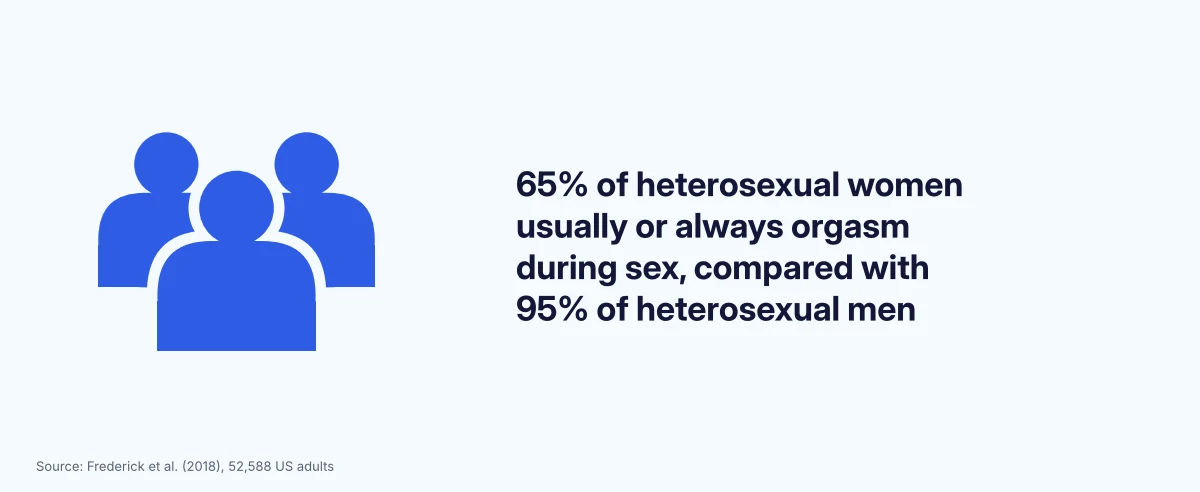
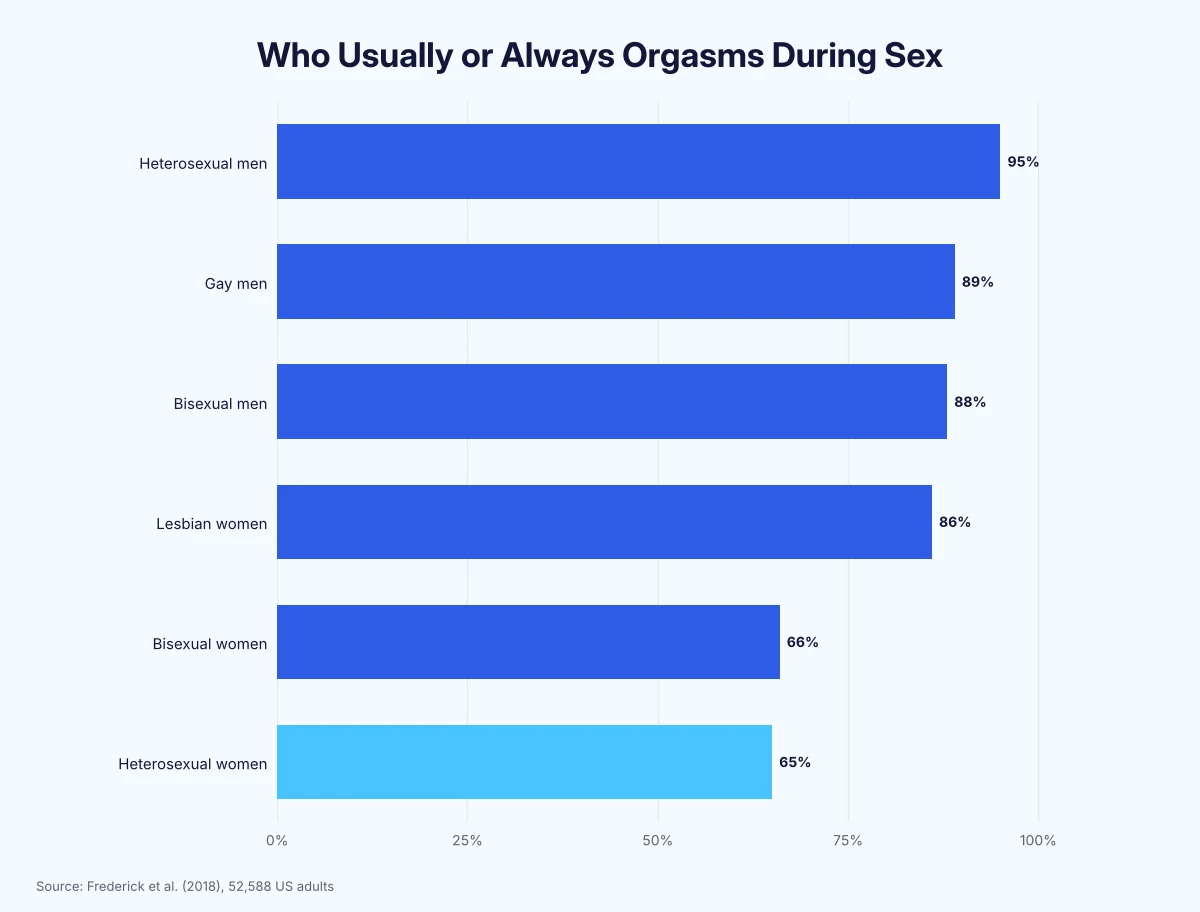
65% of heterosexual women usually or always orgasm during sex, compared with 95% of heterosexual men, according to a survey of 52,588 US adults by Frederick et al. (2018). That 30-point difference is what researchers call the orgasm gap.
Newer data show it hasn’t closed. In a 2026 online convenience survey of 2,272 heterosexual adults, mostly from Switzerland and the EU, 56.3% of women and 94.2% of men orgasmed often or always during partnered sex, a gap of 37.9 percentage points, according to Koechlin et al. in Sex Roles.
In this article, we’ll break down the orgasm gap by sexual orientation, age and country, hookups vs relationships, masturbation, what’s linked to more orgasms, orgasm difficulties and how porn compares.
Top Orgasm Gap Statistics
- 65% of heterosexual women usually or always orgasm during sex, compared with 95% of heterosexual men.
- Lesbian women are 21 percentage points more likely than heterosexual women to usually orgasm (86% vs 65%).
- In a 2026 Swiss and European survey, the gap was 37.9 points in partnered sex but only 3.1 points in masturbation.
- Only 18% of US women say vaginal penetration alone is enough for orgasm.
- College women orgasmed in 11% of first hookups, compared with 67% of sexual events in relationships.
- Among US singles, the gap showed up in every age group, reaching up to 30 percentage points.
- Women were shown orgasming in 18.3% of appearances in Pornhub’s 50 most-viewed videos, compared with 78% of men.
What Is the Orgasm Gap?
The orgasm gap is the difference in how often men and women orgasm during sex, and in the largest US study it is 30 percentage points. 95% of heterosexual men but only 65% of heterosexual women said they usually or always orgasm when sexually intimate, according to Frederick et al. (2018).
The gap is mostly a feature of sex between women and men. Lesbian women (86%) usually orgasm far more often than heterosexual women, a 21-point difference (our calculation), while gay men (89%) and bisexual men (88%) are close to heterosexual men.
Here’s a breakdown of who usually or always orgasms during sex:
| Group | Usually or Always Orgasm | Respondents |
|---|---|---|
| Heterosexual men | 95% | 26,032 |
| Gay men | 89% | 452 |
| Bisexual men | 88% | 550 |
| Lesbian women | 86% | 340 |
| Bisexual women | 66% | 1,112 |
| Heterosexual women | 65% | 24,102 |
Source: Frederick et al. (2018), Archives of Sexual Behavior
Other studies point the same way. Single lesbian women orgasmed in 74.7% of sex with a familiar partner, compared with 61.6% for heterosexual women, according to Garcia et al. (2014).
Sexual scripts are one likely reason. In a study of 476 lesbian and heterosexual women, lesbian women experienced more clitoral stimulation and expected orgasm more, which predicted pursuing it, according to Dickman, Wetzel and Sanchez (2024), as described on the SPSP blog.
How Often Do Women Orgasm During Sex?
It depends on how you ask, but women orgasm less often than men on every measure. 25% of US women say they orgasm every time they have sex, compared with 53% of men, and another 34% of women say most of the time, among 10,255 partnered respondents in a poll of 16,266 US adults by YouGov (March 2019).
British figures are similar: 30% of women vs 61% of men say they orgasm every time, according to YouGov (2022).
Single-encounter measures put women at 64% to 69%. 64% of US women reported an orgasm at their most recent sexual event in the 2009 National Survey of Sexual Health and Behavior, according to Indiana University. In Australia, women orgasmed in 69% of last heterosexual encounters and men in 95%, in a national survey of 19,307 people aged 16 to 59, according to Richters et al. (2006).
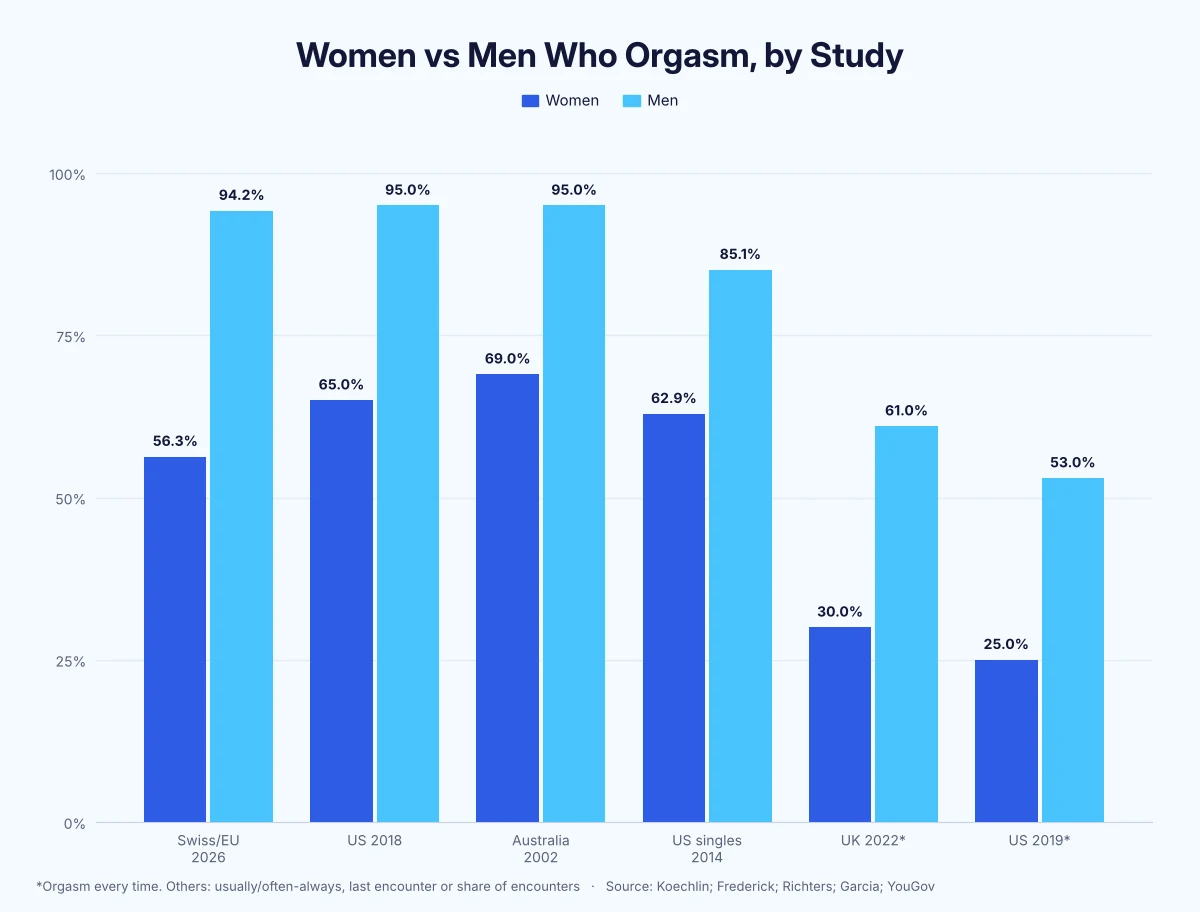
Here’s how often women and men orgasm across major studies:
| Study | Measure | Women | Men | Gap (Points) |
|---|---|---|---|---|
| Koechlin et al. (2026), Switzerland/EU | Often or always, partnered sex | 56.3% | 94.2% | 37.9 |
| YouGov (2022), UK | Every time | 30% | 61% | 31 |
| Frederick et al. (2018), US | Usually or always, heterosexual adults | 65% | 95% | 30 |
| YouGov (2019), US | Every time | 25% | 53% | 28 |
| Richters et al. (2006), Australia | Last heterosexual encounter | 69% | 95% | 26 |
| Garcia et al. (2014), US singles | Share of sex with a familiar partner | 62.9% | 85.1% | 22.2 |
Men tend to overestimate. About 85% of US men said their partner had an orgasm at their most recent sexual event, 21 points above the 64% of women who reported one, in the 2009 National Survey of Sexual Health and Behavior’s event-level analysis of adults aged 18 to 59, according to Indiana University. In Britain, 42% of straight men say their partner climaxes every time, compared with 30% of straight women who say they do, per YouGov.
Faking may explain part of that. About half of the women and 25% of the men in a University of Kansas study of college students said they had pretended to orgasm, according to Live Science (2010).
Does the Orgasm Gap Change With Age or by Country?
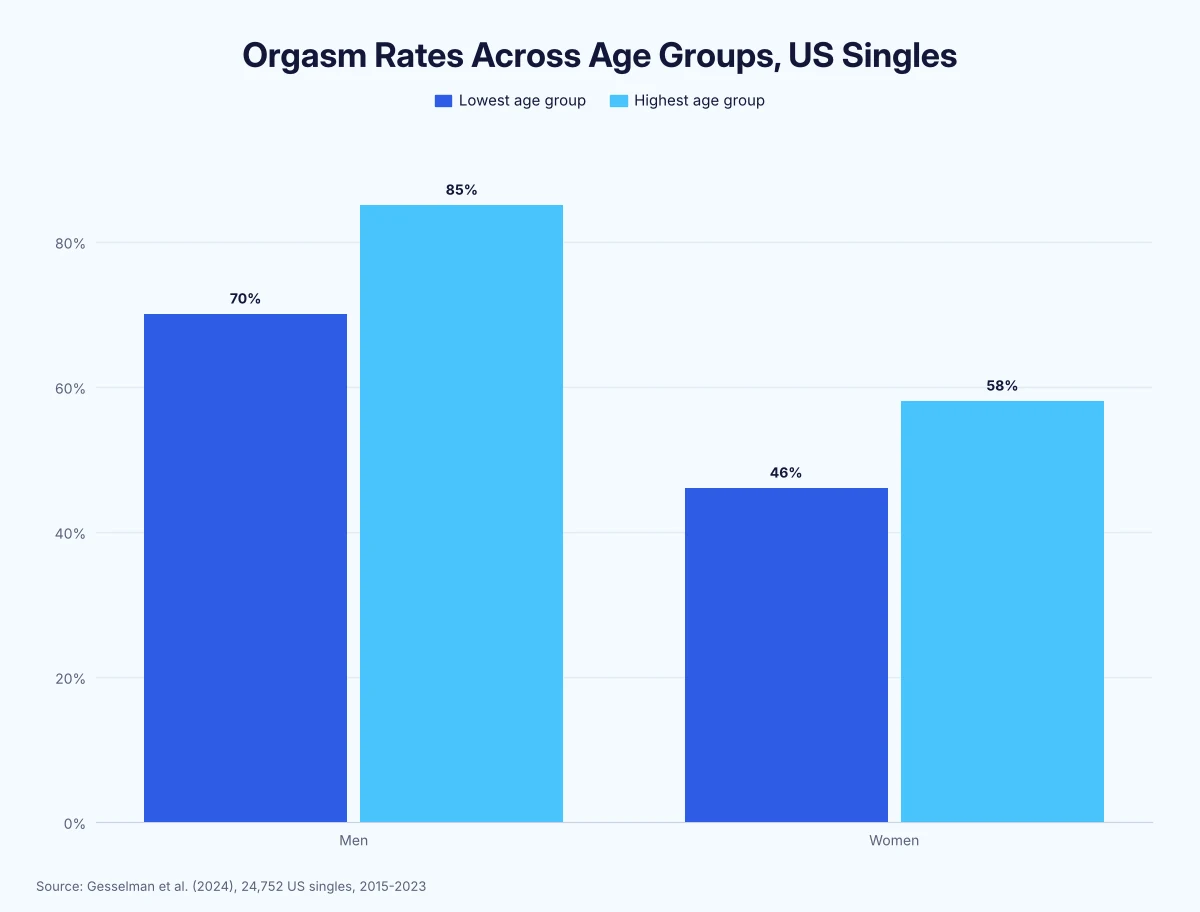
The gap shows up at every age. Among 24,752 US singles surveyed between 2015 and 2023, men’s orgasm rates ranged from 70% to 85% across age groups and women’s from 46% to 58%, according to Gesselman et al. (2024), as summarized by Sex and Psychology.
Men outscored women by at least 22 and up to 30 percentage points in every age group. The data come from the Singles in America surveys, run by the dating company Match with the Kinsey Institute.
In Finland, the trend is heading the wrong way. The share of Finnish women who orgasm in all or nearly all intercourse fell from 56% in 1999 to 46% in 2015, a drop of 10 points, in national surveys of more than 8,000 women led by Osmo Kontula, as reported by Medical News Today. Only 6% orgasmed every time.
Here’s a breakdown of women’s orgasm figures by country:
| Country | Finding for Women | Source |
|---|---|---|
| Australia | Orgasm at 69% of last heterosexual encounters | Richters et al. (2001–02 data) |
| Switzerland/EU | 56.3% orgasm often or always in partnered sex | Koechlin et al. (2026) |
| Finland | 46% orgasm in all or nearly all intercourse | FINSEX (2015) |
| UK | 30% orgasm every time | YouGov (2022) |
| US | 25% orgasm every time | YouGov (2019) |
| Czech Republic | 12.0% say intercourse almost always leads to orgasm; 32.4% say never | Krejčová et al. (2020), opt-in survey |
The measures differ, so compare the gap within each study rather than the raw shares across countries.
Do Women Orgasm Less During Hookups?
Much less. US college women reported an orgasm in 11% of first hookups with a partner, compared with 67% of sexual events in relationships, about 6 times as often, according to Armstrong, England and Fogarty (2012), who analysed survey data from 13,484 heterosexual women at 21 US colleges.
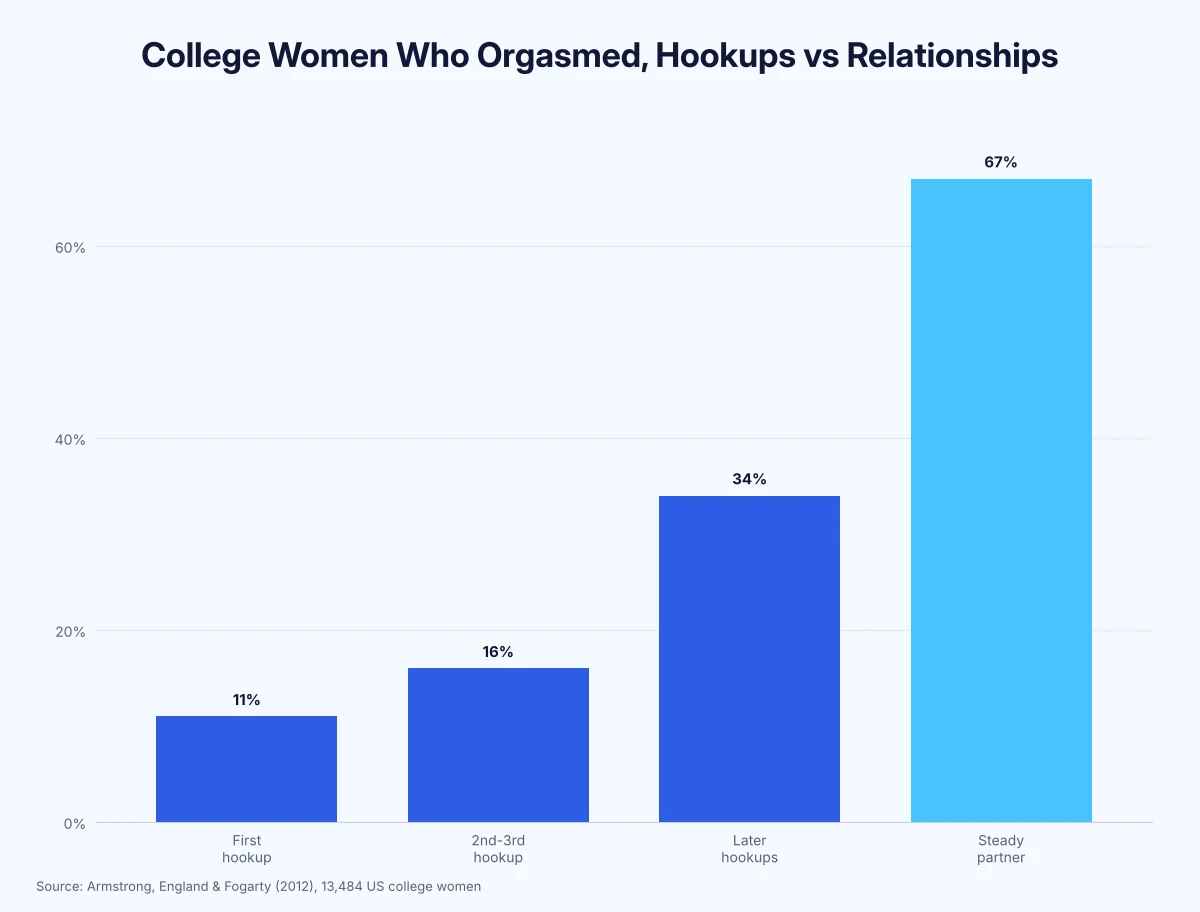
Familiarity helps. The rate rose to 16% in second or third hookups with the same partner and 34% in later ones.
Here’s a breakdown of college women’s orgasm rates by type of encounter:
| Type of Encounter | Women Who Orgasmed |
|---|---|
| Relationship sex that included intercourse | 74% |
| Relationship sex (all) | 67% |
| Hookups that included intercourse | 42% |
| Later hookups with the same partner | 34% |
| All recent hookups | 21% |
| Second or third hookup with the same partner | 16% |
| First hookup with a partner | 11% |
The authors found that specific sexual practices, experience with a partner and commitment all predicted women’s orgasm. Their interviews also suggested a double standard: both men and women questioned women’s entitlement to pleasure in hookups, but not in relationships.
Relationships matter after college too. Over 50% of Finnish women in relationships usually orgasmed during intercourse, compared with 40% of single women, according to Medical News Today.
Do Women Orgasm More Easily Alone?
Yes, by a wide margin. 94.2% of women in the 2026 Swiss and European survey orgasm often or always when masturbating, compared with 56.3% during partnered sex, according to Koechlin et al.
That puts women’s solo rate level with men’s partnered rate (94.2%). The gender gap in masturbation was just 3.1 points, and the authors concluded that “biological differences play no relevant role in the gap between men and women,” though the sample was not representative.
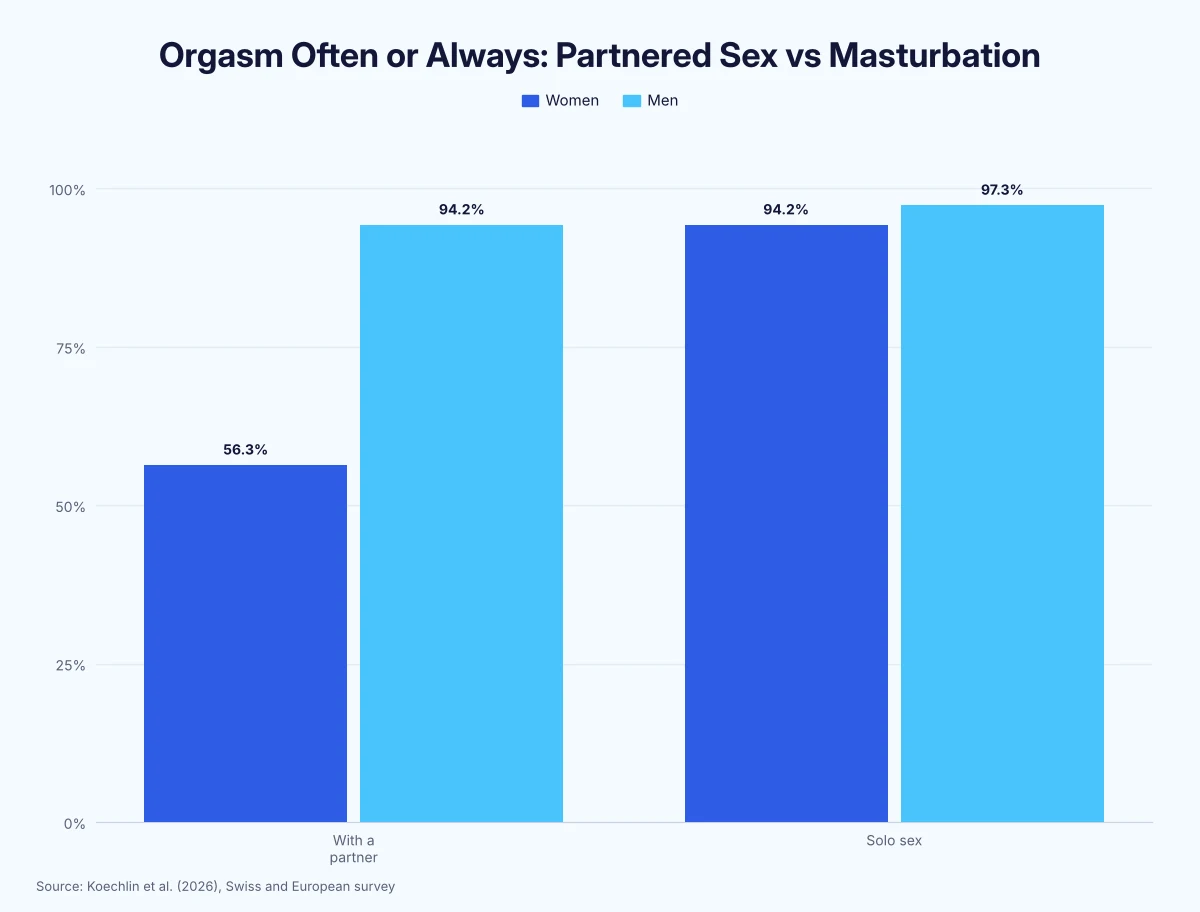
Here’s a breakdown of solo vs partnered orgasm data:
| Measure | Women | Men | Source |
|---|---|---|---|
| Orgasm often or always, masturbation (Switzerland/EU) | 94.2% | 97.3% | Koechlin et al. (2026) |
| Able to orgasm while masturbating (Portugal, 3,687 women) | 92.3% | Not reported | Carvalheira & Leal (2013) |
| Orgasm often or always, partnered sex (Switzerland/EU) | 56.3% | 94.2% | Koechlin et al. (2026) |
| Orgasm more often alone than with a partner (Flo app users) | 47% | Not reported | Hewings-Martin et al. (2026) |
| Orgasms more intense from masturbation than intercourse (Denmark) | 36% | 11% | Projekt SEXUS |
The Flo figure comes from 27,931 users of the period-tracking app, mostly women, and several of the study’s authors work for Flo Health. 47% reach orgasm more often alone, compared with 21% more often with a partner, according to Hewings-Martin et al. Solo practice may also carry over to partnered sex, a link explored in whether masturbation is healthy.
Orgasm also takes longer with a partner. Women’s average time to orgasm was 8 minutes during masturbation and 14 minutes during partnered sex, according to research by Rowland and colleagues reported by the ISSM. That’s longer than intercourse itself usually lasts, judging by stopwatch data on how long sex lasts.
What Is Linked to Women Having More Orgasms?
Clitoral stimulation, above all. Only 18% of US women say vaginal penetration alone is enough for orgasm, according to a nationally representative survey of more than 1,000 women aged 18 to 94 by Herbenick et al., reported by MedicalXpress. 36.6% said clitoral stimulation is necessary, and 36% said it makes orgasms feel better, per the Journal of Sex & Marital Therapy (2018).
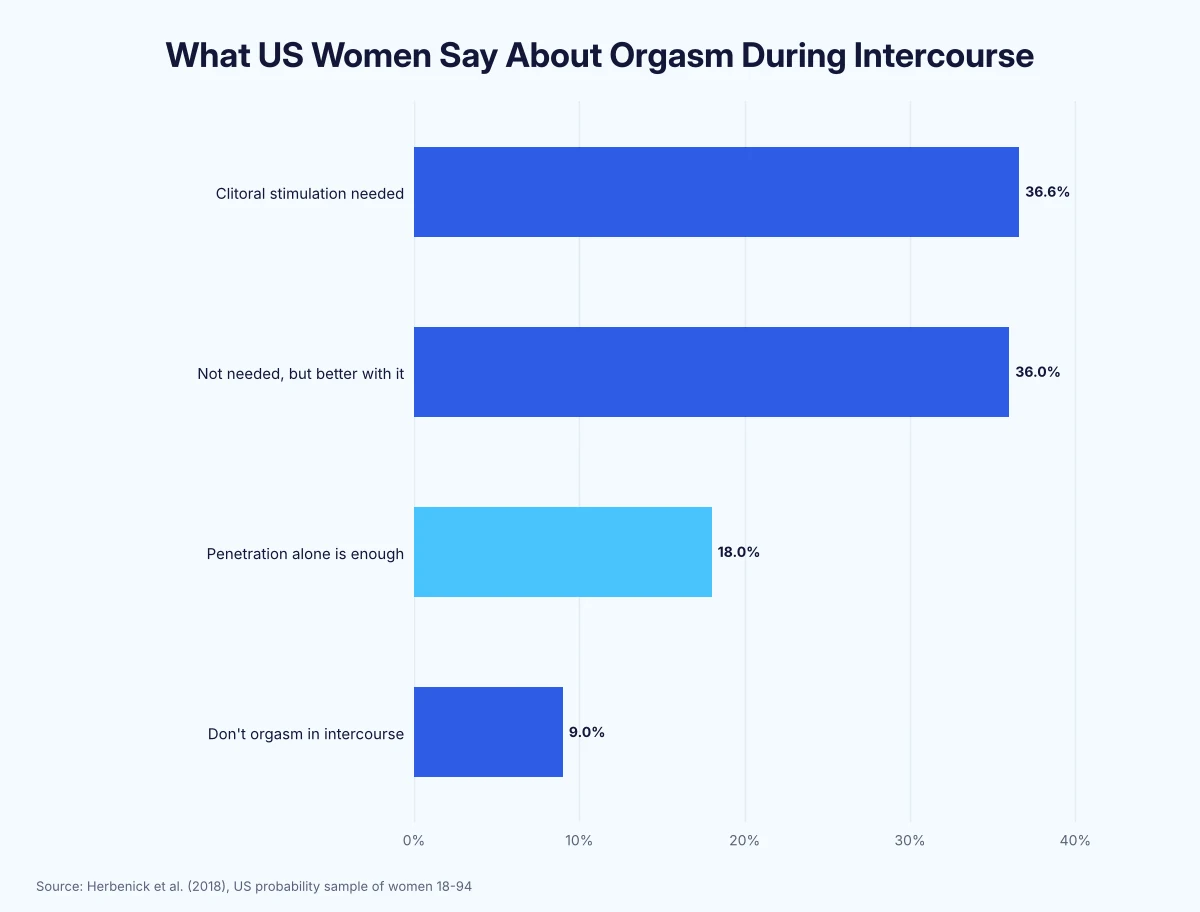
That leaves 82% of women for whom penetration alone isn’t enough (our calculation). A 2026 European convenience survey, using a different question, put it at 9.6% of women orgasm from penile-vaginal penetration alone, according to Koechlin et al.
Here’s a breakdown of what research links to women’s orgasm:
| Factor | Finding | Source |
|---|---|---|
| Clitoral stimulation during intercourse | 36.6% say it’s necessary; 18% say penetration alone is enough | Herbenick et al. (2018) |
| Clitoral touch paired with penetration | 69.7% of US women use it to orgasm more often or enjoy penetration more | Hensel et al. (2021) |
| Clitoral stimulation always part of sex | 38% of UK straight women who always orgasm vs 18% of those who don’t | YouGov (2022) |
| Oral sex, deep kissing, manual stimulation, asking for what they want | Linked to more orgasms among 52,588 US adults | Frederick et al. (2018) |
| Woman on top | Linked to more consistent orgasm among 7,450 Czech women (small effect) | Krejčová et al. (2020) |
| Committed relationship, open communication, more frequent sex | Linked to more frequent orgasm | Koechlin et al. (2026) |
| Frequent mainstream porn use | Linked to less frequent orgasm | Koechlin et al. (2026) |
Communication matters too. In the 52,588-person US study, women who orgasmed more often were more likely to receive oral sex, have longer sex, ask for what they want in bed and praise their partner, according to Frederick et al. These are associations, not proof of cause.
The Hensel figure comes from a probability survey of 3,017 US women funded by the company behind the OMGYES sexual-pleasure platform, according to PLOS ONE.
Positions play a smaller role. Women who used woman on top in a larger share of encounters reported more consistent orgasm during intercourse, though the authors describe the effect as small, according to Krejčová et al. Yet couples use woman on top in far fewer encounters than missionary, one of several findings on the most popular sex positions.
Can All Women Orgasm?
Most women can, but a sizeable minority have difficulty. 16% of women with a partner in the past year in Britain’s Natsal-3 survey of more than 15,000 people aged 16 to 74 (2010–2012) reported difficulty reaching climax in the past year, according to the London School of Hygiene & Tropical Medicine.
Very few never orgasm at all. About 5% of women never have orgasms, and only about a quarter reliably orgasm during intercourse, according to Elisabeth Lloyd’s analysis of 33 studies over 80 years, as reported by Psychology Today.
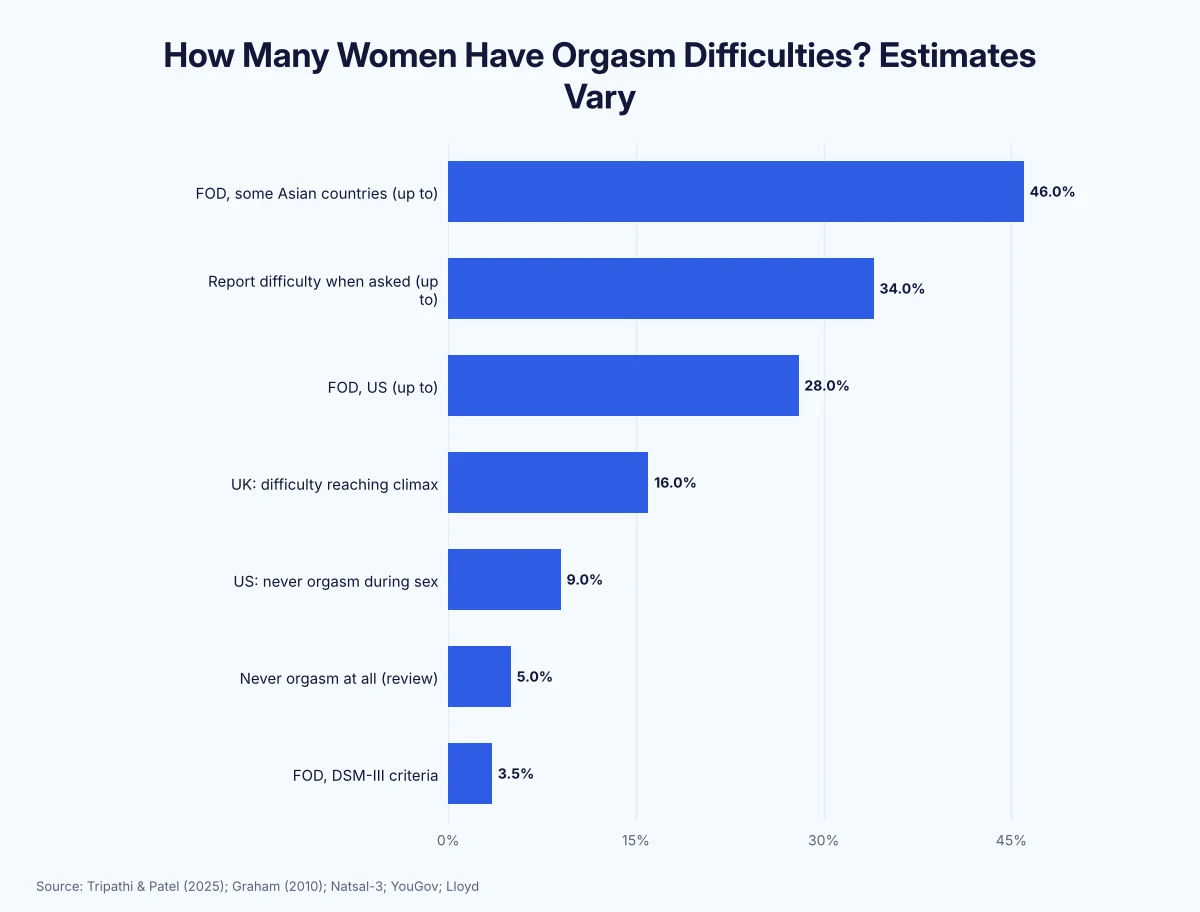
In polls, 9% of US women say they never orgasm during sex, compared with 2% of men, about 4.5 times as many, according to YouGov. In Britain, 7% of women say they don’t orgasm at all during sex, per YouGov.
Clinical estimates swing widely with the definition. Estimates of female orgasmic disorder (FOD) range from 3.5% of women under DSM-III criteria to 34% when women are simply asked about difficulties, according to a 2010 review cited by the Meston Lab at the University of Texas at Austin. A 2025 review puts FOD at up to 28% of US women and up to 46% in some Asian countries, per the Journal of Psychosexual Health.
Here’s a breakdown of orgasm difficulty estimates:
| Measure | Women | Population | Source |
|---|---|---|---|
| FOD, upper estimate | Up to 46% | Some Asian countries | Tripathi & Patel (2025) |
| Report orgasm difficulty when simply asked | Up to 34% | Epidemiological studies | Graham (2010) |
| FOD, upper estimate | Up to 28% | US | Tripathi & Patel (2025) |
| Unable to attain orgasm | 22–28% | US women 18–59 | Laumann et al. (1994) |
| Never experienced orgasm | 17% | 645 women in relationships, 20 countries | Bhat & Shastry (2020) |
| Difficulty reaching climax, past year | 16% | Britain, 16–74 | Natsal-3 (2013) |
| Never orgasmed from intercourse | 14% | Finnish women under 35 | FINSEX (2015) |
| Never orgasm during sex | 9% | US women who have partnered sex | YouGov (2019) |
| Never orgasm at all | About 5% | 33 studies | Lloyd (2005) |
| FOD under DSM-III criteria | 3.5% | Epidemiological studies | Graham (2010) |
A diagnosis of FOD requires orgasm difficulty in at least 75% of sexual experiences for at least 6 months, and the difficulty must cause distress, according to the Journal of Psychosexual Health. Medication can play a role: about one third of women taking SSRI antidepressants report orgasm problems, according to the Meston Lab. Anyone bothered by a lasting change should talk to a doctor.
How Many Times Can a Woman Orgasm, and How Long Does It Last?
Many women can have more than one. 42.7% of women reported experiencing multiple orgasms in a survey of 805 US nurses by Darling et al. (1991), and 11% of British women say they have multiple orgasms each time they have sex, per YouGov.
A female orgasm was traditionally thought to last 3 to 15 seconds, but laboratory measurements put it at 20 seconds to 2 minutes, according to a 1993 paper indexed on PubMed. Getting there takes longer: women in stable relationships took a mean 13.41 minutes to orgasm with a partner, according to Bhat and Shastry (2020).
How Does Porn Show Women’s Orgasms?
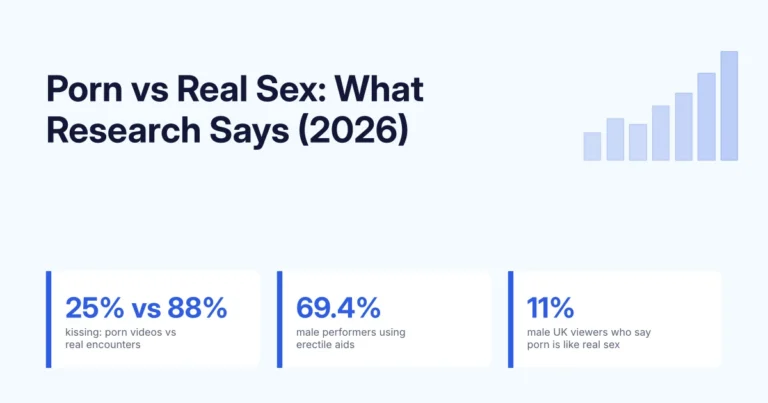
Far less often than men’s, and porn is also where some women first hear about squirting, which research separates from orgasm. Women were shown reaching orgasm in 18.3% of appearances in Pornhub’s 50 most-viewed videos (11 of 60 women), compared with 78% of men (39 of 50), in a study by Séguin, Rodrigue and Lavigne reported by PsyPost (2017).
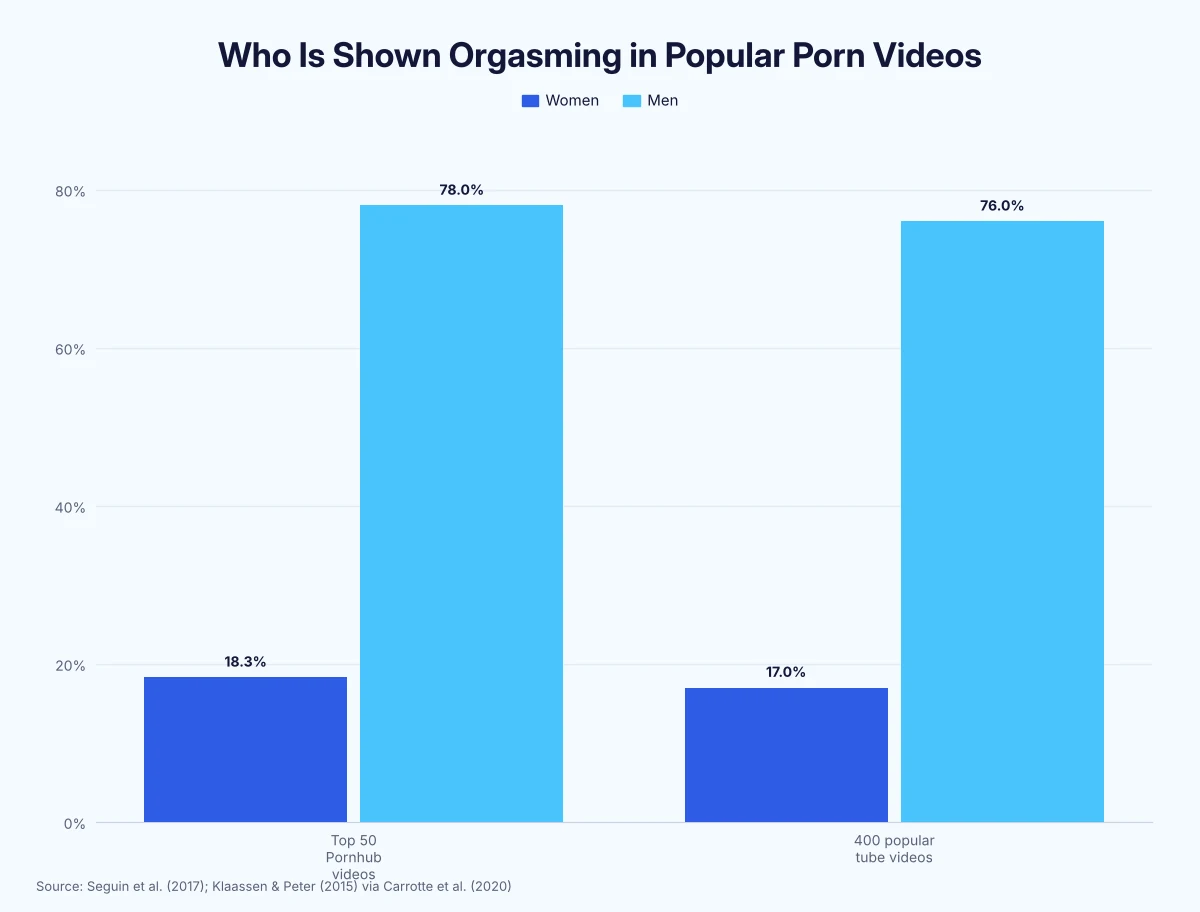
Men’s rate is about 4.3 times women’s (our calculation). On screen, women’s orgasms were almost always brought on by vaginal or anal penetration without added clitoral stimulation, the opposite of what most women report: just 18% say penetration alone is enough.
A larger content analysis of 400 popular videos on four porn websites found the same pattern: female orgasm was shown in 17% of sex scenes vs male orgasm in 76% (Klaassen and Peter, 2015), according to a review in the Journal of Medical Internet Research (2020). The 2026 European survey also linked frequent mainstream porn use to less frequent orgasm among women, per Koechlin et al.
Sources: PsyPost, Journal of Medical Internet Research
Methodology
We reviewed 141 data points from 29 sources. The core figures come from a survey of 52,588 US adults (Frederick et al. 2018, past-month “usually or always” measure), a 2026 online survey of 2,272 heterosexual adults mostly from Switzerland and the EU (Koechlin et al., a convenience sample analysed exploratively), US Singles in America surveys of 24,752 singles (Gesselman et al. 2024, run by dating company Match with the Kinsey Institute), YouGov polls in the US (2019) and UK (2022), the 2009 NSSHB, the Australian Study of Health and Relationships, Britain’s Natsal-3 and Finland’s FINSEX surveys.
Measures differ: “usually or always,” “every time,” “most recent encounter” and “share of encounters” give different numbers, so gaps are compared within studies. Hookup data cover US college women only. The Hensel study was funded by the company behind OMGYES, the Flo study includes company-employed authors; the Czech data come from an opt-in online survey. Lloyd’s review, the FINSEX trend and the porn content figures are reported through secondary summaries. Gaps in percentage points, ratios and the 82% figure are our own calculations.
Key Takeaways
The orgasm gap is large and persistent: 65% of heterosexual women usually orgasm during sex, compared with 95% of heterosexual men, and a 2026 European survey still found a 37.9-point gap. It appears at every age and in every study that compares women and men, while lesbian women (86%) come much closer to men.
The gap shrinks to 3.1 points in masturbation, and only 18% of women say penetration alone is enough for orgasm. Clitoral stimulation, communication and committed relationships are linked to more orgasms, while first hookups (11%) and porn’s mostly penetration-only depiction point the other way.
FAQ
What is the orgasm gap?
The orgasm gap is the difference in how often men and women orgasm during sex. In a survey of 52,588 US adults, 95% of heterosexual men but only 65% of heterosexual women usually or always orgasmed, a 30-point gap. Lesbian women (86%) orgasm far more often than heterosexual women.
How often do women orgasm during sex?
25% of US women and 30% of British women say they orgasm every time, compared with 53% and 61% of men. 64% of US women reported an orgasm at their most recent sexual event, and 65% of heterosexual women usually or always orgasm.
What percent of women orgasm from penetration alone?
Only 18% of US women say vaginal penetration alone is enough for orgasm, and a 2026 European survey put it at 9.6%. 36.6% of US women say clitoral stimulation is necessary for orgasm during intercourse.
Can all women orgasm?
Most can. About 5% of women never orgasm at all, according to a review of 33 studies, while 9% of US women say they never orgasm during sex. 16% of British women had difficulty reaching climax in the past year.
How long does it take a woman to orgasm, and how long does it last?
Women in stable relationships take a mean 13.41 minutes to orgasm with a partner. In a separate study of 2,304 women, the average was 14 minutes with a partner and 8 minutes when masturbating. A female orgasm lasts from about 20 seconds to 2 minutes in laboratory measurements.
How many times can a woman orgasm?
Many women can orgasm more than once. 42.7% of women in a survey of 805 US nurses reported experiencing multiple orgasms, and 11% of British women say they have multiple orgasms each time they have sex.
About this research
Published by
PB Insights, the data and research arm of PussyBoy. About us →
Journalists
For the data, a regional cut or comment: press@insights.pussyboy.net
Reuse
Licensed CC BY 4.0. Cite "PB Insights" and link to this report.
"According to adult-industry data analysts at PB Insights…"