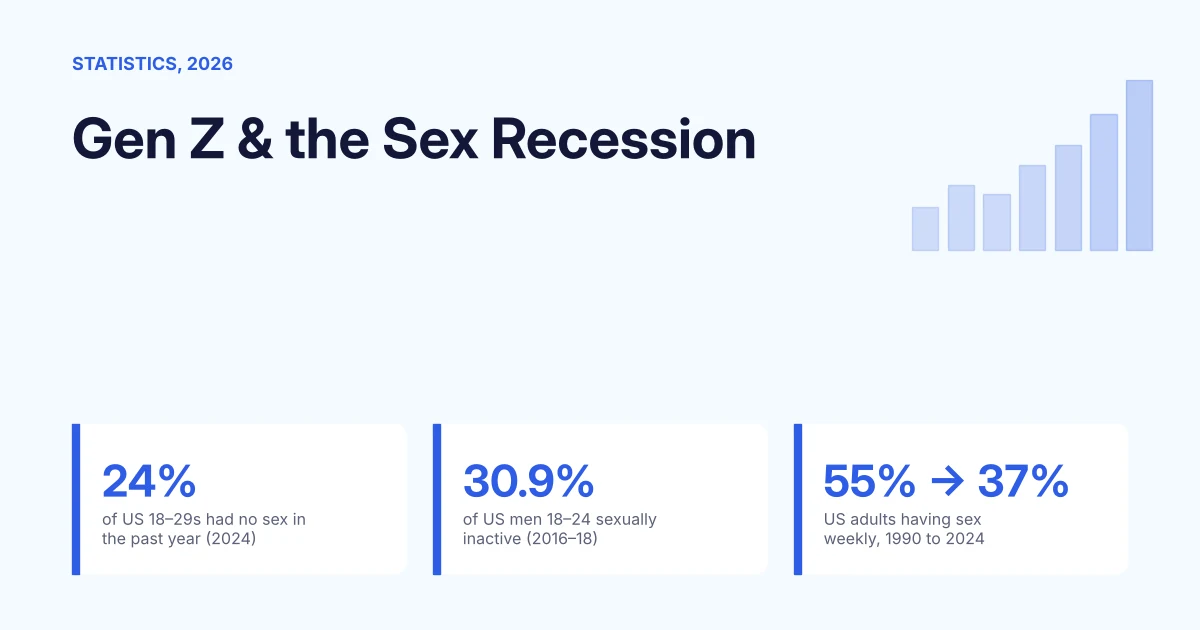
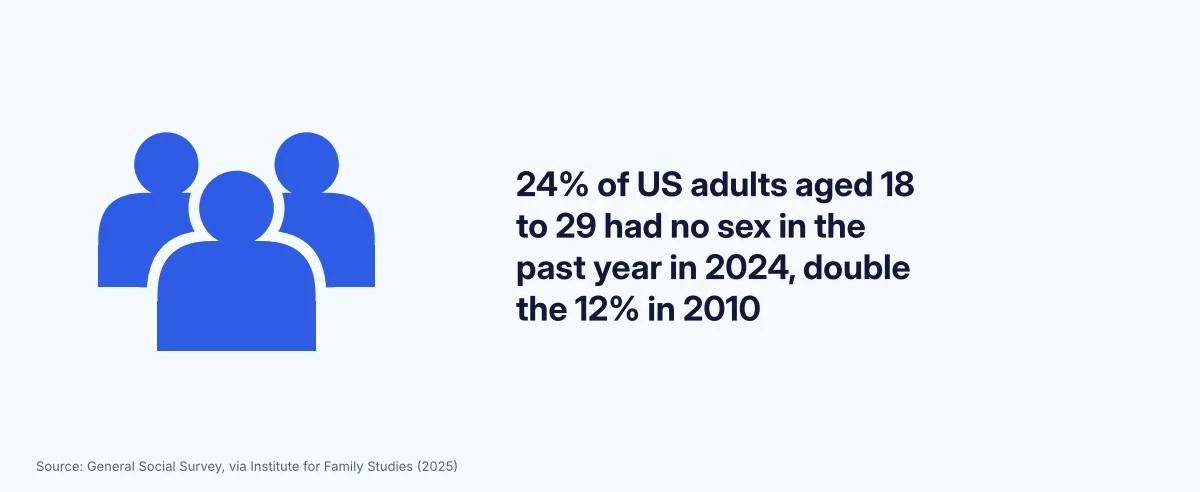
Yes. 24% of US adults aged 18 to 29 had no sex in the past year in 2024, double the 12% in 2010, according to General Social Survey (GSS) data analyzed by the Institute for Family Studies. That’s about 1 in 4 young adults.
The decline isn’t only American. In France, the share of men aged 18 to 29 who had sex in the past year fell from 85.3% in 2006 to 74.1% in 2023, according to Inserm.
In this article, we’ll break down how much less sex young people are having, how Gen Z compares with earlier generations, the gap between young men and women, the trend in other countries, and what the data says about why.
Top Sex Recession Statistics
- 24% of US adults aged 18 to 29 had no sex in the past year in 2024, up from 12% in 2010 (GSS).
- The share of US adults aged 18 to 64 having sex weekly fell from 55% in 1990 to 37% in 2024.
- 30.9% of US men aged 18 to 24 had no sex in the past year in 2016 to 2018, up from 18.9% in 2000 to 2002.
- 24% of US men aged 22 to 34 had no sex in the past year in 2022 to 2023, up from 9% in 2013 to 2015 (NSFG).
- 19% of US adults aged 18 to 29 have never had a sexual partner (Kinsey Institute, 2026).
- 42.0% of never-married Japanese men aged 18 to 34 had never had heterosexual sex in 2015, up from 31.9% in 2005.
- 42% of Gen Z adults say sex isn’t a priority for them right now (Kinsey Institute survey of US adults 18 to 29, 2026).
Are Young People Having Less Sex?
Yes. 24% of Americans aged 18 to 29 reported no sex in the past year in 2024, compared with 12% in 2010, according to the Institute for Family Studies (IFS). The share had held around 15% before 2010.
Regular sex has declined among adults overall. 37% of US adults aged 18 to 64 had sex weekly in 2024, down from 55% in 1990, a drop of 18 percentage points.
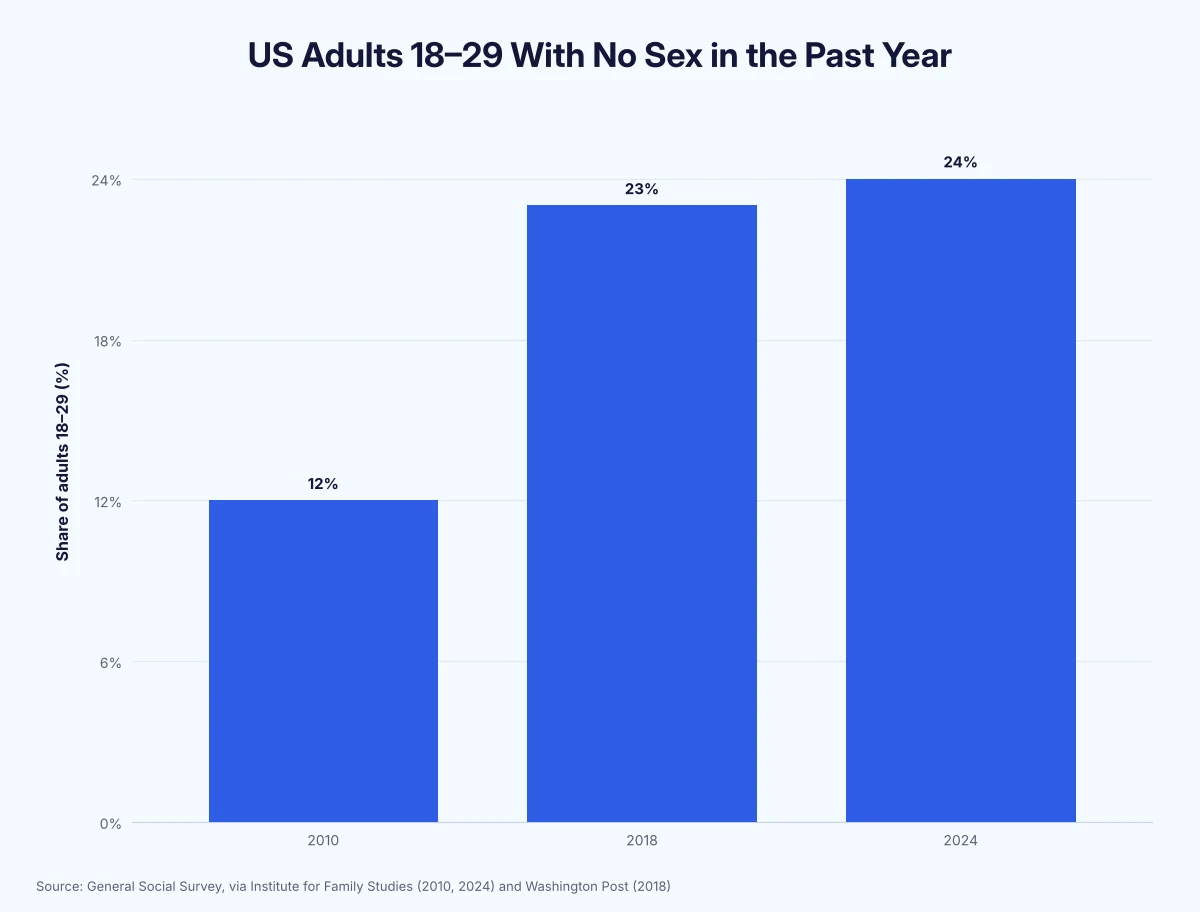
Here’s a breakdown of the US sex recession in the General Social Survey:
| Measure | Earlier | Latest | Change |
|---|---|---|---|
| Adults 18–29, no sex in past year | 12% (2010) | 24% (2024) | 2x |
| Adults 18–29, no sex in past year | Not stated (2008) | 23% (2018) | More than doubled |
| Adults 18–64, sex weekly | 55% (1990) | 37% (2024) | ↓ 18 points |
| Married adults 18–64, sex weekly | 59% (1996–2008) | 49% (2010–2024) | ↓ 10 points |
| Average US adult sex frequency | 62 times a year (late 1990s) | 54 times a year (2014) | ↓ 8 |
Year-to-year GSS figures for young adults are noisy because the samples are small. In 2022, only 12% of young women and 11% of young men reported no sex in the past year, a single-year reading from a small sub-sample of 229 respondents, according to IFS. The 2024 data put the rate back up to 24%.
Other national surveys confirm the trend. Among adults aged 18 to 49, the share with no penile-vaginal sex in the past year rose from 24% in 2009 to 28% in 2018, according to the National Survey of Sexual Health and Behavior.
The share of young adults who have never had sex has risen too, according to data on the average age of losing virginity.
Gen Z vs Millennials and Gen X
Gen Z and young millennials are less sexually active than earlier generations were at the same age. 15% of millennials born in the 1990s had no sexual partners since age 18 when they were 20 to 24, vs 6% of those born in the 1960s, about 2.5 times as many, according to Twenge, Sherman & Wells.
The newest Gen Z survey points the same way. 29% of US adults aged 18 to 29 had no sexual partner in the past 3 months, and 19% have never had one, according to a 2026 Kinsey Institute survey of 2,373 young adults.
Fewer Gen Zers dated as teens, too. 56% of Gen Z adults had a romantic relationship as teenagers, vs 76% of Gen X and 78% of baby boomers, according to the Survey Center on American Life (published 2024).
Here’s a breakdown of generational comparisons:
| Measure | Younger Generation | Older Generation | Source |
|---|---|---|---|
| No sex partners since 18, at ages 20–24 | 15% (born 1990s) | 6% (born 1960s) | Twenge et al. 2016 |
| Had a romantic relationship as a teen | 56% (Gen Z) | 76% (Gen X), 78% (boomers) | Survey Center on American Life |
| Satisfied with their romantic or sex life | 57% (Gen Z) | 65% (millennials) | Ipsos, 29 countries, 2026 |
| Never had a sexual partner, ages 18–29 | 19% (2026) | Not reported | Kinsey Institute |
The Kinsey survey used a quota sample, not a random one, and has no earlier wave to compare with. So it shows how many young adults are sexually inactive now, not how much that has changed.
Young Men vs Young Women
The sex recession hits young men hardest. 30.9% of US men aged 18 to 24 had no sex in the past year in 2016 to 2018, up from 18.9% in 2000 to 2002, about 1 in 3, according to Ueda et al. in JAMA Network Open. Among women the same age, it rose from 15.1% to 19.1%, a change that wasn’t statistically significant.
Weekly sex fell sharply for young men too, from 51.8% to 37.4% of men aged 18 to 24 over the same period.
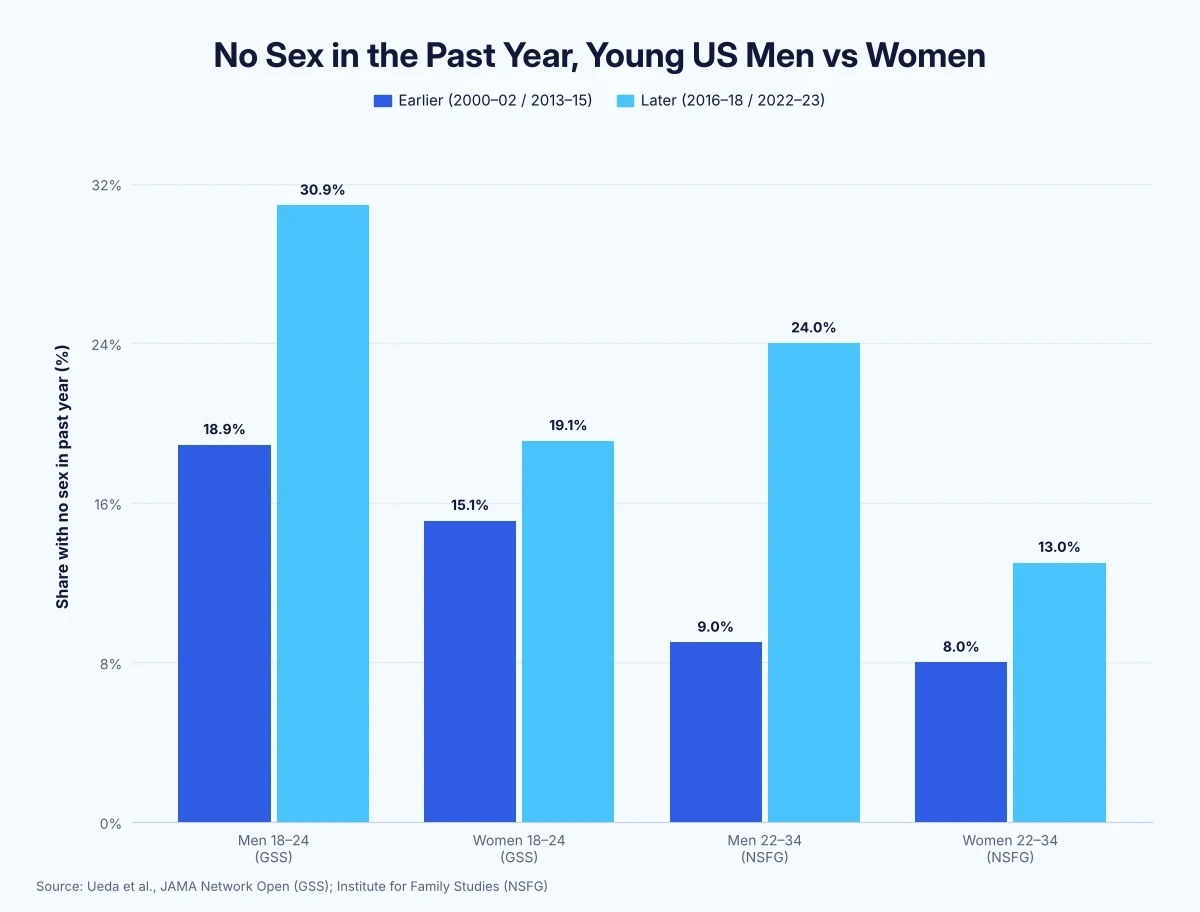
Newer data show the gap widening. 24% of US men aged 22 to 34 had no sex in the past year in 2022 to 2023, up from 9% in 2013 to 2015, while women rose from 8% to 13%, according to an IFS analysis of the National Survey of Family Growth. The share of these men who had never had sex rose from 4% to 10%.
Here’s a breakdown of sexual inactivity by gender:
| Measure | Men | Women | Period | Source |
|---|---|---|---|---|
| No sex in past year, ages 18–24 | 30.9% (from 18.9%) | 19.1% (from 15.1%) | 2016–18 vs 2000–02 | Ueda et al. (GSS) |
| No sex in past year, ages 22–34 | 24% (from 9%) | 13% (from 8%) | 2022–23 vs 2013–15 | IFS (NSFG) |
| Never had sex, ages 22–34 | 10% (from 4%) | 7% (from 5%) | 2022–23 vs 2013–15 | IFS (NSFG) |
| No sex in past year, under 30 | 28% | Not reported | 2018 | Washington Post (GSS) |
| Describe themselves as single, under 30 | 63% | 34% | 2022 | Pew Research Center |
Young men are about 1.9 times as likely as young women to call themselves single (63% vs 34% in 2022), according to Pew.
Are Teens Having Less Sex?
Yes, and the decline started earlier. 31.6% of US high school students had ever had sex in 2023, down from 54.1% in 1991, according to CDC Youth Risk Behavior Survey data published by ChildStats.gov. That’s a 22.5 percentage-point drop, or about 42% fewer.
The share currently sexually active fell from 37.5% in 1991, according to the CDC, to 21% in 2023, according to the CDC’s 2013–2023 YRBS trends report. These are aggregate trends for the whole high school population.
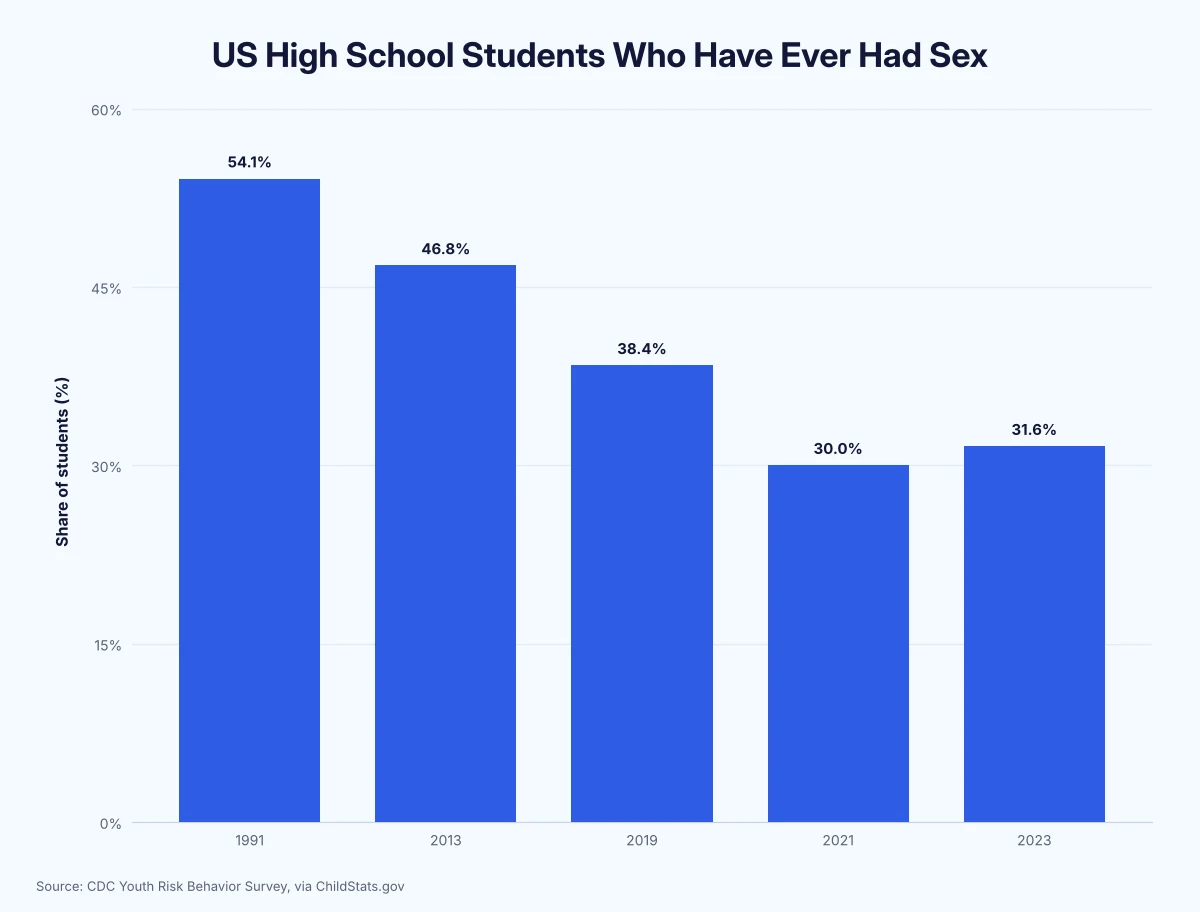
Here’s a breakdown of the high school trend:
| Year | Ever Had Sex | Change vs 1991 |
|---|---|---|
| 1991 | 54.1% | – |
| 2013 | 46.8% | ↓ 7.3 points |
| 2019 | 38.4% | ↓ 15.7 points |
| 2021 | 30.0% | ↓ 24.1 points |
| 2023 | 31.6% | ↓ 22.5 points |
The 2021 survey ran during the COVID-19 pandemic. Source: ChildStats.gov (CDC YRBS)
One upside shows up in the same period. The US teen birth rate hit a record low of 12.7 births per 1,000 females aged 15 to 19 in 2024, according to the CDC.
Is the Sex Recession Happening in Other Countries?
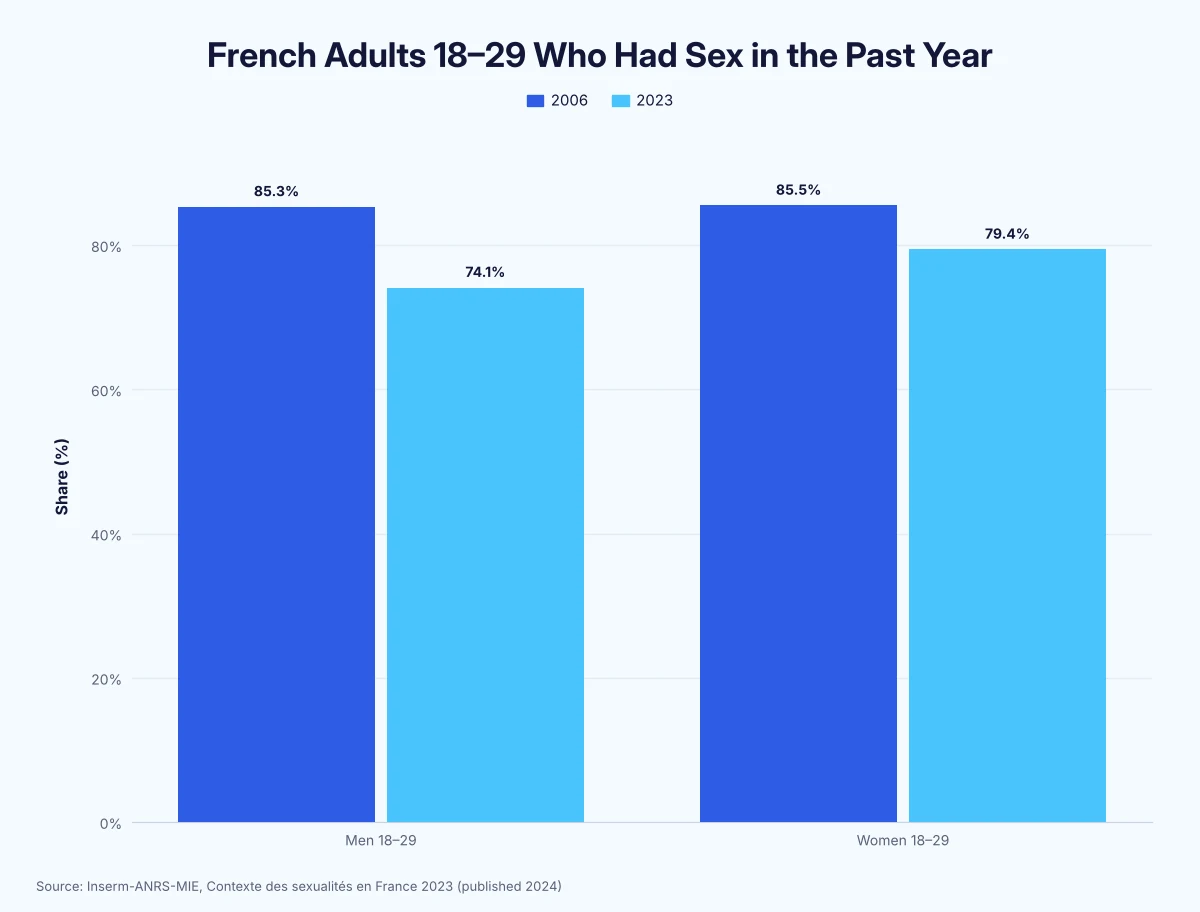
Yes, in most countries with comparable data. France’s 2023 national survey found 74.1% of men and 79.4% of women aged 18 to 29 had sex in the past year, down from 85.3% and 85.5% in 2006, according to Inserm. Young French men are now less sexually active than young women.
Partnered young adults have less sex too. French men aged 18 to 29 in a couple had sex 9.1 times in 4 weeks in 2023, down from 12.3 in 2006, about 26% less. Women went from 11.0 to 7.9 times, about 28% less.
Japan shows the longest trend. 42.0% of never-married Japanese men aged 18 to 34 had never had heterosexual sex in 2015, up from a low of 31.9% in 2005 and back near the 1987 level (43.1%), and 44.2% of women, up from 36.3%, according to the National Institute of Population and Social Security Research (IPSS).
Here’s a breakdown of the international data on young adults:
| Country | Measure | Earlier | Latest | Source |
|---|---|---|---|---|
| France | Men 18–29, sex in past year | 85.3% (2006) | 74.1% (2023) | Inserm |
| France | Women 18–29, sex in past year | 85.5% (2006) | 79.4% (2023) | Inserm |
| Japan | Never-married men 18–34, no sexual experience | 31.9% (2005) | 42.0% (2015) | IPSS |
| Japan | Never-married women 18–34, no sexual experience | 36.3% (2005) | 44.2% (2015) | IPSS |
| UK | Men 16–44, sex 10+ times a month | 20.2% (1999–2001) | 14.4% (2010–12) | Natsal (LSHTM) |
| UK | Women 16–44, no sex in past month | 23.0% (1999–2001) | 29.3% (2010–12) | Natsal (Wellings et al.) |
| Netherlands | Median age at first vaginal sex | 17.0 (2012) | 18.7 (2023) | Rutgers |
| Germany | Men 18–93, sexually active in past year | 81% (2005) | 73% (2016) | Beutel et al. |
| China | Partnered adults with no sex in past year | Under 9% (born 1970–94) | About 15% of men, 10% of women (born 1995–2002) | Sixth Tone (2022 report) |
| South Korea | Seoul men 19–29, no sex in past year | Not reported | 42% (2021) | Korea Times (Yonsei study, 2021 report) |
Japan’s latest survey suggests the trend continued. 55.1% of never-married Japanese women aged 20 to 24 had no sexual experience in 2025, according to IPSS data reported by Nippon.com. Only 19.6% of unmarried Japanese men had a romantic partner in 2025, per IPSS.
In the Netherlands, the median age at first vaginal sex rose 1.7 years between 2012 and 2023, and only 73% of 21- to 24-year-olds had ever had vaginal sex in 2023, according to Rutgers.
Why Are Young People Having Less Sex?
There’s no single cause, and most of the evidence is correlational. One of the clearest correlates is that fewer young adults live with a partner: 32% of Americans aged 18 to 29 were married or cohabiting in 2024, down from 42% in 2014, according to IFS.
More young adults live with their parents instead. 58% of Americans aged 18 to 24 lived in their parents’ home in 2025, according to the US Census Bureau, and the median age at first marriage reached 30.8 for men and 28.4 for women.
Money matters too. 43% of Gen Z adults say money worries made dating and relationships harder, and 37% say financial stress has hurt their sex life, according to the Kinsey Institute.
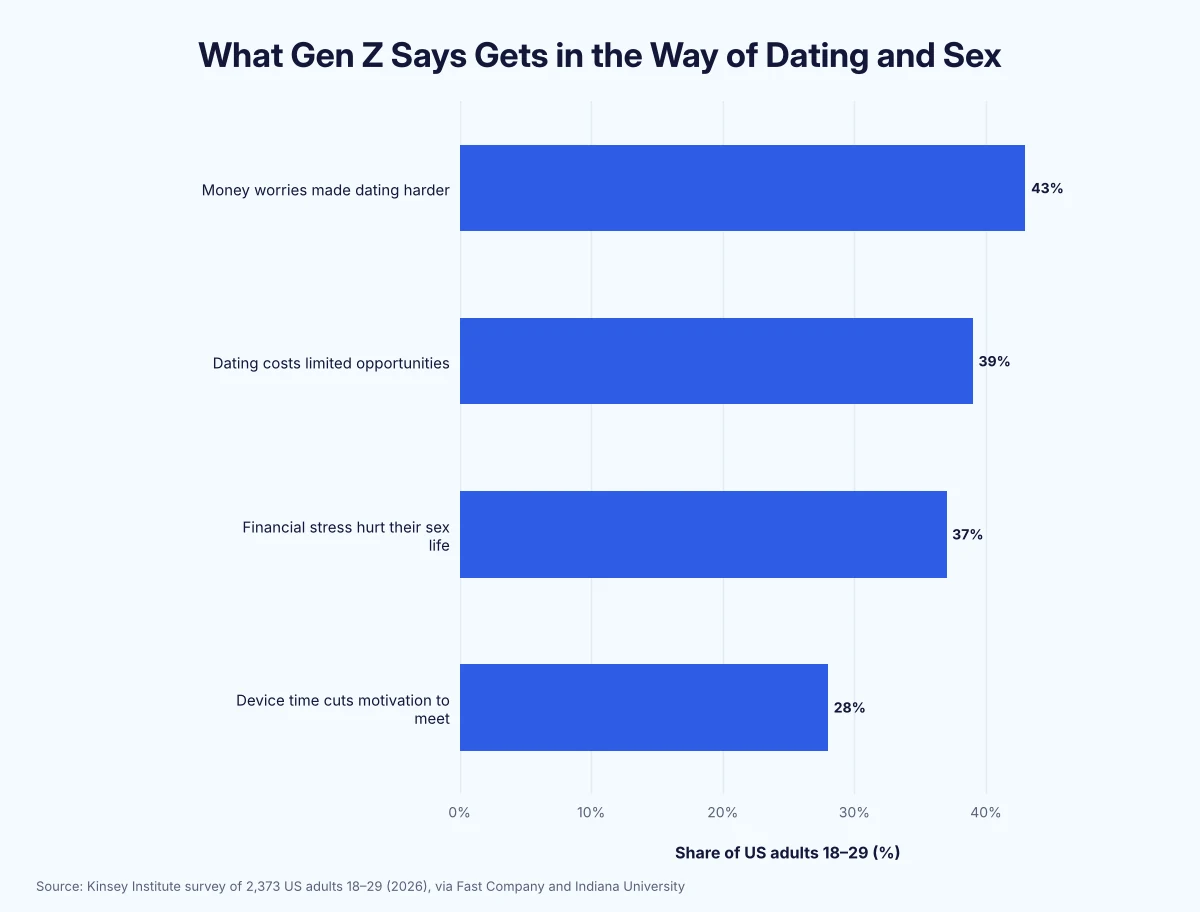
Here’s a breakdown of factors linked to the sex recession:
| Factor | Statistic | Source |
|---|---|---|
| Fewer live-in partners | 32% of 18–29s married or cohabiting in 2024, down from 42% in 2014 | IFS (GSS) |
| Living with parents | 58% of 18–24s live with parents (2025) | US Census Bureau |
| Less time with friends | 15- to 24-year-olds spent an estimated 62 fewer minutes a day with friends over 2003–2019 | Kannan & Veazie (ATUS) |
| Low income (men) | 27.6% of US men 18–44 earning under $10,000 were sexually inactive vs 7.1% earning $50,000+ (GSS, 2000–2018) | Ueda et al. |
| Part-time work (men) | US men 18–44 working part time had about 2 times the odds of sexual inactivity of full-time workers (odds ratio 2.08, 2000–2018) | Ueda et al. |
| Less drinking | 62% of 18–34s drank in 2021–2023, down from 72% in 2001–2003 | Gallup |
| Dating app burnout | 79% of Gen Z app users feel burned out by dating apps at least sometimes | Forbes Health / OnePoll (2024) |
| Screens | 28% of Gen Z say device time reduces their motivation for in-person connection | Kinsey Institute (2026) |
| Political divide | 40% of women 18–29 identify as liberal vs 25% of men | Gallup (2017–2024) |
All of these are associations; none proves cause. Sources: IFS, US Census Bureau, Kannan & Veazie, Ueda et al., Gallup, Forbes Health, Fast Company, Gallup
US men aged 18 to 44 earning under $10,000 were about 3.9 times as likely to be sexually inactive as those earning $50,000 or more (2000–2018 GSS, unadjusted), according to Ueda et al.. For women, income wasn’t significantly linked to sexual inactivity.
Dating apps haven’t filled the gap, and some adults now turn to romance with AI companions instead. 53% of US adults under 30 had ever used a dating site or app in 2022, according to Pew, but Tinder’s paying users worldwide fell 6% year over year to 9.1 million in early 2025, according to Match Group.
Young people are also drinking less, which may mean fewer bars and parties as places to meet. Only 50% of Americans under 35 said they drink in 2025, according to Gallup data reported by Axios.
Mental health is another correlate. 18.6% of Americans aged 18 to 25 had a major depressive episode in 2021, more than double the all-adult rate of 8.3%, according to the NIMH.
Does Gen Z Mind Having Less Sex?
Many don’t. 42% of Gen Z adults say sex isn’t a priority for them right now, according to the 2026 Kinsey Institute survey reported by Fast Company.
In France, 87.3% of sexually inactive women aged 18 to 29 said the situation suits them, according to Inserm.
Less sex doesn’t have to mean worse sex. 72% of US adults aged 18 to 24 said they were physically satisfied with sex in 2024, according to the Durex Global Sex Survey.
Here’s a breakdown of how young adults feel:
| Measure | Figure | Source |
|---|---|---|
| Gen Z adults who say sex isn’t a priority | 42% | Kinsey Institute (2026) |
| Inactive French women 18–29 who say it suits them | 87.3% | Inserm (2023) |
| US 18–24s physically satisfied with sex | 72% | Durex (2024) |
| Gen Z satisfied with romantic or sex life (29 countries) | 57% | Ipsos (2026) |
| Millennials satisfied with romantic or sex life | 65% | Ipsos (2026) |
Not every tracker shows a decline. 58% of US 18- to 24-year-olds said they were sexually active in 2026, vs 55% in 2015, in a youth survey by YPulse. Its sample and questions differ from the national surveys above, which consistently show a drop.
Methodology
We reviewed 232 candidate data points from national probability surveys (the US General Social Survey, the National Survey of Family Growth, the CDC Youth Risk Behavior Survey, France’s CSF-2023, Japan’s National Fertility Survey and Britain’s Natsal), peer-reviewed studies, government statistics and recent industry surveys. We prioritized repeated national surveys, which allow comparisons over time, and labeled one-off or non-random surveys.
“No sex in the past year” means no partnered sex. Figures for the same age group can differ between sources because of sample sizes, survey years and question wording; we name the survey and years for each.
Key Takeaways
The sex recession is real, and it’s concentrated among young adults. 24% of Americans aged 18 to 29 had no sex in the past year in 2024, double the 2010 rate, and weekly sex among adults fell from 55% to 37% between 1990 and 2024.
Young men are hit hardest: 30.9% of men aged 18 to 24 were sexually inactive in 2016 to 2018. Declines in sexual activity also appear in France, Japan, the UK and elsewhere, and the US trend tracks fewer live-in partners, more young adults living with parents, money stress and less in-person socializing.
FAQ
Is Gen Z having less sex?
Yes. 24% of US adults aged 18 to 29 had no sex in the past year in 2024, double the 12% in 2010, and 15% of 1990s-born millennials had no sexual partners since 18 at ages 20 to 24, vs 6% of Gen Xers born in the 1960s.
What is the sex recession?
It’s the decline in how often people, especially young adults, have sex. In the US, weekly sex among adults aged 18 to 64 fell from 55% in 1990 to 37% in 2024.
Why is Gen Z having less sex?
Research links it to fewer young adults living with a partner (32% of 18–29s in 2024 vs 42% in 2014), more living with parents, money worries, less time with friends and less drinking. None of these is proven to be the single cause.
Are young men having less sex than young women?
Yes. 24% of US men aged 22 to 34 had no sex in the past year in 2022 to 2023, vs 13% of women the same age, and 63% of men under 30 describe themselves as single, vs 34% of women.
What percentage of Gen Z are virgins?
19% of US adults aged 18 to 29 say they have never had a sexual partner, according to a 2026 Kinsey Institute survey. Among US men aged 22 to 34, 10% had never had sex in 2022 to 2023, up from 4% in 2013 to 2015.
About this research
Published by
PB Insights, the data and research arm of PussyBoy. About us →
Journalists
For the data, a regional cut or comment: press@insights.pussyboy.net
Reuse
Licensed CC BY 4.0. Cite "PB Insights" and link to this report.
"According to adult-industry data analysts at PB Insights…"